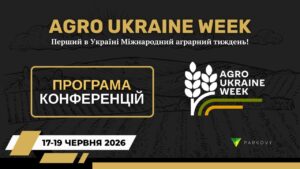
Less than a week remains until the start of the International Agricultural Week – AGRO UKRAINE WEEK! This unique and largest-scale event for the Ukrainian and international agricultural community will take place June 17–19, 2026, at the Parkovy Exhibition and Convention Center (Kyiv).
Why is it the largest?
Because 13 conferences, forums, and summits are scheduled over three days.
Because manufacturers will present their products and services at more than 100 exhibition booths.
Because nearly 300 speakers and experts from various agricultural sectors will share their experiences and discuss innovations, new technologies, and achievements.
Because more than 2,000 participants will gather each day to discuss current industry challenges and collaboratively seek answers to important questions.
Why is it unique?
Because for the first time, representatives not only from the agribusiness sector but also from other industries—without which the development of the Ukrainian sector is impossible—such as construction, energy, storage, finance, IT, marketing, and others, will gather in one place. Our defenders, thanks to whom we can live and work, will not be overlooked either.
Because the organizers will offer not only speaker presentations but also discussion panels, interviews, and workshops.
Because a diverse cultural program awaits Agro Ukraine Week participants and guests—featuring well-known groups, popular performers, film screenings, and even a painting by Ivan Marchuk!
Because at Agro Ukraine Week, Ukrainian farmers will be able to celebrate Farmer’s Day together.
All about agriculture and for agriculture! The event program confirms this slogan. You can view the programs for the conferences, forums, and summits of Agro Ukraine Week here.
The program is preliminary; changes and updates are possible. We are confident that everyone will find events that are interesting and useful to them.
We look forward to seeing you at AGRO UKRAINE WEEK on June 17–19, 2026, at the Parkovy Exhibition and Convention Center (Kyiv)!

According to Serbian Economist, the World Freediving Championships were held in a pool in Futog, a suburb of Novi Sad. The tournament took place from June 9 to 15 and brought together more than 250 athletes from 34 countries across all continents.
At the championships, athletes competed in several disciplines: who could swim the farthest underwater without fins, with two fins, with a monofin, and who could stay underwater the longest without moving.
One of the championship’s standout performers was Polish athlete Mateusz Malina. He won gold in the no-fins underwater swim with a distance of 244 m and set a new CMAS world record. On the final day, he also won the finned swim, covering 322.5 m.
Among the women, Croatian Mirela Kardašević was one of the standout competitors. She won the two-fins swimming event with a distance of 278.5 m and set a new absolute world record. Kardašević also won gold in the fins swimming event, where she achieved a distance of 288 m.
Polish athlete Julia Kozerska won the women’s no-fins swimming event, covering 211 m. The competition in this event was particularly close: Mirela Kardašević took second place with a result of 210.5 m, and third place went to Magdalena Solich-Talanda of Poland with a result of 210 m.
In the men’s static apnea discipline, Poland’s Damian Watrach won with a time of 9 minutes and 36 seconds.
In the women’s division, Germany’s Heike Schwerdtner won gold, staying underwater for 9 minutes and 39 seconds and setting a new CMAS world record.
Ukraine was also represented at the championship. Among the competitors was one of Ukraine’s strongest freedivers, Kateryna Sadurska. In the Masters category, Sadurska took first place with a result of 181 meters.
The tournament brought together the strongest athletes, set several world and continental records, and provided Serbia with a notable international sporting event.
The competition was organized by CMAS—the World Confederation of Underwater Activities. This is an international federation that unites various types of underwater sports, including freediving.
Freediving is underwater swimming while holding one’s breath without scuba gear.
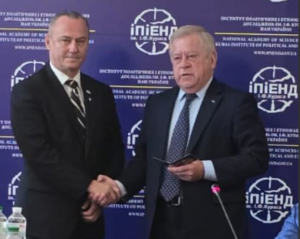
Eduard Burash, Transcarpathia’s Ambassador to Slovakia, has become an advisor to Anatoliy Kinakh, President of the Ukrainian Union of Industrialists and Entrepreneurs (USPP), on issues of trade, economic, and investment cooperation between Ukraine and the Slovak Republic, Eduard Burash himself told Open4Business.
Burash is actively involved in organizing humanitarian aid for the Zakarpattia region and other regions of Ukraine.
In his new capacity as advisor to the USPP president, Burash has already participated in a meeting of the Council on the Reconstruction of Ukraine, which operates as part of the global organization of world leaders Lives Amplified. The meeting took place at the I.F. Kuras Institute of Political and Ethno-National Studies.
Eduard Burash has been involved in the development of Ukrainian-Slovak cooperation for many years. He is the ambassador of Zakarpattia to Slovakia; previously, he served as an advisor to the Prime Minister of Slovakia on cross-border cooperation with Ukraine, an advisor to the Slovak Ombudsman on child protection, and the authorized representative of the city of Košice for the development of cross-border cooperation with Uzhhorod and Zakarpattia Oblast. Burash also heads the FEMAN association and has been a long-time organizer of the Days of Ukraine in Košice. In addition, for over 10 years he has been the organizer of the Days of Ukraine in
Košice, which have featured meetings, conferences, and events involving Ukrainian and Slovak entrepreneurs.
The Ukrainian Union of Industrialists and Entrepreneurs is a nationwide public organization that brings together representatives of business, industry, entrepreneurial structures, and employers. The organization is headed by former Prime Minister of Ukraine Anatoliy Kinakh.
ADVISOR, AMBASSADOR, PRESIDENT, SLOVAKIA, Transcarpathia, UUIE, Едуард Бураш
The Ukrainian Red Cross (URC) disbursed over 94.7 million UAH in cash assistance to vulnerable groups over two months
“Between April and May 2026, the Ukrainian Red Cross provided cash assistance to 7,896 people in frontline and war-affected communities, totaling 94,798,790.5 UAH.”
Support is provided to the most vulnerable people living within 50 km of the front line or affected by the war, particularly in the Kharkiv, Zaporizhzhia, Donetsk, Mykolaiv, Dnipropetrovsk, Chernihiv, Kherson, Sumy, and Odesa regions.
Financial assistance was provided to individuals with Group I and II disabilities, parents of children with disabilities, single mothers and fathers, single pensioners, households consisting exclusively of elderly people, as well as large families. Support was also provided to evacuees who were forced to leave their homes due to active hostilities and shelling. Assistance was also provided to people affected by shelling—due to damage or destruction of their homes, injuries, or the death of family members.
As reported, effective April 1, 2026, the Ukrainian Red Cross adopted a new approach to providing cash assistance to the population affected by the war. General-purpose cash assistance was replaced by targeted cash assistance, allowing for more tailored support to individuals based on their needs and life circumstances.
The Ukrainian Red Cross is implementing this program with support from the U.S. government, the Danish and Norwegian Red Cross, and the International Federation of Red Cross and Red Crescent Societies.

Norway is allocating over €9 million to repair the protective sarcophagus covering the Chernobyl Nuclear Power Plant following damage caused by a Russian drone, the Norwegian Embassy in Ukraine reported.
“Norway is allocating 100 million kroner (approximately 9.1 million euros – IF-U) for the repair of the protective structure covering the No. 4 reactor at the decommissioned nuclear power plant in Chernobyl. The structure was damaged as a result of a Russian drone strike in February 2025.”
The aid will be provided through the European Bank for Reconstruction and Development (EBRD) fund, the International Chornobyl Cooperation Account (ICCA).
State Secretary Eivind Vad Petersen announced the support during a visit to Kyiv, also mentioning the incident on June 7, when a spent nuclear fuel storage facility in the Chernobyl zone was hit by a Russian strike.
“These attacks also pose a threat to European and international security. Norway will make efforts to reduce the risk of radioactive emissions and ensure that the Chernobyl NPP continues to operate safely,” Petersen said.
In April, the U.S. expressed its readiness to provide up to $100 million as part of the Group of Seven’s joint efforts to repair the new sarcophagus over the Chernobyl NPP. Ahead of the 40th anniversary of the Chernobyl accident, the EU called on Russia to stop attacks on nuclear facilities in Ukraine.
In Ukraine, 913 current lawmakers and judges have declared that they will receive pension payments in 2025, according to data from Opendatabot based on the Unified State Register of Declarations.
This includes 55 current lawmakers and 858 judges, accounting for about 14% of the total number of officials who filed annual declarations for the past year.
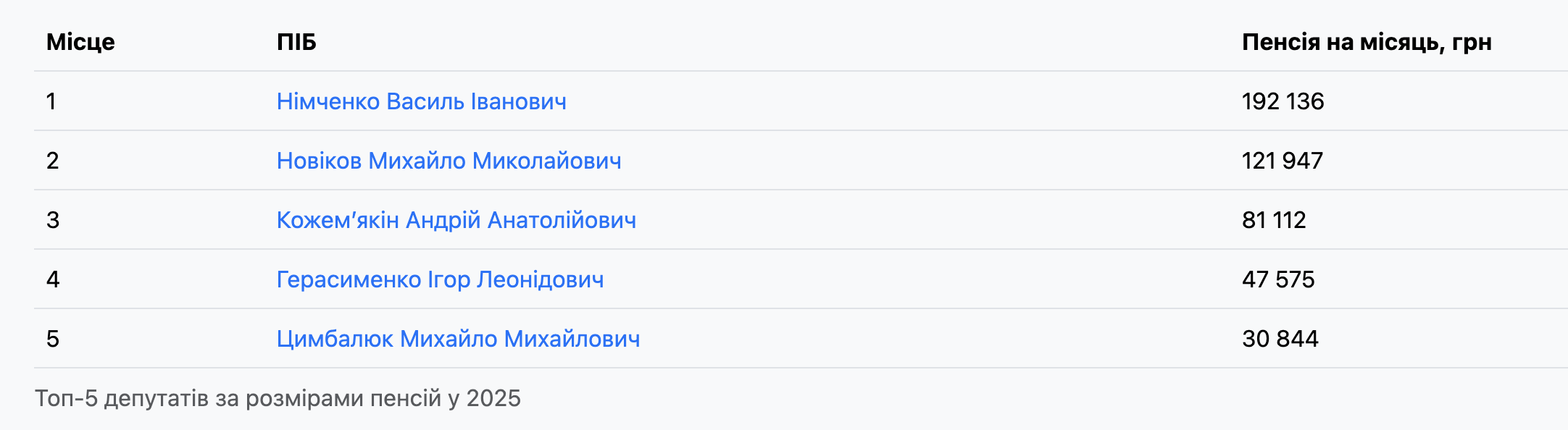
Vasyl Nimchenko, who previously served as a judge on the Constitutional Court of Ukraine, declared the highest pension among lawmakers. Over the course of the year, he received 2.3 million UAH in pension payments, or over 192,000 UAH per month.
Mykhailo Novikov took second place among MPs with a pension of 1.46 million UAH per year, or nearly 122,000 UAH per month. Andrii Kozhemyakin came in third, declaring 973,000 UAH in pension payments for the year, or over 81,000 UAH per month.
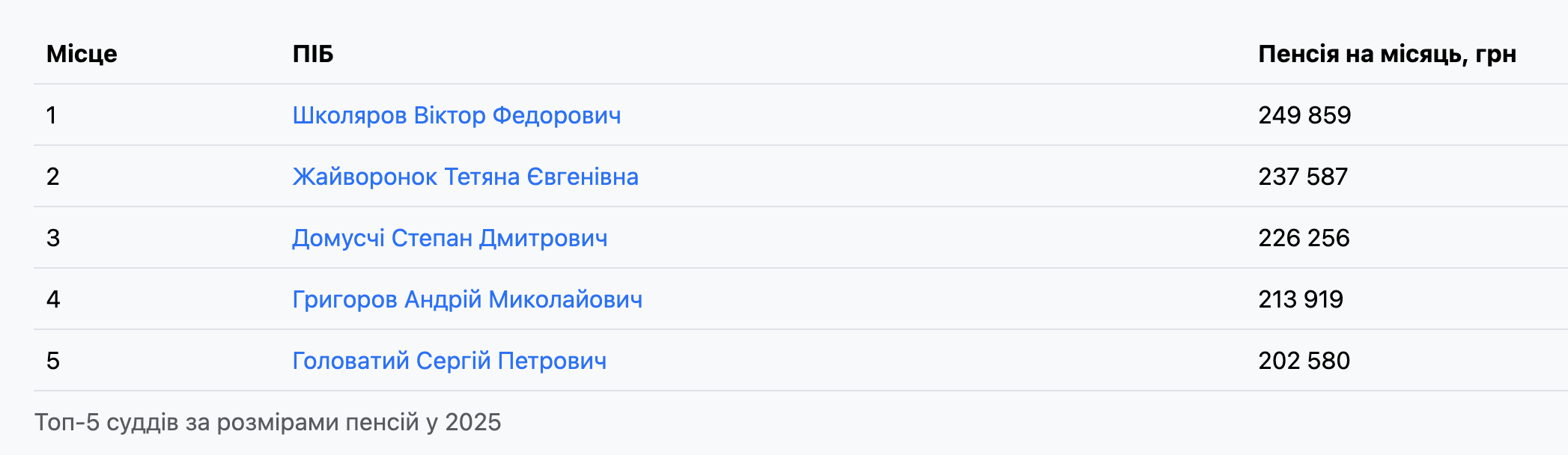
At the same time, the highest pension payments among judges turned out to be even higher. The absolute record-holder was Supreme Court of Ukraine Judge Viktor Shkolyarov, who retired in 2025. His annual pension amounted to nearly 3 million UAH, or an average of 249,900 UAH per month.
Second place among judges went to Tetyana Zhayvoronok, a judge of the Supreme Court of Ukraine, with a pension of 2.85 million UAH per year, or 237,600 UAH per month. Third place went to Stepan Domuschy, a judge of the Fifth Administrative Court of Appeal, who declared a pension of 2.72 million hryvnias per year, or over 226,000 hryvnias per month.
Despite the significant difference between the highest payments, the typical pension among lawmakers and judges is nearly the same. The median pension among lawmakers is 229,600 UAH per year, and among judges, it is 227,100 UAH. This means that half of the recipients in each of these groups receive payments above this level, and half receive less.
For comparison, the average pension in Ukraine currently stands at 7,236 UAH per month, or approximately 85,000 UAH per year. Thus, a judge’s maximum monthly pension is more than 34 times higher than the national average pension.
Opendatabot notes that special pensions for members of parliament were abolished for new recipients, but some current lawmakers continue to receive high pension payments. This primarily applies to individuals who became eligible for a special pension before the pension reform, retained it through court rulings, or hold additional titles.