For the next two days, Tuesday and Wednesday, May 12–13, forecasters predict mostly pleasant weather in Ukraine, with nighttime temperatures of 8–13°C and daytime highs of up to 23°C, along with spring rains and thunderstorms.
“In Zakarpattia and the Carpathians on May 12, heavy rain is expected; during the day on the Right Bank, moderate rain, thunderstorms, and in some places squalls of 15–20 m/s; the rest of the country will be dry. The wind will be predominantly southerly, 7–12 m/s,” according to a report from the Ukrainian Hydrometeorological Center.
Temperatures at night will be 8-13°; during the day 18-23°, and in the far west of the country 12-17°.
In Kyiv on Tuesday, May 12, no precipitation at night; rain and thunderstorms during the day. Winds will be southerly, 7-12 m/s. Temperatures at night will be 10–12°C, and during the day 20–22°C.
According to data from the Boris Sreznevsky Central Geophysical Observatory in Kyiv, on May 12, the highest daytime temperature was 28.9°C in 2013, and the lowest nighttime temperature was –2.4°C in 1900.
On Wednesday, May 13, across Ukraine—except for the west and northeast—there will be moderate rain and thunderstorms, with heavy rain in some areas during the day. The wind will be northwesterly, southerly on the Left Bank, 7–12 m/s.
Nighttime temperatures will range from 8–13°C, and 4–9°C in the western regions; daytime temperatures will range from 12–17°C in the western, Zhytomyr, Kyiv, Vinnytsia, and Odesa regions, and 18–23°C in the rest of the country.
In Kyiv on May 13, rain, with thunderstorms during the day. Winds from the northwest, 7-12 m/s. Nighttime temperatures 10-12°, daytime temperatures 15-17°.

According to preliminary data, Ukrainian steelmakers reduced pig iron production by 0.3% in January–April of this year compared to the same period last year, down to 2.356 million tons.
According to information from the Ukrmetallurgprom association on Monday, 554,000 tons of pig iron were produced in April, 690,200 tons in March, 561,900 tons in February, and 549,900 tons in January.
As reported, Ukraine’s metallurgical enterprises increased pig iron production by 11.2% in 2025 compared to 2024, reaching 7.884 million tons.
In 2024, Ukraine increased pig iron production by 18.1% compared to 2023, reaching 7.090 million tons.
In 2023, Ukraine reduced pig iron production by 6.1% compared to 2022, reaching 6.003 million tons.
In 2022, the country reduced pig iron production by 69.8% compared to 2021, down to 6.391 million tons.
In 2021, before the war, 21.165 million tons of pig iron were produced (103.6%).

The “Silpo” supermarket chain is launching Ukraine’s first traveling food festival, Bragary’s Chicken Circus, according to the company’s press service.
Bragarya’s Chicken Circus will feature performances by acrobats, clowns, and ring performers, street performances, and new culinary offerings from Silpo. The tour across Ukrainian cities is scheduled to run through the end of 2026. The first stop will be Bila Tserkva in the Kyiv region, where the festival will run from May 22 to June 7 near the Rosava Palace of Culture. The festival grounds will feature several zones where food and entertainment will intertwine in Silpo’s signature style. The venue will feature food courts highlighting chicken and signature dishes, relaxation areas, and over 10 attractions inspired by a chicken theme: from “Chicken Race” to a rodeo on a giant chicken. In addition, visitors will be able to play “aerocoke,” throw a puck in “curling,” wander through a maze, and take photos near special zones and art installations.
Tickets for “Bragarya’s Chicken Circus” in Bila Tserkva are now available on the website and in the “Silpo” app. Admission is free for combat veterans, individuals with war-related disabilities, and children under 4 years of age. The rest of the itinerary will be announced later.
Silpo-Food LLC, which operates the Silpo chain, was established in early August 2016. According to information on the website, the chain operates 310 supermarkets in 60 cities across Ukraine and four Le Silpo delicatessen markets: in Kyiv, Dnipro, Kharkiv, and Odesa.
According to YouControl, the founder of the LLC is PJSC “Retail Capital” (100%, Kyiv), a closed-end, non-diversified venture corporate investment fund. The ultimate beneficiary is Volodymyr Kostelman.
Silpo-Food’s revenue for the first nine months of 2025 increased by 13.8% compared to the same period in 2024—to UAH 75.87 billion; net profit amounted to UAH 956.6 million, compared to a net loss of UAH 767.1 million for the same period the previous year.
It is part of the Fozzy Group, a retail and industrial group with more than 825 retail outlets across the country. The company operates retail chains of various formats: Silpo supermarkets, Fozzy wholesale hypermarkets, Fora neighborhood stores, Thrash! discounters, Bila Romashka pharmacy supermarkets, and E-ZOO pet stores.

According to preliminary data, Ukrainian steelmakers reduced their production of rolled steel by 9.1% in January–April of this year compared to the same period last year, down to 1.802 million tons.
According to information from the Ukrmetallurgprom association on Monday, 460,800 tons of rolled steel were produced in April, 544,500 tons in March, 390,300 tons in February, and 406,400 tons in January.
As reported, Ukraine’s steel companies increased total rolled steel production by 4.8% in 2025 compared to 2024, reaching 6.521 million tons.
In 2024, Ukraine increased total rolled steel production by 15.8% compared to 2023—to 6.222 million tons from 5.372 million tons.
In 2023, Ukraine increased total rolled steel production by 0.4% compared to 2022—to 5.372 million tons.
In 2022, the country reduced total rolled steel production by 72% compared to 2021—to 5.350 million tons.
In 2021, before the war, 19.079 million tons of rolled steel were produced (103.5%).

As of the end of March 2025, 4,329,970 citizens of non-EU countries who had left Ukraine due to the full-scale Russian invasion held temporary protection status in EU countries, which is 68,980 or 1.6% fewer than at the end of February, according to Eurostat.
“The largest decrease was recorded in Italy (-30,365; -47.4%) due to the simultaneous expiration of a large number of permits at the end of the month, linked to the annual permit renewal procedure. This was followed by the Czech Republic (-19,810; -5.0%) and Finland (-8,080; -10.2%),” the agency’s report states.
According to the report, the number of people under temporary protection increased in 14 EU countries and decreased in 13. The largest absolute increases were observed in Germany (+7,480; +0.6%), Spain (+2,665; +1.0%), and Romania (+2,125; +1.0%).
Compared to data from a year ago, the number of refugees from Ukraine under temporary protection in EU countries increased by 68,620, or 1.6%.
According to Eurostat data as of the end of March 2026, Germany, with a growing lead, remains the country with the largest number of refugees from Ukraine in the EU and the world—1,274,960 (a year earlier – 1,184,890), or 29.4% of the total number of beneficiaries in the EU.
The top three also include Poland—997,120 (961,410 a year earlier), or 22.2%, and the Czech Republic—379,820 (365,060), or 8.8%.
Trailing far behind are Spain—262,830 (233,830 a year earlier)—and Romania—207,860 (182,840).
According to the agency’s data, compared to the population of each EU member state, the highest number of beneficiaries of temporary protection per thousand people at the end of March 2026 was observed in the Czech Republic (34.8), Poland (26.3), and Slovakia (26.2), while the corresponding figure at the EU level is 9.6.
It is also noted that as of the end of March 2025, Ukrainian citizens accounted for over 98.4% of temporary protection beneficiaries. Adult women made up 43.3% of temporary protection recipients in the EU, children 30.1%, while adult men accounted for 26.6% of the total. A year earlier, the share of women was 44.7%, children 31.8%, and adult men 23.4%; a year before that, the figures were 45.8%, 32.8%, and 21.4%, respectively.
As of the end of March 2026, there were also over 100,000 people with temporary protection status in Slovakia—142,250 (a year earlier – 132,620), the Netherlands – 137,900 (123,340), and Ireland – 120,530 (111,770)
Between 50,000 and 100,000 were in Belgium—95,550 (89,540), in Austria – 86,880 (81,230), Norway – 86,380 (80,180), Bulgaria – 82,050 (72,640), Switzerland – 72,550 (68,860), Finland – 70,830 (70,720), and France – 50,420 (56,300) (data on children in France is largely excluded – Eurostat).
In Italy, following a significant reduction by the end of March this year, only 33,720 refugees from Ukraine held temporary protection status, compared to 165,230 a year earlier.
Less than 50,000 refugees from Ukraine with this status are also present in: Denmark – 48,630 (35,520), Lithuania – 48,270 (44,230), Hungary – 44,050 (39,900), Sweden – 43,240 (27,010), Greece – 38,920 (33,250), Latvia – 31,540 (48,360), Estonia – 29,600 (33,600), Croatia – 29,230 (26,410), Cyprus – 24,890 (23,090), Iceland – 4,090 (latest data as of the end of July 2025), Luxembourg – 3,790 (3,960), Malta – 2,600 (2,280), and Liechtenstein – 920 (730)
Eurostat clarified that all the data provided relates to the granting of temporary protection pursuant to EU Council Decision 2022/382 of March 4, 2022, which establishes the existence of a mass influx of displaced persons from Ukraine in connection with Russia’s military invasion and entails the introduction of temporary protection. On June 13, 2025, the European Council adopted a decision to extend temporary protection for these individuals from March 4, 2026, to March 4, 2027.
According to updated UNHCR data, the number of Ukrainian refugees in Europe as of April 30, 2026, was estimated at 5.213 million, and globally at 5.762 million, which is 162,000 fewer than on February 19.
In Ukraine itself, according to the latest UN data for January 2026, there were 3.7 million internally displaced persons (IDPs), compared to 3.340 million in July and 3.76 million in April.
In its April inflation report, the National Bank again estimated the outflow from Ukraine in 2025 at 0.3 million and maintained its 2026 outflow forecast at 0.2 million. The NBU expects this trend to reverse in 2027, with an inflow of 0.1 million, and an increase to 0.5 million in 2028.
temporary protection, EU, Ukrainians

Why not all children can be removed from state custody
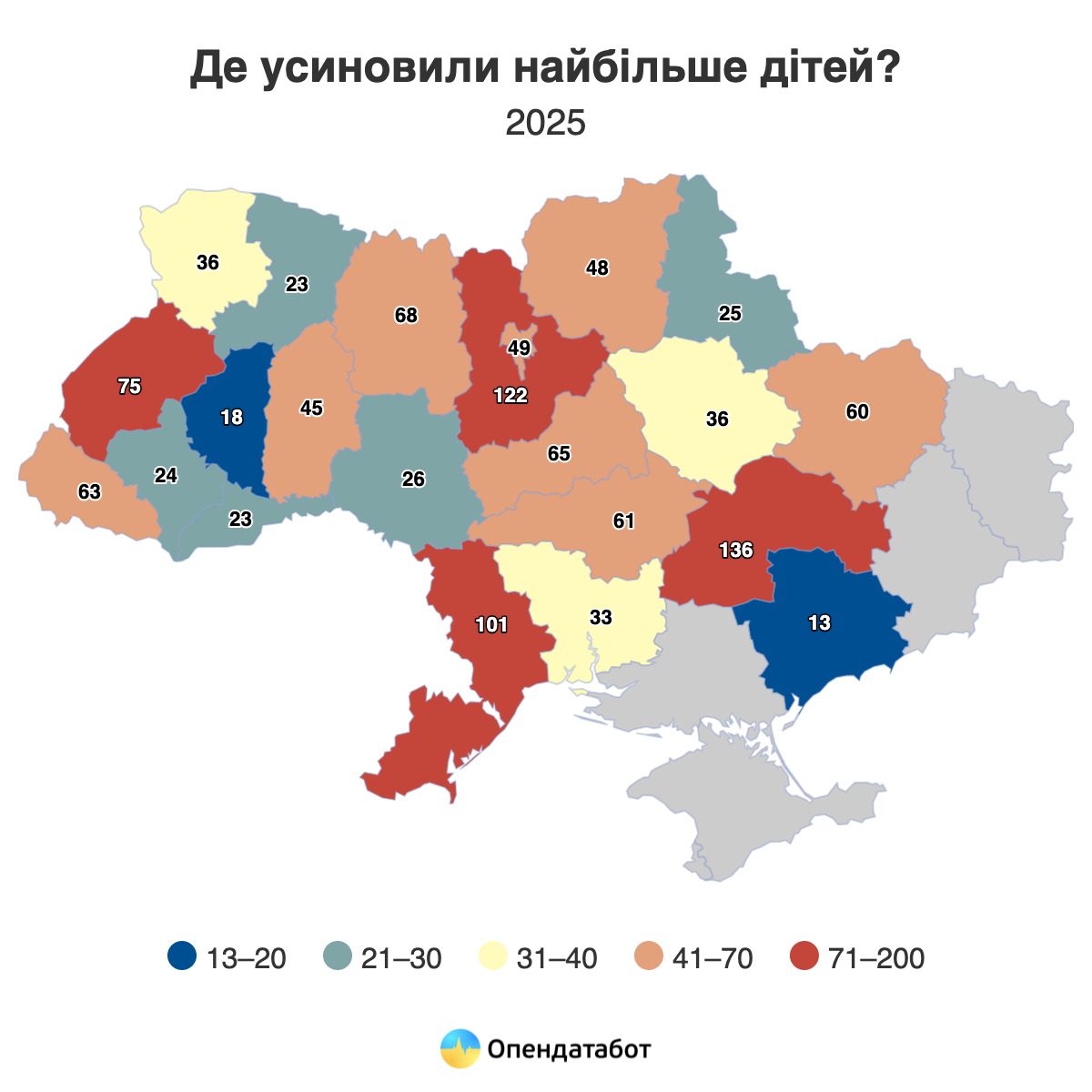
According to the State Service of Ukraine for Children’s Affairs, there were 59,350 orphans and children deprived of parental care in Ukraine as of the end of 2025. This is 4% fewer than in 2024. At the same time, 2,097 prospective adoptive parents are currently registered. On average, there are about 28 children per prospective adoptive parent; however, 1,150 children were placed with new families, and another 6,600 children were placed in foster care last year. The highest number of adoptions and, at the same time, the highest number of children in state care are in the Dnipropetrovsk region.
There were 59,350 orphans and children deprived of parental care in Ukraine as of the end of 2025. This is 4% fewer than in 2024. Overall, the number of such children decreases by an average of 3% each year.
One-third of all these children—20,705—are orphans, meaning those who have lost both parents. The other children are deprived of parental care for various reasons—and by no means all of them can be legally adopted.
“Of the 60,000 children in residential care facilities, only about 5,000 have the status that allows them to be adopted. The rest are so-called social orphans: they have parents or legal guardians, but for various reasons live in institutional facilities. Consequently, they cannot formally be adopted,” notes lawyer and adoptive parent Inna Miroshnychenko
The overall picture is that the number of people wanting to adopt a child is increasing year by year. However, 2025 was an exception: the number of applicants decreased by 13% over the year. In total, 2,097 prospective adoptive parents are currently registered in Ukraine. 77% of them, or 1,619 adoptive parents, are married couples. However, there are still 479 single individuals who wish to take on the responsibility of caring for a child.
Nearly half of all applicants are people between the ages of 40 and 50. Another 41% are under 40, and only 10% are over 50.
The largest number of candidates live in Kyiv (244) and the Kyiv region (224). There are also many adoptive parents in the Lviv and Dnipropetrovsk regions—191 and 182 candidates, respectively.
Despite this, the number of adoptions in 2025 decreased. Last year, 1,150 children found new families. This is 10% fewer than in 2024, when a record number of children were adopted since the start of the full-scale war—1,273 children.
“The adoption procedure itself is fairly clear, understandable, and not overly complicated in formal terms, but it takes a long time. Another major barrier is the territorial system for matching children: an applicant registers in their district and receives information only about children registered there. Previously, this problem was partially solved by the Ministry of Social Policy’s database, where one could view children who had not been placed locally; however, this tool is no longer operational, and as a result, applicants often simply cannot find ‘their’ child,” explains attorney and adoptive parent Inna Miroshnychenko.
The lawyer also notes that a significant portion of the children in the system are not single children but large family groups: three, five, sometimes even more brothers and sisters. They cannot be separated, whereas most prospective adoptive parents are willing to take in one child, at most two. Only a few are willing to take three or four at once.
“Many adoptive parents are looking for a physically healthy child, of whom there are very few in the system. It is important to understand that children end up in residential care facilities not because they have it easy: they may have health or developmental issues caused by difficult conditions in their biological families and in residential care facilities. Also, for most prospective adoptive parents, the child’s age is important—they mostly look for young children of preschool age. However, most of the children in the system who are available for adoption are older children, often teenagers,” comments Inna Miroshnychenko.
Dnipropetrovsk Oblast has led in the number of adoptions for three years in a row—136 children found new families last year. Next are Kyiv Oblast (122 children) and Odesa Oblast (101 children). At the same time, Dnipropetrovsk Oblast has the highest number of orphans and children without parental care—7,397 children.
In addition to adoption, children are also placed in foster care or under guardianship. Thus, 6,627 children found new families in this way in 2025. This is 7% less compared to 2024.
https://opendatabot.ua/analytics/orphans-adoption-2026