

According to Experts.news, Romania became the largest supplier of road bitumen to Ukraine in January–October 2026, increasing exports of this product to the Ukrainian market by nearly 4.9 times—to 107,000 metric tons compared to 22,000 metric tons during the same period last year, according to data from the A-95 Consulting Group released on November 11.
Romania’s share of Ukraine’s total road bitumen imports reached 40.8%, up from 13.8% a year earlier. In physical terms, shipments increased by 85,000 metric tons, or 386%.
Lithuania ranked second among supplier countries, with 94,000 metric tons of bitumen imported over the ten-month period, compared to 38,000 metric tons during the same period in 2025. The increase amounted to 147%, and the share of Lithuanian products in total imports rose to 35.9%.
In contrast, Poland, which was the largest supplier of road bitumen to Ukraine in 2025, reduced its shipments by 51%—from 94,000 to 46,000 metric tons. Its share of the Ukrainian market fell from 59.1% to 17.6%.
From January through October, 12,000 metric tons of bitumen were imported from Greece, a 140% increase compared to the 5,000 metric tons imported a year earlier. Imports from other countries totaled approximately 3,000 metric tons.
Romania, Lithuania, and Poland accounted for 247,000 metric tons, or 94.3% of Ukraine’s total road bitumen imports.
In total, over the first ten months of 2026, Ukrainian companies imported 262,000 metric tons of bitumen, compared to 159,000 metric tons during the same period last year. The increase amounted to 103,000 metric tons, or 65%.
The structure of supplies by major companies has also changed. On the Lithuanian route, ORLEN Lietuva, part of the Polish ORLEN Group, remains the leading producer. In the Romanian market, suppliers to Ukrainian companies include Guven Asfalt, OMV Petrom, and other operators. Supplies from Poland are provided, in particular, by ORLEN and Unimot.
In October, Lithuania became the largest source of imports, supplying nearly 10,000 metric tons of bitumen, compared to 13,000 metric tons in September.
Romanian companies supplied about 9,000 metric tons of product, maintaining volumes at the previous month’s level. The largest suppliers were Guven Asfalt with 4,000 metric tons and OMV Petrom with 3,000 metric tons.
Supplies from Poland in October fell threefold—to 1,700 metric tons. Approximately 75% of this volume was supplied by ORLEN.
Total imports of road bitumen in October amounted to 20,000 metric tons, which is 28% less than in September and 9% less than in October 2025.
The A-95 Consulting Group attributes the increase in imports over the first ten months to an uptick in highway repairs, maintenance of which had been significantly limited following the start of the full-scale Russian invasion.
According to analysts’ estimates, the prolonged hiatus in repairs and the increased strain on road transport due to problems with maritime and rail logistics are driving up the need to restore road infrastructure.
Road bitumen is the primary raw material for the production of asphalt concrete mixtures used in the construction, reconstruction, and repair of highways. The Ukrainian market is heavily dependent on imported supplies of this product.
Source: enkorr, a study by the “A-95” Consulting Group dated November 11, 2026.

In January–October 2026, Ukraine imported 262,000 metric tons of road bitumen, which is 65%, or 103,000 metric tons, more than in the same period last year, according to data from a study by the A-95 Consulting Group published on November 11.
According to analysts, the main factor behind the increase in purchases was the resumption of road repair work, which had been significantly limited following the start of the full-scale Russian invasion.
The “A-95” Consulting Group attributes the growth in demand for bitumen to the need to restore and maintain the road infrastructure.
“The growth in bitumen imports reflects, first and foremost, the intensification of repair work,” noted “A-95.”
According to experts, after nearly four years of limited funding and road repairs, the condition of a significant portion of the road infrastructure requires additional attention.
Road transport has taken on particular importance amid the war, as damage to transportation infrastructure and restrictions on maritime and rail logistics are increasing the burden on the road network.
At the same time, imports of road bitumen fell to 20,000 metric tons in October, down 28% from September and 9% from October 2025.
Road bitumen is used primarily in the production of asphalt concrete mixtures for the construction, reconstruction, and repair of highways.
Source: enkorr, a study by the “A-95” Consulting Group dated November 11, 2026.
A-95, BITUMEN, IMPORTS, INFRASTRUCTURE, LITHUANIA, ROMANIA, UKRAINE

Total operating tax payments (excluding fuel excise taxes and customs duties) in January–June 2026 amounted to 8.727 billion UAH, which is 15.8% more than in the same period of 2025 and 58% more than in the first half of 2024.
This was reported by Serhiy Kuyun, director of the “A-95 Consulting Group,” citing data from the Verkhovna Rada’s Temporary Investigative Commission on Economic Security.
“Perhaps the most telling indicator of fuel chains’ gradual emergence from the ‘shadow economy’ is the trend in the payment of ‘wage’ taxes (personal income tax and unified social tax) and, accordingly, the growth in official salaries,” – he wrote in “DT” on October 20.
Overall, according to the expert, payroll tax payments among the top 40 gas station chains rose by 82%—from 1.993 billion to 3.618 billion hryvnias in the first half of 2024 and 2026, respectively. And the average calculated salary of employees for the comparable periods increased from 12,100 to 22,700 UAH per month, or by 88%.
“These figures indicate that just two years ago, this industry predominantly paid ‘under the table.’ There were those who officially paid even less than the state-mandated minimum wage. However, some progress has been made,” Kuyun noted.
According to him, the market was forced to revise its “wage” practices in 2025, when “economic” retention of employees began, particularly for companies in the fuel and energy sector. One of the criteria is an official salary per legal entity of at least 20,000 UAH, which the government raised on September 1 of this year to three times the minimum wage—25,941 UAH.
As the expert explained, another interesting indicator of the fuel market is the income tax (IT), which, until December 2024, the vast majority of gas station chains either did not pay at all or paid only a nominal amount. It is for this very reason that the government and parliament established a fixed fee—an advance payment on corporate income tax that is non-refundable regardless of business performance. The base payment is 60,000 UAH per month, which applies to many fuel stations.
“The result speaks for itself: in the first half of 2026, the top 40 chains paid 1.72 billion UAH in corporate income tax (CIT), which is 70% more than during the same period in 2024—that is, before the advance CIT was introduced,” emphasized the director of “A-95.”
According to him, the situation in the industry is currently deteriorating due to intensified attacks by the aggressor, as well as damage to and destruction of assets. At the same time, government pressure on fuel prices is becoming increasingly evident. Statistics show that, despite rising costs, gas stations’ markups on diesel and gasoline remained stable from 2024 to 2026.
“All of this could lead to a decline in tax revenue. On the other hand, as the figures show, there is potential for further reduction of the shadow economy,” Kuyun believes.
A-95, FUEL, GAS STATIONS, reduction of the shadow economy, SALARY, TAXES, КУЮН
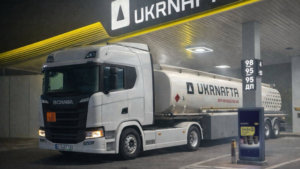
In September 2026, Ukrnafta became the largest importer of diesel fuel to Ukraine for the first time, supplying 105.3 thousand metric tons of the fuel, according to data from the A-95 Consulting Group and its analysis by the Experts Club.
The company’s import volume was 3.3 times higher than in September of last year.
OKKO took second place among the largest importers with 57,500 metric tons, while UPG came in third with 47,000 metric tons.
The top five also included AT Energo Trade with 44,000 metric tons and WOG with 42,500 metric tons.
Next came ZPEK with 29,400 metric tons, “Paid” with 28,900 metric tons, D.Trading with 26,500 metric tons, “Martin Trade” with 18,100 metric tons, and “Gaztrim” with 12,000 metric tons.
Among the largest players, the ZPEK Group showed the most significant growth compared to last year. Over the first nine months of 2026, its imports rose by 228% and approached 250,000 metric tons.
Total diesel fuel imports into Ukraine in September amounted to 537,000 metric tons, which is 21% less than a year earlier.
According to Serhiy Kuyun, director of the A-95 Consulting Group, changes among the largest importers are occurring against the backdrop of logistics transformation, high volatility in global prices, and the need for companies to establish more stable supply channels.
“The fuel market continues to face unprecedented challenges caused by Russian attacks. Importers are actively developing new logistics channels and expanding their vehicle fleets,” notes “A-95”.
The A-95 consulting group has been researching the Ukrainian motor fuel market for over two decades and monitors prices, supplies, and market infrastructure.

In September 2026, Ukraine imported 537,000 metric tons of diesel fuel, which is 21% less than in the same month of 2025 and 9% lower than in August, according to data from the A-95 Consulting Group.
Since the beginning of the year, diesel fuel imports have reached 4.7 million metric tons, which is 3% higher than the January–September figure from last year.
The main feature of September was unusually weak demand. A-95 attributes this, in particular, to massive attacks on industrial enterprises, as well as to problems with the export of agricultural products from the new harvest, including disruptions in maritime logistics.
“We do not yet have precise data, but there are all signs that retail sales of diesel fuel have also declined due to record prices caused by unprecedented global market rates,” note analysts at “A-95”.
The decline in demand is also confirmed by supply trends in the third quarter. During this period, approximately 1.7 million metric tons of diesel fuel were imported into Ukraine, which is about 10% less than a year earlier.
According to Serhiy Kuyun, director of the A-95 Consulting Group, the Ukrainian fuel market continues to operate amid unprecedented logistical and pricing challenges related to the war.
“The fuel market continues to face unprecedented difficulties caused by Russian attacks. Importers are actively developing new logistics channels and expanding their fleets, particularly of gasoline tankers,” the company notes.
The “A-95” consulting group specializes in research on the Ukrainian petroleum products market, price monitoring, logistics, and resource supply for the fuel market. Its director is Serhiy Kuyun.
According to Experts.news, gasoline imports to Ukraine in September 2026 totaled 145,000 metric tons, which is 5% less than in August but 3% higher than in September of last year, the A-95 Consulting Group reported based on the results of a special study.
From January through September, Ukraine imported 1.26 million metric tons of gasoline—15% more than during the same period in 2025.
“The decline in gasoline supplies in September occurred against the backdrop of a seasonal drop in consumption. Demand was also weighed down by this year’s record-high retail prices, which prompted car owners to conserve fuel,” the A-95 Consulting Group reported.
Lithuania remained the largest source of gasoline supplies in September, accounting for 46,400 metric tons, or 32% of the total volume. Compared to August, supplies fell by 10.4%.
Poland ranked second with 36,800 metric tons, or 25% of Ukraine’s imports. A month earlier, 40,100 metric tons were supplied from that country.
Thus, the combined share of Lithuania and Poland in September fell from 60% to 57%. Supplies from the largest supplier—the ORLEN Group—from these two countries decreased from 78,800 to 67,800 metric tons. Despite the decline, ORLEN accounted for about 47% of all Ukrainian gasoline imports.
At the same time, the geography of supplies changed. Imports from Germany fell by 25% compared to August—to 13,600 metric tons. Of this volume, 8,300 metric tons, or 61%, were imported by the UPG network.
At the same time, the share of southern supplies increased. Gasoline shipments from Romania rose by 29%—from 23.4 thousand to 30.1 thousand metric tons. As a result, Romania moved into third place among supplier countries and accounted for over 20% of September’s imports.
Supplies from Greece, on the other hand, fell by 28%—from 15,000 to 10,800 metric tons. Imports from Moldova more than doubled—from 1,900 to 4,100 metric tons.
Thus, despite the decline in total imports in September, shipments remain higher than last year’s level, and in the first nine months of 2026, Ukraine imported 15% more gasoline than in the same period a year earlier.
Source: A-95 Consulting Group.



