
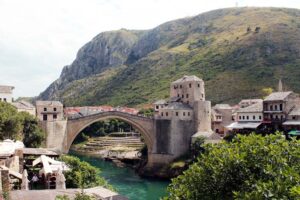
According to an overview article by the Serbian business publication Parametar, the campaign leading up to the general elections on October 4 is coming to a close in Bosnia and Herzegovina. The vote will determine not only the internal balance of power in one of Europe’s most complex countries in terms of its political structure, but also future relations between Banja Luka and Sarajevo, the position of the Republika Srpska, and the nature of Bosnia and Herzegovina’s interactions with Serbia, the EU, the U.S., and Russia.
There are 3,414,364 registered voters. They will elect three members of the Presidency of Bosnia and Herzegovina, the State Parliament, the Parliament of the Federation of Bosnia and Herzegovina, the National Assembly of the Republika Srpska, the president and vice presidents of the Republika Srpska, as well as the parliaments of the Federation’s ten cantons.
Current Prime Minister Savo Minic is running for the office of President of the Republika Srpska on behalf of the SNSD, while Branko Blanusa is the SDS’s lead candidate. Bogdan Jovanovic and independent candidate Marko Jorgic are also running.
Milorad Dodik’s name does not appear on the ballot, but he remains the leader of the SNSD and is actively participating in the party’s election campaign. RTS notes that Dodik’s political presence remains a key factor in the campaign in the Republika Srpska.
The race for the Serbian seat on the three-member Presidency of Bosnia and Herzegovina features incumbent Presidency member Želka Cvijanović of the SNSD, Marinko Božović of the SDS, and Nebojša Vukanović of the “List for Justice and Order.”
Another race of fundamental importance to the country’s political structure is the selection of the Croatian member of the Presidency. The HDZ BiH has nominated Dariana Filipović, the bloc of Croatian opposition parties supports Zdenko Lukić, and the Democratic Front supports Slaven Kovačević.
A dispute has been raging over this position for many years: Croatian parties are demanding a change to the election mechanism, arguing that the current system allows the more numerous Bosniak voters to influence who will represent the Croats. Opponents of changing the model cite the need to preserve the existing voting rights of Federation citizens.
Competing for the Bosniak seat are incumbent Presidium member Denis Bečirović, SDA leader Bakir Izetbegović, Semir Efendić, and Fahredin Radončić.
Another major experiment in these elections involves technology. For the first time on this scale, biometric voter identification and ballot scanning are being used. The Central Election Commission has purchased the necessary system for polling stations, and observers are closely monitoring how it handles the workload following years of disputes over election transparency.
As Parametar notes, Bosnia and Herzegovina effectively exists simultaneously on several political levels. Under the 1995 Dayton Agreement, the country consists of the Republika Srpska and the Federation of Bosnia and Herzegovina, while Brčko has special status. The Federation, in turn, is divided into ten cantons.
Above this structure are state-level institutions, notably the three-member Presidency. At the same time, the Republika Srpska and the Federation have their own parliaments, governments, and a wide range of powers.
There is also another level—international oversight.
BiH is sometimes referred to in the media as an international protectorate, but legally this is inaccurate. It is a sovereign state. Following the Dayton Accords, the position of High Representative of the international community was created; this official oversees the implementation of the peace agreement in the civilian sphere and is vested with exceptionally broad powers, known as the “Bonn Powers.” These powers allowed the High Representative to make decisions and remove politicians from office.
Therefore, the outcome on October 4 is of great significance far beyond the borders of Bosnia and Herzegovina. It will determine the balance of power between Banja Luka and Sarajevo, the composition of the country’s collective leadership, and the alignment of forces regarding further European integration; it will also serve as an indicator of how the Serb, Bosniak, and Croat political components of the complex Dayton system will interact following the elections.
Bosnia and Herzegovina, Dayton Agreement, ELECTIONS, Presidency, Republika Srpska
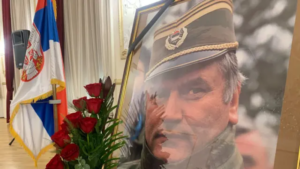
Bosnia and Herzegovina Foreign Minister Elmedin Konaković announced the withdrawal of most of the BiH embassy staff from Belgrade following the funeral of former Army of Republika Srpska commander Ratko Mladić, reports the Serbian Economist Telegram channel. He said he intends to reduce relations with Serbia to the “lowest possible level.”
The BiH ambassador and consul, however, remain in Belgrade: their appointment and recall fall under the authority of the collective Presidency of Bosnia and Herzegovina, not the Foreign Ministry. Under the Constitution, it is the Presidency that conducts the country’s foreign policy, so the minister cannot legally sever relations with Serbia on his own.
The reason was not only the funeral ceremony itself on September 7, but also the scale of participation by Serbian state institutions. As the coffin was returned, it was accompanied by representatives of the state and the military, while Defense Minister Bratislav Gašić and Justice Minister Nenad Vujić attended the funeral. President Aleksandar Vučić did not attend the ceremony, but his son Danilo was present. The funeral drew thousands of people.
Serbian Foreign Minister Marko Đurić responded extremely harshly, calling Konaković’s statements “hypocrisy.” He recalled that former BiH army commander Rasim Delić had also been convicted by the Hague Tribunal for crimes committed by the “El Mujahid” unit, and accused the Bosnian side of taking a selective approach to war crimes. Đurić also recalled the attack on Vučić in Potočari in 2015, when the then Serbian prime minister was pelted with stones after laying flowers at the Srebrenica memorial.
Why does the figure of Mladić still provoke such a harsh reaction in the Balkans?
Ratko Mladić commanded the Army of Republika Srpska from May 1992. The International Criminal Tribunal for the former Yugoslavia, and later the UN appeals chamber, ultimately found him guilty and sentenced him to life imprisonment for the Srebrenica genocide, crimes against humanity and war crimes during the war in Bosnia. In Srebrenica, after the enclave was captured in July 1995, around 8,000 Bosnian Muslims — men and boys — were killed.
Therefore, for a significant part of the Bosniaks in Bosnia, Mladić is above all a symbol of Srebrenica, the siege of Sarajevo and ethnic cleansing. His public honoring in Belgrade is perceived there not as a private funeral, but as a denial or justification of the crimes.
Croatia also views Mladić extremely negatively. Before the formation of the Army of Republika Srpska, he served in the Yugoslav People’s Army in the Knin area during the war in Croatia. After the final verdict in 2021, the Croatian government even officially expressed regret that the Hague proceedings had not covered crimes committed by him on Croatian territory.
In Serbia and Republika Srpska, attitudes are different. For many, Mladić remains the man who defended Bosnian Serbs during the breakup of Yugoslavia. That is why thousands of people attended the funeral, chants of “hero” were heard, and his portraits remain widespread. At the same time, Serbia itself has politicians, public organizations and media outlets that accept the findings of international courts and oppose the glorification of Mladić.
Belgrade also constantly emphasizes the issue of Serbian victims of the war and believes that crimes against Serbs receive less attention in regional and international discourse.
The scandal is already moving beyond Bosnian-Serbian relations. EU Commissioner for Enlargement Marta Kos canceled a planned visit to Serbia, explaining the decision by the unacceptability of glorifying convicted war criminals.
The story surrounding Mladić’s funeral is no longer merely a dispute over a single historical figure. It has once again exposed the central political contradiction of the Western Balkans: more than 30 years after the Bosnian war, Belgrade, Banja Luka, Sarajevo and Zagreb still differ substantially in their assessments of the war, responsibility, and of who should be regarded as a criminal and who as a hero.
BALKANS, Bosnia and Herzegovina, DIPLOMACY, RATKO MLADIĆ, SERBIA

According to “Serbian Economist,” the Financial Action Task Force (FATF) has added Bosnia and Herzegovina to the list of jurisdictions under enhanced monitoring—the so-called “gray list.”
At the same time, Iraq was also added to the “gray list.”
According to the FATF, countries on the “gray list” have strategic deficiencies in their systems for combating money laundering, terrorist financing, and the financing of the proliferation of weapons of mass destruction, but are committed to addressing these issues within agreed-upon timeframes.
FATF President Elisu de Anda Madrazo stated that Bosnia and Herzegovina must strengthen the protection of its financial system against exploitation by criminals and terrorists, as well as ensure more effective oversight of the banking sector.
This is a significant signal for the region. Bosnia and Herzegovina remains part of the Western Balkan economic space, closely linked to Serbia, Croatia, Montenegro, and EU countries through banking, trade, remittances from the diaspora, transportation, construction, and small businesses.
Being placed on the “gray list” does not imply sanctions or a ban on transactions, but it typically leads to stricter compliance requirements on the part of banks and financial institutions. International payments, opening accounts, servicing companies, transfers, and transactions with counterparties from such a jurisdiction may be subject to additional checks.
This is important for Serbia for two reasons. First, Bosnia and Herzegovina is a neighboring market and a key destination for regional trade. Second, Serbian banks, companies, and exporters working with partners in Bosnia and Herzegovina may face more detailed inquiries regarding the origin of funds, ownership structure, beneficial owners, and the purpose of payments.
From a practical standpoint, businesses working with Bosnia and Herzegovina should prepare transaction documents in advance, verify the authenticity of goods and services, and properly draft contracts and payment justifications. This applies particularly to financial services, trade, real estate, logistics, import-export, and companies with complex ownership structures.
For reference: as of June 19, 2026, the current FATF “gray list” includes Angola, Bolivia, Bosnia and Herzegovina, Bulgaria, Cameroon, Côte d’Ivoire, the Democratic Republic of the Congo, Haiti, Iraq, Kenya, Kuwait, Laos, Lebanon, Monaco, Nepal, Papua New Guinea, South Sudan, Syria, Venezuela, Vietnam, the British Virgin Islands, and Yemen.
The FATF blacklist—that is, the list of high-risk jurisdictions for which the FATF calls for enhanced measures or countermeasures—includes North Korea, Iran, and Myanmar.
Bosnia and Herzegovina, COMPLIANCE, FATF, financial monitoring, SERBIA
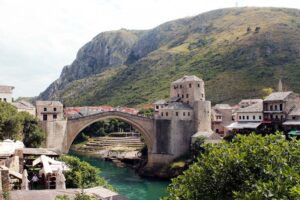
According to Sebsky Economist, Ukraine and Bosnia and Herzegovina have agreed to liberalize international freight transport: starting January 1, 2027, bilateral and transit road transport between the countries will be carried out without permits.
The agreement was reached during the first meeting of the Joint Commission on International Road Transport in Sarajevo, the Ministry of Community and Territorial Development of Ukraine reported.
Prior to the launch of full “transport visa-free travel,” the parties agreed to increase the quota of permits for freight transport until the end of 2026. This should provide carriers with more opportunities already during the transition period and reduce the risk of permit shortages for businesses.
For Ukrainian and Bosnian carriers, the abolition of permits means a reduction in administrative burdens, more predictable route planning, and simplified transit.
For the Western Balkans region, this agreement also has practical significance. Bosnia and Herzegovina becomes yet another country through which Ukraine will be able to develop more flexible transport links with Balkan markets, the Adriatic, and neighboring countries in the region. This could be important for the export of Ukrainian agricultural products, industrial goods, construction materials, and processed goods.
Bosnia and Herzegovina will become the 36th country with which Ukraine has liberalized freight transport conditions. This regime has already become one of the tools for integrating Ukrainian logistics into the European transport space, as it allows carriers to operate without constant dependence on bilateral quotas and permitting procedures.
For the “Serbian Economist,” the key takeaway is that Ukraine continues to gradually integrate into the transport network of Southeast Europe. Following the conclusion of agreements with the EU and a number of European countries, the extension of “transport visa-free travel” to Bosnia and Herzegovina strengthens Ukraine’s logistical ties with the Balkans and creates new opportunities for trade in a region where routes, border procedures, and market access are becoming no less important than tariffs themselves.

According to the “Serbian Economist,” the Central Election Commission of Bosnia and Herzegovina has scheduled general elections for October 4, 2026, the country’s election commission reports.
About 3.3 million registered voters will be called upon to elect the new composition of the country’s highest authorities at several levels. Voting will take place for members of the collective Presidency of Bosnia and Herzegovina, deputies to the House of Representatives of the Parliamentary Assembly of Bosnia and Herzegovina, the Parliament of the Federation of Bosnia and Herzegovina, the National Assembly of the Republika Srpska, the president and vice presidents of the Republika Srpska, as well as cantonal assemblies within the Federation of Bosnia and Herzegovina.
The elections will traditionally be one of the key political events in the region, as Bosnia and Herzegovina remains a state with a complex system of governance, where a significant portion of decisions depends on the balance between Bosniaks, Serbs, and Croats, as well as on relations between the two entities.
At the state level, citizens elect three members of the BiH Presidency: one Bosniak, one Croat, and one Serb. The Bosniak and Croat members are elected within the Federation of Bosnia and Herzegovina, while the Serb member of the Presidency is elected within the Republika Srpska. At the same time, a state-wide parliament is formed, upon which the work of the BiH Council of Ministers depends.
The elections will take place against the backdrop of ongoing political tensions in the country. In recent years, the Republika Srpska has remained the center of conflicts between the entity’s authorities, BiH state institutions, and the international community. Reuters previously noted that the leadership of the Republika Srpska had been pushing a separatist agenda, which hindered the implementation of reforms and the work of state-level institutions.
For the region, the election results will be significant in terms of Bosnia and Herzegovina’s stability, its European integration, relations with Serbia and Croatia, as well as the role of international institutions that continue to participate in supporting the Dayton system.
Bosnia and Herzegovina is structured as a complex state established following the 1995 Dayton Peace Agreement. The country consists of two main entities: the Federation of Bosnia and Herzegovina and the Republika Srpska, as well as the separate Brčko District with special status. The Federation of BiH, where the majority of the population consists of Bosniaks and Croats, is further divided into 10 cantons with their own authorities. The Republika Srpska has its own government, parliament, and president. The Brčko District formally belongs to both entities but effectively functions as a separate self-governing administrative unit under the sovereignty of BiH.
This system makes BiH one of the most complex countries in Europe in terms of governance. In practice, power is distributed among the state level, the entities, the cantons, and the Brčko District. Therefore, elections in the country are not only a contest between parties but also a test of the balance between different ethnic communities, levels of government, and foreign policy orientations.
Bosnia and Herzegovina, Central Election Commission, ELECTIONS
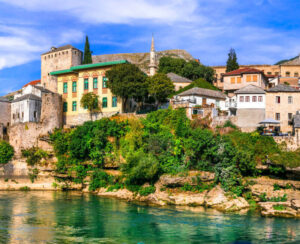
Relocation project has analyzed economic indicators of Bosnia and Herzegovina. For convenience, the data are presented in blocks by topics and areas.
1. GDP growth and economic development rates
2. Nominal GDP and per capita income
3- Inflation and price dynamics
4. Public debt and fiscal sustainability
5. Currency stability and reserves
6. Unemployment and labor market
7. Population and demography
8. Other factors and risks
Bosnia and Herzegovina (BiH) is a state in Southeastern Europe, located on the Balkan Peninsula. The capital is Sarajevo. The population is estimated at about 3.2 million (2025).
The country has a complex state structure: it consists of two autonomous entities, the Federation of Bosnia and Herzegovina and the Republika Srpska, as well as the Brcko District. The country is a candidate for accession to the European Union (since 2016).
http://relocation.com.ua/bosnia-and-herzegovinas-economy-an-overview-from-relocation/



