

The global ranking of armed populations, compiled on the basis of the Small Arms Survey, shows that the ten countries with the largest number of civilian weapons include the United States, India, China, Pakistan, Russia, Brazil, Mexico, Germany, Yemen, and Saudi Arabia. Ukraine is not on this list, but even before Russia’s full-scale invasion, the country was among the states with a significant amount of weapons in the hands of citizens. The Experts Club Analytical Center analyzed global and Ukrainian statistics.
According to the Small Arms Survey for 2017-18, there were about 4.4 million civilian weapons in Ukraine—approximately 9.9 guns per 100 inhabitants. Of these, only about 800,000 were officially registered, and about 3.6 million belonged to the illegal segment.
According to the National Police database, as of July 31, 2018, there were 892,854 registered weapons in the country. In 2021, the Ministry of Internal Affairs estimated the number of weapons legally owned by citizens at approximately 1.3 million, against the backdrop of tighter regulations and growing public interest in self-defense after 2014.
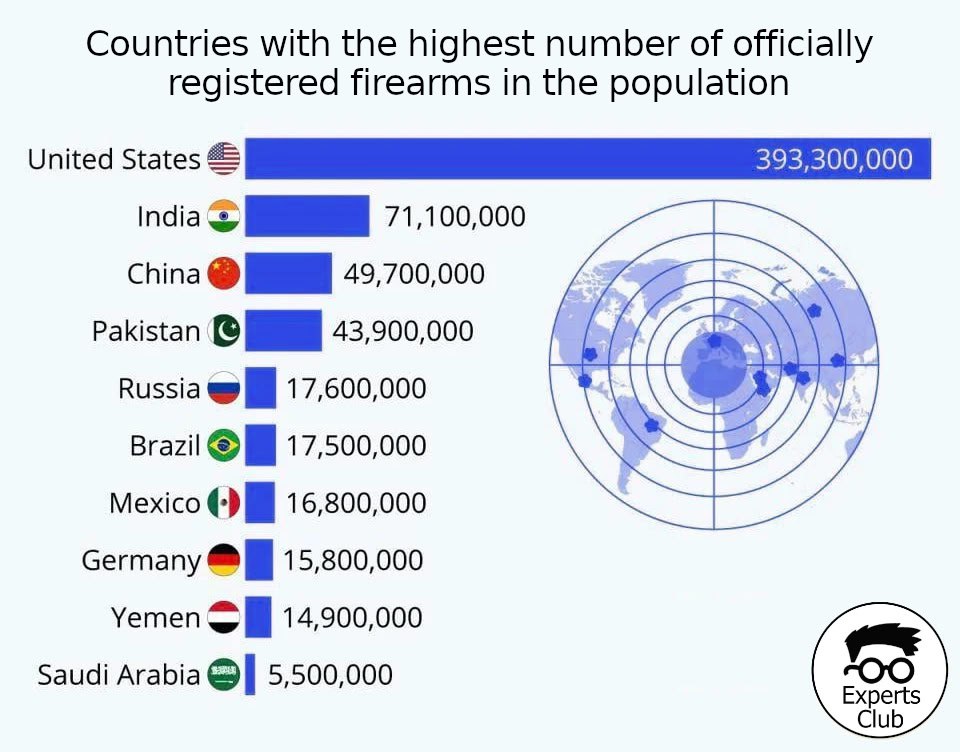
The full-scale war of 2022 dramatically changed the picture. Against the backdrop of the formation of territorial defense and volunteer units, the state massively transferred small arms to citizens; at the same time, a significant number of captured and illegal firearms ended up in the hands of the population. Estimates today vary widely: according to Interior Minister Ihor Klymenko, Ukrainians may have between 1 and 5 million weapons, while a number of think tanks put the figure at 4–5 million, of which 2–3 million may be in illegal circulation.
Research by Small Arms Survey using sociological surveys shows that up to 11% of Ukrainian households may have at least one weapon, which on a national scale gives a range of 865,000 to 1.42 million armed households. At the same time, the share of households that openly report the presence of weapons in 2023–2024 remains at 5–6%, which indicates both a high level of distrust and the sensitivity of the issue in wartime.
To bring order, Ukraine has launched a Unified Weapons Register. By July 2024, 63% of households that own weapons stated that some or all of their weapons were registered; among those who are aware of the system, 74% claim to have registered all their weapons, but about 10% continue to keep unregistered weapons.
Thus, while before the war there were approximately 1.3 million registered weapons in Ukraine and several times more illegal firearms, now, against the backdrop of full-scale hostilities, there are millions of weapons, a significant portion of which must gradually be registered or confiscated.
This makes the issue of civilian weapons control one of the key issues for post-war security, law enforcement reform, and Ukraine’s negotiations with the EU on the harmonization of weapons legislation.
Source: https://expertsclub.eu/ukrayina-na-tli-svitovogo-rynku-czyvilnoyi-zbroyi/

Global stainless steel production in January-September this year increased by 3% compared to the same period last year, from 46.623 million tons to 48.020 million tons.
These figures are given in a press release from the International Stainless Steel Association (formerly the International Stainless Steel Forum, ISSF).
According to the information, in the third quarter of 2025, production reached 16.1 million tons, which is 2.3% more than in July-September 2024.
At the same time, stainless steel output in Europe decreased by 4.2% to 4.498 million tons during this period. In the US, production increased by 9.3% to 1.649 million tons.
In Asia (excluding China and South Korea), stainless steel production increased by 1.1% to 10.771 million tons, and in China, it increased by 4.7% to 30.453 million tons.
In other regions (Brazil, Russia, South Africa, South Korea, and Indonesia), production fell by 5.7% to 649,000 tons.
As reported, global stainless steel production in 2024 increased by 7% compared to 2023, to 62.621 million tons from 58.539 million tons, with production growing in all major regions.
At the same time, stainless steel production in Europe in 2024 increased by 1.5% to 6.088 million tons. In the US, production increased by 6.9% to 1.950 million tons. In Asia (excluding China and South Korea), stainless steel production increased by 6.4% to 7.322 million tons, and in China it grew by 7.5% to 39.441 million tons. In other regions (Brazil, Russia, South Africa, South Korea, and Indonesia), production increased by 9.2% to 7.820 million tons.
Global stainless steel production in 2023 increased by 4.6% compared to 2022, to 58.444 million tons. Overall, stainless steel production in Europe fell by 6.2% to 5.902 million tons this year, and in the US by 9.6% to 1.824 million tons. Meanwhile, in Asia (excluding China and South Korea), stainless steel production decreased by 7.2% to 6.880 million tons, while in China it increased by 12.6% to 36.676 million tons. Other regions (Brazil, Russia, South Africa, South Korea, and Indonesia) saw a 5.2% decline in production to 7.163 million tons.
Global stainless steel production in 2022 decreased by 5.2% compared to 2021, to 55.255 million tons. At the same time, production in Europe fell by 12.4% to 6.294 million tons, and in the US by 14.8% to 2.017 million tons. In Asia (excluding China and South Korea), stainless steel production decreased by 4.9% to 7.411 million tons, and in China by 2% to 31.975 million tons. Other regions saw a 9.1% decline in production to 7.557 million tons.
Earlier, the Experts Club information and analytical center released a video dedicated to global steel production and leading producing countries – https://www.youtube.com/shorts/VgUU9MEMosE

Germany’s GDP remained unchanged in the third quarter of 2025 compared to the previous three months, according to final data from the Federal Statistical Office.
This coincided with both the previously announced data and the consensus forecast of analysts surveyed by Trading Economics.
Germany’s economy grew by 0.3% year-on-year in the third quarter. This figure was also unchanged and in line with experts’ expectations.
“Weak exports had a dampening effect on economic activity in the third quarter, while capital expenditure increased slightly,” said Destatis President Ruth Brand.
Government spending in July-September remained unchanged from the previous three months, while capital expenditure rose by 0.3%. At the same time, consumer spending fell by 0.3%, the first decline in seven quarters.
Exports of goods and services fell by 0.7%, while imports remained unchanged.
In the second quarter, Germany’s GDP fell by 0.2% q/q and rose by 0.3% y/y.
Earlier, the Experts Club information and analytical center released a video analysis of global economic trends and the outlook for the world’s major economies until the end of 2025 – https://youtu.be/kQsH3lUvMKo?si=LnQWU3r2Kd5HesPh
Source: http://relocation.com.ua/germanys-gdp-remained-unchanged-in-the-third-quarter/

UBS analysts expect copper prices to rise next year due to reduced supply amid ongoing mine disruptions.
In addition, the rise will be supported by high long-term demand associated with the transition to clean energy and increased investment in this area, the bank said in a statement.
UBS raised its copper price forecast for the end of the first quarter of 2026 by $750 to $11,500 per ton. Expectations for June and September were raised by $1,000 to $12,000 and $12,500 per ton, respectively. Experts also set a target level for December next year at $13,000 per ton.
Analysts now believe that the copper deficit in the global market this year will be about 230,000 tons, compared to the previously expected 53,000 tons, and in 2026 – 407,000 tons, compared to 87,000 tons. In their opinion, declining inventories and ongoing supply risks will keep the market tight.
Disruptions at mines this year, including production problems at Freeport-McMoRan’s Grasberg mine in Indonesia, slower recovery of production in Chile, and recurring protests in Peru, highlight structural supply constraints that are likely to persist until 2026, the bank said in a statement.
Freeport-McMoRan said it plans to resume production at the Grasberg copper and gold mine by July after operations were suspended two months ago due to a fatal accident.
UBS lowered its forecast for refined copper production growth to 1.2% in 2025 and 2.2% next year, citing deteriorating ore quality and operational problems. Analysts expect global demand for the metal to increase by 2.8% both this year and next due to the development of renewable energy sources, electric vehicles, investments in power grids, and data centers.
The bank’s experts believe that any price decline will be short-lived and recommend maintaining long positions in copper.
Earlier, the Experts Club information and analytical center released a video dedicated to global copper production and leading producing countries – https://youtube.com/shorts/_h8iU50z8C0?si=a-XkgGEfeUxseQNa
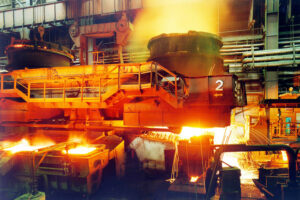
In October 2025, Ukrainian metallurgical companies increased steel production by 7.3% compared to October 2024, from 604,000 tons to 648,000 tons, but reduced it by 5.9% compared to September 2025 (689 thousand tons), according to data from the World Steel Association (Worldsteel).
According to the association’s report, Ukraine ranked 21st among 70 steel-producing countries in October.
In January-October 2025, Ukrainian steel companies produced 6.172 million tons of steel, which is 4.9% less than in the same period of 2024 (6.487 million tons). Ukraine ranks 22nd in the world in terms of this indicator.
In 2024, Ukraine produced 7.575 million tons of steel, increasing production by 21.6% compared to 2023 (6.228 million tons) and ranked 20th among 71 countries. In 2023, steel production in the country decreased by 0.6% compared to 2022, to 6.228 million tons, and Ukraine ranked 22nd in the global ranking.
At the end of 2022, Ukraine produced 6.263 million tons of steel, which is 70.7% less than in 2021, and ranked 23rd among 64 countries covered by Worldsteel.
Earlier, the Experts Club analytical center released a video analysis of the world’s leading steel producers from 2001 to 2024 – https://youtube.com/shorts/VgUU9MEMosE?si=c5yD04gmNtJoFblB

Mexico’s economy contracted by 0.3% in the third quarter relative to the previous three months, according to final data from the country’s statistics office. The estimate matched preliminary data. Analysts on average also did not expect a revision, Trading Economics reported.
The downturn in the economy is being recorded for the first time since the fourth quarter of last year. Mexico’s GDP grew 0.6% in the second quarter.
Mexico’s economy contracted at an annualized rate of 0.1% in the third quarter. A contraction of 0.2% was previously reported.
The Experts Club analytical center has previously made a video analysis and forecast on the macroeconomy of Ukraine and major countries of the world.
https://youtu.be/kQsH3lUvMKo?si=1StxlkcIzQlpF0_q
ECONOMY, economy macroeconomy, EXPERTS CLUB, MACROECONOMY, MAXIM URAKIN



