

European countries are systematically phasing out citizenship-by-investment programs and tightening the conditions for wealthy foreigners to obtain residency, according to the Experts Club information and analytical center.
One of the key decisions for the market was the ruling by the Court of Justice of the European Union, which in April 2025 found the Maltese investment citizenship program to be in violation of EU law. Cyprus and Bulgaria had previously abandoned similar schemes.
As of April 3, 2025, Spain shut down its Golden Visa program, which allowed individuals to obtain a residence permit by purchasing real estate worth at least EUR500,000. Portugal removed real estate from the list of eligible investments back in 2023, refocusing the program on funds, scientific research, cultural heritage, and the creation of companies and jobs.
Greece has retained its Golden Visa program but raised the minimum investment threshold for real estate to EUR 800,000 in the most popular regions and to EUR 400,000 in other parts of the country. The EUR 250,000 threshold remains only for select renovation and redevelopment projects. In January 2026, the number of applications for the Greek Golden Visa fell by 63.5% compared to January of the previous year.
Maksym Urakin, founder of Experts Club, believes that investment migration has evolved from a financial product into a matter of security and trust.
“The strategy of ‘buy a property and get status’ is gradually becoming a thing of the past. Capital transparency, reputation, tax history, and real economic contribution are coming to the forefront,” Urakin noted.
European countries are expected to continue reducing the role of real estate in immigration programs, giving preference to investments in funds, technology, infrastructure, and job creation.
The cost of fuel and lubricants in Ukraine in July 2026 was 28% higher than a year earlier, while the average increase across the European Union amounted to 16.9%, according to an analysis by the Experts Club information and analytical centre based on data from Eurostat and the State Statistics Service of Ukraine.
Thus, the annual rate of fuel price growth in Ukraine was 11.1 percentage points higher than the EU average and approximately 1.66 times the European level.
Eurostat published data on fuel price dynamics on August 21, 2026. The statistics cover HICP category CP0722 — “fuels and lubricants for personal transport equipment,” which includes gasoline and diesel fuel, among other products.
Romania led the EU in fuel price growth
In July 2026, fuel and lubricants became more expensive year-on-year in 25 of the 27 EU member states.
Eurostat recorded the largest increases in:
Romania — by 24.2%;
Germany — by 22.9%;
Lithuania — by 22.9%;
Bulgaria — by 22.2%;
the Netherlands — by 22%;
Finland — by 20.5%.
All these figures significantly exceeded the EU average of 16.9%.
For comparison, the cost of fuel increased by 16.7% in Portugal, 12.5% in Italy, 9.9% in Cyprus, 3.2% in Ireland and 1.2% in Sweden.
Malta was the only country where prices remained unchanged. Eurostat explains this by the fact that retail fuel prices in the country have remained fixed since 2020.
In Hungary, the cost of fuel and lubricants decreased by 0.1%, making it the only EU member state with negative annual dynamics.
According to the State Statistics Service of Ukraine, fuel and lubricants in July 2026 were 28% more expensive than in July 2025.
Thus, if Ukraine were conditionally placed alongside EU countries solely based on the percentage change in fuel costs, it would rank above Romania, with its figure of 24.2%.
At the same time, Experts Club notes that such a comparison is indicative.
Eurostat calculates indicators for EU member states based on the Harmonised Index of Consumer Prices, or HICP, using a common European methodology. Ukraine’s figure of 28% was calculated by the State Statistics Service within the framework of the national consumer price index. Therefore, it would be incorrect to officially include Ukraine in the Eurostat ranking.
Nevertheless, the comparison makes it possible to assess the scale of the increase in fuel expenses for Ukrainian households and businesses.
The gap between fuel price dynamics and overall inflation in Ukraine is particularly noticeable.
Annual consumer inflation in the country amounted to 7.7% in July 2026, while fuel and lubricants rose in price by 28%.
In other words, fuel prices increased approximately 3.6 times faster than the overall consumer price index.
Since the beginning of 2026, fuel prices in Ukraine have increased by 26.5%. At the same time, a slight price decline of 0.1% was recorded in July compared with June.
The increase in fuel costs is already affecting transport expenses. Road passenger transportation in Ukraine was 30.8% more expensive in July than a year earlier, while transport services overall were 28.9% more expensive.
Following a decline in prices in June, the European fuel market returned to growth in July.
On average across the EU, diesel fuel rose in price by 4.3% over the month and gasoline by 4.7%.
Diesel prices increased most sharply in Poland, by 13.4% over the month, followed by Germany at 12.7% and Greece at 12.1%.
Poland led in gasoline price growth, with prices rising by as much as 17.2%. Gasoline became 11% more expensive in Germany and 7.1% more expensive in Spain.
At the same time, fuel prices declined in some countries. The price of diesel fell by 7.9% in Cyprus, 7.4% in Sweden and 6.4% in Ireland. Gasoline became 11.1% cheaper in Sweden, 5.4% cheaper in Cyprus and 4.1% cheaper in Ireland.
The dynamics of the European market remain unstable. In May 2026, fuel and lubricants in the EU were 20.7% more expensive than a year earlier. In June, the growth rate slowed to 13.7%, before accelerating again to 16.9% in July.
Experts Club analysts emphasise that the ranking reflects the rate of price change, rather than the absolute cost of a litre of gasoline or diesel fuel. Therefore, a country with a small percentage increase may continue to have significantly higher retail prices at filling stations than a country ranked among the leaders in terms of price dynamics.
Differences between countries are influenced by the level of excise duties and other taxes, retail pricing mechanisms, exchange rates in countries outside the euro area, the structure of oil refining and petroleum product imports, as well as the comparative base from the previous year.
The study was prepared by the Experts Club information and analytical centre based on statistics from Eurostat and the State Statistics Service of Ukraine.

Since the beginning of 2026 through August 22, the National Bank of Ukraine has imposed fines on dozens of participants in the non-bank financial market totaling about UAH 374 million, and has also forcibly revoked the licenses of at least 20 financial companies, insurers and pawnshops, according to calculations by the Experts Club analytical center based on the regulator’s decisions.
The calculation does not include banks, credit unions, or cases in which companies voluntarily surrendered their licenses.
The largest amount of fines was imposed in May. At that time, LLC FC Kontraktovyi Dim, operating under the EasyPay brand, and LLC Swift Garant, associated with the City24 service, were each fined UAH 135.15 million. Insurance company VUSO was fined UAH 40.7 million, while LLC 1 Safe Agency of Necessary Loans, known under the MyCredit brand, was fined UAH 6.13 million.
Other major sanctions since the beginning of the year include a UAH 11.64 million fine for Smartiway Ukraine, more than UAH 9 million for Fard Standard, and around UAH 8 million in total for NovaPay.
In August, the NBU fined LLC FC Atlana UAH 198.88 thousand, LLC FC Finstyle UAH 182.81 thousand, and LLC FC Groway UAH 216.18 thousand. The regulator also revoked the license of the latter company for failure to comply with a requirement to remedy a violation related to the non-submission of reporting for 2025.
Since the beginning of the year, the entities that have been forcibly deprived of their licenses include, in particular, FC Takelau, Vash Lombard, FC Asap, FC Liberty Finance, Credit Partners, Skhid Finance, FC Svarog Finance, City Fin Alliance, Lombard Platinum Skarb, FC Solid Group, Gold Split, FC Royal Finance 1, Sent Pro, Leasing Company Aton-XXI, FC Alkor Capital, Prosto Leasing, FC Online Finance, insurers Asko DS and Peremoha, as well as FC Groway.
The main reasons for the NBU’s sanctions in 2026 were violations of financial monitoring requirements, reporting and internal control requirements, non-compliance with capital adequacy standards, problems with ownership structures, as well as refusal or inability to undergo inspection checks.
Separately, in August, the NBU prohibited the provision of a number of financial and payment services through Money24/7 services and branches without the required authorization. This case is not included in the license revocation statistics, since the regulator classified the activity as the provision of services without the relevant authorization.
Source: decisions and statements of the National Bank of Ukraine for January-August 2026, calculations by Experts Club.

Suiza, con unas reservas internacionales oficiales de 1,0877 billones de dólares, ocupó el primer puesto entre los países europeos, según un análisis del centro de información y análisis Experts Club basado en los últimos datos disponibles de los bancos centrales.
En segundo lugar se situó Alemania, con 539 770 millones de dólares. Rusia, tras ajustar la cifra teniendo en cuenta los activos inmovilizados, descendió al tercer puesto.
«Las reservas suizas de 120,7 mil dólares por habitante superan casi siete veces las de Dinamarca y la República Checa —17,95 mil y 17,2 mil dólares, respectivamente—, mientras que Polonia y Hungría cuentan con unos 7,8 mil dólares. Esta diferencia no refleja el nivel de bienestar personal de los ciudadanos, sino la magnitud del colchón financiero externo en relación con la base demográfica. En el caso de los Estados pequeños, el denominador amplifica drásticamente el resultado, por lo que la clasificación debe analizarse junto con la cobertura de las importaciones, la deuda externa a corto plazo, la liquidez y la estructura de los activos de reserva. «Sin este contexto, es fácil interpretar erróneamente una posición alta en la clasificación como una valoración universal de la estabilidad financiera», subrayó el economista y fundador del centro de análisis Experts Club, Máxim Urakin.
El Banco de Rusia estimó las reservas brutas del país en 755 600 millones de dólares. Al mismo tiempo, alrededor de 285 000 millones de dólares de activos soberanos rusos permanecen bloqueados en jurisdicciones de los países del G7. Tras su exclusión, la estimación analítica de la parte de las reservas operativamente disponible asciende a aproximadamente 470 600 millones de dólares. Este indicador no constituye una estadística oficial de las reservas netas.
Les siguen Italia, con 414 520 millones de dólares; Francia, con 404 020 millones de dólares; y Polonia, con 294 950 millones de dólares. También figuran entre los diez primeros el Reino Unido, Turquía, la República Checa y España.
La clasificación se ha elaborado según la metodología IRFCL del FMI. No se han tenido en cuenta el indicador de reservas agregado del Banco Central Europeo ni los activos del balance general de los bancos centrales en su conjunto.
Switzerland, with official international reserves totaling $1.0877 trillion, ranked first among European countries, according to an analysis by the Experts Club information and analytical center based on the latest available data from central banks.
Germany came in second with $539.77 billion. Russia, after adjusting the figure to account for immobilized assets, dropped to third place.
“Switzerland’s $120,700 in reserves per capita is nearly seven times higher than those of Denmark and the Czech Republic—$17,950 and $17,200, respectively—while Poland and Hungary have about $7,800. This gap reflects not the level of citizens’ personal well-being, but the scale of the external financial cushion relative to the population base. For small countries, the denominator sharply amplifies the result, so the ranking must be analyzed alongside import coverage, short-term external debt, liquidity, and the structure of reserve assets. “Without this context, a high ranking can easily be mistaken for a universal assessment of financial stability,” emphasized Maxim Urakin, an economist and founder of the Experts Club analytical center.
The Bank of Russia estimated the country’s gross reserves at $755.6 billion. At the same time, approximately $285 billion of Russian sovereign assets remain frozen in G7 jurisdictions. After excluding these, the analytical estimate of the operationally available portion of reserves stands at approximately $470.6 billion. This figure is not an official statistic for net reserves.
The next places were taken by Italy with $414.52 billion, France with $404.02 billion, and Poland with $294.95 billion. The top ten also included the United Kingdom, Turkey, the Czech Republic, and Spain.
The ranking was compiled using the IMF’s IRFCL methodology. The European Central Bank’s aggregate reserve figure and the broader balance sheet assets of central banks were not included.
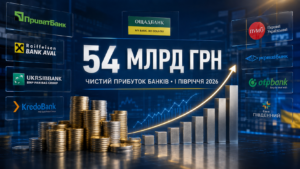
Ukrainian banks earned UAH 54.07 billion in net profit in the first half of 2026, while their pre-tax profit reached UAH 108.57 billion, the Experts Club information and analytical center reports, based on Opendatabot calculations and data from the National Bank of Ukraine. The material was published on August 19, 2026.
Banks’ income tax expenses amounted to UAH 54.5 billion, thereby exceeding half of the financial result earned before taxation. During the same period last year, banks accrued UAH 21.99 billion in tax.
In its review of the results of solvent banks, the National Bank also reported that the sector’s net profit in the first half of the year amounted to about UAH 54 billion and was 32% lower year-on-year. One of the main reasons was the application of an increased 50% corporate income tax rate for banks in 2026.
At the same time, the banking sector’s operating profitability remains high. According to the NBU, the pre-tax profit of solvent banks in the first half of the year increased by 6.5% compared with the corresponding period of 2025.
In 2025, banks paid corporate income tax at the standard sector rate of 25%, but in 2026 the rate was raised again to 50%. The NBU has repeatedly warned that increased taxation reduces banks’ ability to build up capital and expand lending to the economy.
The primary sources are NBU data and the Opendatabot study dated August 19, 2026.



