
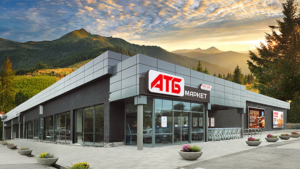
According to Experts.news, Ukraine’s largest retailers continued to increase their revenue in the first half of 2026, with the growth rates of leading chains in most cases exceeding that of the country’s retail market as a whole. ATB remains the leader in terms of revenue, while among the largest companies, Aurora and Fora posted the highest growth rates, according to an analysis by the Experts Club research center based on data from OpenDataBot.
As of mid-August 2026, there were 41,235 companies operating in the retail sector in Ukraine. Their number has been increasing for the fifth consecutive year. Since the beginning of the year, the number of registered retailers has exceeded the number of those that closed by 796 companies, which is practically in line with the pre-war level of net growth—804 companies over a comparable period. A total of 969 new companies were registered in 2026, 32% more than the previous year. (OpenDataBot)
To assess financial trends, OpenDataBot identified 2,073 companies that submitted financial statements for both the first half of 2025 and the corresponding period of 2026. Their combined revenue increased by 18%—from 692.29 billion UAH to 817.14 billion UAH.
The ranking of Ukraine’s largest retailers by revenue for the first half of 2026 is as follows:
ATB-Market – 135.99 billion UAH, up 16.1% compared to 117.15 billion UAH a year earlier.
Silpo-Food – 59.55 billion UAH, +18.2%.
Vygodna Kupka / “Aurora” – 28.26 billion UAH, +30.0%.
Fora – 26.83 billion UAH, +29.4%.
Comfi Trade – 20.16 billion UAH, +27.5%.
Novus Ukraine – 19.65 billion UAH, +20.6%.
RUSH / EVA – 18.02 billion UAH, +21.4%.
Metro Cash & Carry Ukraine – 17.70 billion UAH, +14.5%.
Petrol Contract / WOG – 16.35 billion UAH, +17.2%.
Omega / Varus – 13.72 billion UAH, +21.6%.
According to Experts Club’s calculations, the combined revenue of the top ten companies reached 356.23 billion UAH, an increase of approximately 19.7% compared to the first half of 2025. Thus, the top 10 grew slightly faster than the entire comparable group of retailers.
The ten largest companies accounted for about 43.6% of the total revenue of the 2,073 retailers included in the OpenDataBot sample. ATB and Silpo alone generated approximately 195.5 billion UAH, or nearly 24% of the total revenue of the entire group studied, while the top five companies generated approximately 270.8 billion UAH, or one-third of the total.
ATB remains the undisputed market leader: its revenue is more than double that of Silpo and nearly five times that of Aurora. Furthermore, ATB recorded the largest absolute increase in revenue—18.84 billion UAH over the year.
However, in terms of growth rates, “Aurora” and “Fora” stand out the most. “Aurora’s” revenue increased by 30%, or 6.52 billion UAH, while “Fora’s” rose by 29%, or 6.1 billion UAH. “Komfi” saw an increase of about 27.5%.
Outside the top ten in terms of revenue, FTD-Retail—which operates the “Foxtrot” chain—demonstrated strong growth, increasing its revenue by 4.47 billion hryvnia. OKKO-Light added 3.88 billion UAH, while Glusko Retail—whose gas station network is managed by Ukrnafta—added 2.76 billion UAH.
The financial results also reveal another trend. The combined profit of the companies surveyed grew by 17%—from 14.91 billion UAH to 17.44 billion UAH—but the number of profitable retailers decreased.
In the first half of 2025, 1,354 companies in the comparable group reported a profit; in 2026, that number dropped to 1,272. Their share fell from 65% to 61%.
This means that growth in the Ukrainian retail sector is becoming more concentrated. The sector’s total revenue and profit are increasing, and leading chains are posting double-digit growth rates; however, operating conditions remain challenging for some small and medium-sized companies.
According to Experts Club’s assessment, the discrepancy between the 18% increase in total revenue for the surveyed group and the decline in the share of profitable companies is particularly telling. It may indicate rising operating expenses, labor costs, logistics costs, rent, electricity costs, and financing costs, as well as intensified competition from the largest chains.
At the same time, the financial statements for the first half of the year do not yet reflect the consequences of subsequent massive Russian strikes on distribution centers, warehouses, and other infrastructure of Ukrainian businesses, a point specifically highlighted by OpenDataBot. Their impact may become apparent in the results of the coming quarters.
General government statistics also confirm the continued growth of the consumer market. As previously reported by Open4Business, citing the State Statistics Service, in January–July 2026, the physical volume of Ukraine’s retail trade turnover increased by 9% compared to the same period last year, while its nominal volume reached approximately 1.7 trillion UAH.
Retail turnover of legal entities grew slightly faster over the seven-month period, by 9.1%. In July alone, total retail turnover increased by 8.7% year-over-year and by 4% compared to June, while turnover of legal entities rose by 8.8% and 3.7%, respectively. Overall, Ukrainian retail grew by 8.1% in 2025, so the figures for the first seven months of 2026 indicate that consumer activity continues at a higher pace.
American Tupperware Brands Corp., known for its plastic food storage containers, has filed for bankruptcy.
“Over the past few years, the company’s financial position has been severely impacted by the challenging macroeconomic environment,” said Tupperware CEO Lori Ann Goldman.
The company’s shares have fallen by 75% since the beginning of 2024.
Tupperware initiated bankruptcy proceedings in accordance with Article 11 of the US Bankruptcy Code. The company needs court approval to continue operations and speed up the process of selling the business while protecting its brand.
Tupperware was founded in 1946 by chemist Earl Tupper, who developed airtight plastic containers to help American families preserve food and save on costs. The company’s products are distributed through direct sales by Tupperware consultants around the world. The so-called “Tupperware parties” – events for cooking together using the company’s products – have also gained popularity.
In recent years, however, Tupperware has been experiencing serious difficulties, facing a decline in demand for its core products, increased competition, and a lack of liquidity, the WSJ notes.
Recently, the Experts Club information and analytical center released a video on the history of defaults and a table of countries that may face the risk of default in the medium term.
Watch the video on the Experts Club YouTube channel for more details: https://youtu.be/gq7twYrWuqE?si=KneYUbl2rNOUIGTM

Decentralization in Ukraine is far from completion, considers the local government expert, director of the Practical Policy Program of the Institute of Political Education, Alexander Solontay.
“Today we are far from having a decentralized country, we have done only the first basic steps, but we are moving towards this”, – Solontay claimed in comments on features and problems of the decentralization process in Ukraine
on the Youtube channel “Club of Experts“.

In the expert’s opinion, now has arisen a situation in which the implemented reforms had led to greater autonomy of urban and rural communities. At the national level, however, politicians are chosen by a paternalistic population. These policies support communities’ autonomy on the one hand and, on the other, want the Centre to continue to provide guidance locally.
“From above, the mechanisms for interaction with autonomous communities have not yet been worked out. The politicians act in the old way – to pass laws, to direct an order, to allocate funds, and so on. It’s vertical management. How to manage in a new system, where the bottom is independent and the top has limited possibilities, authorities have not yet learned», – says the expert.
Solontay noted that in our environment, where the shadow economy and corruption have not been overcome, the law enforcement agencies are under-reformed and the local power is increasingly independent, a systemic crisis has arisen in interaction of Center and regions.
«Whatever situation would appear in the country, we are always condemned to conflict between authorities and local self-government», – the expert summarized.
DECENTRALIZATION, EXPERT, EXPERTSCLUB, POLITICS, SELF-GOVERNMENT, SOLONTAY



