
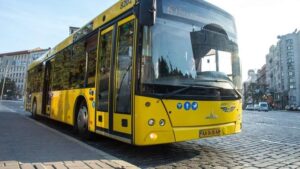
New fares for single rides on public transit will take effect in Kyiv on July 15—a single ride on the metro, bus, tram, trolleybus, or funicular will cost 30 UAH.
Mayor Vitali Klitschko signed the corresponding order on July 7; the document was published on the Kyiv City State Administration’s website on Friday, July 10.
At the same time, discounts are available on “multi-ride passes” depending on the number of trips: 1–9 trips—30 UAH; 10–19 trips—28.90 UAH; 20–29 trips—27.80 UAH; 30–39 trips—26.60 UAH; 40–49 trips—25.50 UAH; 50 trips – 25 UAH.
Starting August 1, a 60-UAH ticket will also be available, allowing for an unlimited number of transfers within 90 minutes.
Tickets purchased before July 14 are valid until September 14. After that, any unused balance will be automatically credited as a cash equivalent to the transit card.
As previously reported, five petitions on the Kyiv City Council website calling for a halt to fare increases on the capital’s public transit system until the end of martial law had already garnered the number of votes required for consideration, but most of them were rejected by city authorities.
On May 18, the Kyiv City State Administration announced plans to update public transit fares. Specifically, the cost of a single trip will depend on the number of trips purchased on the transit card. Specifically, for 1–9 trips, the fare will be 30 UAH; for 10–19 trips, 28.90 UAH; for 20–29 trips, 27.80 UAH; for 30–39 trips, 26.60 UAH; for 40–49 trips, 25.50 UAH; and for 50 trips, 25 UAH. Monthly passes are also available, with the cost of a single trip amounting to approximately 23.3–23.6 UAH. Discounted rates remain in effect for students and schoolchildren: students will pay 50% of the monthly pass price; schoolchildren will ride for free during the school year and receive a 75% discount in the summer. Separately, there are plans to introduce a transfer ticket for 60 UAH, which will allow unlimited transfers between the metro and surface transit within 90 minutes.
Fares in the capital have not been adjusted since 2018. Starting January 1, 2022, there were plans to raise public transit fares to 20 UAH, and to 12 UAH for holders of the “Kyiv Card.”
At the end of 2021, Klitschko assured the public that public transit fares would not increase until the end of the heating season. In 2023, city officials stated that they had no intention of raising public transit fares until the end of the war. In September 2025, Klitschko stated that although public transit in Kyiv is subsidized, the city is looking for ways to avoid raising fares.
According to Experts.new, the global aviation industry faced a new fuel crisis in 2026: a sharp rise in jet fuel prices, supply disruptions caused by the conflict surrounding Iran, and logistical risks in the Middle East are forcing airlines to revise their schedules, cut unprofitable flights, and prepare for fare increases.
The trigger for a new wave of discussion was a report by the German magazine *Spiegel* claiming that Lufthansa was allegedly preparing to ground up to 40 aircraft due to a fuel shortage. However, the magazine later retracted the report, and Lufthansa told Reuters that the information was incorrect and likely based on an outdated internal memo. According to Reuters, *Spiegel* acknowledged that it had used outdated information.
At the same time, the underlying issue of pressure on the aviation market from fuel prices remains relevant. Back in the spring, Lufthansa was indeed considering contingency plans, including a 2.5–5% reduction in capacity and the possible temporary grounding of 20–40 less fuel-efficient aircraft. This was not an immediate decision but rather a set of measures to be implemented should the situation regarding kerosene prices and availability worsen.
The biggest blow to the industry has been the cost of fuel. In June, the International Air Transport Association (IATA) nearly halved its profit forecast for the global aviation industry for 2026—to $23 billion. According to IATA’s estimates, airlines’ fuel costs could rise to $350 billion this year, and fuel’s share of operating expenses could reach 31.4%, up from 25.4% a year earlier.
This is critical for the aviation industry: fuel is traditionally one of the largest expense items, and a sharp spike in prices quickly turns some routes into money-losers. Short European flights, regional routes, older aircraft with high fuel consumption, and carriers with limited hedging capabilities are particularly vulnerable.
In early June, the European Commission stated that, at that time, there were no signs of an aviation fuel shortage in Europe. At the same time, officials in Brussels acknowledged that regional airports could be the most vulnerable, and that the main risk to passengers is not a physical shortage of jet fuel but rising ticket prices.
Major airlines are already responding to the situation. European carriers are warning that as old fuel hedges expire, rising jet fuel costs will have a greater impact on fares. Some companies are cutting flights, revising schedules, canceling less profitable routes, and accelerating the retirement of older aircraft.
Lufthansa announced in the spring that it would be cutting back part of its short-haul program, and other European carriers have also warned of the risk of fare increases. In the U.S., according to the Department of Transportation, major airlines’ fuel costs rose sharply in March: they increased by $1.8 billion, or 56%, over the course of the month.
Globally, the situation is being complicated by several factors at once. The conflict surrounding Iran has heightened risks to supplies transiting the Middle East; the closure or restriction of air corridors has increased route lengths and fuel consumption; and disruptions in maritime logistics along strategic routes have raised the cost of oil and petroleum product shipments.
An additional factor for Europe has been the controversy surrounding future EU regulations on methane emissions from oil and gas imports. Germany, Italy, the Netherlands, the Czech Republic, and a number of other countries are advocating for a postponement of some of the requirements, warning that the new rules, set to take effect in 2027, could complicate imports not only of gas but also of petroleum products, particularly aviation kerosene.
Thus, while there is no confirmed systemic kerosene shortage on the European market yet, three persistent trends are evident: aviation fuel has become significantly more expensive, airlines are cutting unprofitable routes, and they are preparing to pass on some of the costs to passengers.
For passengers, this means that tickets on certain routes may become more expensive, especially on long-haul flights and routes with low load factors. For airlines, it means that fleet efficiency is once again becoming a key factor in competitiveness. Old aircraft, which were viable when fuel prices were low, are quickly becoming economically unviable amid high jet fuel prices.
In 2026, the aviation market is, in essence, undergoing a new post-pandemic stress test: demand for flights remains strong, but route profitability is deteriorating. Therefore, the main trend in the coming months will not be a halt to aviation, but a more expensive and selective flight network, where carriers will retain only those routes that can withstand the pressures of fuel costs, demand, and operating expenses.
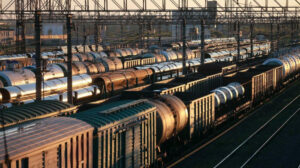
JSC “Ukrzaliznytsia” expects to post a net loss of 21.9 billion hryvnia and a liquidity shortfall of 26.3 billion hryvnia for 2026, assuming no fare indexation, said the company’s CEO, Oleksandr Pertsovskyi, during a press conference on Tuesday, according to a correspondent for the “Interfax-Ukraine” news agency.
According to him, among the main reasons for the deterioration in financial performance are a 2.4-fold increase in the cost of electricity, which led to additional expenses of 15.4 billion hryvnia; the need to index wages—13.4 billion hryvnia; a decline in revenue from freight transportation—7 billion hryvnia—due to hostilities and the occupation of parts of the territory; an increase in exchange rate losses from the revaluation of liabilities amounting to 3.8 billion hryvnia; and a 28% rise in diesel fuel prices, which cost the company an additional 2.1 billion hryvnia.
According to the company’s estimates, due to the suspension of fare indexation, the shortfall in cash receipts for the period from 2023 through the first three months of 2026 amounts to 99.5 billion UAH.
To cover this financial shortfall, Ukrzaliznytsia is implementing additional optimization measures for 2026, which will allow it to raise 1 billion UAH from the sale of non-core and surplus assets and 2.3 billion UAH in loans from international financial institutions, provided that fare indexation takes place.
Other measures include optimizing CAPEX, through which the company plans to accumulate 6.9 billion UAH by addressing the underfunding of critical capital investment needs. At the same time, internal funds for financing CAPEX in 2026 will amount to approximately 16.1 billion UAH.
A government decision is also required to resume, effective July 1, 2026, the sale of electricity to Ukrzaliznytsia through specialized auctions, with the introduction of a corresponding discount from the weighted average market price of electricity.
Other factors include a plan to increase suburban rail fares by 100%, though this requires approval from regional military administrations.
Among the proposed measures to stabilize Ukrzaliznytsia’s financial situation, the company also proposes raising freight rates by 30% effective August 1, 2026. The first phase involves an immediate rate increase and the standardization of rates for empty railcars.
Pertsovskyi emphasized that June is a critical period for making a decision on revising tariffs, as the regulatory procedure takes about two months.
“This is the last chance to make a decision before August, and by August we’ll simply be heading straight into the red at this pace. We still have a guaranteed debt payment due in August,” added the chairman of the board.
According to Pertsovskyi, a second phase could involve a further tariff adjustment of up to 15% starting in January 2027, though no such decision has been made yet.
As noted in the draft order, the need to adjust tariffs stems from the deteriorating financial condition of JSC “Ukrzaliznytsia,” whose revenues are insufficient to cover current expenses. The ministry noted that the last tariff adjustment took place nearly four years ago, while between July 2022 and April 2026, the industrial producer price index rose by 252.1%.
According to the Ministry of Development, in 2025, freight volumes decreased by 12.5% compared to the previous year, and Ukrzaliznytsia’s net loss amounted to 7.6 billion UAH. In the first four months of 2026, the loss reached 9.3 billion UAH.
At that time, the ministry noted that without tariff indexation, the company’s projected net loss for 2026 would exceed 13 billion hryvnia, and the funding shortfall would reach over 26 billion hryvnia.
Among other things, in January of this year, Ukrzaliznytsia refused to make $45 million in coupon payments on its 2026 Eurobonds with an 8.25% coupon rate totaling $703.2 million and on its 2028 Eurobonds with a 7.875% coupon rate totaling $351.9 million, and announced its intention to begin a comprehensive restructuring of its bond obligations with the assistance of financial and legal advisors.
The company cited the ongoing decline in revenue from freight transportation amid a decrease in freight volumes, as well as an increase in attacks on the railway—the total number of which in 2025 (1,195) exceeded the combined total for 2023–2024—as the main reasons for suspending debt service on the Eurobonds.
FARE, FREIGHT TRANSPORTATION, liquidity, LOSS, UKRZALIZNYTSIA
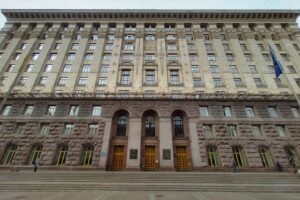
Kyiv plans to update public transportation fares: a single trip will cost 30 UAH, according to the press service of the Kyiv City State Administration (KCSA), which noted that a discount system will be in place for passengers who regularly use public transportation.
As reported on the KCSA’s Telegram channel on Monday, the cost of a single trip will depend on the number of trips purchased on the transit card. Thus, when purchasing 1–9 trips, the fare will be 30 UAH; 10–19 trips – 28.90 UAH; 20–29 trips – 27.80 UAH; 30–39 trips – 26.60 UAH; 40–49 trips – 25.50 UAH; 50 trips – 25 UAH.
Monthly passes are also available, with the cost of a single trip amounting to approximately 23.3–23.6 UAH. Discounted rates remain in place for students and schoolchildren: students will pay 50% of the monthly pass price; schoolchildren will ride for free during the school year and with a 75% discount in the summer.
Separately, there are plans to introduce a transfer ticket for 60 UAH, which will allow unlimited transfers between the metro and surface transit within 90 minutes.
The press service noted that fares in the capital have not been revised since 2018. The need to update fares is attributed to rising costs for electricity, fuel, labor, and maintenance of transportation infrastructure.
The new fares are scheduled to take effect on July 15, 2026, following the completion of regulatory procedures, as well as consultations with the public and labor unions.
As previously reported, starting January 1, 2022, Kyiv planned to raise public transit fares to 20 UAH, and to 12 UAH for holders of the Kyiv City Card.
In late 2021, Kyiv Mayor Vitali Klitschko assured that public transportation fares would not increase until the end of the heating season.
In 2023, Kyiv city officials stated that they do not intend to raise public transportation fares until the end of the war.
In September 2025, Mayor Klitschko stated that despite the fact that public transportation in Kyiv is subsidized, the city is looking for ways to avoid raising fares.
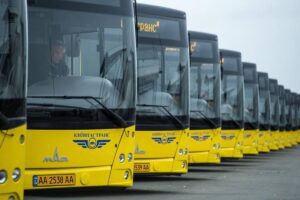
In the capital of Ukraine will return the fare in public transport, said the mayor of Kyiv Vitaliy Klitschko.
“We are already switching to paid travel in public transport,” Klitschko said on the air of the National Telethon on Tuesday.
At the same time, the mayor of the city did not specify when exactly the paid travel would resume, but noted that the price for it remains the same (UAH 8).
Klitschko explained the restoration of paid travel in public transport by the need to replenish the city budget.
“We understand that we now have a large amount of energy resources that we need, and electricity, and wages for our utilities, employees, and I can honestly say that the city will not pull, because the budget must be replenished,” the mayor said.
As reported, since February 24, due to the martial law associated with the military aggression of the Russian Federation, public transport in the capital has been free of charge.



