
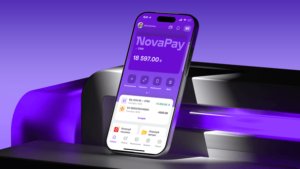
The international financial service “NovaPay” (TM NovaPay, issued by NovaPay Credit LLC) has registered and begun sales of its 16th issue of Series “P” corporate bonds with a face value of 200 million UAH.
According to the company’s press release, the 16th issue consists of 200,000 registered interest-bearing corporate bonds with a face value of 1,000 UAH each.
The interest rate on the “P” series bonds is 18% per annum, and maturity is scheduled for September 10, 2029.
The company emphasized that it plans to use the raised funds to further develop lending to individuals and businesses.
“For us, this is an effective tool for raising funds to develop our business, and for investors, it’s an opportunity to diversify their savings and earn additional income,” noted László Udut, NovaPay’s head of treasury, in the press release.
According to data from the financial service, more than 8,500 customers became bondholders, while total sales exceeded 5.1 billion UAH.
NovaPay noted that it had redeemed three bond issues with a total face value of 300 million UAH. These include Series “C” (maturing in September 2025), Series “A” (maturing in April 2026), and Series “B” (maturing in July 2026).
NovaPay was founded in 2001 as an international financial service provider, part of the Nova Group (“Nova Poshta”), and offers financial services both online and offline at “Nova Poshta” branches. In 2023, the company became the first non-bank financial institution in Ukraine to receive an expanded license from the NBU, which allowed it to open accounts and issue cards.
In July, the National Securities and Stock Market Commission registered NovaPay’s 15th issue of “O” series bonds with a face value of 200 million UAH. In early June, the company announced the full placement of its 14th “N” series issue of the same volume.
Based on the results of the first half of 2026, NovaPay Credit increased its net profit 3.2-fold compared to the same period in 2025—to 172.01 million UAH—and its revenue 2.2-fold, to 586.42 million UAH.
The company’s equity as of the end of June stood at 688.5 million UAH, compared to 516.5 million UAH at the beginning of the year, while liabilities totaled 1.69 billion UAH, compared to 1.37 billion UAH.
The company’s proceeds from bond sales during this period rose to 693 million UAH from 355.63 million UAH a year earlier, while expenses related to their redemption increased to 578.80 million UAH from 244.92 million UAH, respectively.
On October 22–23, Kyiv will host the 24th Ukrainian CFO Forum—the premier professional event for CFOs, CEOs, business owners, investors, and heads of key business functions.
Interfax readers can take advantage of a special offer: 15% off registration using the promo code BraveInterfax
This year’s program focuses on the decisions Ukrainian companies must make today as they develop their financial models and strategies for 2027 amid the war and high uncertainty. The Forum’s two-day program will feature 16 hours of professional content: 10 sessions in the form of panel discussions, interviews, and practical case studies featuring over 50 speakers from market-leading companies.
Ukrainian businesses are entering the 2027 planning cycle without a single baseline scenario. Destruction and loss of assets, attacks on energy and logistics infrastructure, high cost of capital, labor shortages, regulatory changes, and the acceleration of digital transformation are shortening the planning horizon and constantly changing the conditions under which businesses must make decisions.
For CFOs, this means simultaneously ensuring liquidity and business continuity, revising financial models, managing capital and risks, and not postponing investment and transformation decisions on which the company’s future depends.
The program of the Ukrainian CFO Forum 2026 is dedicated to these very issues—from the 2027 financial model and capital management to decisions following asset losses, adaptive planning, digital transformation, and the interaction between the CFO, CEO, and owner.
The 24th Ukrainian CFO Forum will bring together over 700 participants—CFOs of leading companies in the Ukrainian market, CEOs, business owners, international business executives, and representatives of banks, investment funds, technology companies, and government institutions.
▪️ The 2027 Financial Model: What to Include in the Budget When There Is No Base Case Scenario. Scenarios, triggers for revising the financial model, the cost of money, access to capital, and foreign exchange regulations. The forum will open with a strategic dialogue between Serhiy Nikolaychuk, First Deputy Governor of the NBU, and Andriy Dligach, founder and chairman of Advanter Group.
▪️ Business After Asset Loss: Rebuild or Restructure the Model. Replacement CAPEX, relocation, asset decentralization, recovery financing, insurance, and compensation for war risks. Practical experience will be shared by Rozetka-EVO, Nova Poshta, VARUS, Biosphere Corporation, Starlight Media, and Philip Morris Ukraine.
▪️ Strategy in the Face of Uncertainty: Decisions a CEO Must Still Make for Years to Come. Investments, scaling, production, team, and logistics amid a constantly shifting planning horizon. Panelists: Odgers Ukraine, Imperial Brands Ukraine, YASNO, and BGV Group Management.
▪️ Adaptive Planning: How to Manage a Business When the Annual Budget Is No Longer a Reliable Guide. Scenario planning, rolling forecasts, CAPEX, OPEX, liquidity, and working capital. Practical approaches will be presented by KSE, Danone, British American Tobacco Ukraine, FOKSTROT, and Metinvest Group.
▪️ Digital transformation with measurable business results. ERP, AI in finance, SAF-T UA, and data quality through the lens of deadlines, budget, and financial impact. The program features case studies from Farmak / Business Evolution, MTI, “Avtomagistral-Pivden” / SMART business, British American Tobacco Ukraine / Innoware, ALVIVA GROUP / ABM Cloud, D.TRADING / IT-Enterprise, and EBS.
Specific practical sessions at the Forum will focus on capital and liquidity management, identifying “hidden EBITDA” without new CAPEX, human capital, financial monitoring, and the CFO’s interaction with the CEO and owner.
“For CFOs, 2027 begins right now. Businesses cannot wait for certainty to emerge: decisions must be made today on whether to restore an asset or restructure the business model, invest in CAPEX or preserve liquidity, where to raise capital, and what scenarios to factor into the budget. That is why this year we are structuring the forum’s program around concrete solutions and case studies from companies that are already navigating these dilemmas,” — Ihor Solovykh, CEO of FAService and organizer of the Ukrainian CFO Forum.
The Ukrainian CFO Forum 2026 program features CFOs and CEOs of market-leading companies, representatives of the National Bank of Ukraine (NBU), and leading experts from major Ukrainian and international companies. Participants will receive up to 16 ACCA CPD units for attending the Forum.
Event partners: Pivdenny Bank, Odgers Ukraine, PUMB, Innoware, Done, SMART business, EBS, Business Evolution, Payoneer, IT-Enterprise, Advance Finance Alliance, Vchasno, ABM Cloud, ACCA, Silpo Voyage Pro, Bayadera Group, CFO Club, CEO Club, Board.
Main media partner: Starlight Media.
Ukrainian CFO Forum 2026 | October 22–23 | Kyiv + online
A special offer is available for Interfax readers through October 9: 15% off registration with the promo code BraveInterfax
Details and registration: cfo.ua/cfoforum
The Ukrainian CFO Forum is organized by FAService.
https://cfo.ua/cfoforum/?utm_source=Interfax&utm_medium=website&utm_campaign=cfoforum2026
Open4Business is the forum’s information partner.

According to Fixygen, the European Central Bank must begin working with blockchain infrastructure itself in order to preserve the role of central bank money in the new financial system, said ECB Executive Board member Isabel Schnabel.
According to her, central banks must effectively “go on-chain” by providing tokenized central bank money for settlements involving assets on distributed ledgers.
The ECB is already developing the Pontes and Appia projects.
Pontes is intended to connect the existing European payment infrastructure with blockchain platforms, while Appia is exploring a longer-term architecture for a tokenized financial market.
This is a separate project from the retail digital euro.
The main target audience consists of banks, funds, and financial companies that need to settle transactions involving tokenized bonds, funds, and other assets using real central bank money.
If such an infrastructure becomes operational, blockchain will cease to be exclusively a cryptocurrency technology and will, in fact, become one of the settlement layers of the traditional capital market.

Iryna Starominska, Chairwoman of the Board of JSC “UNIVERSAL BANK,” was named the winner of the “Financier of the Year” category as part of the 30th anniversary nationwide “Person of the Year 2025” program.
Starominska has over 25 years of professional experience, the last 16 of which she has spent in leadership roles in the banking sector. She has headed Universal Bank since 2017.
One of the bank’s key projects during this period was the 2017 launch, in collaboration with the Fintech Band team, of the digital banking service monobank, which operates under Universal Bank’s banking license.
As of early June 2026, the monobank ecosystem had over 10.7 million customers, making it one of Ukraine’s largest digital financial services. The project has also been included twice in CNBC’s “Top 250 Fintech Companies in the World” ranking.
The development of monobank has become one of the most notable examples of the transformation of the Ukrainian banking market, where traditional banking infrastructure has been combined with remote services and mobile financial technologies.
Universal Bank is listed among Ukraine’s systemically important banks. According to information provided by the organizers of the “Person of the Year” program, as of the end of 2025, the bank ranked third in Ukraine in terms of retail deposits and second in terms of its retail loan portfolio, and was also among the top five most profitable Ukrainian banks.
For five years, Starominska has also been ranked among the most influential women in Ukraine’s fintech sector. In her management role, she focuses on the development of digital banking services, the automation of operations, and the implementation of technological solutions for retail customers.
Charitable and social projects remain a separate area of activity for Universal Bank and monobank. According to data provided by the award organizers, from the start of the full-scale invasion through April 2026, the total amount of charitable aid provided by the bank and its team exceeded 497 million UAH.
Of this amount, approximately 386 million UAH was allocated to support the Armed Forces of Ukraine, military units, and charitable foundations that assist the army. Another approximately 111 million UAH was allocated to cultural and social projects. The bank also participates in charitable initiatives alongside the UNITED24 fundraising platform and other foundations.
Universal Bank operates in the Ukrainian banking market as a universal financial institution serving both individuals and businesses. Since 2017, the bank has been a partner of Fintech Band in the development of monobank. The bank is part of the TAS Group and is included in the list of systemically important banks in Ukraine.
Open4Business is an information partner of the nationwide “Person of the Year 2025” program.
BANK, FINANCE, FINTECH, MONOBANK, UKRAINE, UNIVERSAL BANK, Старомінська

According to Fixygen, the line between traditional banks and the crypto industry is rapidly blurring. In March 2026, Kraken Financial received a Federal Reserve master account, becoming the first digital bank with direct access to the U.S. payment infrastructure.
Kraken already operates as a special-purpose bank in Wyoming and, at the same time, holds over 100 active regulatory licenses in more than 30 countries.
On the other hand, traditional banks are exploring the possibility of issuing their own stablecoins and tokenized deposits. JPMorgan is studying the possibility of issuing a stablecoin, and similar projects are being discussed by Bank of America, Wells Fargo, and other banks.
Even crypto companies are beginning to obtain federal banking licenses: in August, the U.S. OCC granted World Liberty Financial preliminary approval to establish a national trust bank to handle stablecoins and store assets.
As a result, in a few years, the distinction between a “bank” and a “crypto exchange” may no longer be defined by the range of services offered.
Both sides aim to provide services such as asset custody, payments, stablecoins, trading, tokenized securities, credit products, and international settlements.
The main battle will center on who can keep customers within their own financial infrastructure—JPMorgan, Coinbase, Kraken, or the new digital banks.

Ukraine’s ten largest microfinance organizations reported combined revenue of 12.78 billion hryvnia and earned 1.16 billion hryvnia in net profit for the first half of 2026.
These figures were released by OpenDataBot on September 1.
Ukr Credit Finance, which operates under the CreditKasa brand, generated the highest revenue among MFOs—1.99 billion UAH. It accounted for approximately 16% of the total revenue of the top ten.
Second place in terms of revenue went to FC “Ye Hroshi” with 1.85 billion UAH, and third place went to “Spozhyvchiy Tsentr,” operating under the “ShvidkoHroshi” brand, with 1.52 billion UAH.
Next came “Aventus Ukraine” (CreditPlus) with revenue of 1.42 billion UAH, Miloan with 1.17 billion UAH, MyCredit with 1.08 billion UAH, “Bizpozika” with 1.07 billion UAH, Credit7 with 1.05 billion UAH, Moneyveo with 0.85 billion UAH, and Selfie Credit with 0.78 billion UAH.
In terms of profit, “Spotzhyvchyi Tsentr” took the lead with 361.3 million UAH. This represents about one-third of the combined profit of the ten largest MFIs. “Aventus Ukraine” came in second with 233.4 million UAH, and “Ukr Credit Finance” came in third with 172.6 million UAH.
The sector’s financial indicators are growing rapidly amid rising household debt. As of July 1, 2026, Ukrainians owed MFIs 32.32 billion UAH, which is 17% more than at the beginning of the year.



