
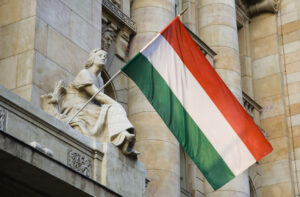
Ukrainians’ attitudes toward Hungary have improved significantly compared to March 2026, but negative views still outnumber positive ones. In August, 22.9% of respondents viewed the country positively, 35.6% negatively, and another 37.4% took a neutral stance. This is evidenced by the results of the third wave of a survey conducted by Active Group and Experts Club, according to the Experts Club Information and Analytical Center. Experts.news
According to the results of the August survey, 6.3% of Ukrainians view Hungary entirely positively, while 16.6% view it mostly positively. A neutral attitude was expressed by 37.4% of respondents. At the same time, 28.8% view the country mostly negatively, 6.8% view it entirely negatively, and another 4.1% were undecided.
The balance of positive and negative assessments in August stands at minus 12.7 percentage points. Based on this indicator, Hungary remains among the countries with a negative balance of public opinion; however, the trend over the past five months has shifted significantly in a positive direction. In the survey’s overall ranking, China had a lower balance in August at minus 25.4 percentage points, and India at minus 14.3 percentage points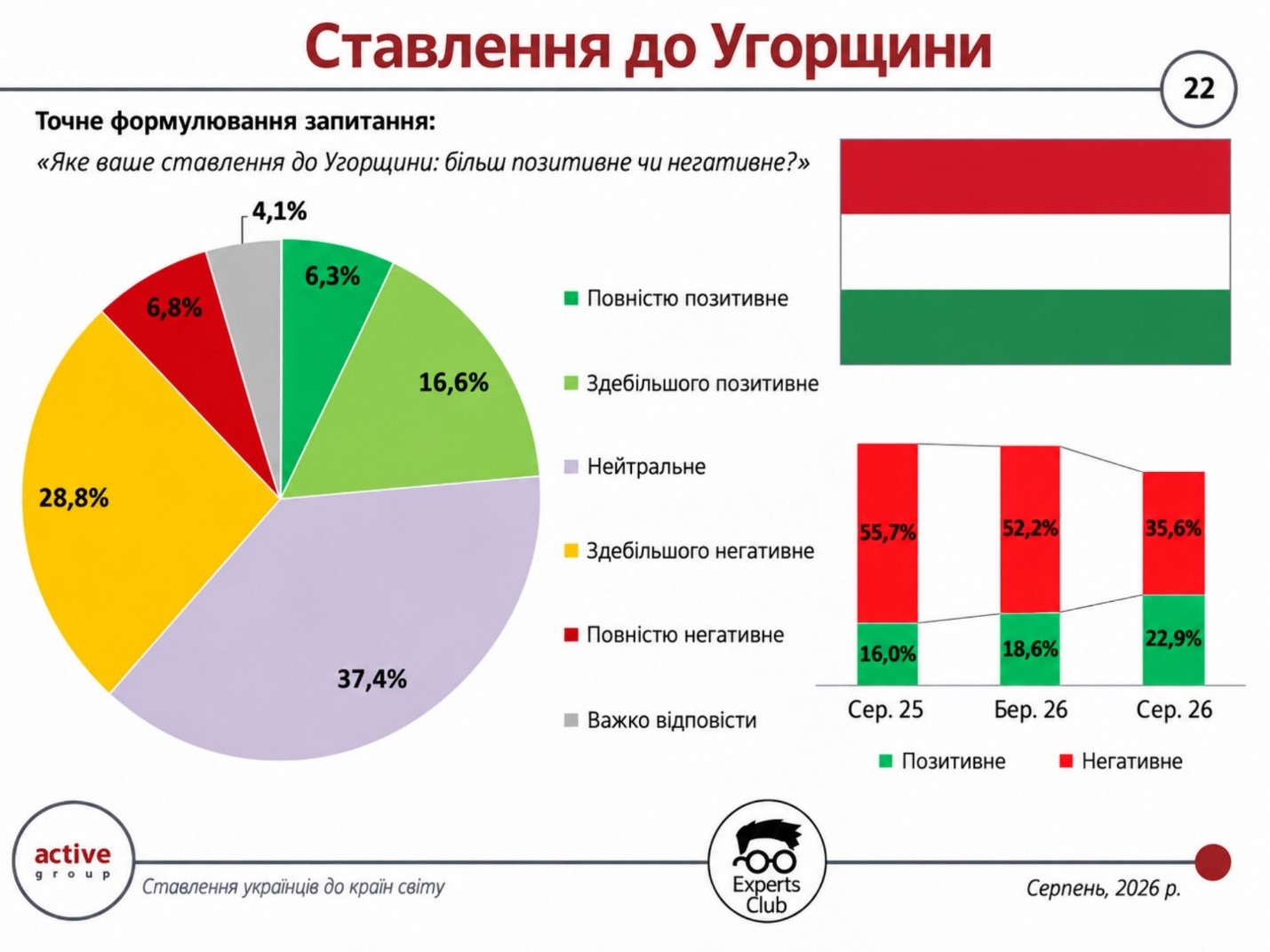
In March 2026, the situation was noticeably more negative. At that time, 4.9% of respondents viewed Hungary entirely positively, and 13.8% viewed it mostly positively—meaning that positive assessments totaled 18.6%. A total of 52.2% of respondents viewed the country negatively: 34.3% viewed it mostly negatively and 17.9% viewed it entirely negatively. 27.3% held a neutral position.
Thus, between March and August, the share of positive assessments increased by 4.3 percentage points—from 18.6% to 22.9%—while negative assessments fell by 16.6 percentage points—from 52.2% to 35.6%. At the same time, the share of neutral responses rose by 10.1 percentage points—to 37.4%.
The shift in the balance is even more pronounced: in March, it stood at minus 33.6 percentage points, and in August, at minus 12.7 percentage points. Thus, the gap between positive and negative assessments narrowed by 20.9 percentage points. At the same time, a significant portion of the former negative sentiment did not directly shift to positive assessments—it was the group of respondents with a neutral attitude that increased significantly.
Oleksandr Pozniy, director of the research company Active Group, commenting on previous waves of the survey, drew attention to the connection between public assessments and international politics as well as perceptions of support for Ukraine.
“This survey confirms the general trend in public sentiment in Ukraine, which has intensified since the start of the full-scale war. Ukrainians clearly associate the support received primarily from European Union countries and the United Kingdom with a positive attitude toward them,” Pozniy noted. Speaking specifically about Hungary, he emphasized: “These results are not surprising—the official rhetoric from Budapest and Bratislava often diverges from Ukraine’s interests and is viewed as pro-Russian, which inevitably influences public opinion.”
The new wave shows a significant softening in assessments of Hungary compared to March. At the same time, it is still too early to speak of a predominantly positive perception: negative responses remain about one and a half times more common than positive ones, and respondents with a neutral attitude now constitute the largest single group.
The survey was conducted in August 2026 using an online self-administered questionnaire via the SunFlowerSociology panel among 800 Ukrainian citizens aged 18 and older. The sample is representative by age, gender, and region; the maximum theoretical margin of error for indicators at the 50% confidence level is ±3.5 percentage points.
ACTIVE GROUP, EUROPE, EXPERTS CLUB, HUNGARY, international relations, Pozniy, PUBLIC OPINION, SOCIOLOGY, UKRAINE

Italy continues to enjoy one of the highest levels of positive perception among Ukrainians: in August 2026, 70.1% of respondents viewed the country positively, while only 2.9% viewed it negatively. Compared to March, the overall share of positive assessments remained virtually unchanged; however, within this group, there was an increase in the number of respondents with an unequivocally positive attitude. This is evidenced by the results of a study conducted by Active Group and Experts Club, according to the Experts Club Information and Analytical Center.
According to the results of the August survey, 24.3% of Ukrainians have a completely positive attitude toward Italy, and 45.8% have a mostly positive attitude. Twenty-five percent of respondents hold a neutral position. Two point seven percent view the country mostly negatively, only 0.2% completely negatively, and another 2% were undecided.
The balance of positive and negative assessments stands at plus 67.2 percentage points. Based on this indicator, Italy ranks among the countries with the highest level of positive attitudes among Ukrainians and holds a high position among the nations of Western and Southern Europe.
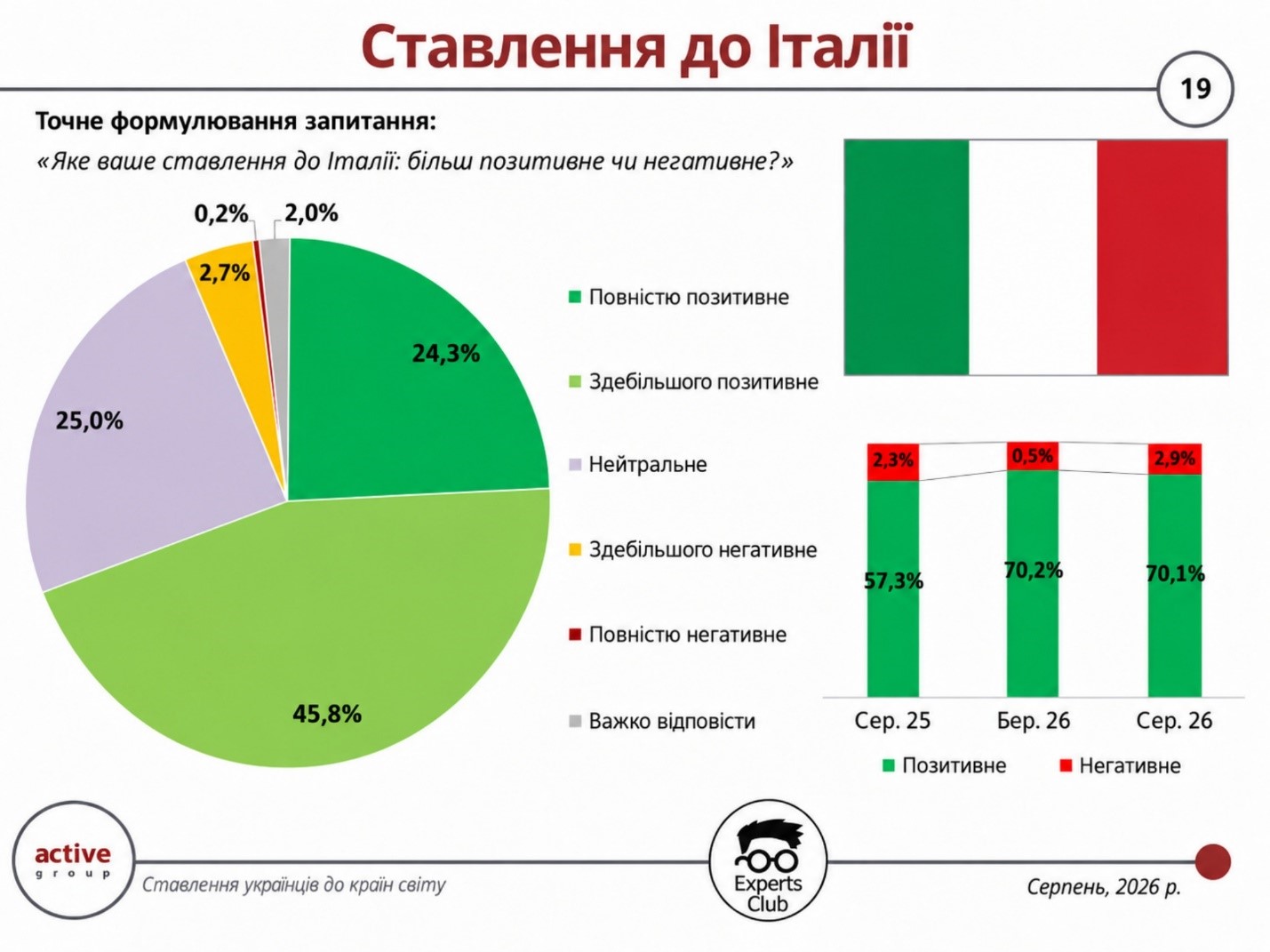
In March 2026, the total share of positive assessments of Italy stood at 70.2%. At that time, 19.3% of respondents described their attitude as entirely positive, and 50.8% as mostly positive. 28.9% had a neutral attitude toward the country, while only about 0.5% had a negative one.
Thus, the overall level of positive attitudes has remained virtually unchanged over the past five months—at around 70%. At the same time, the share of entirely positive assessments rose by approximately 5 percentage points—from 19.3% to 24.3%—while the share of mostly positive assessments fell by roughly the same 5 percentage points. This indicates a certain increase in the intensity of positive perceptions among a segment of respondents.
At the same time, the share of neutral assessments fell from 28.9% to 25%, while negative assessments rose to 2.9%. As a result, the balance of positive and negative attitudes declined from approximately plus 69.7 percentage points in March to plus 67.2 percentage points in August, though it remains very high.
“The consistently high level of positive attitudes among Ukrainians toward Italy is important not only in terms of public sentiment but also in the context of economic ties between the two countries. Italy remains one of Ukraine’s key trading partners in Europe, and a positive perception of the country creates a favorable backdrop for the development of business contacts, investments, tourism, and humanitarian cooperation. It is particularly telling that the share of unequivocally positive assessments is growing, even though the overall level of favorability has remained very high for quite some time,” noted Maksym Urakin, founder of the Experts Club information and analytical center.
Italy also carries significant economic weight for Ukraine. In the first half of 2026, it ranked third among individual countries in terms of the volume of Ukrainian goods exports—approximately $1.28 billion. The high level of public favor is thus combined with significant trade and economic ties.
A new wave of the survey shows that this positive image has generally been maintained: about seven out of ten Ukrainians continue to view Italy positively, and the share of unequivocally positive responses has even increased.
The survey was conducted in August 2026 using self-administered online questionnaires in the SunFlowerSociology panel among 800 Ukrainian citizens aged 18 and older. The sample is representative by age, gender, and region; the maximum theoretical margin of error is ±3.5 percentage points.
ACTIVE GROUP, EXPERTS CLUB, FOREIGN TRADE, international relations, ITALY, PUBLIC OPINION, SOCIOLOGY, UKRAINE, URAKIN
According to Experts Club, Ukrainians’ attitudes toward Algeria in August 2026 remain predominantly neutral—65.8% of respondents hold this view. At the same time, compared to March, the share of positive assessments has increased significantly—to 14.3%, while negative assessments have risen to 12.2%, reports the Experts Club Information and Analytical Center.
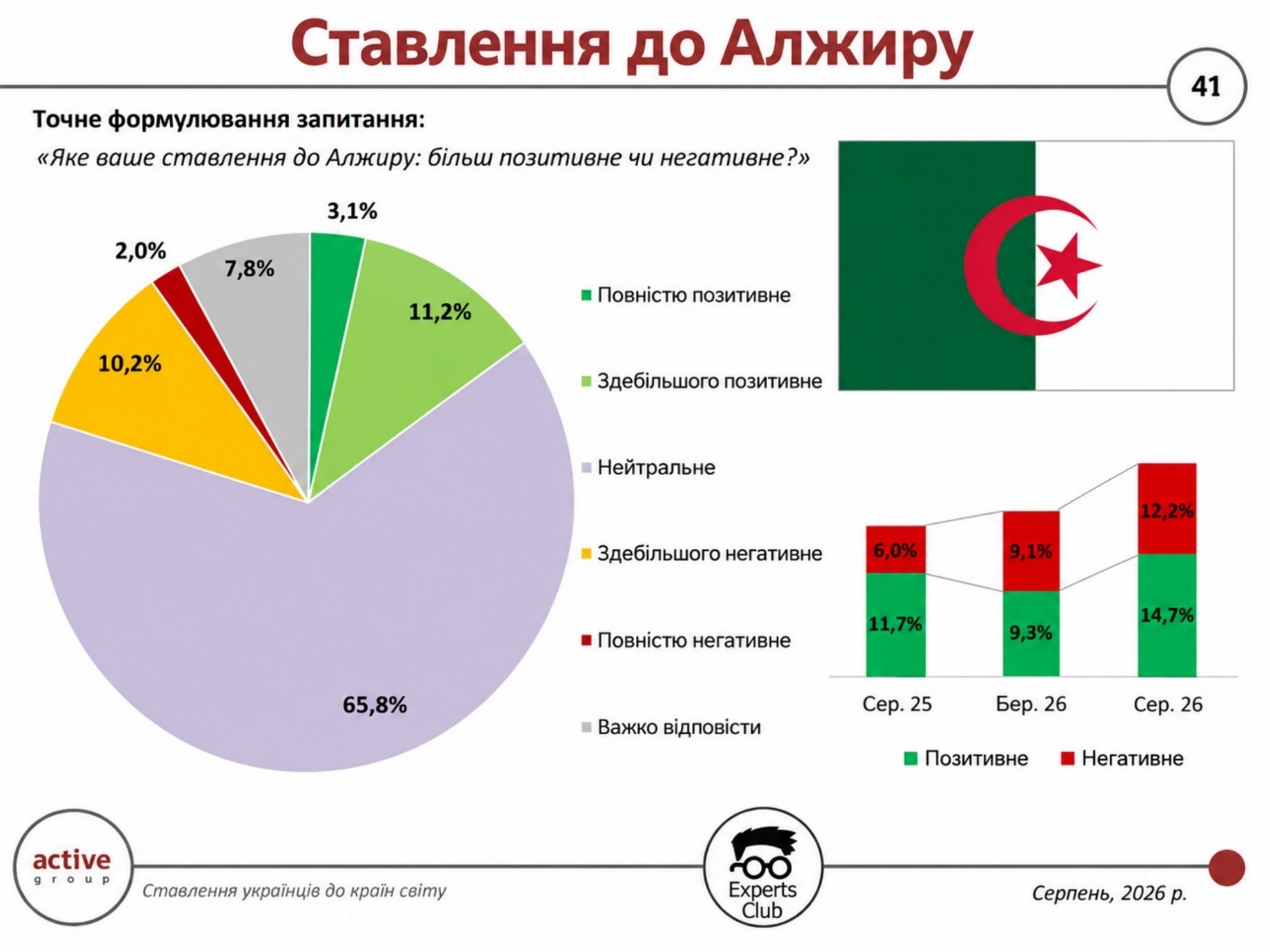
According to the results of the August survey, 3.1% of Ukrainians have a completely positive attitude toward Algeria, while 11.2% have a mostly positive attitude. 65.8% of respondents chose a neutral response. 10.2% expressed a mostly negative attitude, 2% a completely negative one, and another 7.8% were undecided.
Based on rounded figures, the balance between positive and negative assessments stands at approximately plus 2.1 percentage points. Thus, positive assessments only slightly outweigh negative ones, and the main characteristic of perceptions of Algeria remains the high proportion of neutral responses.
In March 2026, public opinion was even less defined. At that time, 74.1% of respondents had a neutral attitude toward Algeria. The overall positive rating in the survey was 9.3%, the negative rating was 9.1%, and 7.5% of respondents were undecided.
Thus, over the course of five months, the share of positive assessments increased by approximately 5 percentage points—to 14.3%—while the share of negative assessments rose by 3.1 percentage points, to 12.2%. The most notable change was the decline in the neutral segment—by 8.3 percentage points, from 74.1% to 65.8%. At the same time, the balance of attitudes rose from approximately plus 0.2 percentage points to plus 2.1 percentage points.
This trend indicates the gradual formation of a more defined attitude toward Algeria: some respondents who previously held a neutral position have shifted to either the positive or negative segments. At the same time, nearly two-thirds of Ukrainians still do not express a clear emotional assessment of the country.
Algeria is one of Ukraine’s trading partners with which it maintains a significant trade surplus. In the first half of 2026, Ukrainian exports to Algeria totaled approximately $388.6 million, imports amounted to $79.3 million, and the trade surplus was about $309.2 million. Agricultural products form the bulk of Ukrainian exports to this market.
Maksym Urakin, founder of the Experts Club information and analytical center and a candidate of economic sciences, has previously drawn attention to the gap between the general public’s limited awareness of Algeria and the actual economic interaction between the two countries.
“Despite relatively weak public interest, Ukraine and Algeria have a significant level of trade interaction. In 2025, bilateral trade exceeded $401 million,” Urakin noted.
He also emphasized that the significant surplus of Ukrainian exports over imports creates an economic foundation for the further development of bilateral relations.
The latest wave of the study shows that public perception of Algeria is gradually becoming more defined, but so far lags significantly behind the country’s actual economic role. Despite a trade surplus favorable to Ukraine, nearly 66% of respondents continue to view Algeria neutrally.
The previous survey was conducted in March 2026 among 800 Ukrainian citizens aged 18 and older using self-administered online questionnaires on the SunFlowerSociology panel. The sample was representative by age, gender, and region; the maximum theoretical margin of error for indicators at the 50% confidence level was ±3.5 percentage points.
ACTIVE GROUP, ALGERIA, EXPERTS CLUB, FOREIGN TRADE, international relations, NORTH AFRICA, PUBLIC OPINION, SOCIOLOGY, UKRAINE
Germany remains one of the countries with a high level of positive perception among Ukrainians; however, in August 2026, this figure dropped significantly compared to the previous survey wave. According to the results of a survey by Active Group and Experts Club, 69.9% of respondents have a positive attitude toward Germany, while 5.5% have a negative one, reports the Experts Club Information and Analytical Center.
According to the August survey, 26.8% of Ukrainians view Germany entirely positively, and 43.1% view it mostly positively. A neutral stance was held by 23.5% of respondents. A mostly negative attitude was expressed by 4.9%, a completely negative one by 0.6%, and another 1.2% were undecided.
The balance of positive and negative assessments stands at plus 64.4 percentage points. This keeps Germany among the countries with a distinctly positive perception, although the figure is lower compared to previous surveys. In August 2026, Germany ranked behind France and the Netherlands among Western European countries in terms of the share of positive attitudes.
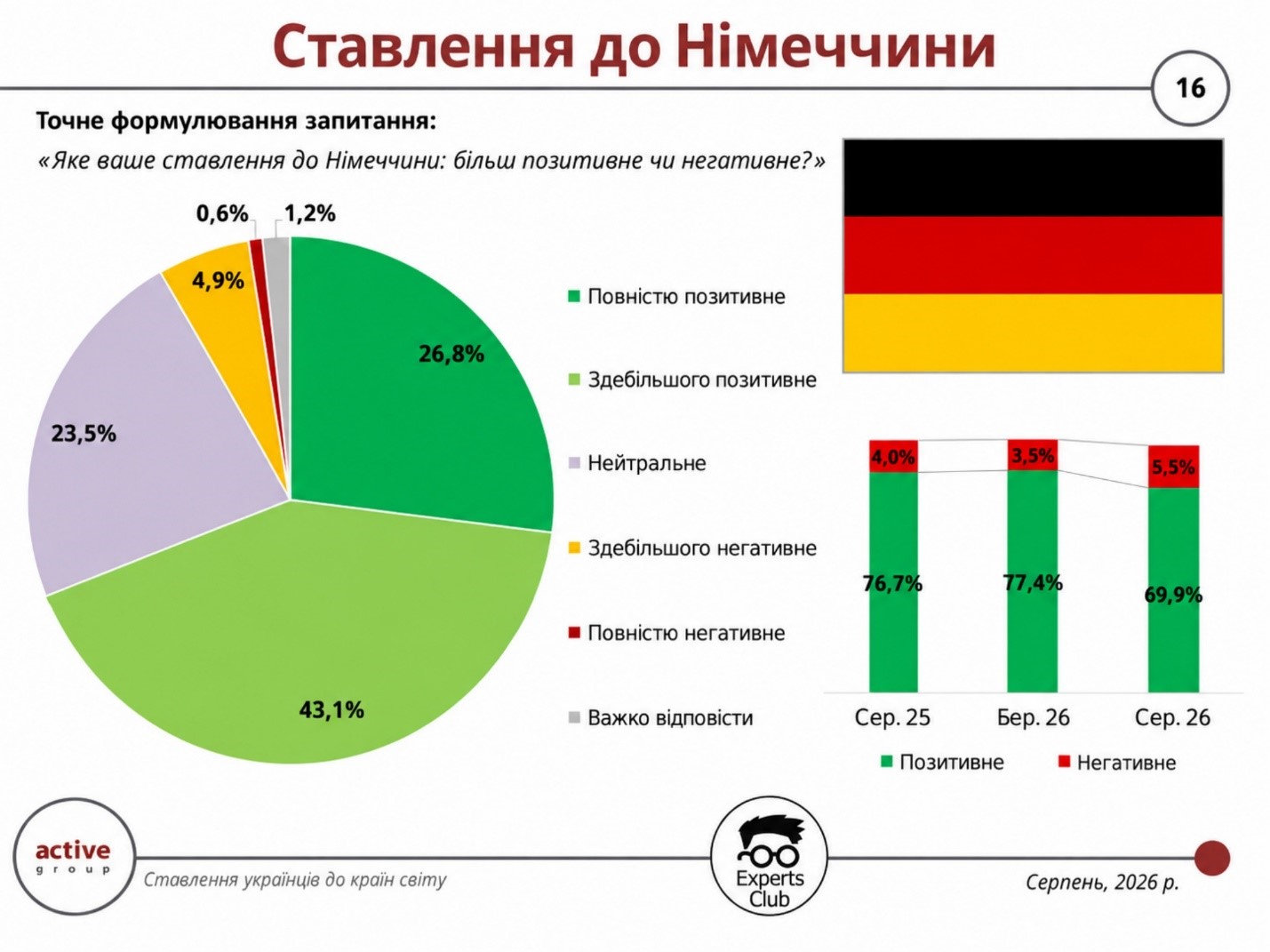
In March 2026, 77.4% of respondents viewed Germany positively: 32.9% viewed it entirely positively and 44.5% viewed it mostly positively. Negative assessments accounted for only 3.5%, while 18.4% of respondents chose a neutral response.
Thus, over the course of five months, the share of positive assessments decreased by 7.5 percentage points—from 77.4% to 69.9%—while negative assessments increased by 2 percentage points—from 3.5% to 5.5%—and neutral assessments rose by approximately 5.1 percentage points. The balance between positive and negative assessments fell from 73.9 to 64.4 percentage points. However, positive attitudes still outnumber negative ones by nearly 13 to 1.
At the same time, Germany remains one of Ukraine’s largest trading partners. In the first half of 2026, Ukrainian exports to Germany totaled approximately $1.267 billion, imports amounted to $3.208 billion, and total trade volume reached about $4.48 billion. The trade deficit for Ukraine amounted to approximately $1.94 billion. Ukraine’s main exports included cable products, rapeseed, furniture, soybeans, and metal pipes, while imports from Germany consisted of automobiles, pharmaceuticals, petroleum products, and agricultural machinery.
Oleksandr Pozniy, director of the research firm Active Group, commenting on Ukrainians’ high regard for Germany in the previous wave of the survey, attributed it to a combination of factors that go beyond purely economic relations.
“Germany is viewed as a strategic ally in the political and security spheres. Hundreds of thousands of Ukrainian refugees have found shelter there, and large-scale financial and military aid plays a key role in the resilience of our state. The combination of these factors explains why more than three-quarters of Ukrainians view Germany positively and why this country remains among the undisputed leaders in terms of trust within our society,” Pozniy noted.
The new wave of the survey shows that the level of positive attitudes toward Germany has declined compared to the spring, but there has been no fundamental change in the structure of public opinions: positive responses continue to significantly outnumber negative ones, and the main increase occurred not in the category of negative attitudes but in that of neutral ones.
The survey was conducted in August 2026 using an online self-administered questionnaire via the SunFlowerSociology panel among 800 Ukrainian citizens aged 18 and older. The sample is representative by age, gender, and region; the maximum theoretical margin of error for indicators at the 50% confidence level is ±3.5 percentage points.
ACTIVE GROUP, EXPERTS CLUB, FOREIGN TRADE, GERMANY, international relations, Pozniy, PUBLIC OPINION, SOCIOLOGY, UKRAINE
Turkey continues to enjoy a predominantly positive perception among Ukrainians: in August 2026, a total of 52.3% of respondents expressed a positive attitude toward the country, while about 7.5% expressed a negative one. At the same time, compared to the previous survey in March, the share of positive assessments has decreased slightly. This is evidenced by the results of the third wave of the Active Group and Experts Club survey, according to the Experts Club Information and Analytical Center.
According to the results of the August survey, 11.2% of Ukrainians have a completely positive attitude toward Turkey, and 41.1% have a mostly positive attitude. A neutral stance is held by 37.6% of respondents. 6.7% view the country mostly negatively, 0.8% view it entirely negatively, and another 2.7% were undecided.
The balance between positive and negative attitudes stands at approximately plus 44.9 percentage points and is the highest among the Middle Eastern countries included in the study. Thus, despite a slight decline in the indicator, Turkey remains a country where positive assessments clearly outweigh negative ones.
Compared to March 2026, positive attitudes have weakened moderately. At that time, 14.5% of respondents viewed Turkey entirely positively, and 40.6% viewed it mostly positively—meaning the combined positive rating stood at 55%. Negative responses accounted for 5.6%, and neutral responses for 36.4%.
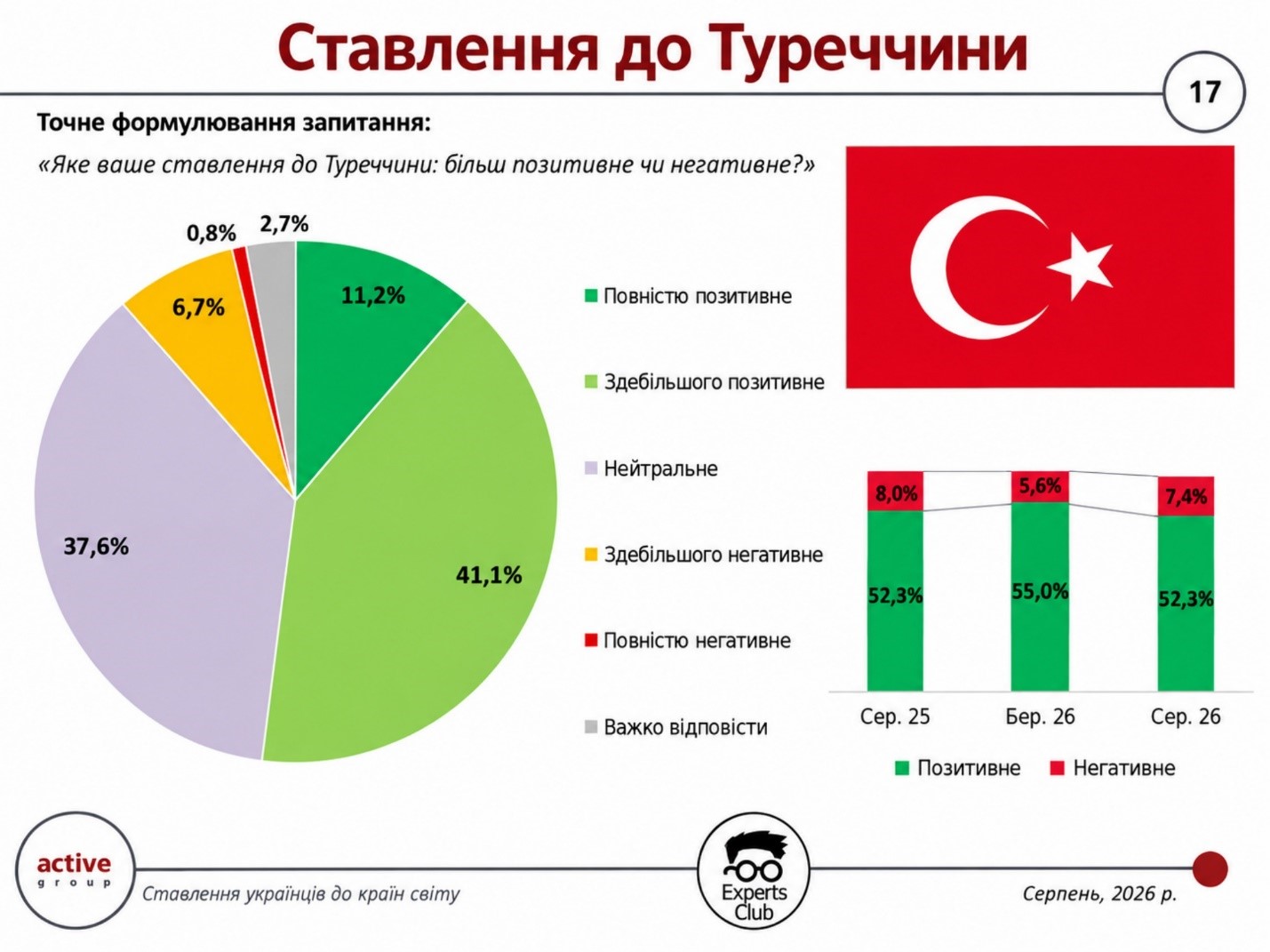
Thus, over the course of five months, the total share of positive assessments decreased by 2.7 percentage points—from 55% to 52.3%. Negative attitudes, on the other hand, increased by approximately 1.9 percentage points, while the share of neutral responses rose by 1.2 percentage points. The balance between positive and negative responses fell from 49.4 percentage points in March to about 44.9 percentage points in August. This indicates a moderate cooling of assessments rather than a fundamental shift in attitude.
Turkey remains one of Ukraine’s largest trading partners. In the first half of 2026, bilateral trade volume approached $4.9 billion: Ukrainian exports totaled about $1.78 billion, while imports amounted to $3.12 billion. Turkey was the second-largest single market for Ukrainian goods after Poland, and Ukraine’s bilateral trade deficit stood at about $1.34 billion.
Maksym Urakin, Ph.D. in Economics and founder of the Experts Club information and analytical center, commenting on the relationship between the economy and public perception of trading partners, noted:
“If society sees a massive flow of imports coming into the country but does not see a corresponding flow of investment, technology, or localized production, a sense of imbalance arises. And this directly affects the emotional perception of the partner. That is precisely why countries with a large trade surplus with Ukraine should pay particular attention to the reputational aspect of their presence in the Ukrainian market,” Urakin noted.
In the case of Turkey, the survey results show that a significant trade imbalance is currently combined with a predominantly positive public perception. At the same time, trends between March and August indicate a gradual decline in the predominance of positive assessments.
The survey, conducted in August 2026, used self-administered online questionnaires from the SunFlowerSociology panel among 800 Ukrainian citizens aged 18 and older. The sample is representative by age, gender, and region; the maximum theoretical margin of error is ±3.5 percentage points.
ACTIVE GROUP, EXPERTS CLUB, FOREIGN TRADE, international relations, PUBLIC OPINION, SOCIOLOGY, TURKEY, UKRAINE, URAKIN
According to Experts Club, Egypt has the highest level of positive sentiment among Ukrainians among the North African countries included in the study: 28.2% of respondents view it positively, and the net positive rating stands at 21.4 percentage points. At the same time, neutral assessments dominate perceptions of all four countries in the region—their share ranges from 59.3% to 67.3%. This is evidenced by the results of the third wave of the study “Ukrainians’ Attitudes Toward Countries Around the World,” conducted by Active Group in collaboration with Experts Club, reports the Experts Club Information and Analytical Center.
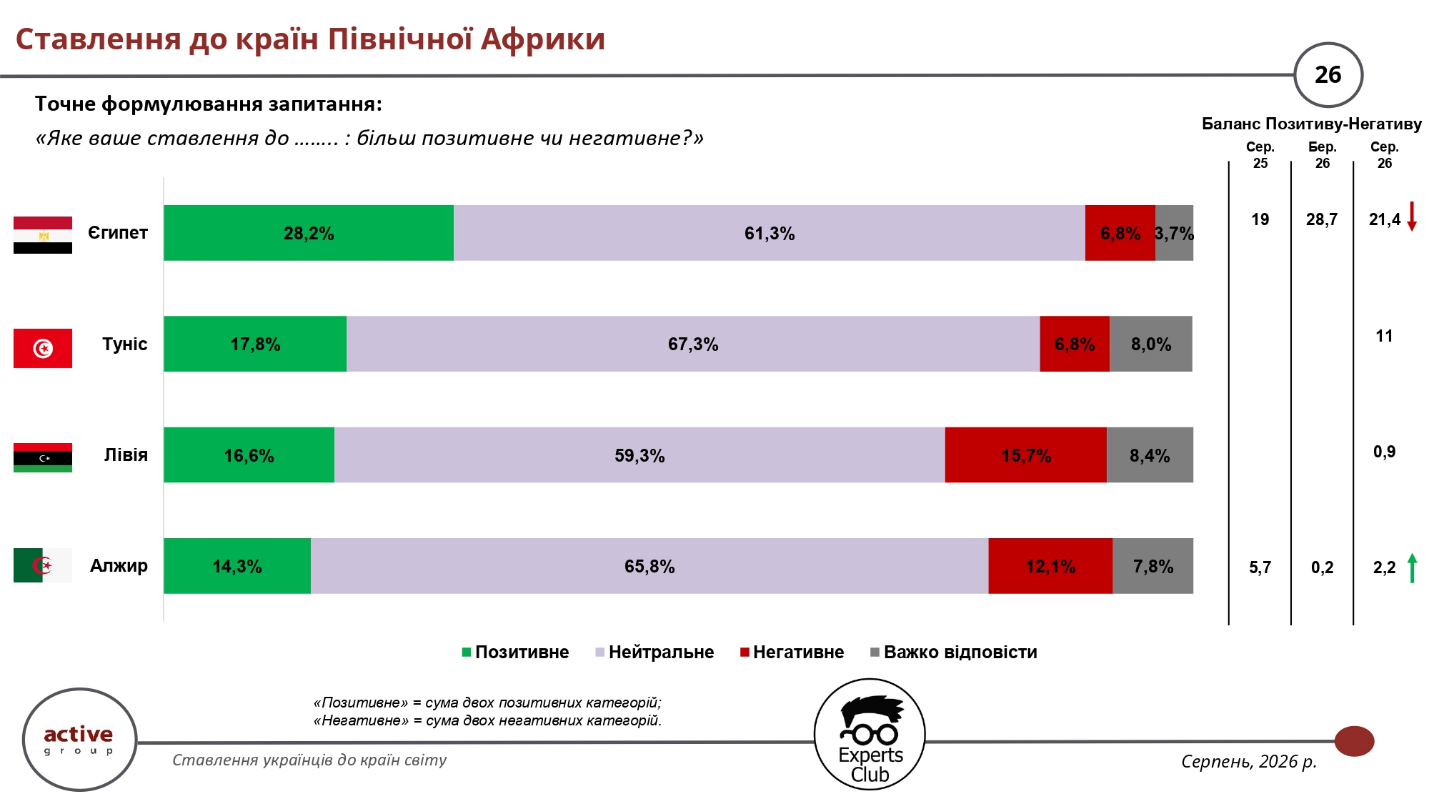
28.2% of Ukrainians surveyed view Egypt positively, 61.3% neutrally, 6.8% negatively, and another 3.7% were undecided. The balance of positive and negative assessments in August 2026 stood at 21.4 percentage points, compared to 28.7 percentage points in March and 19 percentage points in August 2025. Thus, following a spring increase, the indicator has declined but remains slightly higher than it was a year ago.
Neutral attitudes toward Tunisia predominate—67.3% of respondents expressed this view. 17.8% view the country positively, 6.8% negatively, and another 8% were undecided. The balance stands at plus 11 percentage points, placing Tunisia in second place among the North African countries surveyed.
In Libya, positive and negative assessments are virtually equal: 16.6% of respondents view the country positively, 15.7% negatively, and 59.3% neutrally. Accordingly, the balance is only +0.9 percentage points.
For Algeria, the share of positive assessments is 14.3%, negative—12.1%, neutral—65.8%, and another 7.8% of respondents were undecided. The balance stands at plus 2.2 percentage points. In March 2026, it was only plus 0.2 percentage points, and in August 2025, it was plus 5.7 percentage points.
Thus, none of the North African countries surveyed has a negative sentiment balance; however, the high proportion of neutral responses indicates that Ukrainians’ attitudes toward these countries are significantly less well-defined compared, for example, with their attitudes toward European countries. At the same time, Egypt and Algeria are also economically important to Ukraine: according to data presented at the press conference, in the first half of 2026, Ukraine’s trade surplus with Egypt amounted to $527.1 million, and with Algeria—$309.2 million.
Maksym Urakin, founder of the Experts Club Information and Analytical Center, deputy director of the Interfax-Ukraine news agency, and candidate of economic sciences, emphasized the need for partner countries to communicate more actively with the Ukrainian audience.
“The first recommendation is to regularly highlight specific projects, concrete actions, and the presence here of foundations, embassies, teams, and diplomats in the humanitarian sphere and in science. Second, to be open to questions and inquiries from the media and the public,” Urakin noted. According to him, it is also advisable to use sociological survey results to strengthen bilateral relations, particularly in the trade sector.
The survey was conducted in August 2026 using self-administered online questionnaires in the SunFlowerSociology panel among 800 Ukrainian citizens aged 18 and older. According to the organizers, the sample is representative in terms of age, gender, and region, with a maximum theoretical margin of error of ±3.5 percentage points. This is the third wave of the study, following surveys conducted in August 2025 and March 2026.
ACTIVE GROUP, ALGERIA, EGYPT, EXPERTS CLUB, international relations, LIBYA, NORTH AFRICA, SOCIOLOGY, TUNISIA, UKRAINE



