
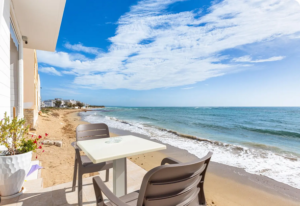
According to Relocation, the Italian municipality of Biccari in the Apulia region has extended its affordable housing program into 2026, including homes for a symbolic price of €1. Local authorities have waived mandatory requirements for permanent residency and property renovation, and have expanded the offering to include properties in better condition priced up to €30,000.
According to the Italian publication Idealista, Biccari remains one of the towns in southern Italy using the sale of affordable real estate to combat population decline and restore historic buildings.
The program has been in effect since 2021. Initially, the municipality offered buyers about 20 properties, most of which were in poor condition and required significant investment for renovation.
However, experience from previous years has shown that many foreign buyers are unwilling to organize major renovations remotely due to the complexity of obtaining permits, finding contractors, and overseeing construction work.
As a result, the municipality has compiled an expanded real estate catalog that includes both dilapidated houses priced at €1 and properties more suitable for living, ranging in price from several thousand to €30,000.
According to Mayor Biccari Gianfilippo Mignoni, buyers can independently determine the future use of the property. Specifically, the properties may be used for permanent residence, seasonal vacation use, or rental, provided that relevant local regulations are followed.
An important feature of the program is the absence of a specific municipal requirement to reside permanently in the purchased property or to complete its renovation within a specified timeframe. At the same time, dilapidated buildings cannot be used without carrying out the necessary repairs and complying with building codes.
Foreign buyers are also eligible to participate. To finalize the transaction, buyers must obtain an Italian tax identification number (Codice Fiscale) and comply with the general legal requirements for real estate purchases by foreigners.
However, the symbolic price of the house does not mean there are no additional costs. The buyer must pay for notary fees, registration fees, verification of the property’s legal status, and, if necessary, repairs.
For houses in poor technical condition, renovation can cost €20,000–25,000 or more, depending on the square footage, the condition of the structures, and the scope of work.
According to local authorities, since the program’s launch, the total value of purchase and sale transactions has reached approximately €650,000, while completed, planned, and ongoing renovation work is estimated at an additional €1.3 million.
The program has attracted buyers from other regions of Italy, as well as from Germany, the United States, Argentina, Peru, and Portugal. Some of the new owners view the property as a future place to live after retirement, while others see it as a seasonal residence or a rental property.
Biccari is located in the province of Foggia, approximately 30 km from the city of the same name. The municipality has a population of 2,600. Its economy is based on agriculture, local services, and tourism.
Programs to sell homes for a nominal price have been in place in Italy since 2008. They have become widespread primarily in small towns in Sicily, Sardinia, Calabria, and other regions facing depopulation and an aging housing stock.
At the same time, purchasing real estate in Italy does not in itself grant foreigners the right to long-term residence or automatic issuance of a residence permit.

The Italian Med-Or Foundation and the Hennadiy Udovenko Diplomatic Academy of Ukraine under the Ministry of Foreign Affairs of Ukraine have signed a memorandum of understanding aimed at developing cooperation in the field of diplomatic training and international dialogue.
According to reports, the document was signed on October 13 at Med-Or’s headquarters in Rome by the foundation’s president, Marco Minniti, and the director of the Diplomatic Academy of Ukraine, Ihor Ostash.
The agreement provides a foundation for joint initiatives in the field of diplomatic education, as well as expanded opportunities for cooperation between Italy and Ukraine. In particular, the agreement envisages the involvement of Italian and international instructors and experts in the Ukrainian academy’s educational programs.
The Med-Or Foundation already has experience in developing international partnerships in the field of personnel training in Africa and the Middle East.
The signing ceremony was also attended by Alfredo Mantovano, State Secretary to the President of the Council of Ministers of Italy and Security Commissioner of the Republic, and Ihor Brusylo, Ukraine’s Ambassador to Italy.
Med-Or noted that the agreement is part of the foundation’s broader program of activities aimed at developing international cooperation amid a complex international situation.
The signing of the memorandum lays the groundwork for further deepening Ukrainian-Italian ties in the areas of diplomatic education, the exchange of expert knowledge, and the training of specialists in international relations.
Italy continues to enjoy one of the highest levels of positive perception among Ukrainians: in August 2026, 70.1% of respondents viewed the country positively, while only 2.9% viewed it negatively. Compared to March, the overall share of positive assessments remained virtually unchanged; however, within this group, there was an increase in the number of respondents with an unequivocally positive attitude. This is evidenced by the results of a study conducted by Active Group and Experts Club, according to the Experts Club Information and Analytical Center.
According to the results of the August survey, 24.3% of Ukrainians have a completely positive attitude toward Italy, and 45.8% have a mostly positive attitude. Twenty-five percent of respondents hold a neutral position. Two point seven percent view the country mostly negatively, only 0.2% completely negatively, and another 2% were undecided.
The balance of positive and negative assessments stands at plus 67.2 percentage points. Based on this indicator, Italy ranks among the countries with the highest level of positive attitudes among Ukrainians and holds a high position among the nations of Western and Southern Europe.
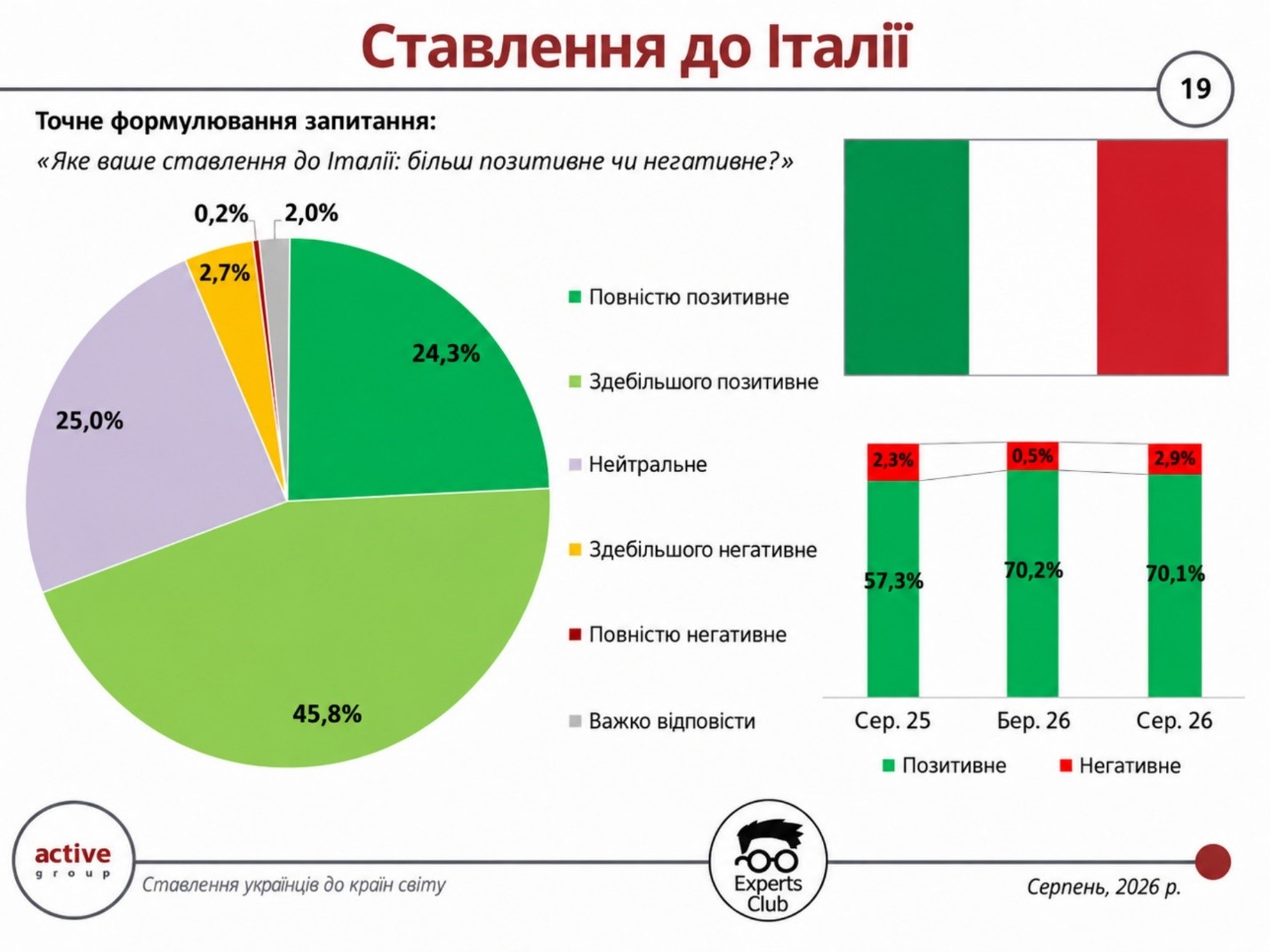
In March 2026, the total share of positive assessments of Italy stood at 70.2%. At that time, 19.3% of respondents described their attitude as entirely positive, and 50.8% as mostly positive. 28.9% had a neutral attitude toward the country, while only about 0.5% had a negative one.
Thus, the overall level of positive attitudes has remained virtually unchanged over the past five months—at around 70%. At the same time, the share of entirely positive assessments rose by approximately 5 percentage points—from 19.3% to 24.3%—while the share of mostly positive assessments fell by roughly the same 5 percentage points. This indicates a certain increase in the intensity of positive perceptions among a segment of respondents.
At the same time, the share of neutral assessments fell from 28.9% to 25%, while negative assessments rose to 2.9%. As a result, the balance of positive and negative attitudes declined from approximately plus 69.7 percentage points in March to plus 67.2 percentage points in August, though it remains very high.
“The consistently high level of positive attitudes among Ukrainians toward Italy is important not only in terms of public sentiment but also in the context of economic ties between the two countries. Italy remains one of Ukraine’s key trading partners in Europe, and a positive perception of the country creates a favorable backdrop for the development of business contacts, investments, tourism, and humanitarian cooperation. It is particularly telling that the share of unequivocally positive assessments is growing, even though the overall level of favorability has remained very high for quite some time,” noted Maksym Urakin, founder of the Experts Club information and analytical center.
Italy also carries significant economic weight for Ukraine. In the first half of 2026, it ranked third among individual countries in terms of the volume of Ukrainian goods exports—approximately $1.28 billion. The high level of public favor is thus combined with significant trade and economic ties.
A new wave of the survey shows that this positive image has generally been maintained: about seven out of ten Ukrainians continue to view Italy positively, and the share of unequivocally positive responses has even increased.
The survey was conducted in August 2026 using self-administered online questionnaires in the SunFlowerSociology panel among 800 Ukrainian citizens aged 18 and older. The sample is representative by age, gender, and region; the maximum theoretical margin of error is ±3.5 percentage points.
ACTIVE GROUP, EXPERTS CLUB, FOREIGN TRADE, international relations, ITALY, PUBLIC OPINION, SOCIOLOGY, UKRAINE, URAKIN
According to Experts Club, Italy and Spain have the highest levels of positive attitudes among Ukrainians among the Southern European countries included in the study—70.1% and 65.2%, respectively. At the same time, a significant portion of respondents hold a neutral stance toward Greece and Slovenia, while attitudes toward Serbia remain the most mixed. This is evidenced by the results of the third wave of the study “Ukrainians’ Attitudes Toward Countries Around the World,” conducted by Active Group in collaboration with Experts Club, reports the Experts Club Information and Analytical Center.
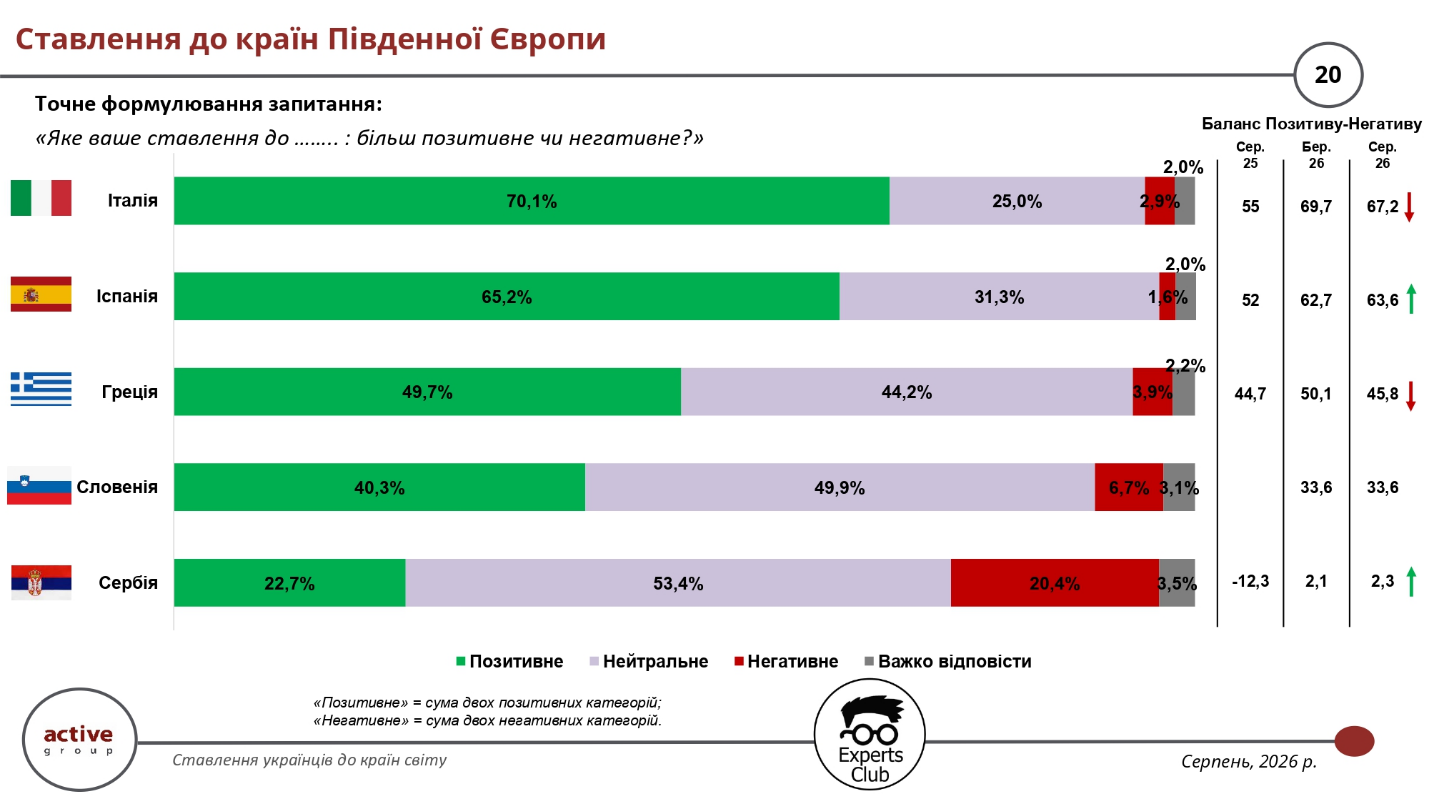
Italy has the best result in the regional group: 70.1% of respondents view it positively, 25% neutrally, 2.9% negatively, and another 2% were undecided. The balance of positive and negative assessments stands at 67.2 percentage points. In March 2026, it was slightly higher—69.7 percentage points—but compared to August 2025, when the figure stood at 55 percentage points, attitudes remain significantly more favorable.
Spain is viewed positively by 65.2% of respondents, neutrally by 31.3%, and negatively by only 1.6%. The balance stands at 63.6 percentage points, compared to 62.7 percentage points in March and 52 percentage points in August of last year. Thus, among the Southern European countries surveyed, Spain is the one showing consistent growth in the balance compared to previous waves.
49.7% of Ukrainians view Greece positively, 44.2% neutrally, and 3.9% negatively. The balance of positive and negative assessments stands at 45.8 percentage points, compared to 50.1 percentage points in March 2026 and 44.7 percentage points in August 2025. This indicates a relatively stable perception of the country, with positive and neutral assessments predominating.
Regarding Slovenia, 40.3% of respondents expressed a positive attitude, while nearly half—49.9%—took a neutral stance. 6.7% view the country negatively, and the balance stands at 33.6 percentage points, the same as in March 2026.
The most contrasting results in the group were recorded for Serbia. 22.7% of Ukrainians view it positively, 20.4% negatively, and the majority, 53.4%, hold a neutral position. The balance stands at plus 2.3 percentage points. At the same time, the trend has improved compared to August 2025, when the indicator was negative—minus 12.3 percentage points.
Maksym Urakin, founder of Experts Club, deputy director of the Interfax-Ukraine news agency, and candidate of economic sciences, emphasized the need for foreign partners to communicate more actively with Ukrainian society.
“The first recommendation is to regularly showcase concrete achievements and specific actions. The second is to be open to questions and inquiries from the media and the public,” Urakin noted.
According to him, sociological data can help diplomatic missions and businesses assess public perception and build bilateral relations more effectively.
Oleksandr Pozniy, director of the research firm Active Group, highlighted the need to combine public awareness with the development of practical economic cooperation.
“We need to do more than just raise general awareness. First and foremost, business associations, the Ministry of Economy, and the Ministry of Foreign Affairs need to take action,” Pozniy noted.
According to him, the most promising areas are those where Ukraine can deepen bilateral ties and increase exports.
In a broader context, the study shows that Ukrainians’ attitudes toward most Southern European countries remain positive or neutral. Italy and Spain score particularly high, while public opinions regarding Serbia are significantly more polarized, although the balance has improved over the past year.
The survey was conducted in August 2026 using self-administered online questionnaires in the SunFlowerSociology panel among 800 Ukrainian citizens aged 18 and older. The sample is representative by age, gender, and region, and the stated maximum theoretical margin of error for indicators at the 50% confidence level is ±3.5 percentage points. This is the third wave of the study, following surveys conducted in August 2025 and March 2026.
ACTIVE GROUP, EXPERTS CLUB, GREECE, ITALY, SERBIA, SLOVENIA, SOCIOLOGY, SOUTHERN EUROPE, SPAIN, UKRAINE

Ukraine has been named the Guest of Honor at the 24th Pisa Book Festival, which takes place October 2–4 in Pisa, Italy.
“This year’s guest country is Ukraine, which is presenting a rich and diverse program covering literature, history, and art, organized under the patronage of the Ukrainian Embassy in Rome,” the festival states on its website.
In particular, the festival will feature writer Andriy Kurkov, as well as writers and translators Olena Kostyukovych, Yaryna Hrush, and Olena Ponomariova.
As part of the program dedicated to Ukraine, an exhibition of Ukrainian illustrators titled “Yellow and Blue” is on display at Palazzo Blu through January 10, 2027.
In total, this year’s festival features 90 booths from Italy’s leading independent publishers, as well as professional meetings with editors, translators, and distributors.
Over 100 events are scheduled as part of the festival, which will welcome more than 200 guests.
The festival was founded in 2003 to support independent Italian publishers.

Residential real estate prices in Italy rose 4% in the second quarter of 2026 compared to the same period last year, according to preliminary data from the Italian National Institute of Statistics (Istat).
The pace of housing price increases slowed slightly: in the first quarter, the year-over-year increase was 5.1%.
Compared to the first quarter of 2026, the housing price index increased by 1.7%. Newly built homes rose in price by 5% over the year, while existing homes rose by 3.7%. In the previous quarter, these figures were 6.7% and 4.6%, respectively.
On a quarterly basis, prices for new housing rose by 2.7%, and for existing housing by 1.5%.
Among major Italian cities, housing prices rose the fastest in Turin. In the second quarter, prices there were 8.5% higher than a year earlier, whereas in the first quarter, the year-over-year increase was only 3.8%.
In Rome, residential real estate prices rose by 6.4% following a 5.5% increase in the first quarter.
In contrast, in Milan—which in previous years had been one of the country’s most dynamic real estate markets—the pace of growth slowed sharply. Prices rose by 2.4% year-over-year, compared to 7.1% in the first quarter.
The most noticeable slowdown in Milan was recorded in the new-construction segment: after a 20.1% jump in the first quarter, year-over-year growth in the second quarter was only 1.1%.
Regionally, Istat recorded the highest price growth in Central Italy—5.1%. In the northeast, housing prices rose by 4.2%; in the northwest, by 3.9%; and in the south and on the islands, by 2.6%.
The rise in prices is occurring against a backdrop of a de facto stabilization in the number of transactions. According to data from the Italian Tax Agency’s Real Estate Market Observatory, the number of housing transactions in the second quarter increased by only 0.1% year-over-year, following a 4.4% increase in the first quarter.
Based on the results of the first two quarters, the cumulative increase in the housing price index for 2026 stands at approximately 3.8%. Istat plans to release its next market assessment on December 17, 2026.



