
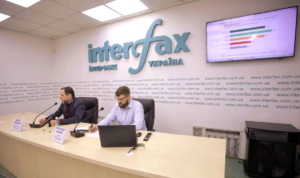
More than half of Ukrainians believe that the military should remain outside politics during the war; however, a significant part of society allows their limited participation in public processes, primarily in defense-related issues, according to the results of the study “Military and Politics: the Balance of Media Presence, Influence and State Unity,” presented by Active Group.
According to the presentation, 23.1% of respondents “definitely” support the apolitical nature of the military, another 27.3% “rather support” it, while 37.6% (23.1% “rather no” and 14.5% “definitely no”) allow their participation in politics, and another 12% were undecided.
“We saw that there are two simultaneous demands in society – that the military stay out of politics and that they have influence. And there is no contradiction in this: the majority want the military to remain military during the war, but at the same time allow their participation in processes directly related to state defense. This is more about balance than extremes,” said Active Group director Oleksandr Poznyi at a press conference at the Interfax-Ukraine agency on Thursday.

At the same time, an absolute majority of Ukrainians support a strict system of army management: 41% consider a unified chain of command very important, another 31.5% consider it rather important (a total of 72.5%), while only about 10% do not share this position.
On the issue of decision-making during the war, public opinion is distributed among key centers of authority: 22.4% believe that decisions should be made by the president as Supreme Commander-in-Chief, 25.6% by the Commander-in-Chief, 25.4% by the General Staff, about 14% by lower-level commanders, and 12.9% were undecided.
“These figures show that society trusts the vertical chain of command and expects that strategic decisions are made at the highest level. At the same time, people do not always clearly distinguish the functions of different levels of military leadership. Therefore, we see a certain distribution of answers between the president, the Commander-in-Chief and the General Staff,” explained Active Group founder Andriy Yeremenko.
The study also recorded a demand for a combination of centralization and flexibility: 40.1% of respondents support mainly a vertical management model (16% – exclusively vertical, 24.1% – rather vertical), while 37% support the autonomy of units (29.5% – more autonomy, 7.5% – full autonomy), and another 22.9% were undecided.

“Society is essentially saying: strategy should be formed at the top, but at the level of units there should be freedom of action. This means rejecting micromanagement and at the same time the need for high-quality feedback. People expect that decisions take into account the real situation on the ground,” Yeremenko added.
The most acceptable forms of military participation in public life, according to Ukrainians, are calls to politicians to make decisions in the field of defense (37.3% support), public positions on draft laws (26.3%), and the creation of veteran and public organizations (24.6%). At the same time, the greatest rejection is caused by the use of military authority to influence voters (–30.4% balance), as well as participation in the formation of political decisions or commenting on political processes.
“There is a clear boundary: the military may influence defense decisions, but should not interfere in electoral processes. Attempts to use military authority in political competition are perceived very negatively. This is an important signal for future political campaigns,” Poznyi emphasized.
Among the key qualities of a modern commander, respondents named responsibility for subordinates (64.9%), strategic thinking (59.9%), as well as the ability to execute tasks (37.1%), discipline (35.4%) and interaction with command (33.4%), while media activity received only 2.4% support.
Among the factors that harm the effectiveness of the army, corruption risks dominate: 53.9% pointed to abuses in procurement, 46.1% to abuses in operational planning. Respondents also named fatigue of personnel and insufficient rotation (42.7%), outdated training approaches (35.3%), low motivation (35.1%) and bureaucratic procedures (34%).
“Corruption is traditionally perceived as the main problem in any sphere. But alongside this, we see systemic issues – rotation, motivation, quality of management. This is a set of factors that shape the effectiveness of the army and require systemic solutions,” Yeremenko noted.
At the same time, 76.5% of Ukrainians (47.8% positive, 28.7% rather positive) have a favorable attitude toward units that combine discipline, state subordination and modern approaches to warfare.
In the ranking of units by perceived discipline and effectiveness, the Special Operations Center “A” of the Security Service of Ukraine (“Alpha”) leads with 17.9%, followed by the 3rd Army Corps (14.5%) and “Azov” (13.2%). In terms of trust in fulfilling state tasks, “Azov” ranks first (15.2%), followed by the Special Operations Forces of the Armed Forces of Ukraine (14.7%) and “Alpha” (13.4%).
At the same time, more than 40% of respondents were unable to name specific units, indicating limited public awareness and the significant influence of media presence on the formation of public opinion.
Overall, the study demonstrates a demand in Ukrainian society for the depoliticization of the military, the preservation of a strict chain of command, and at the same time flexibility at the unit level, as well as a clear distinction between influence in the field of defense and participation in political competition.

According to the results of a survey conducted by the research company Active Group and the Experts Club analytical center in early February and presented at the Interfax-Ukraine press center, 31.4% of respondents called electronic prescriptions “very convenient,” 44.1% called them “rather convenient,” 18.7% called them “rather inconvenient,” and 5.9% called them “very inconvenient.”

“Digital tools gain support when they save time and really simplify access to medicines,” said Experts Club founder Maxim Urakin.
“Negative attitudes among some users are usually associated with practical failures and varying levels of digital literacy, and this needs to be taken into account when fine-tuning the service,” said Alexander Pozniy, CEO and co-founder of Active Group.

The study was conducted on the SunFlowerSociology online panel using a representative sample on February 11-12, 2026. The survey involved 1,000 respondents from a representative sample in all regions of Ukraine, except for the temporarily occupied territories.
ACTIVE GROUP, EXPERTS CLUB, Poznyi, SOCIOLOGY, SOLONINKA, SURVEY, URAKIN, Єременко
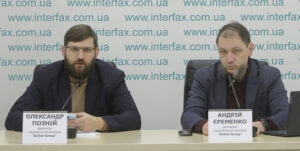
Personnel reshuffles initiated by the President of Ukraine at the start of 2026 are perceived by society with restraint: amid high awareness, Ukrainians more often speak of cautious hope than of a feeling of real renewal of power, according to the results of a nationwide survey by the research company Active Group.
According to the published data, 79.2% of respondents reported that they had heard about the personnel changes, and another 14.8% noted that they “had heard something but are not sure about the details.” 6.0% of those surveyed learned about these decisions for the first time – thus, the overall level of awareness exceeds 94%.
At the same time, assessments of the consequences of the personnel changes remain uncertain: 43.6% of respondents believe that these decisions brought more benefit to the country, 18.3% – more harm, and almost 38.0% were unable to give an unambiguous answer.
The founder of the sociological company Active Group, Andrii Yeremenko, commenting on the survey results, noted that the recorded high awareness of the personnel decisions did not transform into a formed assessment of their consequences.

“We see a situation where more than 94% of respondents have at least heard about these appointments, but almost 38% cannot say whether this is more benefit or harm. This means that society currently does not have sufficiently clear markers of effectiveness – people expect practical results, not signals of a ‘reset’ at the level of personalities. The distribution of answers regarding the ‘renewal of power’ almost equally additionally confirms that there is a demand for change, but it is tied to governance logic and the implementation of decisions, not to the very fact of personnel replacements,” Yeremenko emphasized.
When asked whether the decisions of recent weeks can be considered a renewal of power, 42.5% answered in the affirmative, while 46.7% answered negatively. In the emotional dimension, 52.1% of respondents stated that the personnel reshuffles give more hope, while 29.1% said that disillusionment prevails; at the same time, 10.2% feel “only hope.”
Among the areas of state policy that, in respondents’ opinion, may be strengthened as a result of the appointments, foreign policy, diplomacy and the negotiating track were most often named: 41.5% expect strengthening, 13.2% – weakening. Regarding the defense of the state, 39.0% forecast strengthening, 20.5% – weakening. For a number of domestic areas – social policy, the economy, the work of law enforcement agencies and the fight against corruption – restrained or negative expectations prevail, while a significant share of “hard to say” answers remains.
Assessing the impact of personnel decisions on trust in key officials, most respondents report no changes. In particular, regarding President Volodymyr Zelensky, 63.8% noted that the level of trust did not change, 17.5% speak of an increase in trust, and 13.5% – of a decrease. Regarding Kyrylo Budanov, 54.5% did not feel changes, 24.0% record an increase in trust, and 13.4% – a decrease; regarding Mykhailo Fedorov, respectively 55.3%, 18.6% and 15.8%. The most critical indicators are for Denys Shmyhal: 57.5% stated no change, 24.9% – a decrease, and 8.2% – an increase in trust.
The director of the sociological company Active Group, Oleksandr Poznyi, emphasized that the emotional background around the reshuffles remains restrained, and the impact on trust in key figures is limited.

“More than half of respondents say that personnel decisions give more hope, but only about 10% feel this hope unconditionally. At the same time, for most of those involved in the appointments, the dominant answer is ‘trust has not changed,’ which indicates the absence of an effect of rapid restoration of trust. In such a situation, society will assess these decisions through concrete results – primarily in the external contour and the security sphere, where the balance of expectations is more positive, while in domestic areas, in particular the economy, the law enforcement system and anti-corruption policy, significant skepticism remains,” Poznyi added.
The distribution of trust in well-known public figures, according to the survey data, indicates fragmentation: the highest level of trust is held by Kyrylo Budanov (43.2%), followed by Valerii Zaluzhnyi (37.7%) and Volodymyr Zelensky (27.4%). Also on the list are: Andrii Biletskyi (15.6%), Petro Poroshenko (13.1%), Denys Prokopenko (13.0%), Serhii Prytula (12.0%), Dmytro Razumkov (11.6%), and Vitalii Klychko (10.1%). Separately, 21.3% of respondents stated that they do not trust any of those listed.
The highest indicators of distrust, according to the study, are recorded for Oleksii Arestovych (68.5%), Yuliia Tymoshenko (60.7%) and Yurii Boiko (54.5%); Petro Poroshenko (46.7%) and Vitalii Klychko (36.5%) also have high levels of distrust. At the same time, distrust is also expressed toward Volodymyr Zelensky (33.1%), Valerii Zaluzhnyi (16.6%) and Kyrylo Budanov (15.6%).
More than half of Ukrainians already feel the start of the election campaign: 54.2% answered “yes” (including 17.3% – “definitely yes”), 32.6% – “no,” and 13.2% were undecided.
In February 2026, the highest support among potential presidential candidates is held by Volodymyr Zelensky – 22.3% (compared to 17.8% in December 2025 and 21.7% in January 2026). Support for Valerii Zaluzhnyi, according to the survey, decreased to 10.8% (from 16.6% in December and 14.9% in January). Kyrylo Budanov’s rating increased to 9.4% (after 6.3% in January), Petro Poroshenko has 7.4%, and other candidates do not exceed 4%. The share of those ready to vote “against all” or spoil the ballot increased to 10.6% (from 7.5% in December), 7.2% do not plan to take part in the elections, and 14.5% were undecided. In the negative ratings, the greatest rejection is toward Oleksii Arestovych (56.5%) and Yuliia Tymoshenko (52.2%), followed by Yurii Boiko (45.3%) and Petro Poroshenko (42.5%).
Electoral attitudes regarding possible elections to the Verkhovna Rada also do not form a dominant force. Valerii Zaluzhnyi’s party has 11.9% in February (against 14.2% in December), Kyrylo Budanov’s party – 10.1% (after 8.8% in January), Volodymyr Zelensky’s party fluctuates within 9.9–10.7%, and European Solidarity – 10.3% in February (after 11.0% in January). The Azov party decreased to 6.1% (from 7.6% in December). The share of those ready to vote “against all” increased to 10.1% (from 6.3% in December), 7.7% do not plan to participate in the elections, and 13.1% were undecided.
The survey was conducted by Active Group using the SunFlower Sociology online panel методом self-completion of questionnaires among citizens of Ukraine aged 18+. The sample size is 2,000 respondents; the sample is representative by age, gender and regions of Ukraine. The data collection period was January 31 – February 1, 2026. The theoretical margin of error at a confidence probability of 0.95 does not exceed 2.2%.
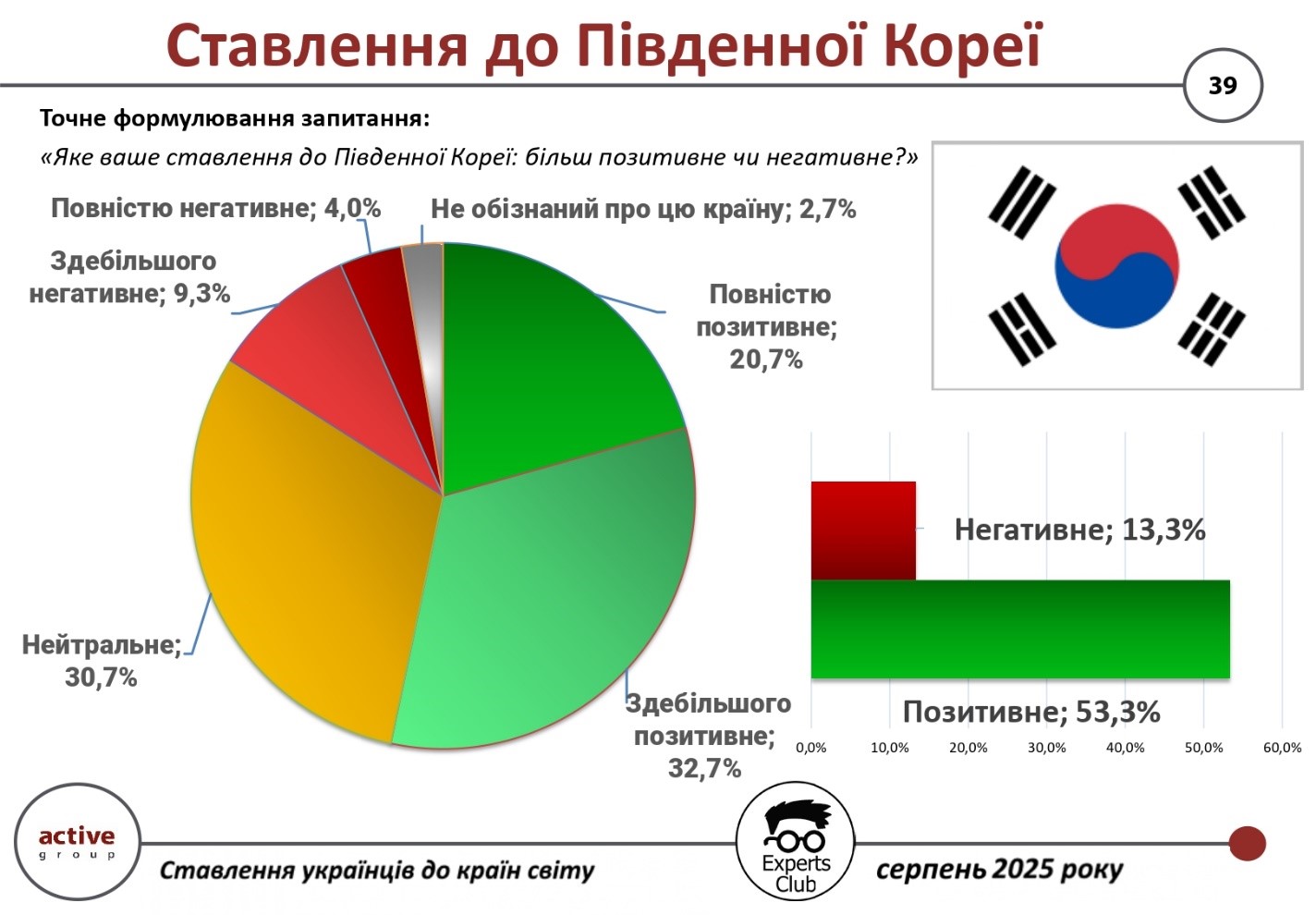
According to a survey conducted by Active Group in cooperation with Experts Club in August 2025, more than half of Ukrainians have a positive opinion of South Korea.
In total , 53.3% of respondents expressed favorable attitudes toward this country (32.7% – mostly positive, 20.7% – completely positive). A neutral attitude was recorded in 30.7% of respondents, and negative assessments amounted to 13.3%. Another 2.7% said they did not know enough about the country.
“South Korea is perceived by Ukrainians as a modern high-tech country that is developing dynamically and at the same time preserving its cultural identity. Ukrainians see it as a potential partner, especially in the field of technology, education, and innovation,” said Oleksandr Poznyi, CEO of Active Group.
At the same time, Maksym Urakin, co-founder of Experts Club, emphasized the economic dimension of bilateral relations:
“In the first half of 2025, the total trade turnover between Ukraine and the Republic of Korea amounted to more than $518 million. Exports of Ukrainian goods amounted to only $96.9 million, while imports amounted to more than $421 million. This resulted in a negative trade balance of $324 million. The situation demonstrates the need for more active promotion of Ukrainian goods to the Korean market, particularly in the agricultural and food sectors,” he emphasized.
The research is part of the systematic monitoring of Ukraine’s international relations and public opinion about its partners in the world.
The full video can be viewed here:
https://www.youtube.com/watch?v=YgC9TPnMoMI&t
You can subscribe to the Experts Club YouTube channel here:
https://www.youtube.com/@ExpertsClub
ACTIVE GROUP, EXPERTS CLUB, Poznyi, SOCIOLOGY, SOUTH KOREA, TRADE, UKRAINE, URAKIN
 1
1
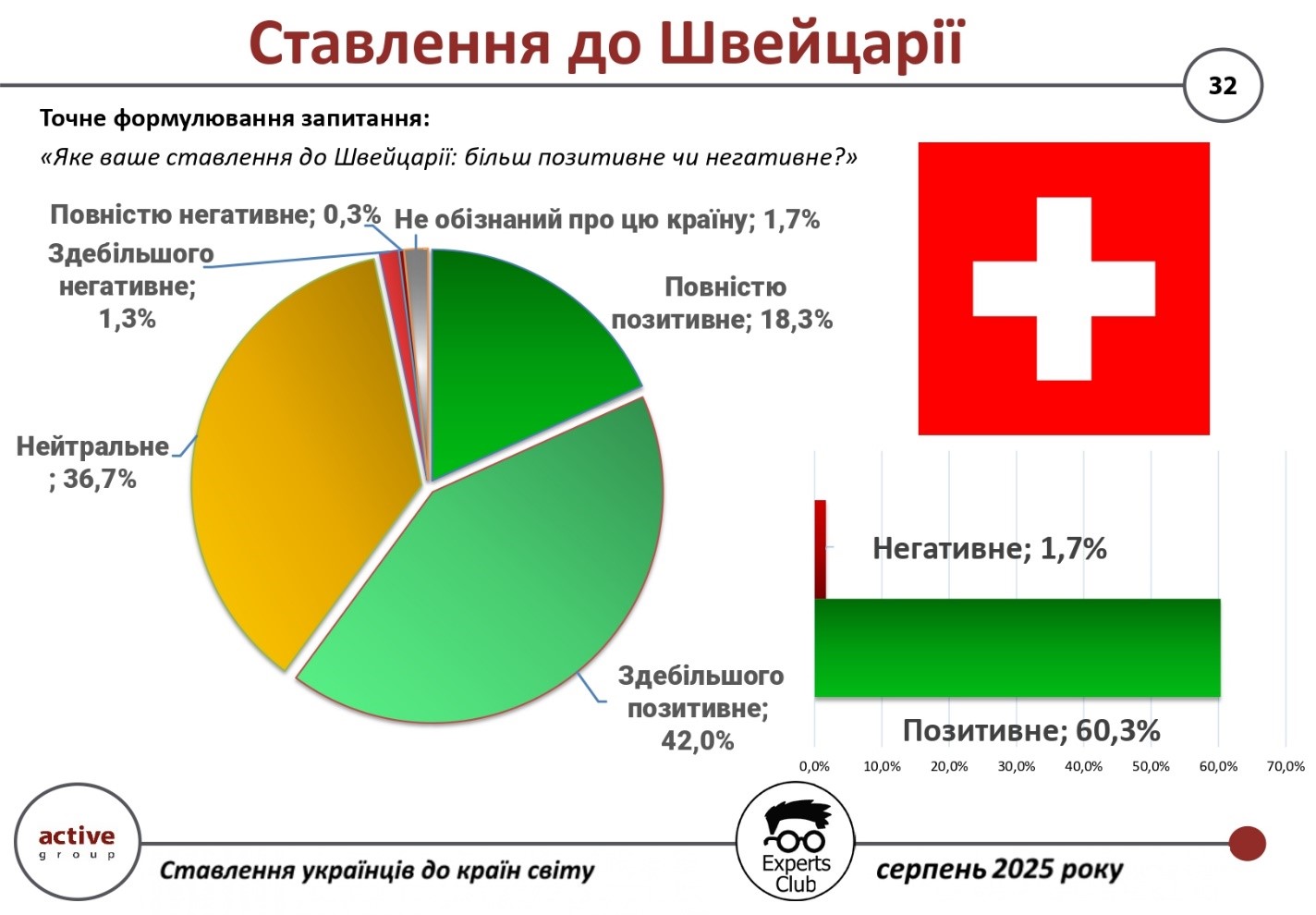
The majority of Ukrainians express a positive attitude towards Switzerland, although a significant number of respondents remain neutral. This is evidenced by the results of an all-Ukrainian sociological survey conducted by Active Group in cooperation with the Experts Club information and analytical center in August 2025.
According to the data, 60.3% of Ukrainians have a positive attitude towards Switzerland (42.0% – mostly positive, 18.3% – completely positive). Only 1.7% of respondents expressed a negative attitude (1.3% – mostly negative, 0.3% – completely negative). At the same time , 36.7% remain neutral, and 1.7% said they did not have enough information about the country.
“For Ukrainians, Switzerland is associated with reliability, stability and humanitarian support that the country provides in difficult times. The high level of trust reflects the positive image of Switzerland, despite its certain detachment from global politics,” commented Alexander Poznyi, co-founder of Active Group.
In his turn, Maxim Urakin, founder of Experts Club, focused on economic ties:
“In the first half of 2025, trade between Ukraine and Switzerland exceeded $928 million. At the same time, Ukrainian exports amounted to only $44 million, while imports from Switzerland reached almost $884 million. The negative balance of more than $839 million is significant, indicating Ukraine’s significant dependence on imports from this country,” he emphasized.
The survey was part of a broader program of research on international sympathies and antipathies of Ukrainians in the current geopolitical context.
The full video is available here:
https://www.youtube.com/watch?v=YgC9TPnMoMI&t
You can subscribe to the Experts Club YouTube channel here:
https://www.youtube.com/@ExpertsClub
ACTIVE GROUP, DIPLOMACY, EXPERTS CLUB, Poznyi, SOCIOLOGY, SWITZERLAND, TRADE, URAKIN

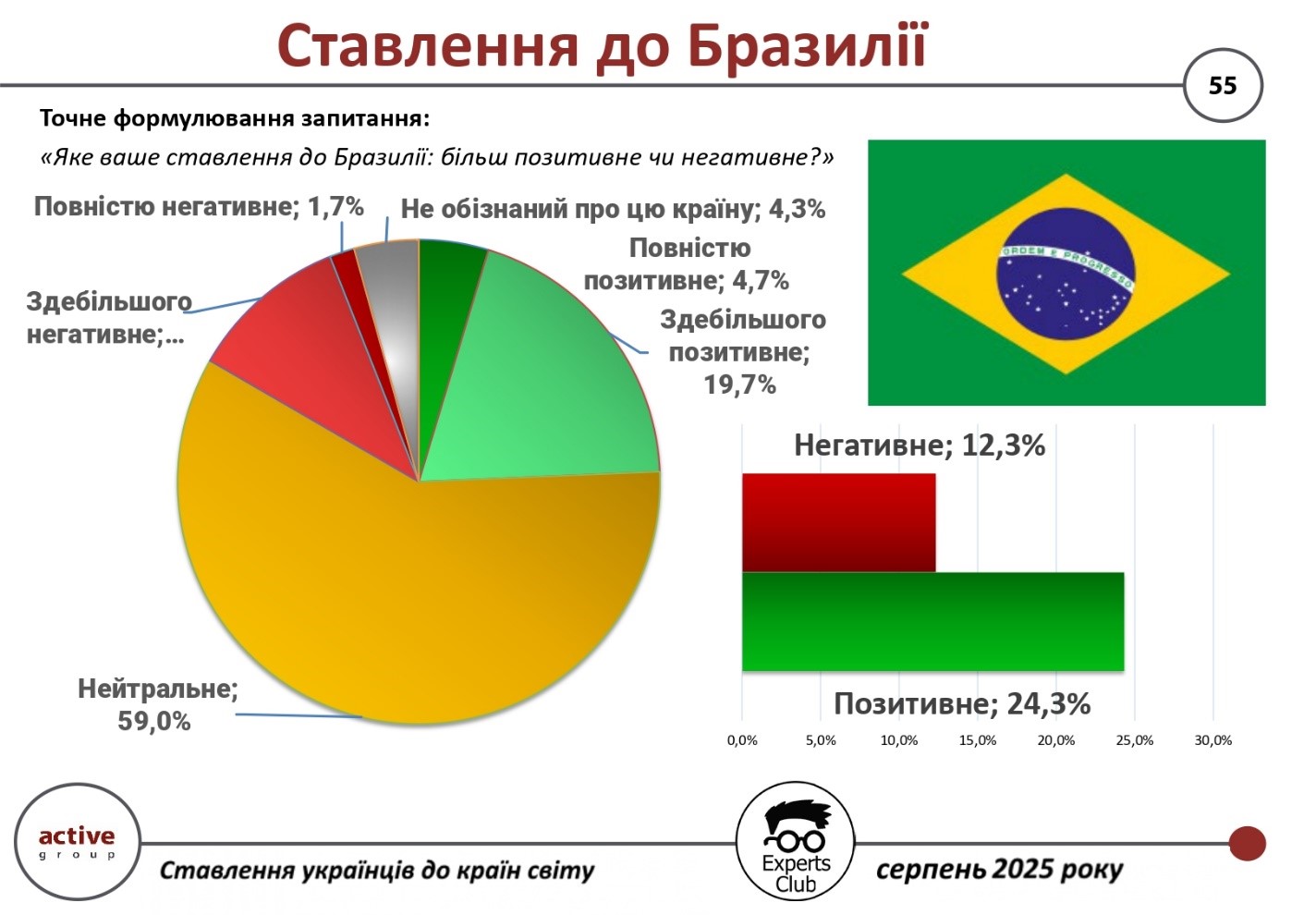
The majority of Ukrainians have a neutral attitude toward Brazil, according to a survey conducted by Active Group and the Experts Club.
According to the survey, 59.0% of respondents have a neutral position on the country. 24.3% of respondents have a positive attitude (in particular, 19.7% – “mostly positive” and 4.7% – “completely positive”). At the same time, 12.3% of Ukrainian citizens expressed a negative attitude toward Brazil, and another 4.3% said they were not familiar with the country.
Thus, the balance of positive and negative attitudes is +12 percentage points (24.3% vs. 12.3%).
According to the latest data, the volume of trade in goods between Ukraine and Brazil amounted to $180.3 million in 2024.
Ukrainian exports to Brazil amounted to $36.1 million,
– imports from Brazil amounted to $144.2 million,
– the negative balance was $108.1 million.
The total trade turnover reached $180.3 million, which indicates Ukraine’s significant dependence on Brazilian imports.
“Brazil remains an important trading partner for Ukraine in Latin America, but the structure of bilateral trade is currently asymmetrical. The significant deficit reflects the predominance of imports, in particular agricultural products and industrial goods,” said Maksym Urakin, economist and founder of Experts Club.
He emphasized that amid growing global competition, Ukraine should actively seek opportunities to increase exports to the Brazilian market: “This applies not only to agricultural products, but also to high-tech industries where Ukraine has competitive advantages.”
The full video can be viewed here:
https://www.youtube.com/watch?v=YgC9TPnMoMI&t
You can subscribe to the Experts Club YouTube channel here:
https://www.youtube.com/@ExpertsClub
ACTIVE GROUP, BRAZIL, EXPERTS CLUB, Poznyi, SOCIOLOGY, TRADE, UKRAINE, URAKIN



