

Ukrainians’ attitudes toward Tunisia in August 2026 remain predominantly neutral: 67.3% of respondents hold this view. 17.8% of those surveyed view the country positively, while 6.9% view it negatively, according to the Experts Club information and analytical center.
According to the survey results, 4.5% of Ukrainians have a completely positive attitude toward Tunisia, while 13.3% have a mostly positive attitude. 67.3% chose a neutral response. 5.9% expressed a mostly negative attitude, 1% a completely negative one, and another 8% were undecided.
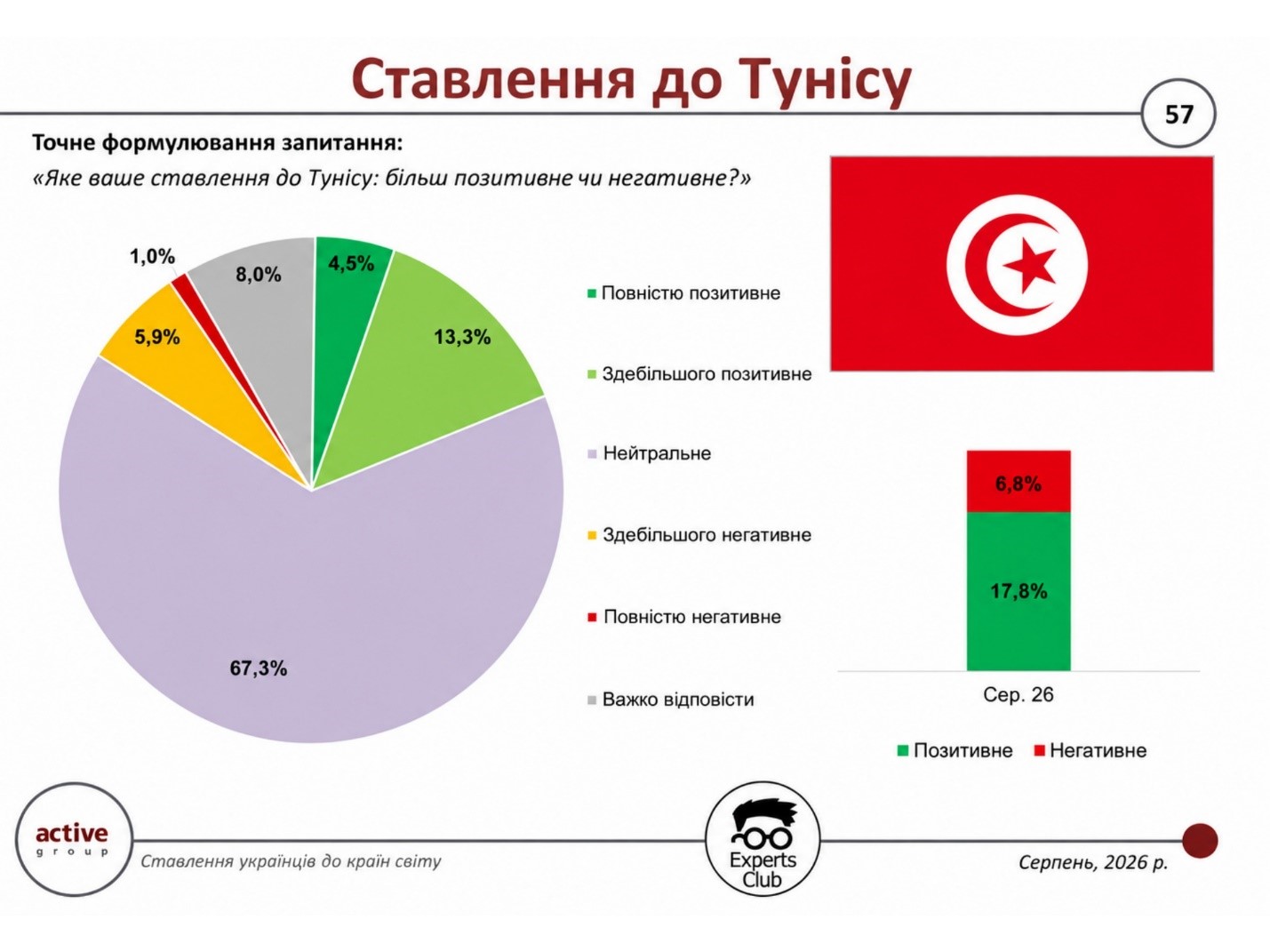
The balance between positive and negative assessments stands at plus 10.9 percentage points. Thus, positive attitudes outnumber negative ones by approximately 2.6 times. At the same time, three-quarters of respondents—including those who found it difficult to answer—do not express a clearly positive or negative assessment of the country.
Unlike most of the countries analyzed in previous reports, this study for March 2026 does not include a separate section on Tunisia; therefore, a direct comparison of the current results with those from the March survey based on this document is not possible. At the same time, the August data show that Tunisia’s public image in Ukraine remains largely neutral.
That said, Tunisia is of practical importance for Ukrainian exports. According to the results for the first half of 2026, Ukraine’s trade surplus with this country amounted to approximately $155.1 million. Tunisia was part of the group of markets in North Africa and the Middle East where Ukrainian exports exceeded imports.
ACTIVE GROUP, EXPERTS CLUB, EXPORTS, FOREIGN TRADE, NORTH AFRICA, PUBLIC OPINION, SOCIOLOGY, TUNISIA, UKRAINE
Ukrainians’ attitudes toward Libya in August 2026 remain predominantly neutral: 59.3% of respondents hold this view. 16.7% of those surveyed view the country positively, while 15.6% view it negatively, according to the Experts Club Information and Analytical Center. Experts.news
According to the survey results, 5.7% of Ukrainians have a completely positive attitude toward Libya, while 11% have a mostly positive attitude. 59.3% chose a neutral response. 12.1% expressed a mostly negative attitude, 3.5% a completely negative one, and another 8.4% were undecided.
Based on the rounded figures in the table, positive assessments exceed negative ones by only 1.1 percentage points. In the overall survey data, the balance regarding Libya is estimated at approximately plus 0.9 percentage points, which is one of the lowest positive results among the countries surveyed.
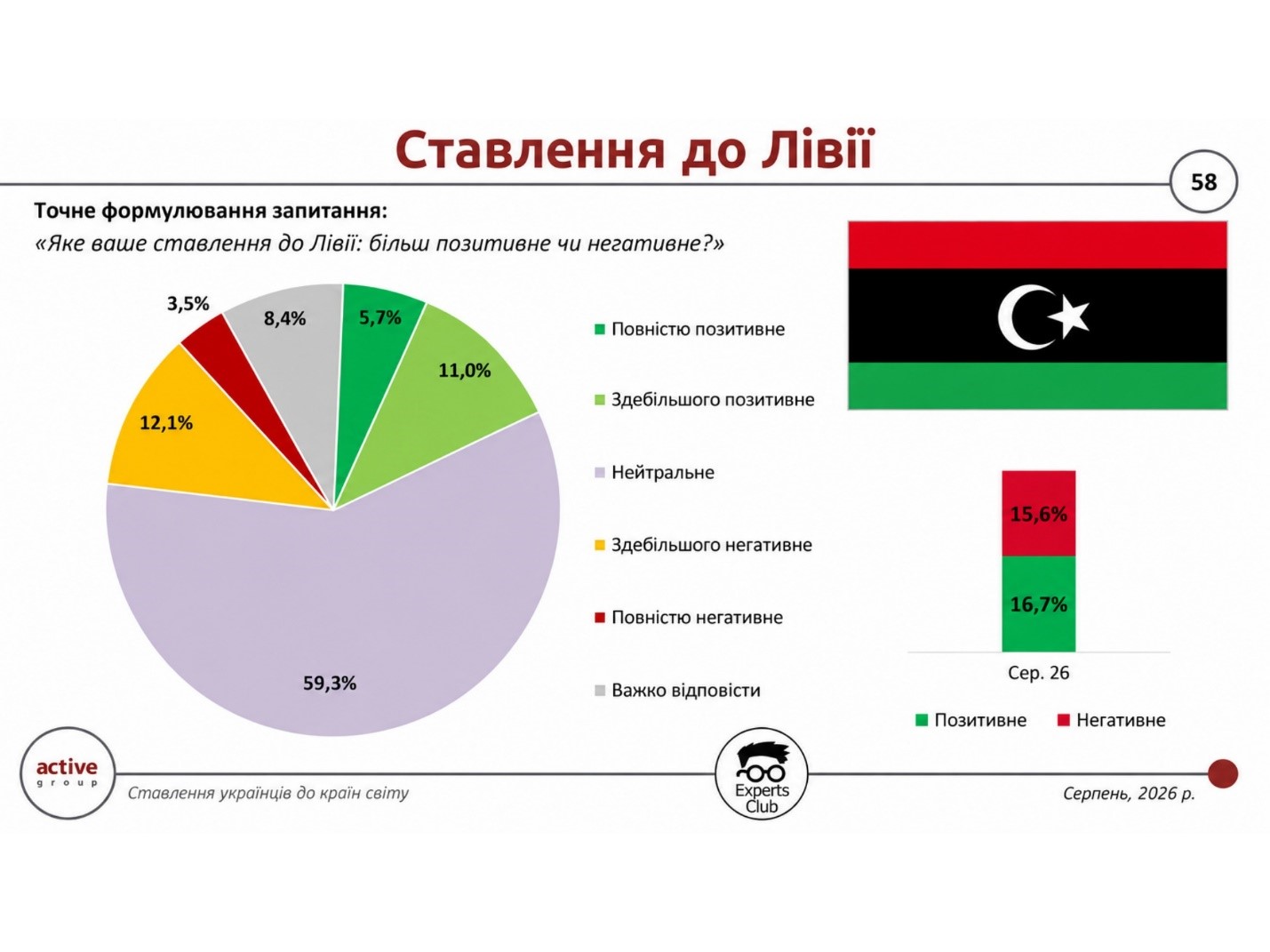
Thus, public opinion regarding Libya is effectively at a balance point: the positive and negative segments are nearly equal, but both are significantly lower than the neutral segment. If we add the 8.4% of respondents who found it difficult to answer, more than two-thirds of respondents do not express a clearly positive or negative attitude toward the country.
A similar pattern is characteristic of other North African countries. According to the results of the August survey wave, the share of neutral assessments in this region generally ranges from about 59% to 67%. At the same time, Egypt has a significantly more pronounced positive balance, Tunisia has a moderately positive one, while the figures for Algeria and Libya remain close to the neutral threshold.
At the same time, Libya is of practical importance for Ukraine’s foreign trade. Based on the results of the first half of 2026, it ranked among the top ten trading partners with whom Ukraine maintained a positive trade balance. This places it on par with such key export destinations as Egypt, Algeria, Lebanon, Tunisia, Iraq, and Yemen.
Oleksandr Pozniy, director of the research firm Active Group, noted that a high proportion of neutral responses does not necessarily indicate a lack of interest in a particular country.
“For Ukrainians, the world is not ‘black and white,’ and the high proportion of neutral assessments regarding a number of countries indicates caution and a desire for balanced judgment rather than indifference,” Pozniy noted, commenting on the results of a survey on Ukrainians’ attitudes toward international partners.
In the case of Libya, this point is particularly telling: 59.3% of neutral responses are accompanied by nearly equal proportions of positive and negative responses. This means that the public perception of the country in Ukraine remains underdeveloped, and future shifts in these assessments may depend to a large extent on media coverage, economic ties, and the development of bilateral relations.
The survey was conducted in August 2026 using an online self-administered questionnaire via the SunFlowerSociology panel among 800 Ukrainian citizens aged 18 and older. The sample is representative by age, gender, and region; the maximum theoretical margin of error for indicators at the 50% confidence level is ±3.5 percentage points.
ACTIVE GROUP, EXPERTS CLUB, FOREIGN TRADE, international relations, Livia, NORTH AFRICA, Pozniy, PUBLIC OPINION, SOCIOLOGY, UKRAINE
Canada continues to enjoy a very high level of positive perception among Ukrainians: in August 2026, 76.3% of respondents viewed the country positively, 19.2% neutrally, while negative assessments, based on the indicators listed in the table, totaled only 2.6%, according to the Experts Club Information and Analytical Center. In the published overall ranking of the survey, the net sentiment toward Canada stands at +73.8 percentage points.
According to the results of the August survey, 37.4% of Ukrainians have a completely positive attitude toward Canada, and 38.9% have a mostly positive attitude. 19.2% of respondents hold a neutral position. 2.2% view the country mostly negatively, 0.4% completely negatively, and another 2% were undecided.
Not only is the high total share of positive responses significant, but so is their breakdown: more than a third of respondents chose the most positive category—“entirely positive.” Based on the rounded figures in the table above, positive assessments outnumber negative ones by nearly 30 to 1.
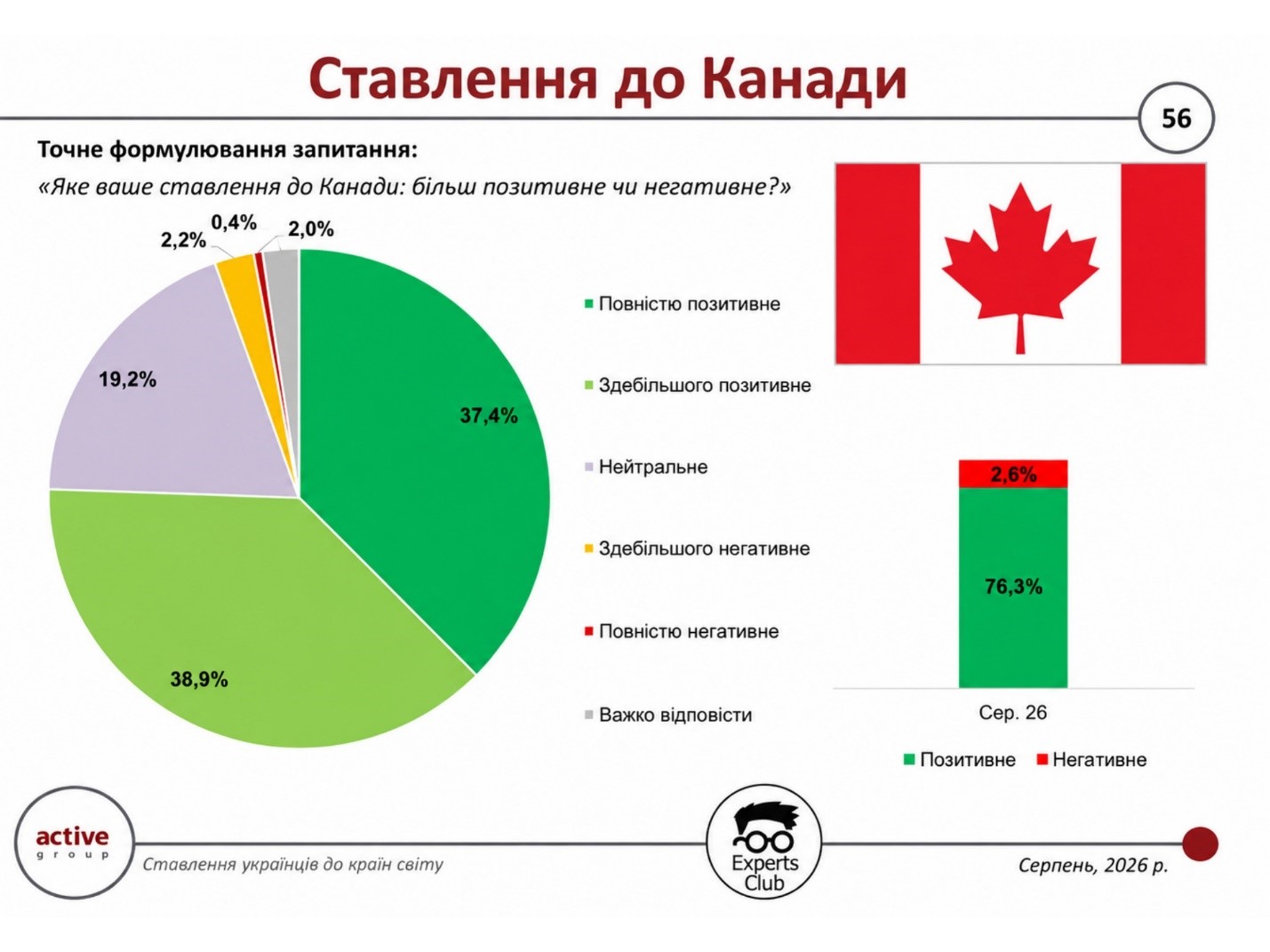
In March 2026, the results were nearly identical. According to the published data from the previous survey wave, 76.2% of respondents viewed Canada positively: 39.4% viewed it “completely positively” and 36.8% viewed it “mostly positively.” 20.3% of respondents held a neutral position, 2.3% held a negative one, and another 1.2% were undecided.
Thus, over the course of five months, the overall share of positive assessments remained virtually unchanged—76.2% in March and 76.3% in August. At the same time, the share of “completely positive” responses decreased by 2 percentage points, while the share of “mostly positive” responses increased by 2.1 percentage points. The neutral segment shrank by 1.1 percentage points.
Oleksandr Pozniy, director of the research firm Active Group, commenting on the results of the previous wave, emphasized precisely the stability of this perception.
“Canada is among those countries toward which Ukrainians have formed not just a positive, but a consistently positive attitude. This is the result of long-term interaction, support, and a presence in the Ukrainian information space. In such cases, even neutral responses do not blur the overall picture but only underscore its consistency,” Pozniy noted.
The August wave confirms this stability: the total positive sentiment remained virtually at the March level, while the neutral group shrank slightly. According to the comprehensive survey conducted in August 2026, Canada had the highest positive balance among the countries covered by the survey.
ACTIVE GROUP, CANADA, EXPERTS CLUB, international relations, Pozniy, PUBLIC OPINION, SOCIOLOGY, UKRAINE
Finland continues to enjoy one of the highest levels of positive perception among Ukrainians: in August 2026, 71.3% of respondents viewed the country positively, while only 2% viewed it negatively. Compared to March, the share of positive assessments has decreased slightly, while the share of neutral responses has increased, according to the Experts Club Information and Analytical Center.
According to the results of the August survey, 34.1% of Ukrainians view Finland entirely positively, and 37.2% view it mostly positively. A neutral stance is held by 25.4% of those surveyed. 1.8% view the country mostly negatively, only 0.2% view it entirely negatively, and another 1.4% were undecided.
The balance between positive and negative assessments stands at plus 69.3 percentage points. Positive attitudes thus outweigh negative ones by more than 35 times, characterizing public perception of Finland as distinctly favorable.
In March 2026, 76.2% of respondents had a positive attitude toward Finland: 38% viewed it entirely positively and 38.2% viewed it mostly positively. A neutral attitude was expressed by 21.4% of respondents, a negative one by about 1.1%, and another 1.2% were undecided.
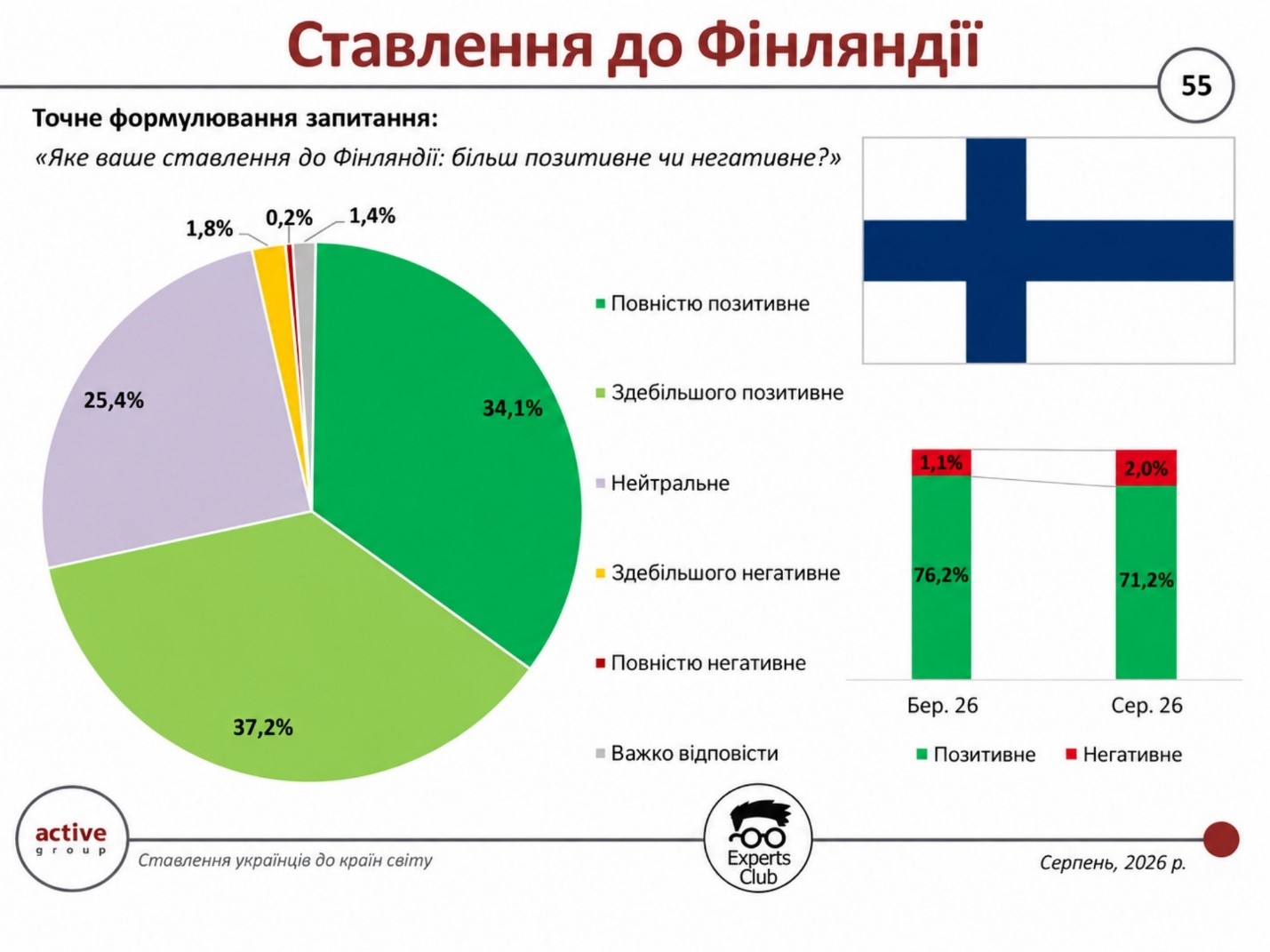
Thus, over the course of five months, the positive segment decreased by 4.9 percentage points—from 76.2% to 71.3%. The share of negative assessments increased by approximately 0.9 percentage points, while neutral responses rose by 4 percentage points. The balance between positive and negative attitudes decreased from plus 75.1 to plus 69.3 percentage points, respectively.
The most notable decline was in the share of respondents with a completely positive attitude—from 38% to 34.1%. The share of mostly positive responses changed much less—from 38.2% to 37.2%. In other words, the bulk of the changes was not due to a shift toward a negative attitude, but rather to an increase in the neutral segment.
Alexander Pozniy, director of the research firm Active Group, previously attributed Finland’s consistently high ratings to the trust and predictability of its image among Ukrainians.
“Ukrainians quite clearly distinguish between countries based on the level of trust and predictability of their policies. Where there is consistency and a clear position, a stable positive attitude is formed. That is why countries like Finland maintain high ratings regardless of short-term fluctuations in the news,” Pozniy noted.
The August wave shows a certain softening of assessments, but no fundamental change in public perception. More than seven out of ten respondents continue to view Finland positively, while the share of negative responses remains at just 2%.
The previous wave of the survey was conducted in March 2026 among 800 Ukrainian citizens aged 18 and older using an online questionnaire. The sample was representative in terms of age, gender, and region.
ACTIVE GROUP, EXPERTS CLUB, FINLAND, international relations, NORTHERN EUROPE, Pozniy, PUBLIC OPINION, SOCIOLOGY, UKRAINE
Ukrainians’ attitudes toward Lebanon in August 2026 remain predominantly neutral; however, among respondents with a formed opinion, negative assessments significantly outnumber positive ones. 57.3% of those surveyed have a neutral attitude toward the country, 22.1% have a negative attitude, and 12.9% have a positive attitude, according to the Experts Club Information and Analytical Center.
According to the results of the August survey, 3.9% of Ukrainians have a completely positive attitude toward Lebanon, while 9% have a mostly positive attitude. 57.3% of respondents hold a neutral position. 18% expressed a mostly negative attitude, 4.1% a completely negative one, and another 7.6% were undecided.
The balance between positive and negative assessments stands at minus 9.2 percentage points. Lebanon is thus one of the few countries surveyed with a negative balance of attitudes. At the same time, a notable feature is the large neutral group—more than half of those surveyed do not hold a clearly positive or negative stance.
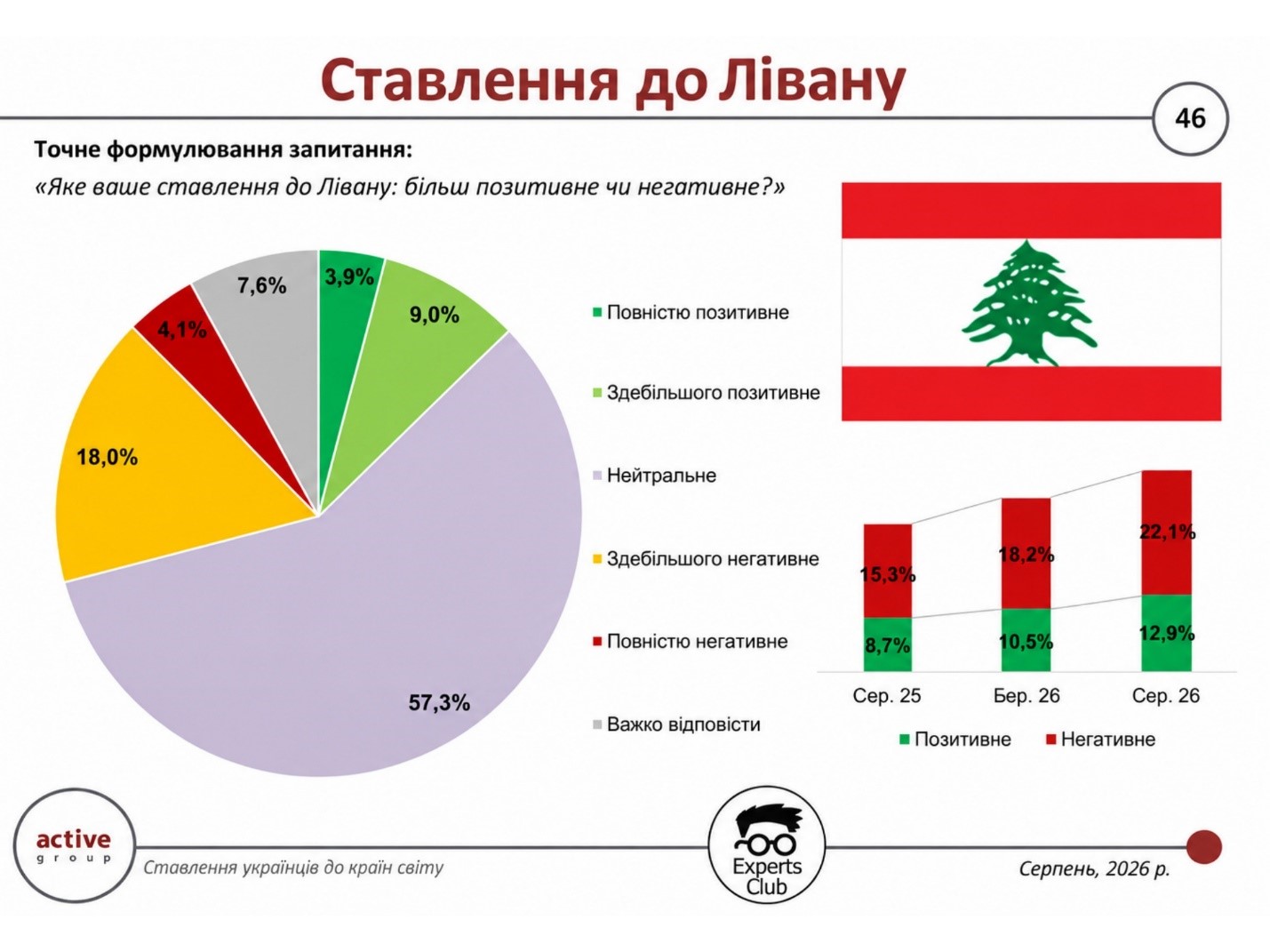
In March 2026, 10.5% of respondents viewed Lebanon positively: 3.3% viewed it entirely positively and 7.2% viewed it mostly positively. 62.5% of respondents held a neutral stance, 18.2% expressed a negative attitude, and another 8.9% were undecided.
Thus, over the course of five months, the positive segment increased by 2.4 percentage points—from 10.5% to 12.9%—but the negative segment grew more sharply, by 3.9 percentage points, to 22.1%. The share of neutral responses decreased by 5.2 percentage points. The balance of attitudes accordingly worsened from minus 7.7 to minus 9.2 percentage points.
On an annual basis, the trend is also characterized by greater certainty in assessments, but with a shift toward the negative. In August 2025, 8.7% of Ukrainians viewed Lebanon positively, while 15.3% viewed it negatively, resulting in a balance of minus 6.6 percentage points.
At the same time, the economic picture differs significantly from public perception. According to the results of the first half of 2026, Lebanon ranked among the top ten trading partners with the largest trade surplus for Ukraine—approximately $220.5 million. Thus, the country serves as an example of a market where Ukrainian exports structurally outweigh imports, despite the negative balance in public assessments.
ACTIVE GROUP, EXPERTS CLUB, EXPORTS, FOREIGN TRADE, LEBANON, MIDDLE EAST, PUBLIC OPINION, SOCIOLOGY, UKRAINE

Ukrainians’ attitudes toward Azerbaijan in August 2026 became more positive compared to the previous wave of the study: 48.7% of respondents view the country positively, compared to 44.3% in March. At the same time, the share of neutral assessments decreased from 47.1% to 39.5%, according to the Experts Club Information and Analytical Center. In the Caucasus and Central Asia regional group, Azerbaijan ranks second after Georgia in terms of the level of positive attitudes among Ukrainians.
According to the results of the August survey, 12.5% of Ukrainians have a completely positive attitude toward Azerbaijan, while 36.2% have a mostly positive attitude. A neutral stance is held by 39.5% of respondents. 7.6% view the country mostly negatively, 1% view it entirely negatively, and another 3.1% were undecided.
The total share of negative assessments is 8.6%, and the balance between positive and negative attitudes is +40.1 percentage points. Thus, positive assessments of Azerbaijan outnumber negative ones by more than five to one.
In March 2026, 14.2% of respondents had a completely positive attitude toward Azerbaijan, while 30.1% had a mostly positive attitude, meaning the overall positive rating was 44.3%. At that time, 47.1% of respondents expressed a neutral attitude, 6.5% a negative one, and another 2.1% were undecided.
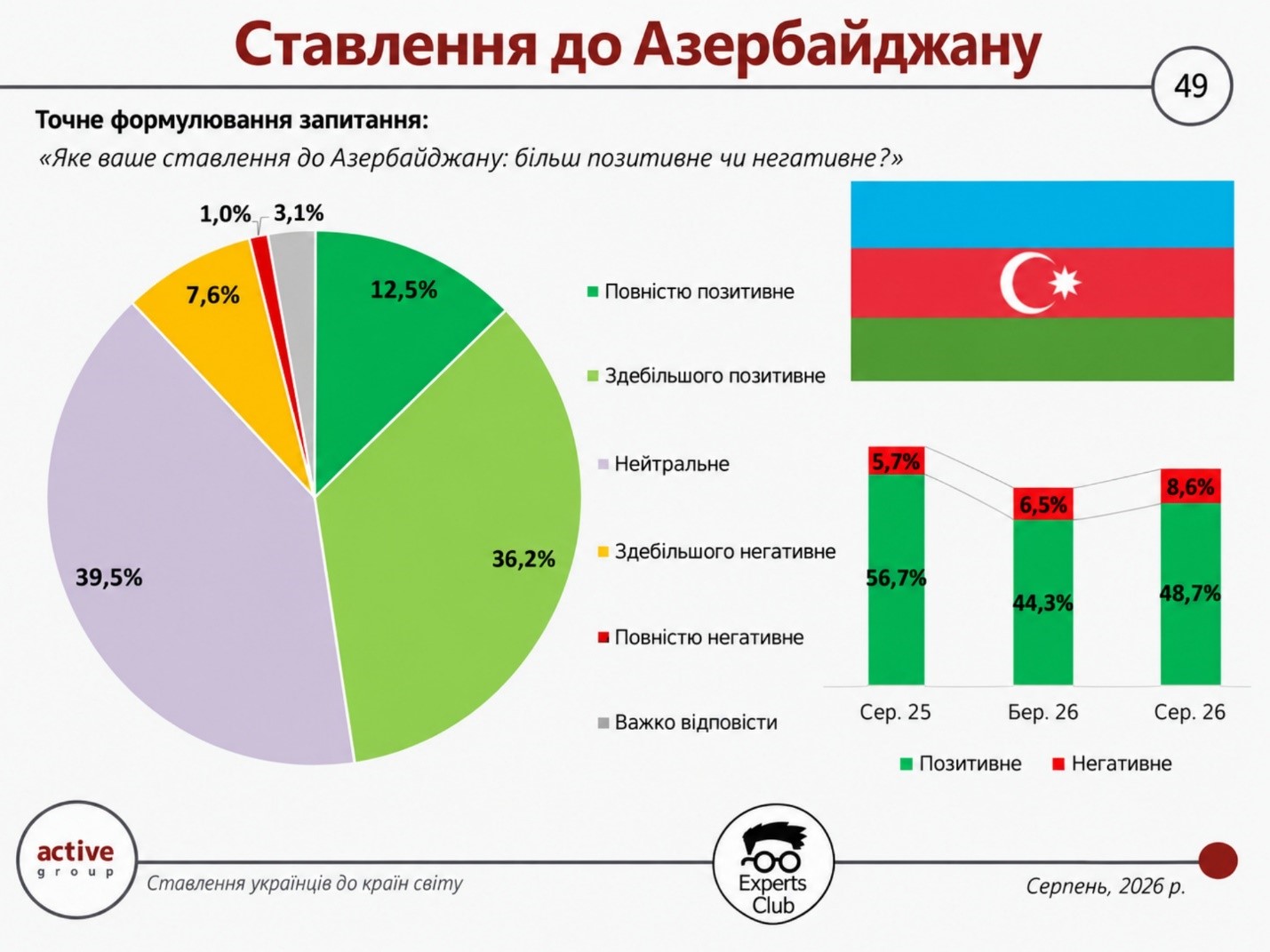
Consequently, over the course of five months, the positive segment increased by 4.4 percentage points—from 44.3% to 48.7%. Negative assessments also increased—by 2.1 percentage points—while the neutral segment shrank by 7.6 percentage points. The balance between positive and negative attitudes rose from +37.8 to +40.1 percentage points.
At the same time, a noticeable shift occurred within the positive segment: the share of fully positive responses decreased from 14.2% to 12.5%, while the share of mostly positive responses rose from 30.1% to 36.2%. This indicates an expansion of the overall group with a favorable attitude, although their assessments have become somewhat less categorical.
At the same time, the figures remain lower year-over-year. In August 2025, 56.7% of Ukrainians viewed Azerbaijan positively, while 5.7% viewed it negatively. Thus, the current trend shows an improvement compared to March but has not yet returned to the level of positive perception recorded a year earlier.
Maksym Urakin, founder of the Experts Club information and analytical center and a candidate of economic sciences, emphasized that public perception of international partners depends not only on the scale of economic relations but also on their visibility to citizens.
“The modern international economy is not just about foreign trade figures, but also about reputation, trust, political closeness, humanitarian presence, and a sense of partnership at the societal level. It is precisely within this framework that both Ukraine’s trade ties and the work of foreign embassies in Ukraine’s information and public spheres should be assessed,” Urakin noted.
In his assessment, for countries with a significant share of neutral responses, a systematic informational presence, the demonstration of specific economic and humanitarian projects, and active engagement by diplomatic missions with Ukrainian society remain crucial.
The latest wave of the survey shows that attitudes toward Azerbaijan are becoming more defined: the share of neutral responses has decreased significantly, while positive assessments have risen to nearly half of those surveyed. At the same time, the 39.5% of neutral responses indicate significant potential for further shaping the country’s public image.
ACTIVE GROUP, AZERBAIJAN, CAUCASUS, EXPERTS CLUB, international relations, PUBLIC OPINION, SOCIOLOGY, UKRAINE, URAKIN



