
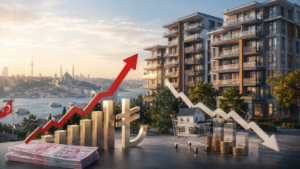
Muğla Province, home to the popular resorts of Bodrum, Marmaris, and Fethiye, remains Turkey’s most expensive region for buying a home. As of June 2026, the average price per square meter there reached 85,182 thousand Turkish lira, or approximately $1,850.
The average price of a residential property in Muğla was 11.074 million lira, which is equivalent to approximately $240,000, according to the June report by Emlakjet and Endeksa.
Istanbul took second place in terms of price per square meter, with an average of 63,788 thousand lira. The average property in Turkey’s largest city is valued at approximately 7.017 million lira.
Antalya ranks third, where a square meter costs an average of 55,264 thousand lira, and a property costs about 6.079 million lira. Next are Izmir, with 52,677 thousand lira per square meter, and Çanakkale, with 52,634 thousand lira.
Aydın also made the list of regions with the highest average property prices. The average housing price in the province, which includes the resort towns of Kuşadası and Didim, reached 6.782 million lira, with a price per square meter of 50,238 thousand lira.
High prices in coastal regions are driven by the concentration of resort real estate, limited land supply in the most sought-after locations, the development of premium projects, and demand from buyers in other regions of Turkey and abroad.
Nationwide, the average price per square meter of housing at the end of June was 40,944 thousand lira, while a standard property with an area of approximately 125 square meters cost 5.118 million lira, or roughly $111 thousand. Over the past year, prices in the national currency rose by 22.3%.
However, when adjusted for inflation, Turkish housing became 7.6% cheaper over the year. A real decline was recorded in all 30 of the country’s largest provinces. In Istanbul, inflation-adjusted prices fell by 5.5%; in Antalya, by 4.1%; in Ankara, by 3.5%; and in Izmir, by 9.5%.
The average payback period for rental investments in Turkey is estimated at 13 years. In Muğla, it reaches 18 years; in Antalya, 16 years; in Istanbul, 12 years; and in Ankara, 11 years. The longer payback period for resort properties is due to the high purchase price relative to long-term rental income.
In June 2026, 129,979 residential properties were sold in Turkey, which is 15.8% more than a year earlier. The number of mortgage transactions increased by 72.1% to 25,993.

According to estimates by “Intergal-Bud,” the Darnytskyi district has both the highest level of development activity and the highest concentration of housing near metro stations. This is stated in a study published by “Intergal-Bud.”
Approximately 70,000–74,000 apartments are located within a 15-minute commute of metro stations in the district. In the Holosiivskyi district, this figure is estimated at 53,000–57,000; in the Shevchenkivskyi district, 45,000–48,000; in the Obolonskyi district, 40,000–42,000; and in the Sviatoshynskyi district, 33,000–35,000 apartments.
The Darnytskyi and Dniprovskyi districts together form the largest cluster of modern residential development on the Left Bank. Analysts cite its advantages as a significant volume of new supply, lower apartment prices compared to central districts, proximity to the metro, and well-established commercial and social infrastructure.
An additional factor is the wider selection of properties available for purchase through government mortgage programs.
“Intergal-Bud” operates in the Ukrainian residential real estate market and develops projects in Kyiv and other cities across Ukraine.
Darnytskyi District, DEAL, INTERGAL-BUD, KYIV, NEW CONSTRUCTION, REAL ESTATE

The Darnytskyi District led Kyiv in the number of sales launches for new residential complexes and new phases of existing projects in 2025—accounting for 27% of all such launches in the capital.
This is according to a study published by Intergal-Bud, whose analysts examined the geography of new construction, the transportation accessibility of districts, and changes in the structure of demand in Kyiv’s primary housing market.
The Holosiivskyi District ranked second in terms of development activity, with a 19% share. The Obolon district accounted for 13% of sales launches, the Shevchenkivskyi district for 11%, and the Sviatoshynskyi district for 9%. Another 20% or so was distributed among the capital’s other districts.
According to the company’s assessment, the full-scale war has altered the geography of Kyiv’s primary market. Development activity is gradually shifting from central districts to areas where comprehensive development projects can be implemented and mid-range housing can be offered.
Until 2022, buyers tended to compare the right and left banks, the prestige of the district, and the distance to the city center. Now, the main criteria are the price of the apartment, access to the metro, shelters, the building’s autonomous power supply, and the ability to use public transportation during air raid alerts.
Existing social infrastructure—such as schools, kindergartens, medical facilities, supermarkets, and other amenities necessary for daily life—is also of great importance.
“Intergal-Bud” operates in the Ukrainian residential real estate market and develops projects in Kyiv and other cities across Ukraine.
Darnytskyi District, DEAL, INTERGAL-BUD, KYIV, NEW CONSTRUCTION, REAL ESTATE
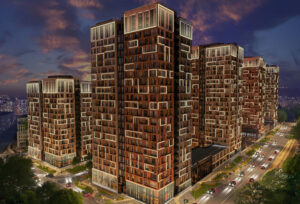
In 2026, Hong Kong remained the world’s most expensive city for purchasing a downtown apartment, according to the Deutsche Bank Research Institute’s study “Mapping the World’s Prices 2026.”
The average cost of housing in the city’s central districts is estimated at $27,753 per square meter. Zurich, Seoul, Singapore, and Geneva follow in the ranking. Despite a price decline of approximately 10% compared to pre-pandemic levels, Hong Kong retained its top spot.
Compared to the previous edition of the study, the average price per square meter in Hong Kong rose from $26,749 to $27,753. High real estate prices remain one of the main factors limiting housing affordability, even for city residents with relatively high incomes.
High real estate prices also affected Hong Kong’s ranking in the quality of life index. The city dropped from 48th to 55th place out of 69. Among other negative factors, the study’s authors cite air pollution and long commutes to work.

The number of inquiries from foreign clients regarding the purchase of luxury real estate in the U.S. during the first five months of 2026 doubled compared to the same period last year, according to an interim report by Coldwell Banker Global Luxury published on July 14.
The calculation is based on data from the international platform JamesEdition and reflects trends in buyer inquiries from January 1 through May 10, 2026, compared to the same period in 2025. Thus, this reflects a rise in interest among potential clients, rather than a doubling in the number of closed deals.
California accounted for the largest share of inquiries from foreign buyers. New York and Florida followed, with New York in particular showing the highest growth rate in interest from abroad. Foreign investors view American premium-class properties as a way to geographically diversify their assets and preserve capital over the long term.
Another trend has been the rise of so-called “landmaxxing”—the acquisition of neighboring homes and land parcels to expand one’s estate, enhance privacy, preserve the view from windows, or create multi-generational family estates. Demand for unique properties—including estates, historic buildings, branded residences, and private islands—has risen by 146%, while interest in land parcels has increased by 97%.
Nearly 40% of luxury real estate professionals surveyed reported that affluent buyers are willing to purchase homes in need of renovation if they are located in a prestigious neighborhood. At the same time, 63% of real estate agents noted an increase in the share of cash transactions among clients in the premium segment, compared to 51% a year earlier.
According to the latest study published by the National Association of Realtors, covering transactions from April 2024 through March 2025, foreigners purchased 78,100 U.S. residential properties with a total value of $56 billion. The number of purchases rose by 44%, and their total value increased by 33.2%. The median price of residential properties purchased by foreign buyers reached a record $494,400, with 47% of transactions paid for entirely in cash.
The top 10 countries of origin for foreign buyers included China with a 15% share, Canada with 14%, Mexico with 8%, India with 6%, the United Kingdom with 4%, as well as Brazil, Colombia, Nigeria, and the UAE, each with 3%. Israel ranked tenth with a 2% share. These figures apply to the entire U.S. residential real estate market, not just the luxury segment.
Among U.S. states, the top destinations for foreign buyers remained Florida, which accounted for 21% of transactions, California—15%, Texas—10%, New York—7%, and Arizona—5%.

Greece is gradually introducing new rules designed to speed up the sale, gifting, and inheritance of real estate, as well as to reduce the number of documents that owners must obtain on their own from government agencies. Some of the provisions are already in effect, while the full implementation of the rest will require additional decisions by government agencies.
One of the key innovations will be the “single window” principle. Notaries will independently obtain, through government digital systems, tax and insurance certificates, electronic property passports, cadastral extracts, and documents required for filing tax returns. This should reduce the number of times sellers and buyers need to contact various government agencies.
However, the “single window” system is not yet fully operational. The date of its practical launch, technical specifications, and the list of available operations must be determined by a joint decision of the relevant ministries.
The law also eliminates the requirement to attach a topographic plan to contracts for properties located in areas where cadastral surveying has already been completed. This provision takes effect upon the law’s publication.
Heirs are permitted to pay inheritance, gift, or property transfer tax on assets received from their parents directly from the proceeds of the property’s sale. Previously, the requirement to pay the tax before the transaction was finalized could force owners to seek additional financing or renounce the inheritance. Between 2013 and 2019, approximately 180,000 renunciations of inherited property were registered in the country.
Certain changes pertain to real estate seized for tax debts. Following the adoption of a supplementary resolution by the Independent State Revenue Service, notaries will be able to conduct the sale of such properties, withholding a portion of the proceeds to settle the debt. Once the specified amount is transferred, the tax lien will be lifted.
In addition, the state will restrict the assertion of rights to private land plots when correcting initial entries in the National Cadastre. Specifically, claims may not be asserted against certain properties whose ownership is confirmed by old purchase agreements, government land allocation deeds, or documents granting plots to resettlers and farmers.
The reform may make the Greek real estate market more accessible to foreign buyers, as it reduces the administrative burden and lowers the risk of transaction delays due to the lack of certain certificates. However, investors should note that some of the measures are being introduced gradually, and verification of a property’s legal status and cadastral records remains mandatory.



