
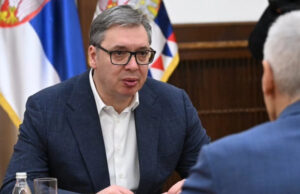
According to “Serbian Economist”, Serbian President Aleksandar Vučić has effectively announced the start of a new election campaign, stating at a rally of the ruling Serbian Progressive Party in Belgrade that he will resign as head of state in a few weeks. Formally, this appears to be a resignation nearly a year before the end of his term, but politically, it is less about the end of the Vučić era and more about an attempt to relaunch it in a new configuration.
Speaking to supporters at the “Serbia—One Family” rally, Vučić stated that this was likely his last address to such a large gathering of citizens in his capacity as president of the republic. He emphasized that for 14 years he had “served Serbia” in various government positions—as deputy prime minister, prime minister, and president—and thanked his supporters for their backing during periods of political crisis.
The key moment of his speech was the announcement of his upcoming resignation. “These are my last days and last weeks as President of the Republic,” Vučić said, rejecting his opponents’ accusations that he intends to cling to power at any cost. At the same time, he immediately noted that he is not leaving politics: according to him, if the leadership of the Serbian Progressive Party deems it necessary, he will assist the ruling party in the upcoming elections.
It is precisely this combination—resignation plus participation in the campaign—that constitutes the main political message of the statement. Vučić is not simply cutting short his presidential term, but is shifting the crisis of legitimacy into the electoral arena. For him, this is a way to regain the initiative after a year and a half of protests that began following the tragedy at the train station in Novi Sad, where the collapse of a canopy became a symbol of the public’s grievances regarding corruption, the quality of public administration, and oversight of infrastructure projects.
The name Vucic has proposed for the list—“United Serbia”—is also no coincidence. It is intended to pit the ruling party not against individual opposition parties, but against the entire protest movement, primarily the student movement. This name incorporates a tactic typical of Vučić: to present the elections not as a competition of platforms, but as a referendum on stability, national unity, and the government’s ability to protect the country from chaos.
At the same time, Vučić clearly seeks to prevent the protest agenda from becoming the sole framework of the campaign. That is why, in his speech, socioeconomic promises took on almost as much importance as political statements. He promised that in two years, the average salary in Serbia would reach 1,400 euros and the average pension would reach 650 euros; he also announced additional support measures for low-income pensioners.
The economic portion of the speech serves several purposes at once. First, it is intended to steer the campaign back onto a track favorable to the government—growth in incomes, investments, infrastructure, and industrial development. Second, it is aimed at the most loyal segments of the electorate, primarily pensioners and workers in public-sector-dependent industries. Third, it allows Vučić to shift from a defensive stance on the issues of corruption and protests to an offensive agenda focused on “future development.”
Separately, Vučić emphasized technological modernization, energy, and defense. He spoke about robot manufacturing, data centers, gas-fired power plants, hydropower, and even future small- and large-scale nuclear power facilities. This segment is aimed at a different audience—those who see Serbia as a regional industrial and technological hub.
However, the president’s early resignation also carries risks for Vučić. If he does indeed resign in the coming weeks, Serbia will enter a period of accelerated institutional procedures. Presidential elections must be held within a limited timeframe, and holding early parliamentary elections will require a separate decision to dissolve parliament. This means that the government is taking on the responsibility of drastically compressing the political calendar and conducting a campaign amid high levels of polarization.
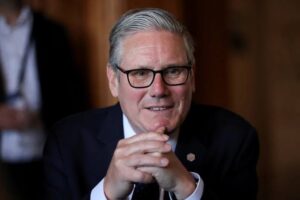
U.S. President Donald Trump has suggested that British Prime Minister Keir Starmer may resign as head of government following what he claims are failures on immigration policy and energy issues.
“Keir Starmer will resign as Prime Minister of the United Kingdom. He has suffered a major defeat on two very important issues—IMMIGRATION AND ENERGY (THE OPENING OF OIL FIELDS IN THE NORTH SEA!). I wish him all the best!” Trump said in a post published on the social media platform Truth Social.
As previously reported, Reuters noted that British Prime Minister Keir Starmer plans to announce his resignation on Monday and intends to present a clear timeline for his departure.
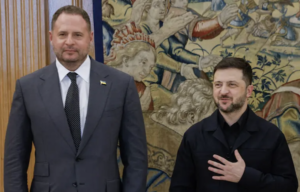
Ukrainian President Volodymyr Zelensky announced a restart of the Presidential Office, and Andriy Yermak submitted his resignation as head of the Presidential Office.
“I want no one to have any questions about Ukraine. Therefore, today we have the following internal decisions. First. There will be a reboot of the Office of the President of Ukraine. The head of the Office, Andriy Yermak, has submitted his resignation,” Zelensky said in an evening address on Friday.
He thanked Yermak for always representing Ukraine’s position in the negotiation track exactly as it should be.
“It has always been a patriotic position. But I want there to be no rumors or speculation,” the president emphasized.
Earlier on Friday, the National Anti-Corruption Bureau of Ukraine (NABU) and the Specialized Anti-Corruption Prosecutor’s Office (SAPO) reported conducting searches at Andriy Yermak’s residence.
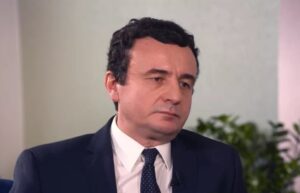
Kosovo’s Prime Minister Albin Kurti has resigned, according to Politika. The reasons for the resignation are not specified, but it comes amid ongoing tensions between Kosovo and Serbia.
Relations between Serbia and Kosovo: historical context
Kosovo, formerly an autonomous region within Serbia, unilaterally declared independence on February 17, 2008. Serbia did not recognize this independence and continues to consider Kosovo its territory.
The conflict between ethnic Albanians and Serbs in Kosovo escalated in 1998, leading to armed confrontation. In 1999, after NATO intervention and the withdrawal of Yugoslav troops,
Kosovo came under UN administration. Since then, the region has been the subject of international negotiations and disputes.
Biography of Albin Kurti
Albin Kurti was born on March 24, 1975 in Pristina. He graduated from the University of Pristina with a degree in Computer Science and Telecommunications. In 1997, he became the vice president of the student union and an organizer of peaceful protests against the Serbian government.
During the conflict in Kosovo, Kurti was arrested and sentenced to 15 years in prison, but was released in 2001. In 2005, he founded the Self-Determination movement (Vetëvendosje), which advocates for the full independence of Kosovo.
He first became prime minister in February 2020, but his government was overthrown a few months later. In March 2021, he became prime minister again and held the position until his resignation in April 2025.
Albin Kurti’s resignation could affect the further development of relations between Kosovo and Serbia, as well as the internal political situation in the entire region.
Source: https://t.me/relocationrs/822
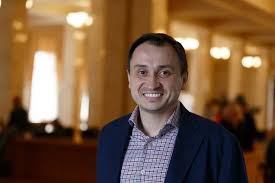
Mykola Solsky submitted a letter of resignation from the post of Minister of agrarian policy and food of Ukraine, the Verkhovna Rada will consider it at one of the next plenary sessions, said the Chairman of the Verkhovna Rada Ruslan Stefanchuk.
“The Verkhovna Rada of Ukraine received a statement from Mykola Solsky on resignation from the post of Minister of agrarian policy and food of Ukraine. The statement will be considered at one of the next plenary sessions,” he wrote on his Facebook page on Thursday.
The Ministry of agrarian policy and food in turn published a comment from Solskiy about the application submitted to the Parliament.
“Yes, I wrote a letter of resignation from the post of Minister. In such a situation, I believe it is the right step. The Verkhovna Rada will decide to accept my resignation – I will be grateful for such a decision, will decide that I should work further – I will continue to work”, – he explained.
As reported, on April 23, the NABU notified Solsky about suspicion in the possession of state land for 291 million UAH and an attempt to seize land for another 190 million UAH.
The Minister denied the accusations and stated that “the events, which, according to NABU, are reported in the suspicion to me, relate to the period 2017-2018, that is, at the time when I was a lawyer and was neither the Minister of agrarian policy and food of Ukraine, nor the Chairman of the Verkhovna Rada Committee on agrarian and land policy”.
According to his information, the circumstances of seven years ago concern a dispute between state enterprises and individuals, in particular ATO military personnel, over lands granted to them in possession in accordance with the law.
On April 25, leading agrarian associations petitioned the Supreme Anti-Corruption Court to take Solskyy on bail, and also expressed confidence in the work of the Ministry of Agrarian Policy.
The HACC heard the prosecution and defense sides during the trial on Thursday. SAP demanded for the current Minister of detention, and in case of a decision to release on bail two representatives of agrarian associations – chairman of the All-Ukrainian Agrarian Confederation Maria Didukh and deputy head of the All-Ukrainian Agrarian Rada Denis Marchuk – to prohibit Solskiy communication with other suspects, travel from Kiev, obliged to wear an electronic bracelet and bail 200 million hryvnia.
According to the broadcast of the meeting, the court declared a break and will continue consideration of the motion SAP on Friday morning.
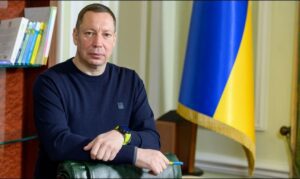
The head of the National Bank of Ukraine, Kirill Shevchenko, submitted his resignation to the President of Ukraine on Tuesday, the NBU said in a statement.
“For reasons related to health, which I cannot ignore in the future, I made a difficult decision for myself. I am leaving the post of head of the NBU. I have asked the President of Ukraine to accept my resignation,” Shevchenko is quoted as saying.
He thanked the head of state Volodymyr Zelensky for the trust shown and joint work for the benefit of the state in peacetime and wartime, as well as the NBU team and colleagues from all over the financial market.
“From the first days at the NBU, I was, first of all, an anti-crisis manager and fulfilled my mission: I ensured the smooth operation of the financial system in the extremely difficult time of a full-scale war. The war became another difficult test for our team and me personally – and we passed it with dignity,” – said the head of the NBU.
According to him, the National Bank managed to ensure the smooth operation of the financial system, prevent panic in the foreign exchange market, stop a large-scale outflow of capital in order to protect reserves, keep inflation at an adequate level and “support the state budget, understanding the difficulties in attracting funds during the war.”
“Today, the NBU is indeed stronger than ever in its ability to meet challenges and overcome crises, it is worthy of being tested by war. And it retains its ability to be the basis of post-war economic recovery and direct the entire financial sector to this,” Shevchenko stressed.
He said he was handing over the banking system to a strong, capitalized, resilient banking system for those who would come after him.
“Until the relevant decisions of the Verkhovna Rada of Ukraine on the dismissal and appointment of the head of the National Bank are made, the Board of the National Bank will continue to perform its functions and manage the activities of the National Bank in its current composition,” the message says.
As reported, the Rada appointed Shevchenko head of the NBU on July 16, 2020, before that he was the head of the board of the state-owned Ukrgasbank.
Earlier, on July 1, 2020, the head of the NBU, Yakov Smoliy, resigned due to political pressure.



