
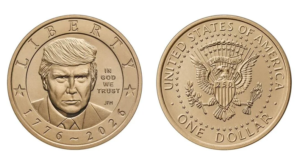
The U.S. Mint plans to begin minting a dollar coin featuring the country’s current president, Donald Trump.
Treasury Secretary Scott Bessent unveiled sketches of the new “gold coin” on Wednesday, one side of which features a profile of Trump alongside the phrase “In God We Trust.”
“To commemorate the 250th anniversary of American independence, the U.S. Mint will begin minting this new $1 gold coin to honor the enduring legacy of freedom and the enduring symbol of patriotism,” Bessent wrote on social media.
The Treasury Department and the Mint did not respond to inquiries from The Wall Street Journal regarding the mintage and release date of these coins, as well as the material from which they will be made and where they will be available.
The publication notes that it is rare for a sitting president to be depicted on U.S. commemorative coins. In the U.S., coins bearing the image of the head of state are usually issued posthumously. The only exception was a 50-cent coin issued in 1926 to mark the 150th anniversary of U.S. independence. Its obverse features the profiles of the first U.S. president, George Washington, and the then-sitting president, Calvin Coolidge, while the reverse depicts the Liberty Bell.
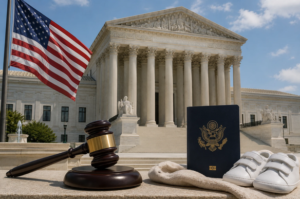
The U.S. Supreme Court ruled that children born on U.S. soil to parents who are in the United States illegally or on a temporary basis are U.S. citizens from the moment of birth. The decision effectively blocks President Donald Trump’s attempt to restrict the automatic granting of citizenship by birthright.
The case was heard in connection with Executive Order 14160, “Protecting the Meaning and Value of American Citizenship,” which Trump signed on January 20, 2025. The order proposed that children born in the U.S. to parents without permanent immigration status should not automatically be considered U.S. citizens.
The court concluded that such children are protected under the Fourteenth Amendment to the U.S. Constitution, which states that all persons born or naturalized in the United States and subject to its jurisdiction are citizens of the United States and of the state in which they reside.
The ruling is significant not only for immigration policy but also for the market for services related to childbirth in the United States. In practice, it means that U.S. passports obtained by virtue of birth on U.S. soil remain valid, and the right to citizenship by birth itself cannot be revoked by presidential decree.
However, the debate surrounding so-called “birth tourism” is not over. Following the court’s decision, the Trump administration may tighten controls over visa applications, travel by pregnant women, and cases of potential fraud upon entry into the United States. But this is a different legal matter: combating visa violations is not the same as revoking the citizenship of a child born on U.S. soil.
For foreigners who view the U.S. as a destination for childbirth, the main takeaway is this: the fundamental constitutional principle has been upheld, but immigration and visa risks may increase. U.S. authorities may scrutinize the purpose of travel, financial documents, medical plans, and any potential concealment of true intentions more closely when issuing visas or at the border.
For the international market for immigration and medical services, the Supreme Court’s decision means the preservation of one of the most well-known mechanisms of jus soli—citizenship by place of birth. The United States remains one of the key countries where the mere fact of being born on U.S. soil grants a child citizenship, regardless of the parents’ citizenship, with the exception of a few specific cases.
Thus, Trump’s executive order has not altered the fundamental principle of U.S. citizenship. Children born in the United States are still entitled to U.S. citizenship, but there will likely be more scrutiny, legal disputes, and political pressure surrounding travel for the purpose of giving birth.
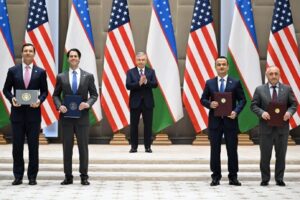
Uzbekistan and the United States of America have launched the “U.S.–Uzbekistan” Joint Investment Platform, designed to expand bilateral cooperation in the areas of investment and export financing, as well as to attract additional resources for the implementation of strategically important projects.
The new platform is being created to identify, support, and promote strategic investment projects of mutual interest to Uzbekistan, the U.S., and their partners. The mechanism also provides for the development of cooperation in the field of export financing and the attraction of international capital to priority sectors of the economy.
The platform’s key areas of focus include energy, infrastructure, transportation and logistics, information and communication technologies, the pharmaceutical industry, as well as the exploration and development of critical mineral resources.
Particular attention will be paid to projects capable of strengthening production and logistics supply chains, ensuring a sustainable energy supply, and promoting the development of modern high-tech manufacturing.
The new mechanism is expected to serve as a tool for mobilizing private capital and to enable sovereign wealth funds, international financial institutions, multilateral development banks, and other major investment organizations to participate in financing promising projects.
According to DFC estimates, Uzbekistan and Central Asia have significant economic potential due to growing global demand for critical minerals, an increasing need for reliable energy supplies, and expanding trade flows along the Trans-Caspian Transport Corridor.
DFC CEO Ben Black noted that the launch of the platform is the first step toward implementing investments that align with the strategic interests of both countries. According to him, the new mechanism will help strengthen supply chains and create additional opportunities for economic growth in the United States and Uzbekistan.
At the same time, the parties are discussing moving toward the practical implementation of a number of major joint projects. Promising areas include the construction of a new airport in Tashkent, the creation of a modern medical complex in the Fergana region, and the launch of a digital bank.

Eco-Snack LLC (Agronomichne village, Vinnytsia region), a Ukrainian manufacturer of fruit snacks under the Bob Snail brand, has begun selling its products at Walmart, the largest retail chain in the U.S.
“I am extremely pleased to announce that Bob Snail is officially available in Walmart stores across the United States. Starting this weekend, our products can be found in approximately 1,100 Walmart stores nationwide,” Pavlo Miroshnychenko, sales director of Bob Snail’s U.S. branch, announced on social media. Customers can find Bob Snail in-store or order online.
As previously reported, Bob Snail recently entered another major U.S. retail chain, Target, where its products are available on the shelves of nearly 2,000 stores.
According to data from YouControl, the ultimate beneficial owners of Eco-Snack LLC, via the Cypriot company WHS World Healthy Snack Limited, are Mykhailo Siverchuk and Yevhen Shugaev, each holding a 37.19% stake on an equal basis.
Earlier this year, it was reported that the HCGF IV fund, managed by Horizon Capital, had acquired a stake in the company, though the investor’s share was not disclosed.
According to YouControl, Eco-Snack’s revenue for 2025 increased by 22.3% compared to 2024—to 1 billion 813.1 million UAH—while net profit decreased by 37.2%—to 148.9 million UAH.
The brand’s products are available in 26 countries worldwide. Bob Snail has subsidiaries in Poland, Canada, the United States, and the United Kingdom.
Target Corporation is an American retail chain and one of the largest retailers in the United States. Target’s revenue for fiscal year 2025 exceeded $106 billion.

The spot price of gold hit a new record high on Monday. As of 9:34 a.m., it stands at $4068.74 per ounce, which is 1.3% higher than the previous session’s close. Earlier in trading, the spot price of gold rose to $4078.24 per ounce, marking an all-time high. Gold futures on the Comex exchange are up 2.2%, reaching $4087.4 per ounce.
The precious metal is supported by rising tensions between the United States and China, as well as expectations of further interest rate cuts by the Federal Reserve.
On Friday, U.S. President Donald Trump announced the possibility of significantly increasing import tariffs on Chinese goods in response to Beijing’s tightened export controls on rare earth metals. He also said he saw no point in meeting with Chinese President Xi Jinping. However, on Sunday, Trump stated that Washington wants to help Beijing rather than harm it and suggested that he might still meet with Xi later this fall.
In addition, traders expect two more rate cuts by the Fed before the end of the year. According to futures market pricing, the probability of a 25-basis-point rate cut by the U.S. central bank at its next meeting on October 28–29 is estimated at 95.7%. Investors in the derivatives market also expect another similar cut in December.
Earlier, the analytical center Experts Club released an analysis of the world’s leading gold-producing countries in a video on its YouTube channel — https://youtube.com/shorts/DWbzJ1e2tJc?si=9YBue5CS6dz-tA6_
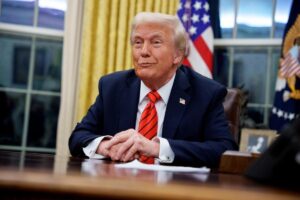
Beijing urges Washington to adhere to previously reached consensuses and considers President Donald Trump’s threats of new tariffs a mistake, the Chinese Ministry of Commerce said.
“China urges the United States to immediately reconsider its mistaken actions, adhere to the important consensuses reached during telephone conversations between the two heads of state, safeguard the hard-won results of consultations, and continue to use the mechanism of China–US trade and economic consultations,” the statement published on the ministry’s website said.
Beijing emphasized that it stands for resolving differences through dialogue, and if Washington insists “on the wrong path,” China will take measures to protect its legitimate rights and interests.
“Deliberate threats of high tariffs are the wrong way to build relations with China,” the ministry stressed. The agency also noted that US statements about possible new tariffs are an example of double standards.
On Saturday night, Trump announced that he intends, starting November 1, “or maybe even earlier,” to impose additional 100% tariffs on goods imported from China.
“Starting November 1, or perhaps earlier, depending on China’s actions, the United States will impose 100% tariffs in addition to the existing ones. In addition, starting November 1, we will implement export control measures for any vital software,” he wrote on Truth Social.
Trump explained that he made this decision because China “declared that starting November 1 it would implement serious export control measures on almost all products manufactured in the PRC.” “This will affect all countries and is clearly a plan that China has been preparing for years,” the US president said.



