

Ukrainians’ attitude toward Slovakia in August 2026 improved significantly compared to the previous survey: the share of positive assessments rose to 40.7%, while negative assessments fell to 12.2%. Respondents with a neutral attitude remain the largest group—44.4%, according to the Experts Club Information and Analytical Center. Experts.news
According to the results of the August survey, 9.8% of Ukrainians have a completely positive attitude toward Slovakia, and 30.9% have a mostly positive attitude. A neutral attitude was expressed by 44.4% of respondents. 10.8% view the country mostly negatively, 1.4% view it entirely negatively, and another 2.7% were undecided.
Based on the rounded figures in the table, the balance of positive and negative assessments is approximately plus 28.5 percentage points, while in the consolidated survey results it is reported at plus 28.6 percentage points. This is one of the most notable examples of improved public perception among the countries of Central and Eastern Europe.
In March 2026, 34.3% of respondents viewed Slovakia positively: 8.9% viewed it entirely positively and 25.4% viewed it mostly positively. At that time, 18.2% of respondents expressed a negative attitude, while 43.6% were neutral.
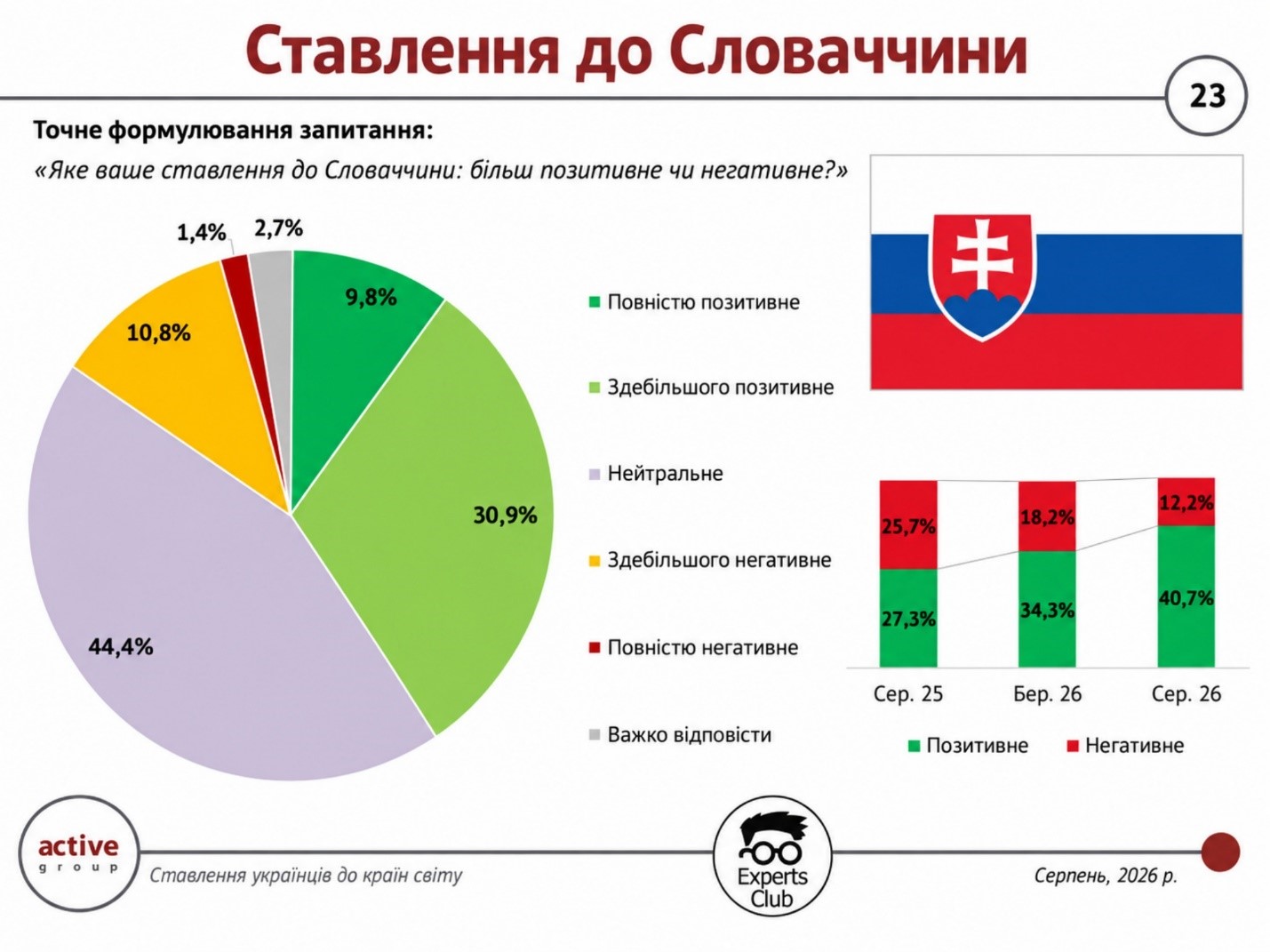
Thus, over the course of five months, the share of positive assessments increased by 6.4 percentage points—from 34.3% to 40.7%—while negative assessments decreased by approximately 6 percentage points—from 18.2% to 12.2%. The neutral group remained virtually unchanged—43.6% in March versus 44.4% in August.
Even more noticeable is the shift in the balance between positive and negative assessments: it rose from approximately plus 16.1 percentage points to plus 28.6 percentage points, or by more than 12 percentage points. Unlike a number of other countries in the region, where August saw a deterioration or largely stable trends, the survey shows a shift toward a more favorable perception in the case of Slovakia.
Maksym Urakin, founder of the Experts Club information and analytical center and a candidate of economic sciences, believes that the improvement in attitudes toward Slovakia may be linked to a gradual shift from an emotional perception of political rhetoric to a more pragmatic assessment of the actual relations between the two countries.
“For Ukraine, Slovakia is a neighboring country with which there are very concrete daily ties: trade, transit, energy, border cooperation, humanitarian contacts, and the movement of people. When the public sees these practical ties and they remain stable, it gradually softens even a rather tense political backdrop. In my opinion, the current increase in positive assessments indicates precisely this shift toward a more pragmatic perception of Slovakia,” noted Maksym Urakin.
According to him, the simultaneous growth of the positive segment and the decline in the negative segment are particularly telling.
“It’s not just the shift in the overall balance that’s important here. Over the course of five months, the share of negative assessments has fallen by about a third, while positive assessments have increased significantly. This means that some of the people who previously viewed Slovakia critically are shifting not just to the neutral group, but to the positive one as well. At the same time, the 44.4% of neutral responses indicate that there remains significant potential for further shaping the country’s image in Ukraine,” added Urakin.
The survey was conducted in August 2026 using an online self-administered questionnaire via the SunFlowerSociology panel among 800 Ukrainian citizens aged 18 and older. The previous wave in March also included 800 respondents; the sample was representative by age, gender, and region, with a maximum theoretical margin of error of ±3.5 percentage points for a 50% indicator.
ACTIVE GROUP, Central Europe, EXPERTS CLUB, international relations, PUBLIC OPINION, SLOVAKIA, SOCIOLOGY, UKRAINE, URAKIN
The Czech Republic continues to enjoy a high level of positive perception among Ukrainians, although in August 2026 the share of favorable assessments decreased compared to March. 61.3% of respondents view the country positively, 5.1% negatively, while nearly one-third of respondents hold a neutral stance, according to the Experts Club information and analytical center.
According to the results of the August survey, 18.8% of Ukrainians view the Czech Republic entirely positively, and 42.5% view it mostly positively. A neutral stance was chosen by 32.1% of respondents. 4.1% view the country mostly negatively, 1% view it entirely negatively, and another 1.6% were undecided.
The balance of positive and negative assessments stands at plus 56.2 percentage points. This is the highest figure among the Central and Eastern European countries included in the study. Following the Czech Republic in this regional group are Moldova, Romania, Bulgaria, and Slovakia.
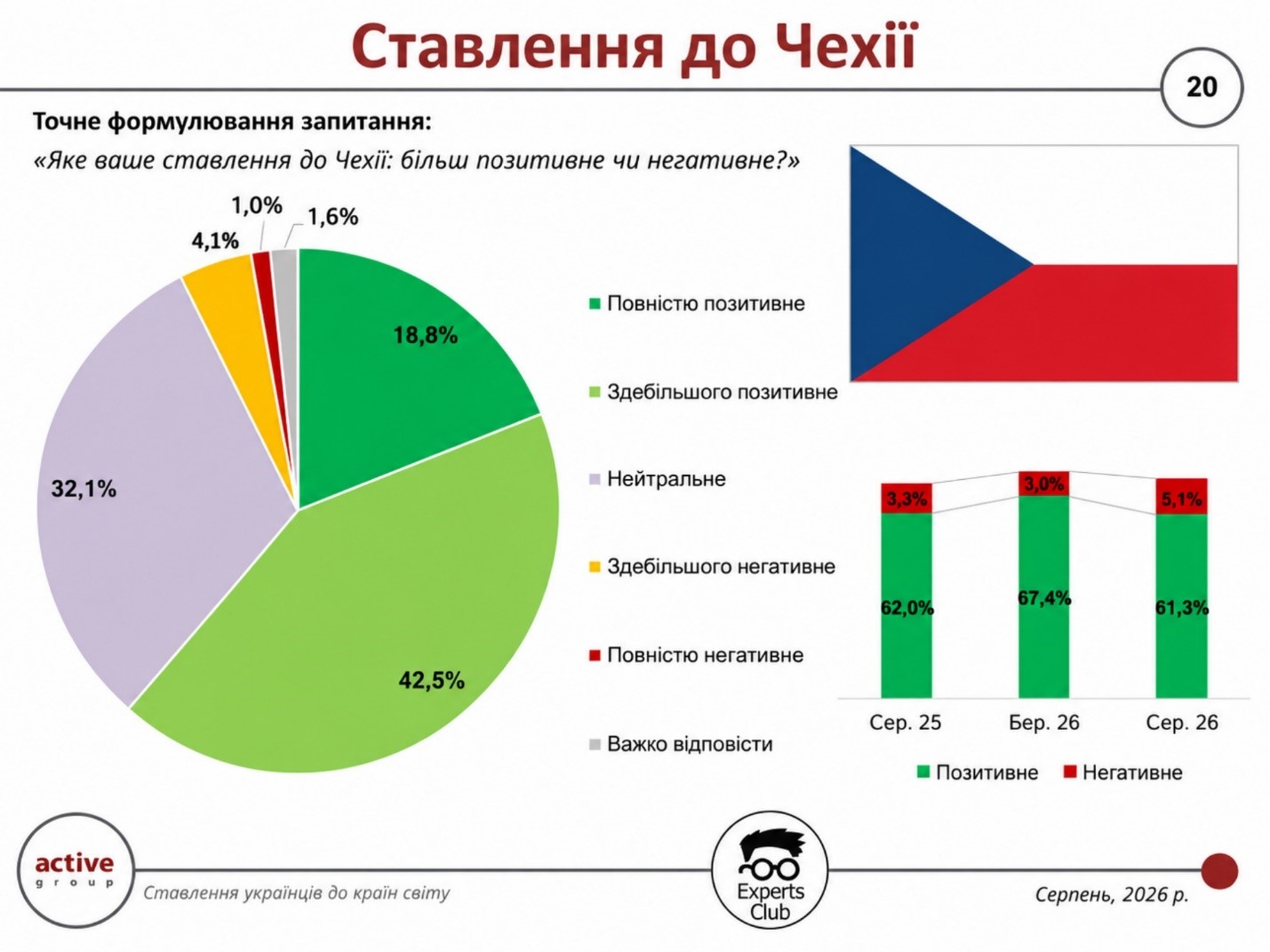
Compared to the previous wave of the survey, attitudes toward the Czech Republic have deteriorated somewhat. In March 2026, 23.3% of respondents rated the country entirely positively, and 44.1% rated it mostly positively—meaning the total share of positive responses was 67.4%. 28.2% had a neutral attitude, and about 3% had a negative one.
Thus, over the course of five months, the share of positive assessments fell by 6.1 percentage points—from 67.4% to 61.3%. Negative responses increased by approximately 2.1 percentage points, while neutral responses rose by 3.9 percentage points. The balance between positive and negative attitudes decreased from approximately plus 64.4 percentage points to plus 56.2 percentage points.
At the same time, these changes do not indicate a fundamental shift in Ukrainians’ attitudes toward the Czech Republic. Positive assessments outnumber negative ones by more than 12 to 1, and the main shift in responses was toward a neutral stance. The Czech Republic also remains significantly higher than most other countries in Central and Eastern Europe in terms of the balance of public perception.
Maksym Urakin, founder of the Experts Club information and analytical center and a candidate of economic sciences, commenting on the results of a previous study on the Czech Republic, attributed the high level of positive sentiment to the nature of bilateral relations.
“Ukrainians’ positive attitude toward the Czech Republic is explained not only by historical proximity but also by Prague’s active support for Ukraine. At the same time, economic relations between the countries are characterized by a significant imbalance—imports from the Czech Republic substantially exceed exports. This creates opportunities for developing new areas of cooperation, particularly in the fields of high technology, investment projects, and energy,” Urakin noted.
The latest wave of the survey shows that the overall positive image of the Czech Republic among Ukrainians remains, although its intensity has decreased compared to the spring. At the same time, the increase in neutral assessments is more noticeable than the rise in negative ones.
The survey, conducted in August 2026, used self-administered online questionnaires from the SunFlowerSociology panel among 800 Ukrainian citizens aged 18 and older. The previous survey in March also included 800 respondents; the sample was representative by age, gender, and region, and the maximum theoretical margin of error for indicators at the 50% confidence level was ±3.5 percentage points.
ACTIVE GROUP, Central Europe, CZECH REPUBLIC, EXPERTS CLUB, international relations, PUBLIC OPINION, SOCIOLOGY, UKRAINE, URAKIN
Ukrainians’ attitude toward Serbia in August 2026 remains predominantly neutral: 53.4% of respondents hold this view. 22.7% of those surveyed view the country positively, while 20.3% view it negatively. Compared to March, the figures have changed only slightly; however, on a year-over-year basis, perceptions of Serbia have improved noticeably, according to the Experts Club Information and Analytical Center.
According to the results of the August survey, 5.5% of Ukrainians view Serbia entirely positively, while 17.2% view it mostly positively. A neutral response was chosen by 53.4%. The country is viewed mostly negatively by 17.6%, entirely negatively by 2.7%, and another 3.5% were undecided.
According to the rounded data in the table, the balance between positive and negative attitudes is approximately plus 2.4 percentage points. Thus, positive assessments already slightly outweigh negative ones, although the difference remains small, and more than half of Ukrainians continue to hold a neutral position.
In March 2026, 21.7% of respondents viewed Serbia positively: 5.6% viewed it entirely positively and 16.1% viewed it mostly positively. Fifty-five percent held a neutral position, 19.6% viewed the country negatively, and another 3.7% were undecided.
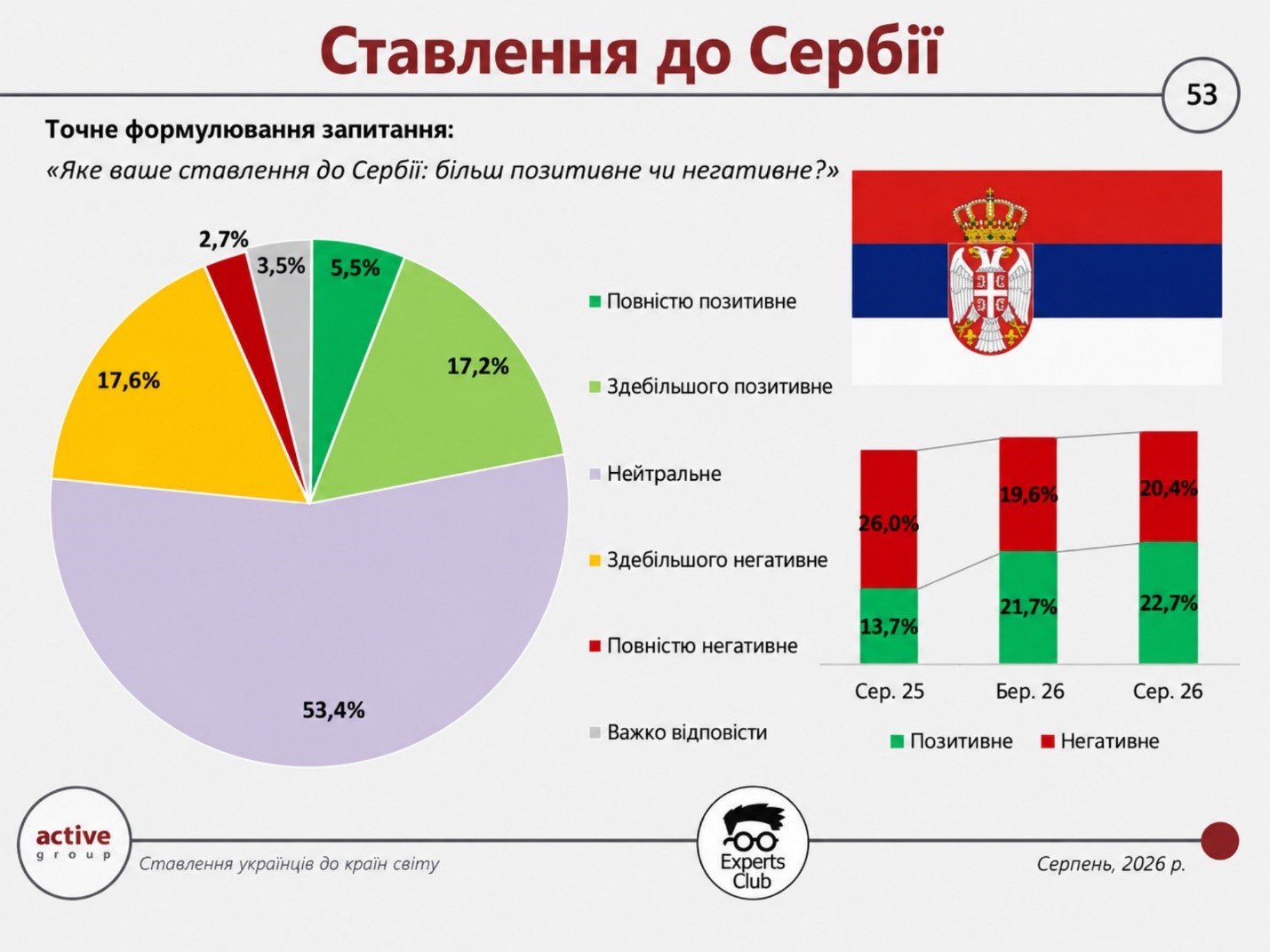
Thus, over the course of five months, the positive segment grew by approximately 1 percentage point—to 22.7%—while the negative segment also increased slightly—by about 0.7 percentage points—and the share of neutral responses decreased by 1.6 percentage points. In fact, following a noticeable improvement recorded in the spring, attitudes have stabilized.
The annual trend is much more pronounced. In August 2025, only 13.7% of Ukrainians had a positive attitude toward Serbia, while 26% had a negative one. By March 2026, the positive figure had risen to 21.7%, while the negative figure had fallen to 19.6%. Thus, compared to August of last year, positive attitudes are now approximately 9 percentage points higher, while negative attitudes are nearly 6 percentage points lower.
Maksym Urakin, founder of the Experts Club information and analytical center and a candidate of economic sciences, attributed this positive trend, in particular, to the more active work of Serbia’s diplomatic mission in Ukraine, headed by Ambassador Extraordinary and Plenipotentiary Andon Sapundži. The Serbian Embassy resumed operations in Kyiv in 2025, and Sapundži publicly emphasized the need to restore active cooperation between the two countries.
“The results regarding Serbia show that Ukrainian society reacts quite sensitively to the foreign policy behavior of other countries. The increase in positive assessments indicates a certain softening of perceptions, but the high level of neutrality means that the country’s image remains ambiguous. In such cases, consistency in actions and signals that build trust at the societal level plays a key role. “The active involvement of the Serbian diplomatic mission, led by the new ambassador, in humanitarian and economic initiatives and in establishing intergovernmental dialogue has undoubtedly had a positive impact on Ukrainians’ attitudes toward this Balkan country,” Urakin noted.
According to Maksym Urakin, an additional factor in 2026 was the noticeable revival of political and economic contacts between Kyiv and Belgrade. In May, a Serbian-Ukrainian business forum was held in Belgrade, attended by more than 40 representatives of companies from both countries. The forum discussed the resumption of negotiations on a free trade zone, the expansion of trade, and the possibility of using Serbia as one of the logistics and business hubs for Ukrainian companies in the Balkans.
In addition, in July, Serbian President Aleksandar Vučić traveled to Kyiv for the Ukraine–Southeast Europe Summit, and in September he visited Ukraine again to participate in the Carpathian Summit.
In the first half of 2026, Ukraine’s trade turnover with Serbia totaled approximately $345.9 million, of which $102.7 million came from Ukrainian exports and $243.2 million from imports of Serbian goods. The trade deficit for Ukraine amounted to approximately $140.5 million.
Current results indicate that the long-term trend in attitudes toward Serbia is more positive than it was a year ago, but a significant neutral group—more than half of those surveyed—leaves considerable potential for further shaping the country’s image through diplomatic, humanitarian, cultural, and economic contacts.
ACTIVE GROUP, Andon Sapundži, EXPERTS CLUB, international relations, PUBLIC OPINION, SERBIA, SOCIOLOGY, the Balkans, UKRAINE, URAKIN

Italy continues to enjoy one of the highest levels of positive perception among Ukrainians: in August 2026, 70.1% of respondents viewed the country positively, while only 2.9% viewed it negatively. Compared to March, the overall share of positive assessments remained virtually unchanged; however, within this group, there was an increase in the number of respondents with an unequivocally positive attitude. This is evidenced by the results of a study conducted by Active Group and Experts Club, according to the Experts Club Information and Analytical Center.
According to the results of the August survey, 24.3% of Ukrainians have a completely positive attitude toward Italy, and 45.8% have a mostly positive attitude. Twenty-five percent of respondents hold a neutral position. Two point seven percent view the country mostly negatively, only 0.2% completely negatively, and another 2% were undecided.
The balance of positive and negative assessments stands at plus 67.2 percentage points. Based on this indicator, Italy ranks among the countries with the highest level of positive attitudes among Ukrainians and holds a high position among the nations of Western and Southern Europe.
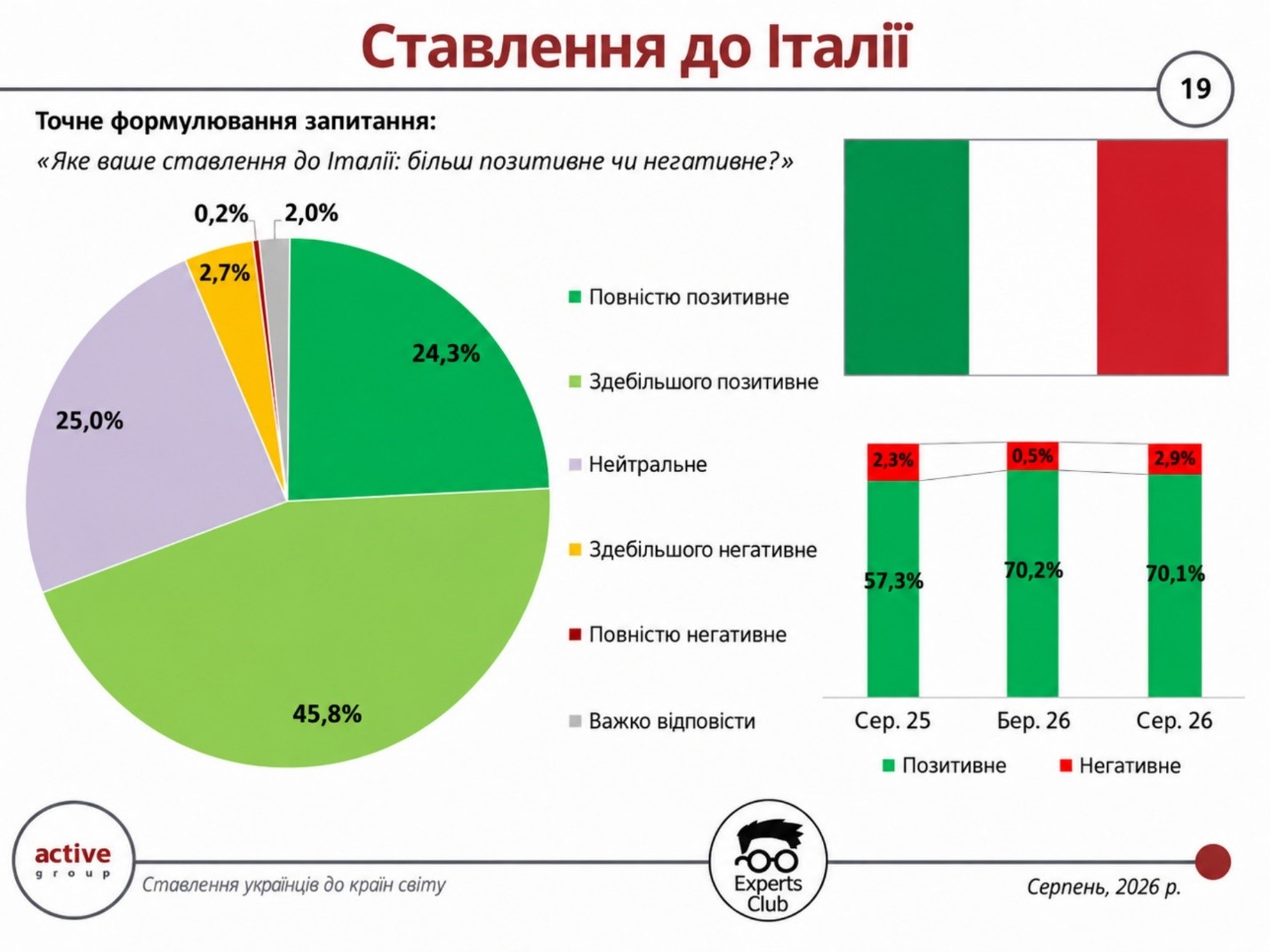
In March 2026, the total share of positive assessments of Italy stood at 70.2%. At that time, 19.3% of respondents described their attitude as entirely positive, and 50.8% as mostly positive. 28.9% had a neutral attitude toward the country, while only about 0.5% had a negative one.
Thus, the overall level of positive attitudes has remained virtually unchanged over the past five months—at around 70%. At the same time, the share of entirely positive assessments rose by approximately 5 percentage points—from 19.3% to 24.3%—while the share of mostly positive assessments fell by roughly the same 5 percentage points. This indicates a certain increase in the intensity of positive perceptions among a segment of respondents.
At the same time, the share of neutral assessments fell from 28.9% to 25%, while negative assessments rose to 2.9%. As a result, the balance of positive and negative attitudes declined from approximately plus 69.7 percentage points in March to plus 67.2 percentage points in August, though it remains very high.
“The consistently high level of positive attitudes among Ukrainians toward Italy is important not only in terms of public sentiment but also in the context of economic ties between the two countries. Italy remains one of Ukraine’s key trading partners in Europe, and a positive perception of the country creates a favorable backdrop for the development of business contacts, investments, tourism, and humanitarian cooperation. It is particularly telling that the share of unequivocally positive assessments is growing, even though the overall level of favorability has remained very high for quite some time,” noted Maksym Urakin, founder of the Experts Club information and analytical center.
Italy also carries significant economic weight for Ukraine. In the first half of 2026, it ranked third among individual countries in terms of the volume of Ukrainian goods exports—approximately $1.28 billion. The high level of public favor is thus combined with significant trade and economic ties.
A new wave of the survey shows that this positive image has generally been maintained: about seven out of ten Ukrainians continue to view Italy positively, and the share of unequivocally positive responses has even increased.
The survey was conducted in August 2026 using self-administered online questionnaires in the SunFlowerSociology panel among 800 Ukrainian citizens aged 18 and older. The sample is representative by age, gender, and region; the maximum theoretical margin of error is ±3.5 percentage points.
ACTIVE GROUP, EXPERTS CLUB, FOREIGN TRADE, international relations, ITALY, PUBLIC OPINION, SOCIOLOGY, UKRAINE, URAKIN
Turkey continues to enjoy a predominantly positive perception among Ukrainians: in August 2026, a total of 52.3% of respondents expressed a positive attitude toward the country, while about 7.5% expressed a negative one. At the same time, compared to the previous survey in March, the share of positive assessments has decreased slightly. This is evidenced by the results of the third wave of the Active Group and Experts Club survey, according to the Experts Club Information and Analytical Center.
According to the results of the August survey, 11.2% of Ukrainians have a completely positive attitude toward Turkey, and 41.1% have a mostly positive attitude. A neutral stance is held by 37.6% of respondents. 6.7% view the country mostly negatively, 0.8% view it entirely negatively, and another 2.7% were undecided.
The balance between positive and negative attitudes stands at approximately plus 44.9 percentage points and is the highest among the Middle Eastern countries included in the study. Thus, despite a slight decline in the indicator, Turkey remains a country where positive assessments clearly outweigh negative ones.
Compared to March 2026, positive attitudes have weakened moderately. At that time, 14.5% of respondents viewed Turkey entirely positively, and 40.6% viewed it mostly positively—meaning the combined positive rating stood at 55%. Negative responses accounted for 5.6%, and neutral responses for 36.4%.
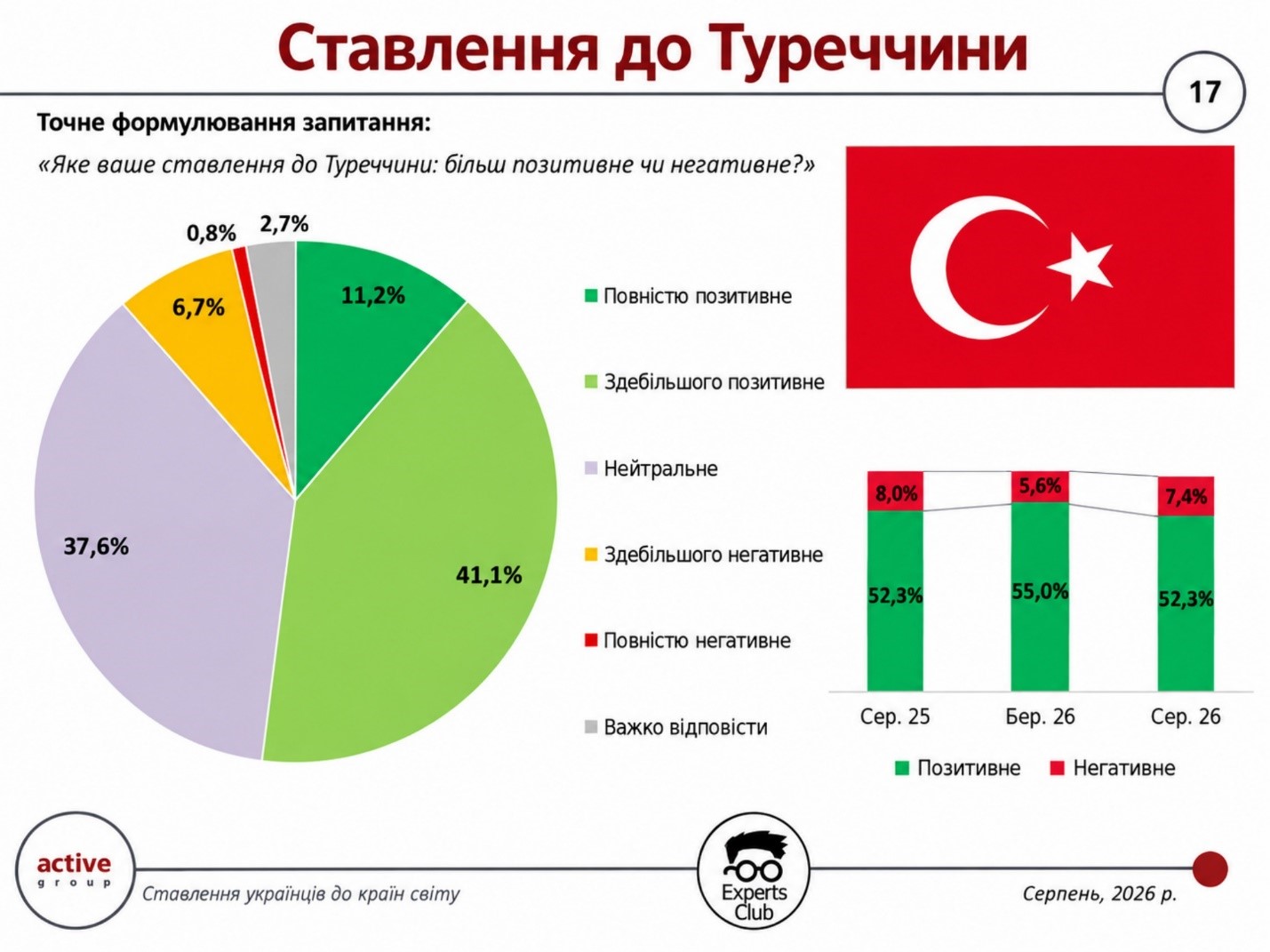
Thus, over the course of five months, the total share of positive assessments decreased by 2.7 percentage points—from 55% to 52.3%. Negative attitudes, on the other hand, increased by approximately 1.9 percentage points, while the share of neutral responses rose by 1.2 percentage points. The balance between positive and negative responses fell from 49.4 percentage points in March to about 44.9 percentage points in August. This indicates a moderate cooling of assessments rather than a fundamental shift in attitude.
Turkey remains one of Ukraine’s largest trading partners. In the first half of 2026, bilateral trade volume approached $4.9 billion: Ukrainian exports totaled about $1.78 billion, while imports amounted to $3.12 billion. Turkey was the second-largest single market for Ukrainian goods after Poland, and Ukraine’s bilateral trade deficit stood at about $1.34 billion.
Maksym Urakin, Ph.D. in Economics and founder of the Experts Club information and analytical center, commenting on the relationship between the economy and public perception of trading partners, noted:
“If society sees a massive flow of imports coming into the country but does not see a corresponding flow of investment, technology, or localized production, a sense of imbalance arises. And this directly affects the emotional perception of the partner. That is precisely why countries with a large trade surplus with Ukraine should pay particular attention to the reputational aspect of their presence in the Ukrainian market,” Urakin noted.
In the case of Turkey, the survey results show that a significant trade imbalance is currently combined with a predominantly positive public perception. At the same time, trends between March and August indicate a gradual decline in the predominance of positive assessments.
The survey, conducted in August 2026, used self-administered online questionnaires from the SunFlowerSociology panel among 800 Ukrainian citizens aged 18 and older. The sample is representative by age, gender, and region; the maximum theoretical margin of error is ±3.5 percentage points.
ACTIVE GROUP, EXPERTS CLUB, FOREIGN TRADE, international relations, PUBLIC OPINION, SOCIOLOGY, TURKEY, UKRAINE, URAKIN
Canada has the highest balance of positive and negative attitudes among Ukrainians—not only among the countries represented in the Americas and Australia, but also among all countries covered by the study: in August 2026, it stood at 73.8 percentage points. Australia scored 61.6 percentage points, the U.S. — 38.4 percentage points, and Brazil — 19.4 percentage points. These findings are based on the results of the third wave of the study “Ukrainians’ Attitudes Toward Countries Around the World,” conducted by Active Group in collaboration with Experts Club, according to the Experts Club Information and Analytical Center.
Canada is viewed positively by 76.3% of Ukrainians surveyed, negatively by only 2.5%, neutrally by 19.2%, and another 2% were undecided. As a result, the balance of positive and negative assessments stands at 73.8 percentage points—the highest value among Ukraine’s 50 largest trading partners included in the study.
Australia ranks second in this regional group: 63.8% of respondents expressed a positive attitude toward it, 32.1% were neutral, only 2.2% were negative, and another 2% were undecided. The balance of positive and negative assessments stands at 61.6 percentage points, which also indicates a predominantly positive perception of the country among the Ukrainian audience.
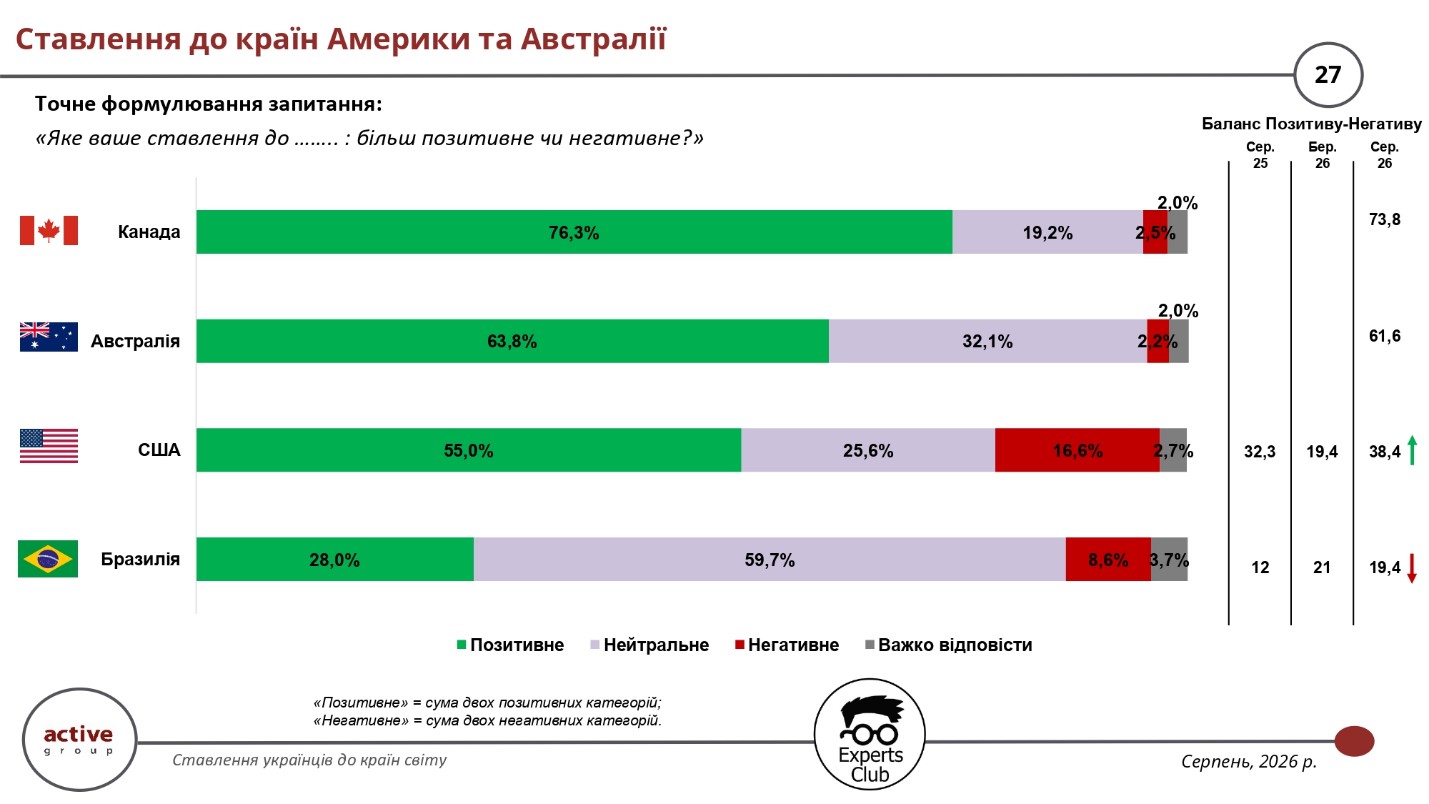
Fifty-five percent of respondents view the U.S. positively, 16.6% negatively, 25.6% neutrally, and another 2.7% were unable to answer. The balance stands at 38.4 percentage points. At the same time, this figure has improved significantly compared to the previous survey wave: in March 2026, the figure was 19.4 percentage points, while in August 2025, it was 32.3 percentage points. Thus, over the course of five months, the balance of attitudes toward the U.S. has increased by 19 percentage points.
Brazil is viewed much more neutrally. Twenty-eight percent of Ukrainians expressed a positive attitude, while 59.7% chose a neutral response, 8.6% expressed a negative attitude, and another 3.7% were undecided. The balance of positive and negative assessments stands at 19.4 percentage points, compared to 21 percentage points in March 2026 and 12 percentage points in August 2025.
Thus, the data reveal significant differences within the group: Canada and Australia are characterized by a high level of established positive attitudes; in the U.S., positive assessments also predominate and have increased noticeably compared to March, while a neutral stance dominates regarding Brazil. Overall, Canada tops the entire ranking of the surveyed countries with a balance of +73.8 percentage points
Maksym Urakin, founder of the Experts Club Information and Analytical Center, deputy director of the Interfax-Ukraine news agency, and candidate of economic sciences, emphasized the need for systematic communication between foreign countries and Ukrainian society.
The survey was conducted in August 2026 using self-administered online questionnaires in the SunFlowerSociology panel among 800 Ukrainian citizens aged 18 and older. According to the organizers, the sample is representative in terms of age, gender, and region; the maximum theoretical statistical margin of error for indicators at the 50% confidence level is ±3.5 percentage points. This is the third wave of the study, following surveys conducted in August 2025 and March 2026.
ACTIVE GROUP, AMERICA, AUSTRALIA, BRAZIL, CANADA, EXPERTS CLUB, PUBLIC OPINION, SOCIOLOGY, the U.S., UKRAINE, URAKIN



