
According to a survey conducted in March 2026 by the research company Active Group in collaboration with the Experts Club information and analytical center, Ukrainians’ attitudes toward Iraq are characterized by a significant proportion of neutral and negative assessments, which collectively form a generally reserved and distant image of the country. According to the survey results, positive attitudes account for only 8.4%, while negative ones account for 35.2%, indicating a significant imbalance in perception. At the same time, more than half of the respondents (50.6%) hold a neutral position, indicating a limited level of formed perceptions about Iraq.
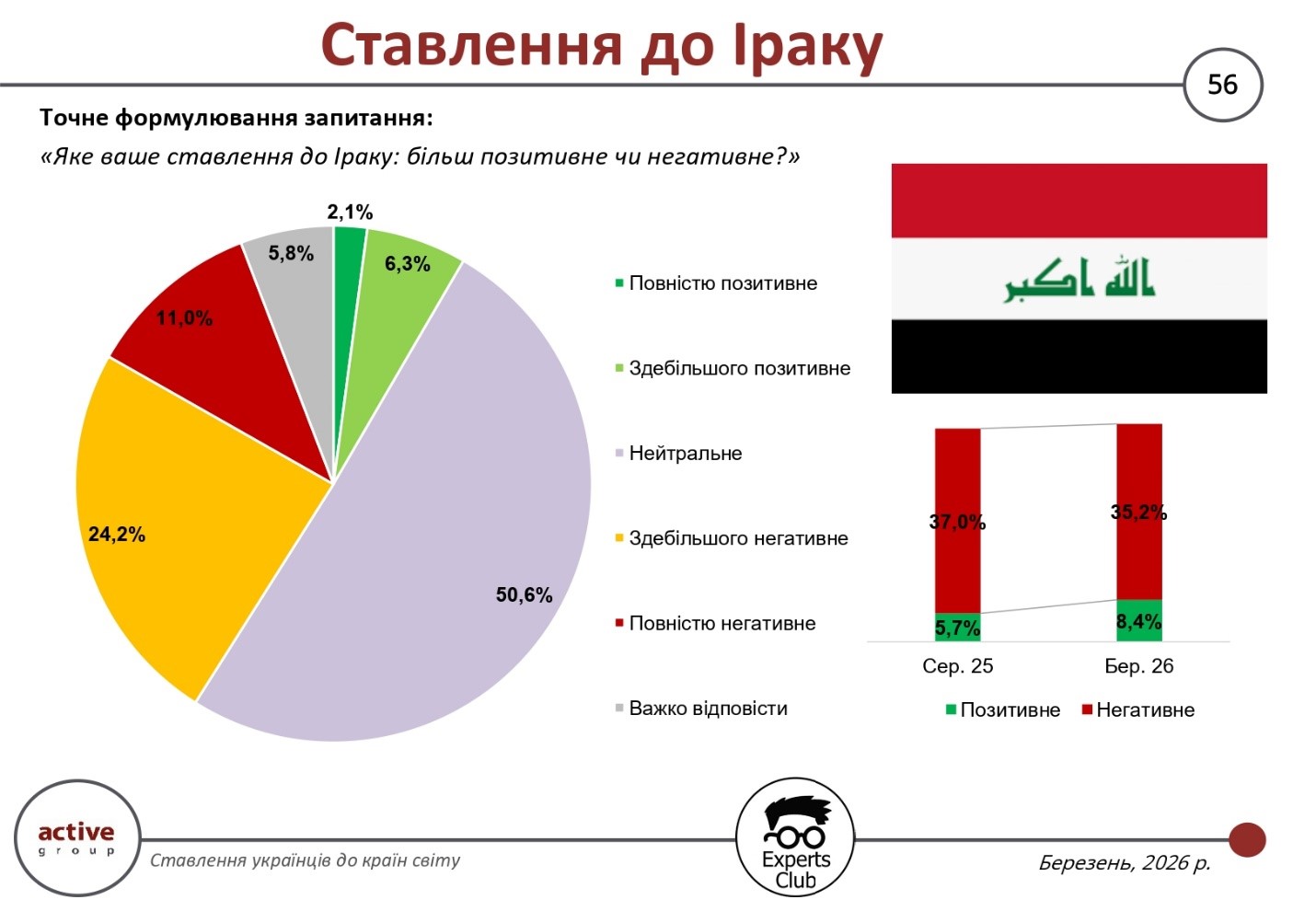
The structure of positive assessments is quite weak: only 2.1% of respondents expressed a “completely positive” attitude, and another 6.3% said it was “mostly positive.” This is one of the lowest figures among the countries included in the study. In contrast, negative perceptions are significantly more pronounced: 24.2% of respondents chose “mostly negative,” and 11.0% selected “completely negative.”
Despite this, a certain positive trend is observed compared to August 2025. The share of positive assessments rose from 5.7% to 8.4%, while negative ones decreased slightly—from 37.0% to 35.2%. This may indicate a gradual softening of perceptions, although the overall balance remains negative.
The high proportion of neutral responses, combined with a significant level of negativity, indicates the specific nature of perceptions of Iraq in Ukraine. On the one hand, a significant portion of the population lacks sufficient information or personal experience to form a clear position. On the other hand, existing perceptions are likely linked to the global information context, which tends to foster a cautious or critical attitude.
“If we see a high proportion of neutral assessments alongside significant negativity, it means the country is present in the information space, but this presence does not create a positive image. In such cases, it is important to work not only on economic cooperation but also on communication and reputation. Without this, neutrality can gradually transform into a persistent negative perception,” noted Maksym Urakin, founder of the Experts Club information and analytical center.
Thus, Iraq remains a country with a limited level of trust and weak positive identification for Ukrainians. The future dynamics of perception will depend on whether this country can strengthen its presence in Ukraine’s positive informational and economic context.
According to a study conducted by the Experts Club Information and Analytical Center based on data from the State Customs Service, Iraq ranks 44th in terms of total trade in goods with Ukraine, amounting to $392.8 million. This is one of the most striking examples of a positive trade balance for Ukraine, as nearly the entire volume of bilateral trade consists of Ukrainian exports, and the positive balance amounts to $392.2 million.
The study was presented at the Interfax-Ukraine press center; the video can be viewed on the agency’s YouTube channel. The full version of the study can be found at this link on the Experts Club analytical center’s website.
ACTIVE GROUP, EXPERTS CLUB, IRAQ, Pozniy, SOCIOLOGY, SURVEY, UKRAINE, URAKIN
Finland is among the group of countries that consistently enjoy a high level of trust among Ukrainians. According to a survey conducted in March 2026 by Active Group in collaboration with the Experts Club information and analytical center, 76.2% of respondents have a positive attitude toward this country, indicating its consistently positive image in Ukrainian society. At the same time, the share of negative assessments is minimal—only about 1.1%, which is effectively within the margin of error.
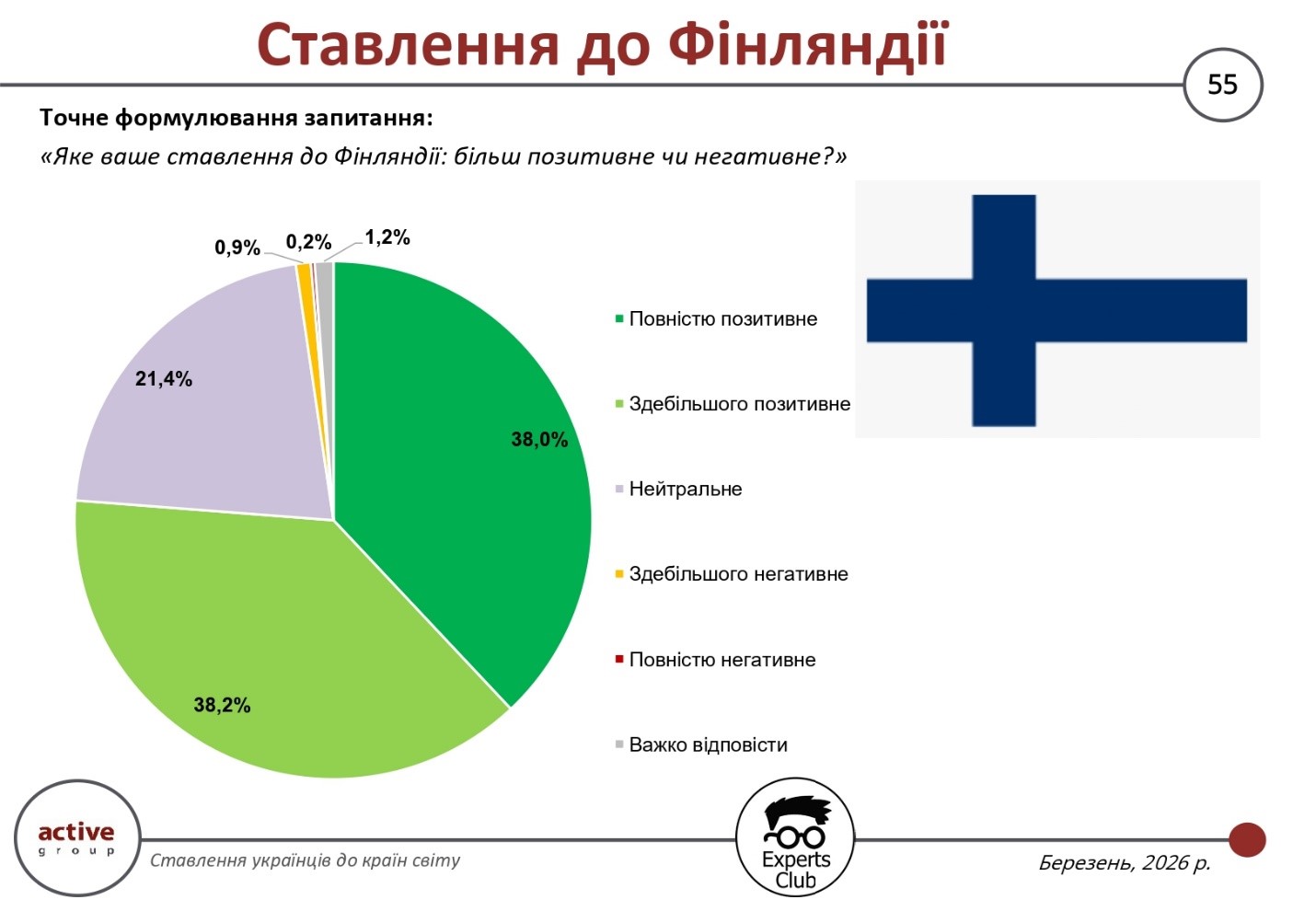
The structure of positive perceptions is evenly distributed: 38.0% of respondents expressed a “completely positive” attitude, while another 38.2% described it as “mostly positive.” This balance indicates not only general approval but also deep trust in Finland as a partner. At the same time, 21.4% of respondents hold a neutral position, which may be explained by the country’s relatively limited presence in Ukraine’s everyday information landscape.
Negative assessments remain marginal: 0.9% of respondents chose the “mostly negative” option, and only 0.2% selected “completely negative.” The share of those who could not decide on an answer is 1.2%. This pattern indicates the absence of systemic factors that could shape a negative image of Finland in Ukraine.
Overall, Finland is perceived as a country with a high level of institutional trust, stability, and consistent policies. Its image in Ukrainian society is shaped not only by its political stance but also by associations with effective governance, a social model, and high living standards.
The high level of positive attitude also reflects a broader trend: Northern European countries are perceived by Ukrainians as reliable partners who demonstrate consistency in their policies and support for Ukraine. Against this backdrop, Finland is consolidating its position as one of the countries with the most stable positive image, without significant fluctuations in perception.
“Ukrainians quite clearly distinguish between countries based on the level of trust and predictability of their policies. Where there is consistency and a clear position, a stable positive attitude is formed. That is why countries like Finland maintain high ratings regardless of short-term fluctuations in public opinion,” noted Oleksandr Pozniy, director of the research company Active Group.
According to a study conducted by the Experts Club information and analytical center based on data from the State Customs Service, Finland ranks 43rd in total trade volume of goods with Ukraine, with a figure of $392.9 million. At the same time, imports from Finland are nearly seven times higher than Ukrainian exports, resulting in a trade deficit of $293.5 million.
The study was presented at the Interfax-Ukraine press center; the video can be viewed on the agency’s YouTube channel. The full version of the study can be found at this link on the Experts Club analytical center’s website.
ACTIVE GROUP, EXPERTS CLUB, FINLAND, Pozniy, SOCIOLOGY, SURVEY, UKRAINE, URAKIN
According to the results of a public opinion poll conducted in March 2026 by the research company Active Group in collaboration with the Experts Club information and analytical center, Ukrainians’ attitudes toward Kazakhstan are characterized by a predominance of neutral assessments and a moderate level of positive perception, which, however, shows a certain decline compared to the previous period. The share of positive attitudes stands at 38.2% compared to 42.7% in August 2025, while negative assessments have risen slightly—from 8.0% to 8.9%.
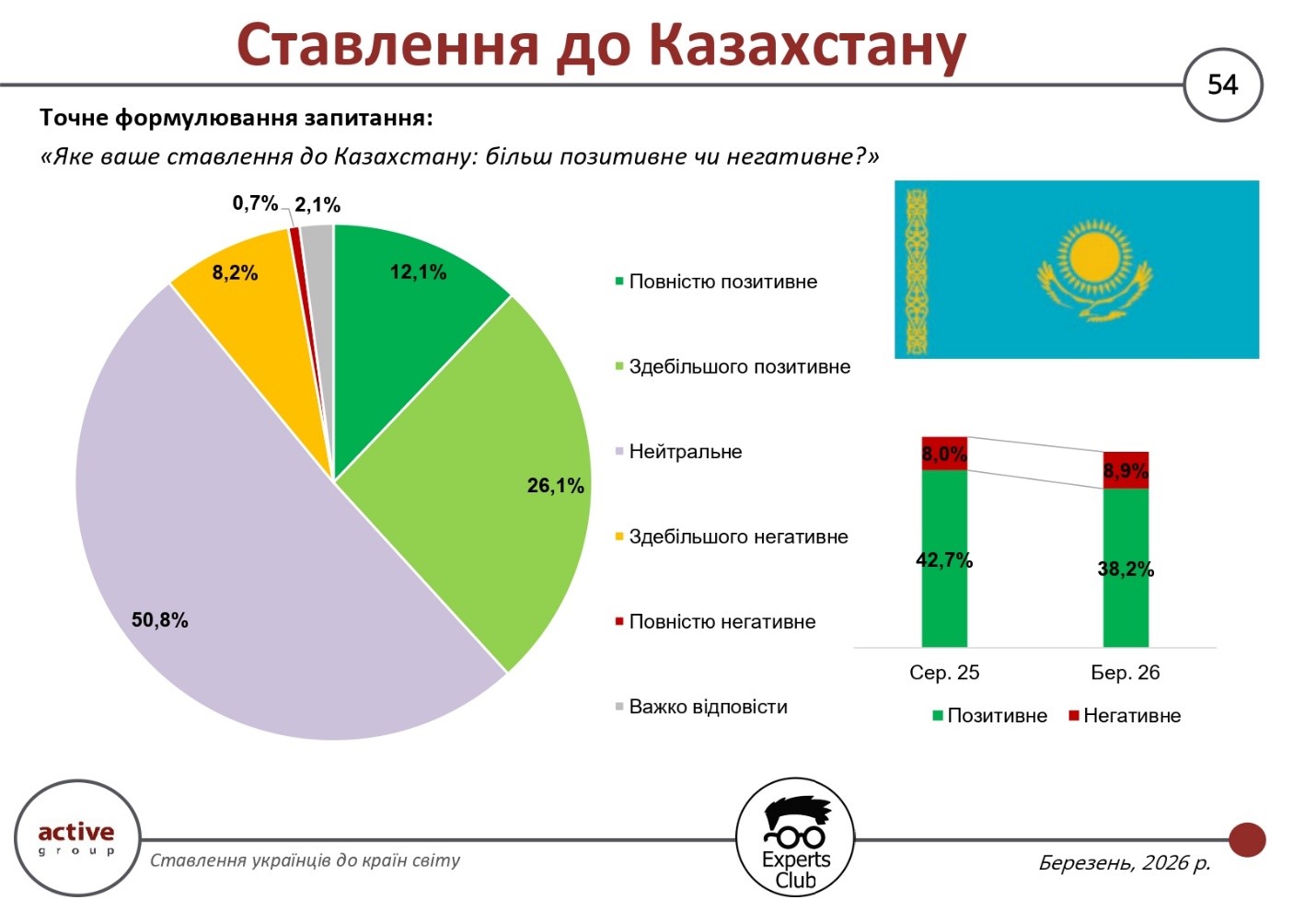
A key feature is the dominance of a neutral stance: 50.8% of respondents do not have a clear assessment of Kazakhstan. This indicates a relatively low level of emotional engagement among Ukrainians in their perception of this country and Kazakhstan’s limited presence in Ukraine’s information and public sphere.
The structure of positive assessments appears balanced: 12.1% of respondents expressed a “completely positive” attitude, while another 26.1% described it as “mostly positive.” At the same time, negative attitudes are formed primarily through moderate assessments: 8.2% of respondents chose the “mostly negative” option, while only 0.7% selected “completely negative.” The share of those who could not answer is 2.1%.
The trend indicates a certain cooling of positive perceptions of Kazakhstan. Although negative assessments remain relatively low, their gradual increase, combined with a decline in positive sentiment, may signal a weakening of interest or trust in the country among the Ukrainian public.
Overall, Kazakhstan is perceived as a country with a neutral image, without a clearly defined emotional assessment. Such a profile is characteristic of states that do not play a prominent role in the Ukrainian information space or are not associated with political or security processes that are key to Ukraine.
In this context, future shifts in attitudes will largely depend on how actively Kazakhstan engages in relations with Ukraine and how prominent its role becomes on the international agenda relevant to Ukrainian society.
According to a study conducted by the Experts Club information and analytical center based on data from the State Customs Service, Kazakhstan ranks 42nd in total trade volume with Ukraine, amounting to $400.2 million. At the same time, Ukraine has a trade surplus with Kazakhstan of $245.3 million, as exports exceed imports by more than four times.
The study was presented at the Interfax-Ukraine press center; the video can be viewed on the agency’s YouTube channel. The full version of the study can be found at this link on the Experts Club analytical center’s website.
ACTIVE GROUP, EXPERTS CLUB, KAZAKHSTAN, Pozniy, SOCIOLOGY, SURVEY, UKRAINE, URAKIN
The results of a survey conducted in March 2026 by the research company Active Group in collaboration with the Experts Club information and analytical center indicate that Ukrainians’ attitudes toward Malaysia are characterized by a high proportion of neutral assessments and relatively low levels of both positive and negative perceptions. Overall, 17.7% of respondents expressed a positive attitude toward this country, which is slightly lower compared to August 2025 (18.7%). At the same time, negative attitudes remained virtually unchanged—4.9% versus 4.7% in the previous period.
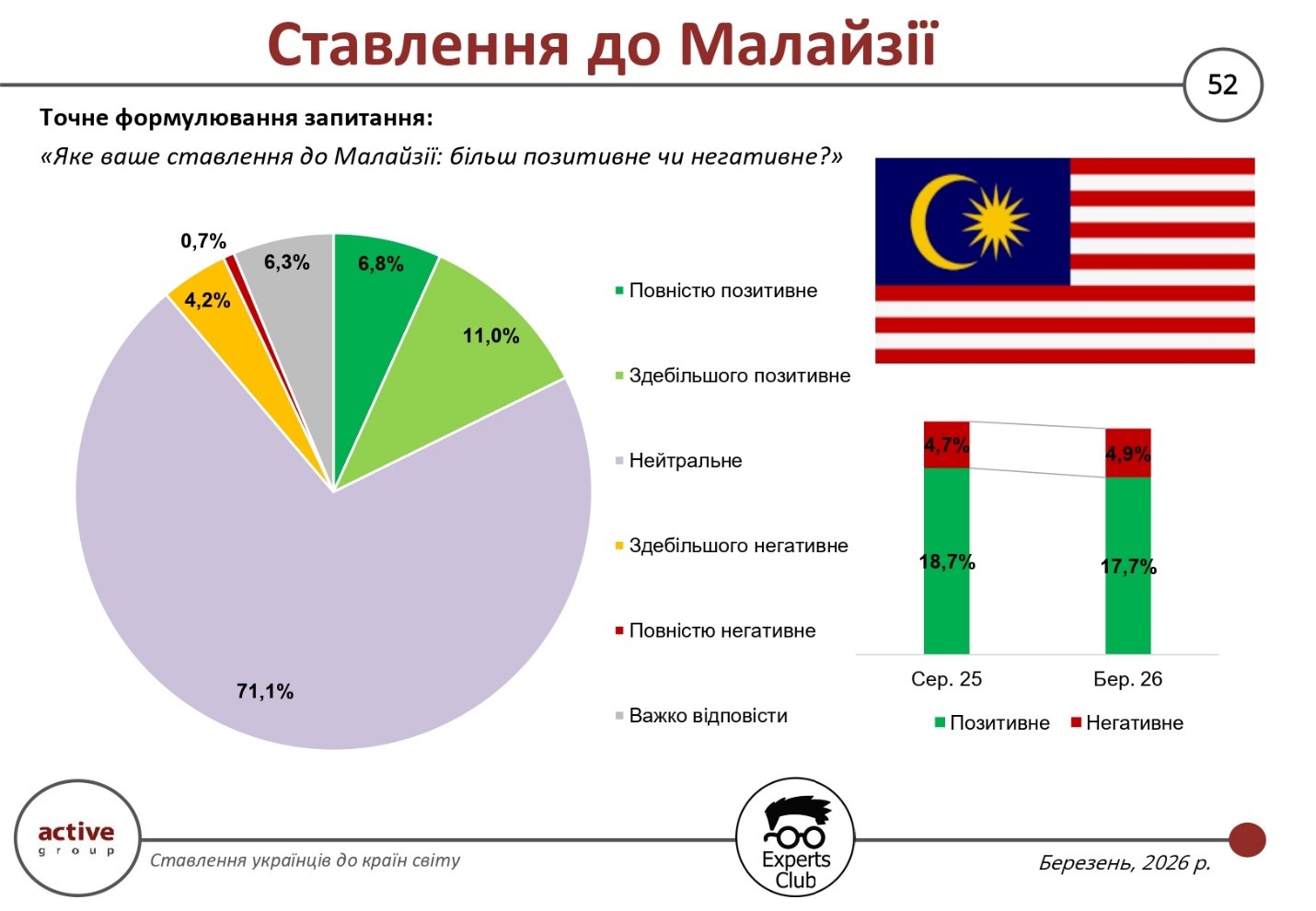
The breakdown of responses shows a clear dominance of neutral views: 71.1% of respondents have no formed attitude toward Malaysia. This is one of the highest figures among the countries surveyed, indicating the limited presence of this country in the information landscape and in the everyday experience of Ukrainians.
Positive assessments are formed primarily due to a moderately favorable perception: only 6.8% of respondents chose the “completely positive” option, while 11.0% selected “mostly positive.” This distribution indicates the absence of a clearly defined positive image, even among those who generally view the country favorably.
Negative assessments also remain at a low level: 4.2% of respondents expressed a “mostly negative” attitude, and only 0.7% selected “completely negative.” The share of those who could not answer is 6.3%, which further underscores the uncertainty in perceptions of this country.
The trend in indicators compared to August 2025 shows a slight decline in positive perceptions while negative assessments remain stable. This means that Malaysia is not the subject of active image change in Ukrainian society, and its perception remains inertial and largely independent of current international events.
In a broader context, these results indicate that Southeast Asian countries, including Malaysia, do not yet occupy a prominent place in the structure of Ukrainians’ foreign policy or economic priorities. The high proportion of neutral assessments indicates significant potential for image-building, but at the same time points to the absence of a clearly defined perception.
Thus, Ukrainians’ attitude toward Malaysia can be characterized as neutral-indifferent: the country does not evoke significant negativity, but is also not associated with processes important to Ukrainian society that shape a positive perception of other states.
According to a study conducted by the Experts Club information and analytical center based on data from the State Customs Service, Malaysia ranks 39th in total trade volume with Ukraine, with a figure of $454.1 million. At the same time, imports from Malaysia are more than three times higher than Ukrainian exports, resulting in a trade deficit of $239.9 million.
The study was presented at the Interfax-Ukraine press center; the video can be viewed on the agency’s YouTube channel. The full version of the study can be found at this link on the Experts Club analytical center’s website.
ACTIVE GROUP, EXPERTS CLUB, MALAYSIA, Pozniy, SOCIOLOGY, SURVEY, UKRAINE, URAKIN
The results of a survey conducted in March 2026 by the research company Active Group in collaboration with the Experts Club information and analytical center show that Ukrainians’ attitude toward the United Arab Emirates remains stable and is characterized by a combination of moderate positivity and a significant proportion of neutral assessments. Overall, 38.7% of respondents describe their attitude as positive, which is virtually unchanged from August 2025 (38.3%). At the same time, negative attitudes have decreased slightly—from 6.3% to 6.1%.
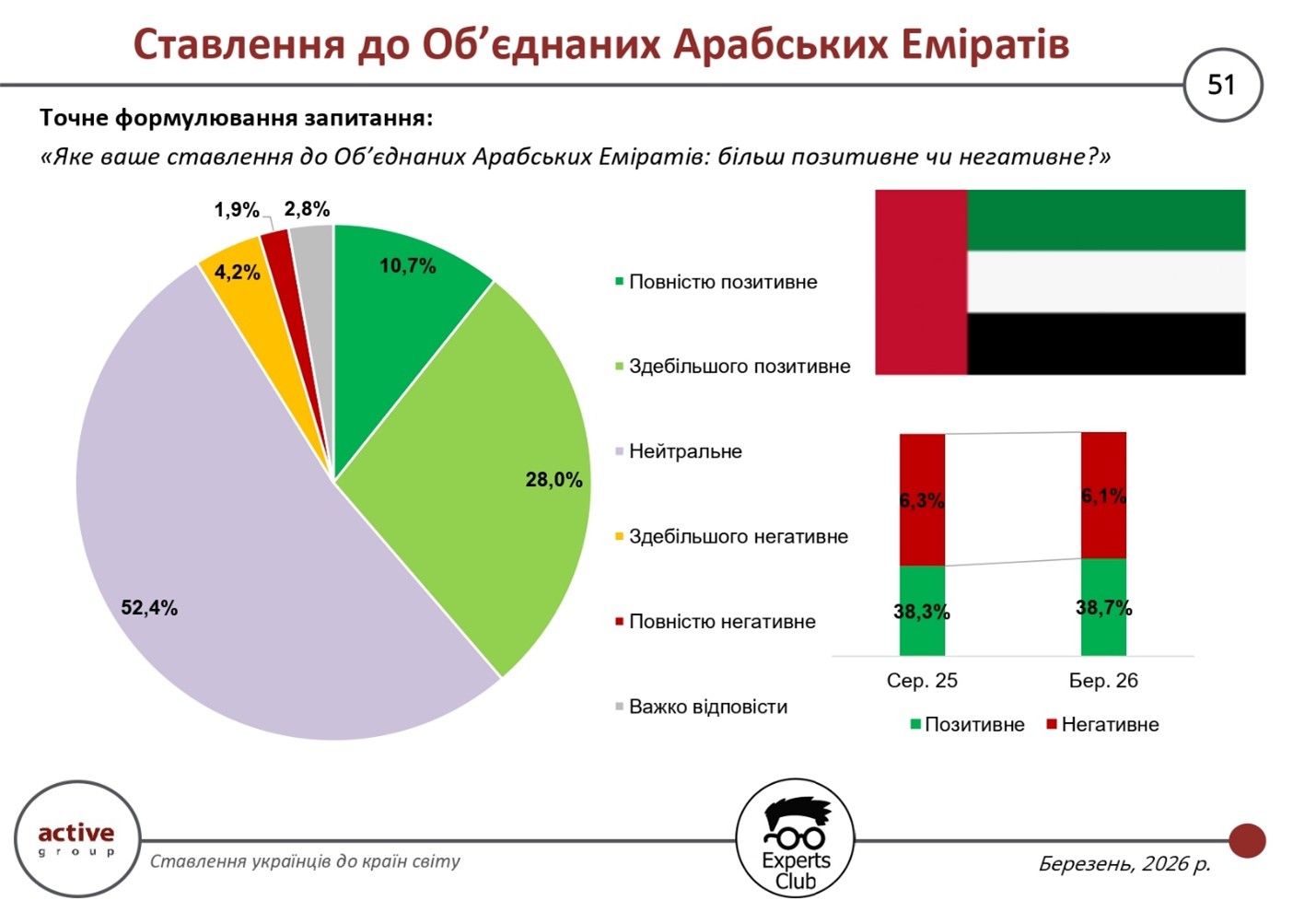
The distribution of responses indicates a predominance of neutral perceptions: 52.4% of respondents do not have a clearly formed opinion regarding the UAE. The positive segment consists of 10.7% who selected “completely positive” and 28.0% who selected “mostly positive.” This pattern indicates a generally favorable backdrop, though without a high level of emotional engagement.
Negative assessments remain relatively low: 4.2% of respondents chose “mostly negative,” and 1.9% chose “completely negative.” The share of those who could not decide is 2.8%. This confirms that the UAE does not evoke significant negative perceptions in Ukrainian society, yet it also does not form a clearly positive image.
The change between August 2025 and March 2026 is minimal. A slight increase in positive assessments is accompanied by an equally slight decrease in negative ones, indicating a stabilization of attitudes. At the same time, a key characteristic remains the high proportion of neutral responses, which exceeds half of all respondents.
In a broader context, this means that Ukrainians perceive the UAE as an economically interesting country, but one that is not close enough or well understood. The absence of sharp fluctuations in the indicators confirms that the established image is stable but not deeply integrated into the public consciousness.
“In the case of countries such as the United Arab Emirates, we see a typical example of a predominantly neutral perception. This means that Ukrainians’ level of knowledge and experience of interaction with this country remains limited, even despite economic contacts. At the same time, this creates potential for the positive image to grow, provided there is a more active presence in Ukraine’s information and economic spheres,” noted Maksym Urakin, founder of the Experts Club information and analytical center.
Thus, the survey results indicate that Ukrainians’ attitudes toward the UAE are stable and moderately positive, though neutrality remains the dominant feature. This opens opportunities for further shaping the country’s image through economic cooperation, investment, and public diplomacy.
According to a study conducted by the Experts Club information and analytical center based on data from the State Customs Service, the United Arab Emirates ranks 38th in total trade volume with Ukraine, amounting to $456.7 million. At the same time, Ukraine has a trade surplus with the UAE of $214.1 million, as exports of Ukrainian goods exceed imports.
The study was presented at the Interfax-Ukraine press center; the video can be viewed on the agency’s YouTube channel. The full version of the study can be found at this link on the Experts Club analytical center’s website.
ACTIVE GROUP, EXPERTS CLUB, Pozniy, SOCIOLOGY, SURVEY, UAE, UKRAINE, URAKIN
The results of a public opinion poll conducted in March 2026 by the research firm Active Group in collaboration with the Experts Club information and analytical center show that Norway continues to rank among the countries with the highest level of positive perception among Ukrainians. Overall, 72.7% of respondents rate their attitude toward this country as positive, although this figure has declined slightly from 77.7% compared to August 2025. At the same time, negative ratings remain minimal—1.9% versus 1.3% previously.
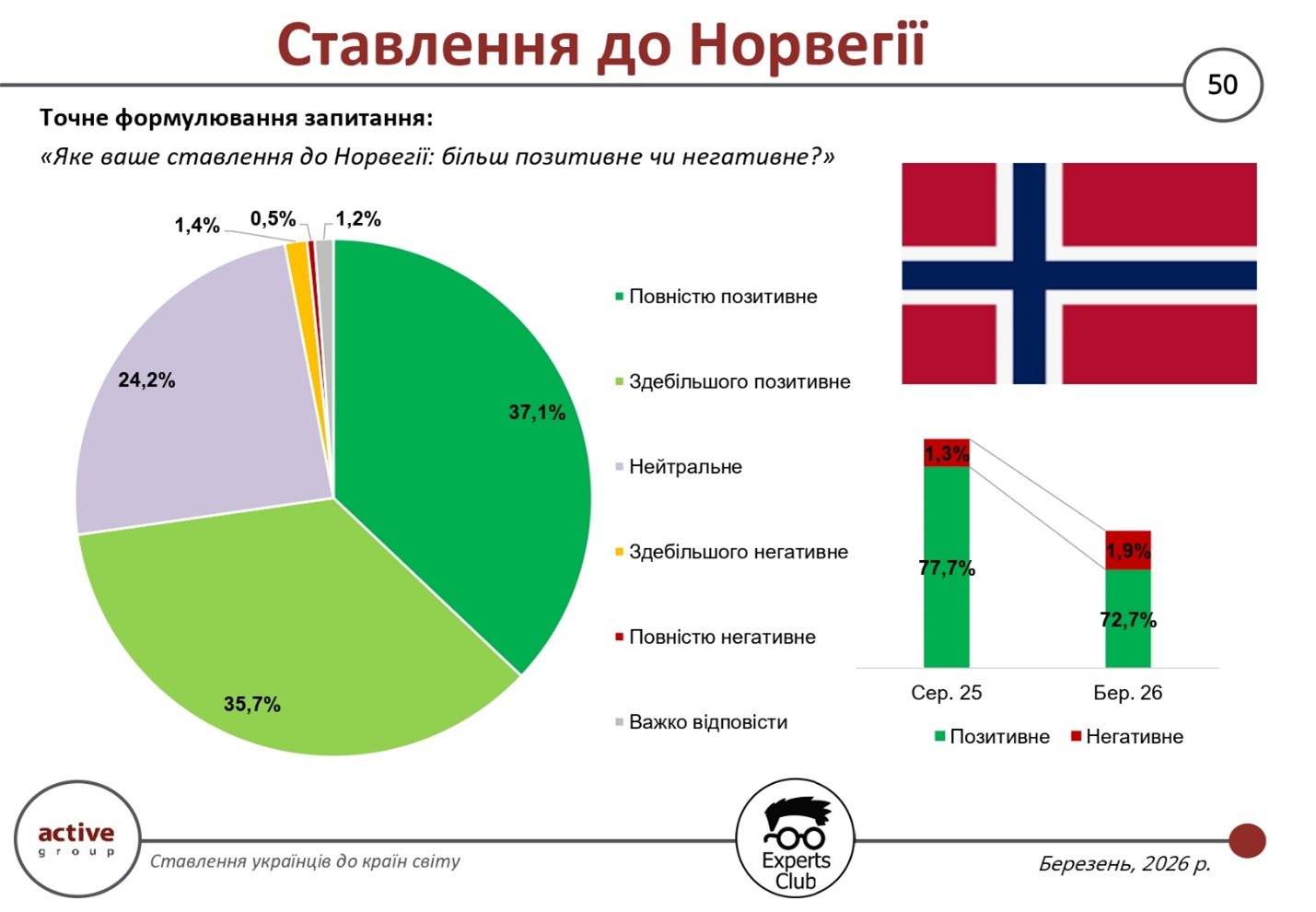
The breakdown of responses shows a consistently high level of positivity. The share of those who have a completely positive attitude toward Norway stands at 37.1%, while another 35.7% selected the “mostly positive” option. Thus, the dominance of positive perception is undeniable. At the same time, 24.2% of respondents hold a neutral position, indicating a certain degree of distance in their perception of the country, despite its generally favorable image.
Negative assessments remain marginal: 1.4% of respondents chose “mostly negative,” and another 0.5% selected “completely negative.” The share of those who could not decide on an answer is 1.2%. This distribution of responses confirms that Norway practically does not evoke rejection in the public consciousness of Ukrainians.
The decline in the positive rating by a few percentage points is accompanied not so much by an increase in negative views as by an increase in neutral assessments. This means that the changes are more a matter of a redistribution of responses than a fundamental shift in attitude. Ukrainians continue to perceive Norway as a stable and friendly partner, although the intensity of this perception has decreased somewhat.
In the broader context of the study, Norway belongs to the group of Northern and Western European countries that demonstrate the highest levels of positive attitude. This reflects a general trend in Ukrainian society toward countries with a high level of development, a stable political system, and consistent support for Ukraine.
“Ukrainians quite clearly differentiate countries based on levels of trust and actual support. In the case of Norway, we see a consistently high level of positive attitude, which is not shaped by current events but rather by a long-term perception of this country as a reliable partner. Even a slight decline in the indicators does not change the overall picture—it remains one of the most positive among all the countries surveyed,” noted Oleksandr Pozniy, director of the research company Active Group.
Thus, the survey results confirm that Norway maintains a strong position in Ukrainians’ positive perception. The slight downward trend is not systematic and is not accompanied by an increase in negative sentiment. This indicates a well-established and stable image of the country, which is not dependent on short-term factors and remains one of the strongest in Europe.
According to a study conducted by the Experts Club information and analytical center based on data from the State Customs Service, Norway ranks 37th in total trade volume with Ukraine, with a figure of $502.5 million. At the same time, imports of Norwegian goods significantly exceed exports of Ukrainian products, resulting in a negative bilateral trade balance of $430.7 million.
The study was presented at the Interfax-Ukraine press center; the video can be viewed on the agency’s YouTube channel. The full version of the study can be found at this link on the Experts Club think tank’s website.
ACTIVE GROUP, EXPERTS CLUB, NORWAY, Pozniy, SOCIOLOGY, SURVEY, UKRAINE, URAKIN



