
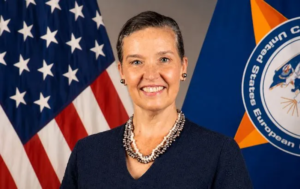
Sandra Oudkirk, who has more than 30 years of experience in the diplomatic service, has become the new U.S. chargé d’affaires in Ukraine.
This was reported on the website of the U.S. Embassy in Ukraine.
Sandra Oudkirk is a career diplomat and a member of the U.S. Senior Foreign Service who has represented the interests of the United States in various countries around the world for more than 30 years, holding positions with a steadily expanding range of authority and responsibility.
Since 2024, she has worked at the U.S. Department of Defense, where she initially served as deputy director of the George C. Marshall European Center for Security Studies and later became the civilian deputy and foreign policy adviser to the United States European Command. From 2021 to 2024, Sandra Oudkirk headed the American Institute in Taiwan.
While working in Washington, Oudkirk held positions in the Bureau of East Asian and Pacific Affairs, the Bureau of Energy Resources, and the Bureau of Economic and Business Affairs. She dealt with issues of strategic competition among major powers, energy security, countering threat financing, and imposing economic sanctions. She previously also worked as a senior watch officer at the U.S. Department of State Operations Center.
Abroad, she served in Taipei, Dublin, Ankara, Kingston, Istanbul, and Beijing.
Sandra Oudkirk was born and raised in Tampa, Florida. She graduated from Georgetown University’s School of Foreign Service. She is married to diplomat Scott Oudkirk and has three adult children. She speaks Chinese (Mandarin) and Turkish.
As reported, Julie Davis had served as U.S. chargé d’affaires in Ukraine since May 2025.
Davis’s predecessor, former U.S. Ambassador Bridget Brink, left the ambassadorial post in April 2025. She later openly stated that she had decided to resign because of the foreign policy of President Donald Trump’s administration.

The volume of passenger car imports to Ukraine, including cargo-passenger vans and race cars (UKT ZED code 8703), amounted to $2.18 billion in January–June 2026, which is 14.6% less than the figure for the first half of 2025 ($2.554 billion).
According to statistics released by the State Customs Service of Ukraine, imports of passenger cars in June, in particular, fell by 6.8% compared to June of last year, but rose by 16.9% compared to May 2026—to $468.12 million.
The top three suppliers of passenger cars to Ukraine for January–June have consistently been the United States, Germany, and Japan, while in the previous year these were the same countries, but Germany was the largest exporter, followed by the United States and Japan.
Specifically, car imports from the United States declined slightly to $417.9 million, while those from Germany fell by 26.7% to $347.6 million; imports from Japan, however, rose by 3.4% to $302.5 million.
Imports of passenger cars from other countries during this period totaled $1.11 billion—18.7% less than last year’s figure.
At the same time, over the six-month period, Ukraine exported only $1.38 million worth of such vehicles, whereas last year, total exports to the UAE, Poland, and the Czech Republic amounted to $3.49 million.
Passenger cars accounted for 4.43% of total goods imports into Ukraine in the first half of the year, compared to 6.67% during the same period last year; their share of total exports was 0.01% and 0.02%, respectively.
As previously reported, in 2025, passenger cars worth nearly $6.15 billion were imported into Ukraine, which is 40.2% more than in 2024. The top three exporters were the United States, Germany, and China. Car exports totaled $10.1 million (2.7 times less).
The significant increase in passenger car imports to Ukraine in the final months of 2025 was driven by news that VAT exemptions on electric vehicle imports would be abolished as of January 1, 2026, whereas imports had declined significantly since the beginning of the current year. However, starting in March, a slow but steady recovery of the passenger car market—including electric vehicles—began.

The U.S. Department of Homeland Security (DHS) and U.S. Citizenship and Immigration Services (USCIS) published a draft of new rules for the EB-5 investor visa program, through which foreign investors can obtain U.S. permanent resident status by investing capital in an American business and creating jobs.
The primary source of the information is the DHS/USCIS document “EB-5 Reform and Integrity Act of 2022; Ensuring the Integrity of the EB-5 Program; Automatic Revocation of Petitions for Immigrant Classification,” published for the Federal Register. This is specifically a notice of proposed rulemaking, meaning a draft rule for public discussion, rather than a final regulation that has already entered into force. The document is to be published in the Federal Register, and comments will be accepted for 60 days after publication.
The EB-5 program allows a foreign national to apply for permanent residence in the United States if they invest in a new commercial enterprise in the United States and create at least 10 permanent jobs for qualified U.S. workers. Following the 2022 reform, the standard minimum investment amount is $1.05 million, while for projects in a Targeted Employment Area (TEA) or infrastructure projects it is $800,000.
The main change in the new proposal is that the United States wants to formally establish a stricter architecture for the EB-5 program following the adoption of the EB-5 Reform and Integrity Act of 2022. DHS states that the proposal is intended to bring the rules for investors and the Regional Center Program into line with the 2022 reform, strengthen transparency and oversight of participants, and protect the program from fraud.
One of the most notable provisions is a new category of high employment area, meaning areas with high employment. For projects in such locations, DHS proposes setting an increased minimum investment threshold of $1.4 million. This is higher than the standard $1.05 million and is intended to reduce the incentive to direct EB-5 money into already prosperous areas instead of territories that genuinely need investment and jobs.
DHS also proposes automatically reviewing investment thresholds starting January 1, 2027, and every five years thereafter. The standard amount is to be indexed to inflation, while for TEA and infrastructure projects the reduced threshold will equal 75% of the standard amount. For a high employment area, the amount is to equal 133% of the standard threshold, rounded to the nearest $50,000.
Another important section for investors concerns verification of the source of capital. DHS proposes establishing a requirement that the investor must prove the lawful origin not only of the investment itself, but also of the funds used to pay administrative expenses and fees. The document separately states the need to show the path of the money from the investor to the new commercial enterprise, including bank statements, tax documents, transfer confirmations and information about intermediaries.
The rules for intermediaries are also being tightened. The proposal provides for the registration of promoters, including migration agents, who advertise or promote investment offerings of regional centers. Promotional materials must accurately describe the visa process and permitted commissions, while the definition of promotional materials includes advertising, offering memoranda, recommendations, testimonials, solicitation and communication with investors.
Particular emphasis is placed on the Regional Center Program, through which the majority of EB-5 investments are made. DHS states that more than 90% of EB-5 petitions are filed through regional centers, and that since 1994 they have accounted for about $74.97 billion in investments and 239,580 jobs created. The Regional Center Program is authorized through September 30, 2027.
For regional centers, the proposal introduces stricter requirements for disclosure of information, changes in ownership structure and vetting of individuals associated with the centers, new commercial enterprises and job-creating entities. USCIS will be able to suspend the consideration of applications and petitions if changes in ownership or control require separate review.
The EB-5 visa quota accounts for 7.1% of the overall worldwide limit for employment-based visas, usually about 9,940 visas per year. Following the 2022 reform, 20% of EB-5 visas are reserved for investments in rural areas, 10% for areas with high unemployment and 2% for infrastructure projects.
For the investment immigration market, this means that EB-5 is becoming less like “buying a green card” and more like a regulated investment product with increased scrutiny of the source of funds, the project, intermediaries and the regional center. The new rules may be particularly sensitive for investors who planned to invest in projects in large and economically strong urban areas: there the threshold may rise to $1.4 million.
The practical conclusion for investors is simple: for now, this is a proposed rule, not a final regulation that has entered into force. But the direction of the reform is already clear: the United States wants to strengthen oversight of EB-5, limit the use of the program in prosperous areas, raise documentation requirements and make regional centers more accountable. Therefore, before filing under EB-5, an investor will have to check not only the profitability of the project, but also its geographic category, visa quota, regional center status, fee structure and documentary evidence.

On July 4, the United States marks the 250th anniversary of the adoption of the Declaration of Independence — the key document that began the formation of the American state. The central events are taking place in Washington, where the anniversary is combined with the traditional Independence Day and the federal America250/Freedom 250 program.
The National Mall in Washington has become the main venue for the celebration. Under the Freedom 250 program, the day will feature the Great American State Fair, FIFA Fan Zone, aviation demonstrations and flyovers above the center of the capital, an evening concert program, an address by US President Donald Trump, and a major fireworks display. Organizers said the fireworks show is expected to be the largest in history and begin at 10:30 p.m. local time.
The anniversary is not taking place without adjustments. Because of extreme heat in Washington, organizers moved some activities to a later time, expanded cooling points, water stations, and medical support. The National Independence Day Parade, which was supposed to take place on July 4, was canceled because of an excessive heat warning.
Events are also taking place in other US cities. Associated Press notes that the celebration includes fireworks, concerts, and public ceremonies in Washington, New York, Chicago, Los Angeles, and other cities, while the anniversary is taking place against the backdrop of political polarization and debates about the country’s future.
“The 250th anniversary of the United States is not only a historic date, but also an occasion to assess the balance of strength and vulnerability of the world’s largest economy. America retains first place in nominal GDP, military spending, the depth of its financial market, the role of the dollar, and its energy base, but at the same time enters the anniversary year with debt of almost $39.4 trillion. For the global economy, this means that the United States remains the main center of power, but its fiscal sustainability is becoming one of the key risks of the next decade,” said Maksym Urakin, founder of the Experts Club analytical center.
Historically, Independence Day is associated with the decision of the 13 American colonies to sever political ties with Great Britain. The Declaration of Independence was adopted by the Continental Congress on July 4, 1776. Formal international legal recognition of US independence by Great Britain came later — under the Treaty of Paris of 1783, which ended the War of Independence.
Today, the United States remains a federal presidential republic consisting of 50 states and the federal District of Columbia. The country’s population, according to the IMF estimate, is about 343 million people, while nominal GDP in 2026 is estimated at approximately $32.38 trillion, preserving the United States’ status as the world’s largest economy at current prices.
The United States also retains several leading global positions. According to SIPRI, the country remains the world’s largest military spender: in 2025, US spending amounted to $954 billion, or about one-third of global military expenditure. According to the EIA, the United States set a new oil production record in 2025 — 13.6 million barrels per day — remaining the world’s largest oil producer. The US dollar, according to IMF COFER, accounted for 57.13% of allocated global foreign exchange reserves in the first quarter of 2026, remaining the world’s leading reserve currency.
The American financial market also remains the largest center of global capital. According to the World Federation of Exchanges, the two largest US exchanges alone — Nasdaq and NYSE — each had tens of trillions of dollars in domestic market capitalization at the end of 2025, significantly ahead of most global exchanges.
The main weak point of the United States in the anniversary year is the national debt. According to the US Treasury, as of July 2, 2026, total federal debt stood at $39.375 trillion, of which $31.679 trillion was debt held by the public.
The US Congressional Budget Office forecasts that the federal deficit in fiscal year 2026 will amount to $1.9 trillion, or 5.8% of GDP. Debt held by the public, according to the CBO estimate, will reach 101% of GDP by the end of 2026 and rise to 120% of GDP by 2036.
Thus, the United States enters its 250th anniversary as a country with a unique combination of global leadership and internal imbalances. The American economy remains the largest in the world, the dollar is the key currency of the international system, and the capital market is the main source of liquidity. But the scale of the debt and chronic budget deficits are increasingly becoming factors that investors, US allies, and competitors take into account no less than the country’s technological, military, and financial power.

U.S. Director of National Intelligence Tulsi Gabbard announced the discovery of evidence of long-standing U.S. government funding of more than 120 biological laboratories in over 30 countries worldwide, including Ukraine.
“After months of searching through intelligence community archives and files, Director of National Intelligence Tulsi Gabbard is revealing new evidence of long-term U.S. government funding of over 120 biological laboratories in more than 30 countries,” according to a statement from the Office of the Director of National Intelligence.
According to the statement, some of the laboratories funded by the U.S. government have worked or continue to work with dangerous and highly contagious pathogens, and in some cases have conducted gain-of-function research.
The Office of the Director of National Intelligence also stated that among such facilities are laboratories in Ukraine, which, according to U.S. intelligence assessments, could be vulnerable to risks of seizure, damage, or attacks amid the Russia-Ukraine war.
According to Gabbard, information about the existence, location, and funding of these laboratories has long been concealed from the public.
“Politicians, so-called medical professionals such as Dr. Fauci, and members of the Biden administration’s national security team lied to the American people about the existence of U.S.-funded and supported biolabs,” the agency’s press service quoted Gabbard as saying.
She also reported that she had issued new directives to the intelligence community to intensify the collection of information on such laboratories and related institutions abroad.
The statement notes that the new data also includes information on clinical trials conducted at these facilities, which, according to the agency, raises ethical, financial, and security concerns.
According to reports, on May 25, 2025, U.S. President Donald Trump signed an executive order halting federal funding for research on pathogen gain-of-function worldwide.
It is worth noting that Hubbard released this information a few days before her resignation.
As reported, U.S. Director of National Intelligence Tulsi Gabbard is stepping down from her post to support her husband in his battle with an “extremely rare form of bone cancer,” according to Fox News. Her last day at the Office of the Director of National Intelligence (DNI) is expected to be June 30.
Source: https://www.dni.gov/index.php/newsroom/press-releases/press-releases-2026/4163-pr-10-26

The U.S., China, and Germany remain the world’s most valuable country brands, according to data from Brand Finance’s annual study.
The company valued the U.S. brand at nearly $34.72 trillion, down 7% from last year’s level. The assessment covers a wide range of indicators, including GDP, investment and tourism appeal, policy and trade regulations, social aspects, and more.
At the same time, the value of the PRC’s brand increased by 7% (to $22.02 trillion), narrowing the gap with the top spot.
Germany ranks third, far behind (-8%, to $4.61 trillion), and the United Kingdom ranks fourth (-5%, to $4.23 trillion).
France moved up to fifth place (-7%, to $3.63 trillion), pushing Japan (-14%, to $3.62 trillion) down to sixth place. Canada (-12%, to $2.41 trillion) moved up to seventh place from eighth last year, Italy (-4%, to $2.3 trillion) to eighth from ninth, and Spain (-4%, to $2.12 trillion) to ninth from tenth.
India fell to tenth place from seventh (-30%, to $1.94 trillion).
The total value of G7 countries’ brands fell by $4.5 trillion over the year due to geopolitical tensions, tariffs, and economic uncertainty.
“The weakening of the Western alliance’s cohesion, combined with persistent inflationary pressures and high energy prices, contributed to a deterioration in sentiment toward a number of major economic powers,” the report notes.
According to a Brand Finance study, Russia, whose brand value fell by 11%, dropped to 25th place from 23rd last year; Kazakhstan (-26%) fell to 45th from 43rd; Uzbekistan dropped to 53rd from 55th; Azerbaijan fell to 74th from 82nd; Belarus – to 86th from 88th place, Turkmenistan – to 87th from 80th place, Georgia – to 91st from 97th place, Armenia – to 105th from 103rd place, and Kyrgyzstan – to 120th from 127th place. Tajikistan remained in 136th place.
Among the top 100 countries, Egypt fell significantly in the ranking—to 51st place from 35th a year earlier; Iran—to 63rd from 50th; Kenya—to 90th from 70th; and Angola—to 94th from 76th. Meanwhile, Costa Rica jumped to 70th place from 81st, the Democratic Republic of the Congo to 72nd from 87th, and Iceland to 80th from 90th.
In total, the ranking includes 192 countries. The total brand value of these countries decreased by 6% over the past year.



