

Bulgaria is investigating the suspected arson of Starlink satellite system equipment at a secured facility near Sofia. According to Ivaylo Mirchev, co-chair of the “Yes, Bulgaria” party, the incident damaged 11 of the 17 antennas that provided communication with SpaceX’s satellite network.
As reported by the Bulgarian Telegraph Agency (BTA), Mirchev stated that two unidentified, masked individuals broke into the facility and set the telecommunications equipment on fire.
According to the politician, these antennas are used to maintain communication with Starlink satellites, whose technology plays a crucial role in supporting communications during the war in Ukraine.
Mirchev criticized Bulgarian law enforcement agencies and special services for failing to provide public information about the incident. He also questioned whether the competent authorities had received warnings from partner intelligence agencies about a possible sabotage plot.
The politician reported that, together with MP Bozhidar Bozhanov, he had submitted parliamentary inquiries to the Bulgarian State Agency for National Security (DANS) and the Ministry of the Interior, demanding an explanation of the circumstances surrounding the incident.
On October 13, Bulgarian media reported that an investigation was underway. According to their reports, law enforcement agencies are reviewing surveillance camera footage and other materials that could help identify the attackers.
On October 14, Bulgarian Prime Minister Rumen Radev confirmed that an intensive investigation into the case is underway, involving the relevant authorities and partner agencies. At the same time, he declined to disclose details, citing the need to maintain the confidentiality of the investigation.
The incident occurred amid increased attention from European countries toward protecting critical telecommunications infrastructure. In particular, law enforcement agencies in Poland are investigating a separate case of arson targeting Starlink equipment in the Masovian Voivodeship. In October, German police detained two Turkish citizens on suspicion of involvement in this crime.
Starlink is a satellite-based broadband internet access system developed by the American company SpaceX. In Ukraine, it is used by civilian institutions, emergency services, businesses, and the military to maintain communications when ground-based infrastructure is damaged.
However, there is currently no official confirmation that the antennas damaged in Bulgaria were directly serving specific Ukrainian units or that the incident caused communication disruptions in Ukraine.
Source: Bulgarian Telegraph Agency (BTA)
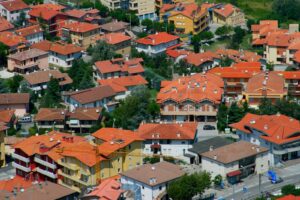
The Bulgarian real estate market continued to cool sharply: in the third quarter of 2026, 45,312 transactions were registered in the country, marking the lowest figure since at least 2005, the earliest year for which comparable data from the Bulgarian Registry Agency is available.
Compared to July–September 2025, when 58,184 transactions were recorded, market volume contracted by 22.1%. For the first time since 2010, the number of transactions in the third quarter fell below 50,000.
The decline affected nearly the entire country. An increase in the number of transactions was recorded in only six of the 113 cities included in the statistics. Among them were Blagoevgrad, where sales rose by 19.8%, and Gotse Delchev, with an 11.2% increase.
In Sofia, 7,282 transactions were recorded in the third quarter, 21.2% fewer than a year earlier. In the Burgas region, the figure fell by 14.3% to 2,047 transactions. Both markets have effectively returned to 2023 levels.
In the Plovdiv region, the number of transactions fell by 23.9% to 3,356, the lowest level since 2013. In Varna, the decline was 26.3%, and the number of transactions fell below 3,000 for the first time since 2015.
An even sharper decline was observed in a number of resort and regional markets. In Nessebar, which also includes transactions in Sunny Beach, the number of transactions fell by 37%. In Razlog, which includes the Bansko market, the decline was 30.4%; in Smolyan, 30.7%; and in Chepelare, nearly 40%.
From January through September 2026, 129,431 transactions were recorded in Bulgaria, which is nearly 19% fewer than a year earlier. By comparison, 159,338 transactions were completed during the same period in 2025, 152,316 in 2024, and 153,109 in 2023.
However, the decline in the number of transactions has not yet been accompanied by a drop in prices. According to data from the National Statistical Institute of Bulgaria, in the second quarter of 2026, housing prices rose by 15.5% year-over-year and by 4.5% compared to the first quarter. Bulgaria ranked second in the EU in terms of the annual growth rate of housing prices.
Consequently, an unusual situation is unfolding in the market: the number of transactions is falling sharply, but prices continue to rise. This may indicate a decrease in the supply of high-quality properties, a high proportion of cash buyers, and price inertia following the strong growth of recent years.
Official source: Bulgarian Registry Agency – Property Registry Statistics.
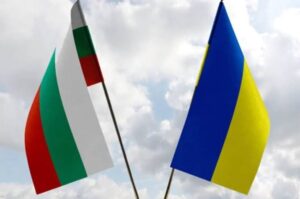
Ukrainians’ positive attitude toward Bulgaria in August 2026 declined compared to the previous phase of the study: 42.7% of respondents view the country positively, down from 53.8% in March. At the same time, Ukrainians with a neutral attitude became the largest group—47.6%, according to the Experts Club Information and Analytical Center.
According to the results of the August survey, 11% of Ukrainians have a completely positive attitude toward Bulgaria, while 31.7% have a mostly positive attitude. A neutral stance is held by 47.6% of respondents. A mostly negative attitude was expressed by 6.8%, a completely negative attitude by 0.6%, and another 2.3% were undecided.
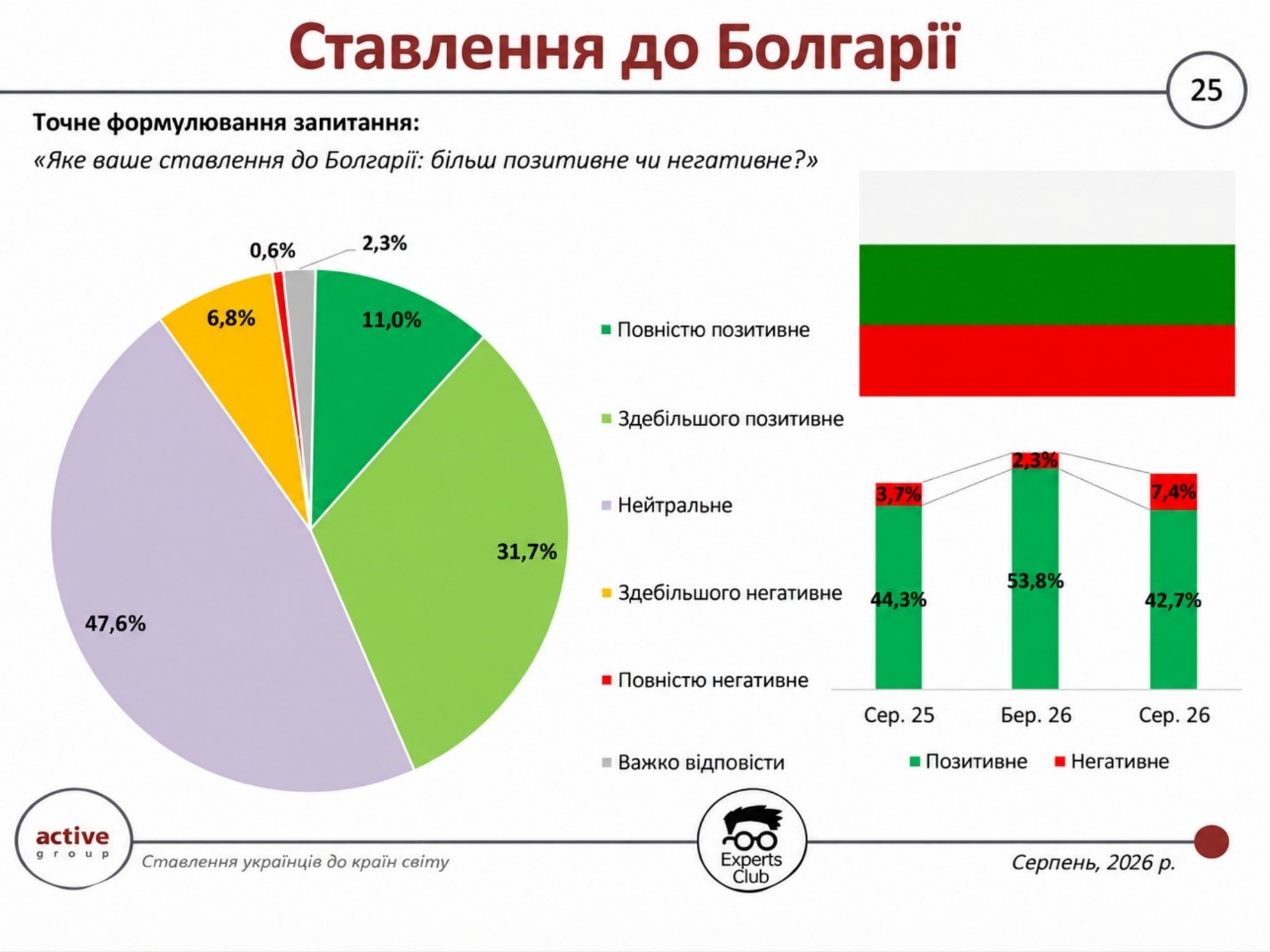
Thus, the combined share of negative assessments is 7.4%, and the balance between positive and negative attitudes is +35.3 percentage points. Despite a decline in positive ratings, favorable assessments of Bulgaria are nearly six times higher than negative ones. At the same time, nearly one in two respondents expresses neither a positive nor a negative attitude toward the country.
Compared to March 2026, the changes are quite noticeable. In the previous survey, 14.2% of respondents viewed Bulgaria entirely positively, and another 39.6% viewed it predominantly positively. The overall positive rating stood at 53.8%, the neutral rating at 42.4%, while negative assessments accounted for only 2.3%.
Over the course of five months, the share of positive responses fell by 11.1 percentage points—from 53.8% to 42.7%. Negative attitudes increased by 5.1 percentage points—from 2.3% to 7.4%—while neutral attitudes rose by 5.2 percentage points to 47.6%. The balance of positive and negative assessments fell from approximately plus 51.5 percentage points in March to plus 35.3 percentage points in August.
At the same time, the “mostly positive” category saw the sharpest decline—from 39.6% to 31.7%—while the share of entirely positive responses fell from 14.2% to 11%. Thus, the deterioration in the indicators occurred simultaneously due to growth in both the neutral and negative segments.
Maksym Urakin, founder of the Experts Club information and analytical center and a candidate of economic sciences, had previously drawn attention specifically to the significant share of uncertain or neutral perceptions of Bulgaria.
“This result indicates not so much indifference as the lack of an active Bulgarian presence in Ukraine’s information space,” Urakin noted. In his view, the problem lies not so much in an established negative image as in the country’s insufficient visibility to the Ukrainian audience. More active communication in the areas of economic, humanitarian, and other practical cooperation could help foster a more defined attitude.
The latest round of the survey partially confirms the validity of this assessment: the share of neutral respondents has once again approached half. At the same time, unlike in March, the share of negative responses has also increased, although it remains significantly lower than the share of positive responses.
The survey was conducted in August 2026 using self-administered online questionnaires from the SunFlowerSociology panel among 800 Ukrainian citizens aged 18 and older. The previous round of the survey in March also included 800 respondents; the sample was representative by age, gender, and region, with a maximum theoretical margin of error of ±3.5 percentage points for indicators at the 50% level.
ACTIVE GROUP, BULGARIA, CENTRAL AND EASTERN EUROPE, EUROPEAN UNION, EXPERTS CLUB, international relations, PUBLIC OPINION, SOCIOLOGY, UKRAINE, URAKIN
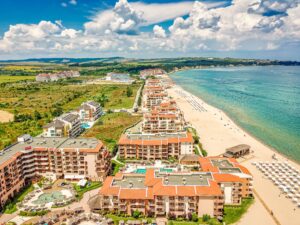
The Bulgarian real estate market continued to cool sharply: in the third quarter of 2026, 45,312 transactions were registered in the country, marking the lowest figure since at least 2005, according to comparable data from the Bulgarian Registry Agency.
Compared to July–September 2025, when 58,184 transactions were recorded, market volume shrank by 22.1%. For the first time since 2010, the number of transactions in the third quarter fell below 50,000.
The decline affected nearly the entire country. An increase in the number of transactions was recorded in only six of the 113 cities included in the statistics. Among them were Blagoevgrad, where sales rose by 19.8%, and Gotse Delchev, with an increase of 11.2%.
In Sofia, 7,282 transactions were recorded in the third quarter, which is 21.2% less than a year earlier. In the Burgas region, the figure fell by 14.3% to 2,047 transactions. Both markets have effectively returned to 2023 levels.
An even sharper decline was recorded in a number of resort and regional markets. In Nessebar, which also includes transactions in Sunny Beach, the number of transactions fell by 37%. In Razlog, which includes the Bansko market, the decline was 30.4%; in Smolyan, 30.7%; and in Chepelare, nearly 40%.
From January through September 2026, 129,431 transactions were registered in Bulgaria, which is nearly 19% fewer than a year earlier. By comparison, 159,338 transactions were concluded during the same period in 2025, 152,316 in 2024, and 153,109 in 2023.
However, the decline in the number of transactions has not yet been accompanied by a drop in prices. According to data from the National Statistical Institute of Bulgaria, in the second quarter of 2026, housing prices rose by 15.5% year-over-year and by 4.5% compared to the first quarter. Bulgaria ranked second in the EU in terms of the annual growth rate of housing prices. Consequently, an unusual situation is unfolding in the market: the number of transactions is falling sharply, but prices continue to rise. This may indicate a reduction in the supply of high-quality properties, a high proportion of cash buyers, as well as price inertia following significant growth in recent years.
The Czech Republic and Moldova have the highest net sentiment—the balance of positive and negative attitudes—among Ukrainians among the Central and Eastern European countries included in the study—56.2 and 48.2 percentage points, respectively. At the same time, the balance of attitudes toward Poland turned negative in August 2026, while assessments of Slovakia and Hungary improved significantly compared to previous waves. This is evidenced by the results of the third wave of the study “Ukrainians’ Attitudes Toward Countries Around the World,” conducted by Active Group in collaboration with Experts Club, according to the Experts Club Information and Analytical Center.
The Czech Republic received the highest share of positive assessments in this group—61.3%. 32.1% of respondents have a neutral attitude toward it, 5.1% have a negative attitude, and another 1.6% were undecided. The balance of positive and negative attitudes stands at 56.2 percentage points, compared to 64.4 percentage points in March 2026 and 58.7 percentage points in August 2025.
Regarding Moldova, 55.4% of respondents have a positive attitude, 35.6% are neutral, and 7.2% have a negative attitude. The balance stands at 48.2 percentage points, which is lower than the 54.7 percentage points recorded in March but higher than the 46.6 percentage points recorded in August of last year.
Regarding Romania, 45.2% of respondents expressed a positive attitude, 42.3% were neutral, and 9.8% were negative. The balance fell to 35.4 percentage points from 41.7 percentage points in March. In Bulgaria, positive assessments accounted for 42.7%, neutral ones for 47.6%, and negative ones for 7.4%, with the balance standing at 35.3 percentage points, compared to 51.5 percentage points in March.
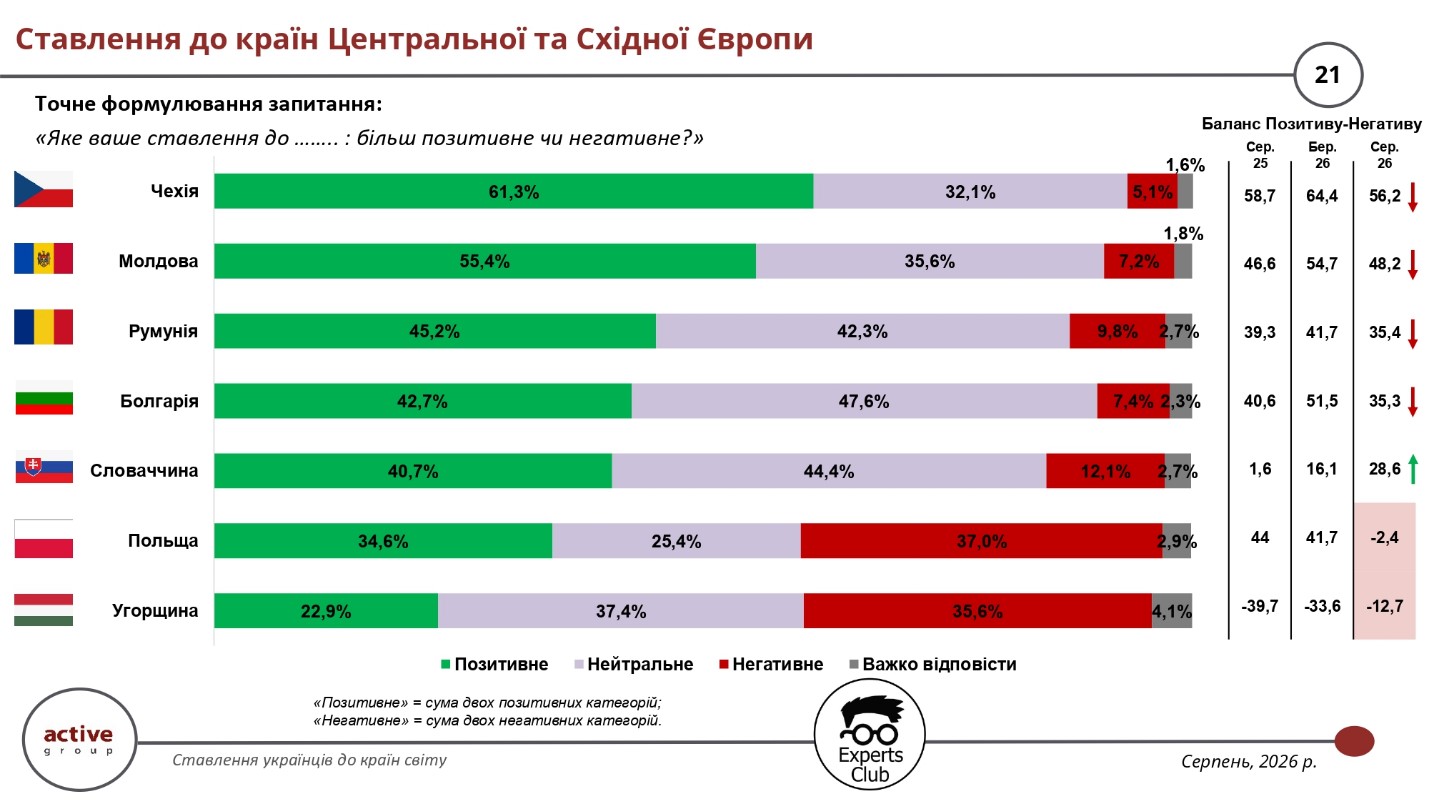
Unlike most countries in the group, attitudes toward Slovakia showed a noticeable improvement. It is viewed positively by 40.7% of respondents, negatively by 12.1%, and neutrally by 44.4%. The balance rose to 28.6 percentage points from 16.1 percentage points in March 2026 and just 1.6 percentage points in August 2025.
The sharpest negative trend was recorded regarding Poland. 34.6% of Ukrainians view it positively, 37% negatively, and 25.4% neutrally. As a result, the net balance stands at minus 2.4 percentage points, whereas in March 2026 it was plus 41.7 percentage points, and in August 2025—plus 44 percentage points. The deterioration in attitudes toward Poland was one of the most notable shifts in the third wave of the survey.
Hungary remains in the negative zone: 22.9% of respondents expressed a positive attitude, 35.6% a negative one, and 37.4% a neutral one. At the same time, its balance improved to minus 12.7 percentage points compared to minus 33.6 percentage points in March and minus 39.7 percentage points in August 2025.
Maksym Urakin, founder of the Experts Club Information and Analytical Center, deputy director of the Interfax-Ukraine news agency, and candidate of economic sciences, emphasized that public perception of countries must be analyzed in parallel with Ukraine’s actual economic ties.
“That is why it is very important for us to analyze our main partners. The first recommendation is to regularly showcase concrete projects, specific actions, and the presence here of foundations, embassies, teams, and diplomats in the humanitarian sphere and in science. We also need to use our sociological data to draw conclusions and strengthen our relations, particularly trade relations,” Urakin noted.
Oleksandr Pozniy, director of the research firm Active Group, highlighted the practical significance of the study’s findings for economic and diplomatic policy.
“We should focus on developing more than just general awareness. First and foremost, business associations, the Ministry of Economy, and the Ministry of Foreign Affairs need to work to develop bilateral relations and improve the balance of trade. We must expand cooperation with countries where we can achieve a positive trade balance,” Pozniy noted.
The survey was conducted in August 2026 using self-administered online questionnaires in the SunFlowerSociology panel among 800 Ukrainian citizens aged 18 and older. According to the organizers, the sample is representative by age, gender, and region, with a maximum theoretical margin of error of 3.5%. This is the third wave of the study, following surveys conducted in August 2025 and March 2026.
ACTIVE GROUP, BULGARIA, Central Europe, CZECH REPUBLIC, EASTERN EUROPE, EXPERTS CLUB, HUNGARY, MOLDOVA, POLAND, Pozniy, ROMANIA, SLOVAKIA, SOCIOLOGY, UKRAINE, URAKIN
There are 256 companies registered in Ukraine with Bulgarian beneficial owners that filed financial statements for 2025; 46 of them—or nearly one in six—have annual revenue exceeding 100 million UAH.
The combined revenue of these companies for 2025 totaled 24.72 billion UAH, which is 6% less than the previous year, according to data from Opendatabot published on August 10.
The largest company with Bulgarian owners in terms of revenue was “Construction Machinery,” which distributes construction equipment. Its revenue totaled 4.43 billion UAH, compared to 4.29 billion UAH in 2024.
In second place was “Green Cool,” a company operating in the import and distribution of food products, with revenue of 2.09 billion UAH. A year earlier, the company reported 2.79 billion UAH in revenue.
Third place went to the energy trader “Elementum Energy Trade,” with revenue of 1.85 billion UAH, compared to 1.1 billion UAH in 2024. Next were the Kostopol Glassworks, with 1.8 billion UAH, and the Dniester Wind Farm, with 1.56 billion UAH.
The top ten also included “Plastchem Ukraine” with revenue of 1.51 billion UAH, “Compressors International” with 1.28 billion UAH, “Sopharma Ukraine” with 0.95 billion UAH, the insurance company “Euroins Ukraine” with 0.91 billion UAH, and “Sanvin 5” with 0.7 billion UAH.
Thus, several industries are represented among the largest Ukrainian companies with Bulgarian capital: trade, energy, industrial manufacturing, pharmaceuticals, and insurance.
According to Opendatabot, a total of 256 companies with Bulgarian beneficiaries filed financial statements for 2025. At the same time, business concentration is quite high: just 46 companies generate annual revenue exceeding 100 million UAH.



