
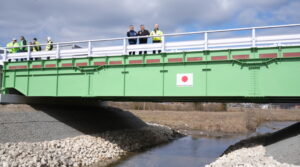
The possibility of establishing backup bridge crossings was discussed by Mykola Kalashnyk, Ukraine’s Minister of Recovery, Infrastructure, and Transport; Yo Osumi, the Japanese Ambassador; and Osamu Hattori, the head of the JICA office in Ukraine.
“The key issue is the possibility of establishing backup bridge crossings. Given the ongoing Russian attacks on transportation infrastructure, we must ensure alternative routes so that, even if the main bridges are damaged, we can maintain connections between the banks, the movement of critically important cargo, the operation of emergency services, and the ability to evacuate people,” Kalashnik wrote on Telegram on Wednesday evening following a meeting with Japanese representatives.
According to Kalashnik, Japan has already provided Ukraine with 720 meters of prefabricated bridge structures. “We are currently exploring the possibility of using the available equipment to construct backup crossings. We have agreed with JICA to continue working together to find effective engineering solutions,” Kalashnik wrote.
The minister also highlighted a second important area—the resilience of critical utility infrastructure ahead of winter. “We discussed the need for backup power supplies for water utilities, modular boiler rooms, and equipment to ensure the uninterrupted operation of heating and water supply systems. Priority lists of necessary equipment have already been submitted to JICA for the development of a new emergency assistance project,” Kalashnik reported.
“We also discussed the implementation of joint reconstruction projects. We recently signed the fifth phase of the Emergency Recovery Program, which allocates $15 million for infrastructure needs. We are also working on extending technical assistance for infrastructure recovery,” he added.
“I am grateful to the Government and people of Japan, the Embassy, and the JICA team for their consistent support of Ukraine and their willingness to address our urgent needs,” the minister concluded.

The Japanese government is considering a new package of sanctions against Russia, which could include restrictions on vessels belonging to the so-called “shadow fleet,” as well as further tightening of export controls.
This was reported on October 2 by the Japanese newspaper Yomiuri Shimbun, citing several government officials.
According to the publication, Tokyo is considering joining efforts to further intensify sanctions pressure on Russia amid new restrictions being imposed by European countries.
One of the main targets of the new package could be vessels of the Russian “shadow fleet,” which are used to transport oil and petroleum products in circumvention of Western sanctions.
The Japanese government is also considering expanding the list of goods whose export to Russia is prohibited or restricted, as well as further strengthening export control mechanisms.
The final composition of the new package and the date of its implementation have not yet been officially announced.
As of October 2, the new package has not yet been published in the Japanese Ministry of Finance’s official list of current sanctions. Nor has a corresponding decision been announced in the country’s Ministry of Foreign Affairs’ statements.
The last major package of additional Japanese sanctions related to the war in Ukraine was announced on September 12, 2025.
At that time, Japan imposed asset freezes on 47 Russian organizations and nine individuals. Restrictions were also imposed on five individuals and one organization that Japanese authorities link to the annexation of Crimea, the destabilization of eastern Ukraine, and the Russian occupation of Ukrainian territories.
In addition, three organizations from third countries were subject to the restrictions.
The package included not only asset freezes but also expanded export restrictions. Japan has banned supplies to certain Russian organizations and companies from third countries that, according to the Japanese authorities, are linked to the Russian military-industrial complex or help circumvent the restrictions.
Thus, if the new package is adopted, it will mark the first significant expansion of Japanese sanctions against Russia in over a year.
A focus on the “shadow fleet” will mean a further alignment of Japan’s sanctions regime with the approach taken by the EU, the United Kingdom, and other G7 countries, which in recent years have been actively imposing restrictions on vessels involved in the transport of Russian energy resources.
At the same time, Japan maintains a unique position regarding Russian energy resources. The country continues to import LNG from the “Sakhalin-2” project, viewing these supplies as a crucial element of its own energy security.
The official list of Japan’s current sanctions has been published by the country’s Ministry of Finance. The new restrictions will take effect after the government adopts a corresponding decision and publishes the documents required by Japanese law.
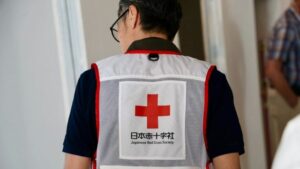
A delegation from the Japanese Red Cross and representatives of the National Committee of the Ukrainian Red Cross (URC) familiarized themselves with the implementation of joint humanitarian initiatives in the Ivano-Frankivsk region.
“As part of the visit, the delegation visited the Ivano-Frankivsk Regional Clinical Cardiology Center and the Pohonya Psychoneurological Residential Care Facility, where they observed the work of a mobile medical team operating as part of the ‘Comprehensive Support for Primary Health Care in the Ivano-Frankivsk Region’ program in collaboration with partner Medics Opika,” – the UCC reported on Facebook on Wednesday.
The guests paid particular attention to the mobile medical teams’ visits to geriatric facilities in the region. The purpose of these visits is to provide medical care to palliative care patients who require constant medical supervision due to chronic and severe illnesses. During these visits, patients receive primary medical care, necessary consultations, and support from specialized professionals.
The delegation also familiarized itself with the activities of the Ivano-Frankivsk Regional Organization of the Ukrainian Red Cross. During the meetings, they discussed the results of ongoing programs, experiences of cooperation, and prospects for the further development of joint humanitarian projects aimed at supporting the region’s population.
“Cooperation with the Japanese Red Cross is a vital component of the development of the Ukrainian Red Cross’s humanitarian and medical programs in the Ivano-Frankivsk region. Thanks to the support of our partners, we are able to expand access to quality primary health care, develop the work of mobile medical teams, and provide comprehensive support to people who, due to their health condition, require special attention and care,” the Ukrainian Red Cross noted.
JAPAN, MEDICINE, Prykarpattia, RED CROSS, Ukrainian Red Cross
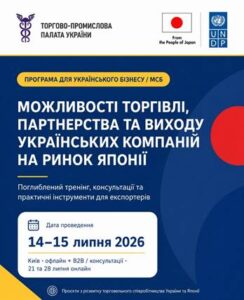
As part of projects aimed at developing trade cooperation between Ukraine and Japan, and with the support of the Japanese government and UNDP, the Ukrainian Chamber of Commerce and Industry has announced a call for applications from Ukrainian companies to participate in a practical training program on entering the Japanese market.
The program’s goal is to help Ukrainian small and medium-sized enterprises better understand the requirements of the Japanese market, prepare their products and commercial proposals, and take the first steps toward finding partners, importers, distributors, and sales channels in Japan.
The program includes online training for a wide range of companies, as well as a two-day in-depth in-person seminar in Kyiv for selected participants.
The in-person seminar will take place on July 14–15, 2026, in Kyiv. Up to 60 companies will be selected to participate. The online training will be held on either July 21 or 28, 2026; companies may choose one of the offered dates, as the online module curriculum is identical for both.
Ukrainian small and medium-sized enterprises, exporters, manufacturers, and service providers who already have experience in foreign economic activity or view Japan as a promising market for export development are invited to participate.
Priority will be given to companies with export-oriented products or services that can be adapted to the requirements of the Japanese market. Special attention will be paid to companies in the agri-food sector, the cosmetics industry, the fashion industry, woodworking, IT/software, and related fields.
The online training will include a general overview of the Japanese market, an analysis of promising Ukrainian goods and services for export to Japan, the advantages, challenges, and typical barriers to market entry, logistics issues, basic documentation and product requirements, as well as the specifics of business communication, trust-building, and negotiations with Japanese partners.
The training will also feature practical materials from the Ukrainian Chamber of Commerce and Industry (UCCI): a study of the Japanese market, an export guide, checklists, and tools to help companies prepare to operate in the Japanese market.
Based on the registration forms submitted and in accordance with the selection methodology, a group of up to 60 companies will be formed to participate in a two-day in-depth seminar in Kyiv.
During the in-person seminar, participants will address practical issues related to entering the Japanese market, including business models involving importers, distributors, e-commerce platforms, trade shows, and B2B and B2G contacts. The seminar will also cover Japanese consumer behavior, importers’ expectations, factors related to trust, quality, and reputation, e-commerce platforms, potential sales channels, product adaptation, packaging, labeling, and certification and commercial requirements.
A separate session will be dedicated to preparing a short presentation, a company profile, and a commercial proposal for Japanese partners. Participants will also have access to individual or group consultation sessions, the collection of company inquiries, and the development of next steps.
Selection of companies for the in-person seminar will be based on the submitted registration form. The evaluation will take into account the company’s legal status and size, its registration and operations in Ukraine at the time of application, the availability of a product or service with export potential, its export orientation, alignment with priority or related sectors, and the quality of the completed application.
Preference may be given to companies with proven export experience, participation in previous export-oriented programs, as well as companies that demonstrate a realistic readiness to engage with the Japanese market.
Program participants are expected to gain an understanding of the basic requirements and logic for entering the Japanese market, practical checklists and benchmarks for assessing a company’s readiness, as well as recommendations regarding products, communication, sales channels, and initial contact with partners. Selected companies will also be able to participate in a two-day in-depth seminar and practical consulting sessions.
Registration is open until July 11, 2026, at the following link: https://forms.gle/JGp1PcfLAwV5RodU6
Contact persons: Daniil Chepelev, tel. +380506803223, e-mail: idu-ier@ucci.org.ua; Yelizaveta Syonova, tel. +380962531240, e-mail: sei-ier@ucci.org.ua.
The training sessions are organized by UNDP in Ukraine in cooperation with the Ukrainian Chamber of Commerce and Industry (UCCI) and the Japan External Trade Organization (JETRO) as part of the project “Supporting Inclusive Recovery to Ensure Resilience and Human Security in Ukraine,” with financial support from the Government of Japan.

The Japan International Cooperation Agency (JICA) has provided a batch of technical assistance to Odesa, according to the Japanese Embassy in Ukraine.
“On May 28, Japan, through JICA, donated eight high-pressure water jets to Odesa’s municipal utilities to help clean and maintain critical infrastructure, thereby strengthening the city’s resilience and recovery. Japan will continue to support the reconstruction of Ukraine and affected communities,” reads a post on social media.
In addition, Japanese Ambassador Masashi Nakagome held meetings with the head of the Odesa City Council, Serhiy Lysak, and the acting mayor of Odesa, Ihor Koval.

The results of a sociological survey conducted in March 2026 by the polling firm Active Group in collaboration with the Experts Club information and analytical center show a high and steadily rising level of positive sentiment toward Japan among Ukrainians. The share of positive assessments stands at 71.8%, exceeding the August 2025 figure (68.7%). At the same time, negative attitudes remain minimal—2.8% compared to 2.7% previously.
The breakdown of responses indicates a deeply positive perception of this country. Specifically, 32.9% of respondents describe their attitude as “entirely positive,” while another 38.9% describe it as “mostly positive.” This combination of indicators results in one of the highest proportions of positive attitudes among all countries surveyed.
At the same time, 24.2% of respondents hold a neutral position, indicating a certain distance in perception—likely due to limited direct contact or Japan’s limited presence in the Ukrainian media landscape. Negative assessments remain at a low level: 1.9% — “mostly negative” and 0.9% — “completely negative.” Another 1.2% of respondents were undecided.
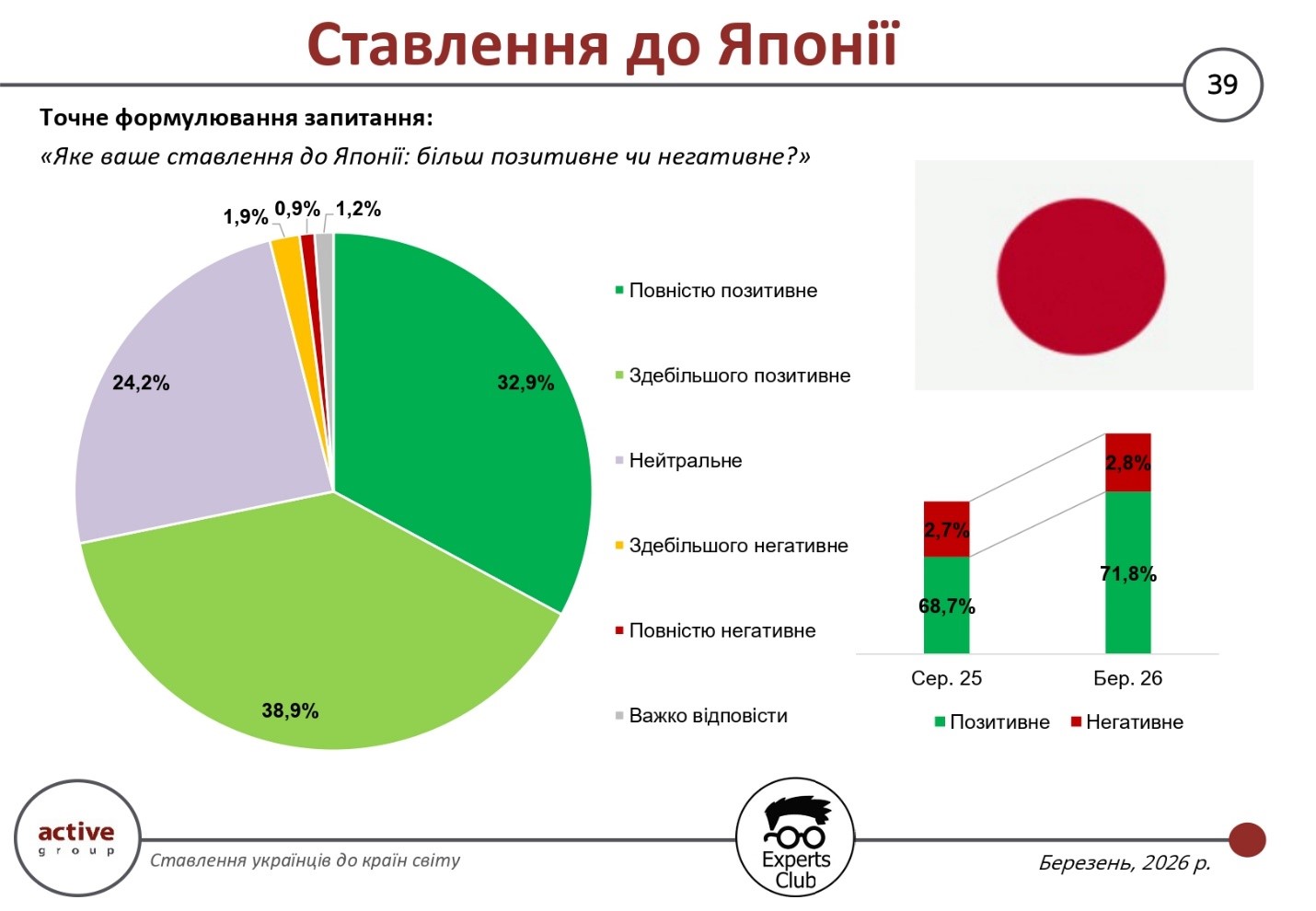
The trend indicates a gradual strengthening of Japan’s positive image in Ukraine. The increase in the share of positive responses occurred without a significant rise in negative sentiment, indicating a steady expansion of positive perception rather than a redistribution of assessments across categories.
“For Ukrainians, Japan is an example of a country with a high level of trust and a stable positive image. We see that even without any major news events, its perception is gradually improving. This means that long-term reputation and consistent cooperation policies work much more effectively than short-term media effects,” noted Oleksandr Pozniy, director of the research company Active Group.
Overall, the survey results confirm that Japan is among the countries with the most positive perception among Ukrainians. At the same time, the growth in positive assessments against a backdrop of consistently low negative sentiment indicates the formation of a long-term and stable image of the country as a reliable partner.
According to a study conducted by the Experts Club information and analytical center based on data from the State Customs Service, Japan ranks 26th in total trade volume with Ukraine, with a figure of $1.12 billion. At the same time, imports from Japan almost entirely dominate bilateral trade, resulting in a significant trade deficit for Ukraine of over $1.05 billion.
The study was presented at the Interfax-Ukraine press center; the video can be viewed on the agency’s YouTube channel. The full version of the study can be found at this link on the Experts Club analytical center’s website.
ACTIVE GROUP, EXPERTS CLUB, JAPAN, Pozniy, SOCIOLOGY, SURVEY, UKRAINE, URAKIN



