

“Kernel,” one of Ukraine’s largest agricultural holdings, reduced oilseed processing by 32% in the fourth quarter of fiscal year 2026 (FY, April–June 2026) reduced oilseed processing by 32% compared to the same period last year—to 645,000 metric tons, the company reported in its operating report on Monday.
“The total volume of oilseed processing for FY 2026 amounted to 3.185 million metric tons, which is 8% less than in FY 2025, due to limited availability of sunflower seeds on the domestic market as a result of one of the worst sunflower harvests in Ukraine in the last decade,” the document states.
At the same time, Kernel noted that this decline was partially offset by the processing of alternative oilseeds, particularly soybeans and rapeseed.
According to the report, sales of edible oil in the fourth quarter fell by 12% to 338,000 metric tons, reflecting a decline in oilseed processing volumes during the quarter.
“However, sales remained relatively high thanks to the sale of vegetable oil inventories accumulated in previous quarters. Total sales of edible oil for fiscal year 2026 reached 1.407 million metric tons, which is 2% more than in fiscal year 2025,” the report states.
Bottled sunflower oil accounted for 14,000 metric tons of the quarterly total, compared to 19,000 metric tons in the previous quarter.
At the same time, the volume of grain stored in elevators (silos) from April through June of this year totaled 320,000 metric tons, compared to just 34,000 metric tons during the same period last year. As a result, the Group’s total grain intake for the 2026 marketing year reached a record high of 4.341 million metric tons, which is 60% more than in the 2025 marketing year.
“The year-over-year growth was primarily driven by a higher share of corn in the Group’s 2025 harvest mix, which led to an increase in grain processing volumes, as well as a rise in grain intake from third-party suppliers,” the document states.
Kernel’s grain exports from Ukraine in the last quarter of fiscal year 2026 totaled 2.011 million metric tons, which is 33% more than in the previous quarter and more than double the figure for the corresponding period of the previous year. “This was driven by an increase in grain supply on the domestic market, as farmers accelerated grain sales toward the end of the season. Total grain exports from Ukraine for fiscal year 2026 reached 6.265 million metric tons, which is 15% more than in fiscal year 2025,” the report notes.
Transshipment through export terminals in the fourth quarter of fiscal year 2026 totaled 2.699 million metric tons, which is 3% more than in the previous quarter and 49% higher than in the fourth quarter of fiscal year 2025. Of this volume, grain accounted for 80%, edible oils for 12%, and the remainder consisted of vegetable meal.
“For the year, Kernel’s terminals handled a record 9.587 million metric tons of agricultural products, a 5% increase from the previous year, thanks to significant grain exports in the second half of the fiscal year,” the document states.
Kernel Agricultural Holding is the world’s largest producer and exporter of sunflower oil, Ukraine’s largest grain exporter, the operator of an extensive network of logistics assets, and a leading producer of grains and oilseeds in Ukraine. It is one of the largest producers and sellers of bottled oil in Ukraine. It is engaged in the cultivation and sale of agricultural products.
For the first nine months of fiscal year 2026, Kernel reported a 5% decline in net income to $208 million, while its revenue increased by 0.4% to $3.092 billion and EBITDA rose by 1% to $403 million.
The Ukrainian Grain Association (UGA) has raised its estimate of the potential 2026 grain and oilseed harvest by 1 million tons—to 83.6 million tons, which is 11.6% higher than the 2025 figure (74.9 million tons)—due to increased yields of corn and sunflower, the UGA press service reported on Monday.
“With such a harvest, exports in the new 2026/2027 season could potentially reach 50.8 million tons (the export estimate for the current season is 42.3 million tons). However, this is an optimistic scenario, the realization of which will be possible only if Ukraine’s logistical problems do not worsen due to Russia’s aggression and its constant bombing of Ukrainian transport infrastructure and energy facilities,” the statement noted.
According to the UGA’s estimate, the wheat harvest in 2026 could reach 22.8 million tons (22.5 million tons in 2025), and its exports in the 2026/2027 marketing year (MY) could reach 17 million tons compared to the expected 13.5 million tons in the current season.
The UGA estimates the barley harvest in 2026 at 5.2 million tons (4.9 million tons in 2025), with likely exports of about 2.2 million tons, compared to 1.6 million tons in the current season.
According to the UGA’s forecast, the corn harvest in 2026 will total 32.1 million tons (31.1 million tons in 2025), and exports could reach 27 million tons compared to 22 million tons in the current season.
“Expectations for this year’s corn harvest are positive thanks to favorable weather conditions so far,” the association explained.
The UGA expects the sunflower harvest in 2026 to reach 13.3 million tons, compared to 11.1 million tons in 2025.
“Traditionally, almost all sunflowers will be processed in Ukraine—13.5 million tons. Exports will not exceed 50,000 tons,” the statement said.
In 2026, the rapeseed harvest, according to UGA forecasts, could reach 3.4 million tons compared to 3.2 million tons in 2025, while exports for the 2026/2027 marketing year may amount to only 1.9 million tons.
This year’s soybean harvest is expected to reach 4.9 million tons, which is less than last year’s 5 million tons, while potential exports are projected at 2.3 million tons compared to 2.9 million tons in the current season.
As reported, the U.S. Department of Agriculture (USDA) forecasts wheat and corn exports from Ukraine in the 2026/2027 season at 13 million tons and 23 million tons, respectively, which is 0.5 million tons and 1 million tons more than in the current season.
At the same time, the USDA expects wheat production to decline to 23 million tons from 24.1 million tons last year, and corn production to decline to 30 million tons from 30.9 million tons last year.
Ukrainian farmers will harvest about 56 million tons of early grain crops and 21 million tons of oilseeds in the 2025 season, according to Deputy Minister of Economy, Environment, and Agriculture Taras Vysotsky.
“In principle, in terms of early grain crops, production is expected to be around 26 million tons, which is slightly less than last year. The decrease is due to the fact that in the southeastern regions, the yield of winter wheat and rye is, unfortunately, lower due to drought,” he said on Ukrainian Radio.
Speaking about the corn harvest, which will begin in September, the deputy minister noted that the harvest is also expected to be good. At the same time, corn crops in the southeast — parts of Dnipropetrovsk, Kirovohrad, Mykolaiv, and Odesa regions — have been virtually lost. However, the main corn belt of Ukraine — Sumy, Chernihiv, Poltava, Kyiv regions and further west, despite late sowing and late emergence, thanks to precipitation and optimal temperature conditions, has produced good plants.
“Ultimately, the corn harvest will be quite good on a national scale. We can talk about about 28 million tons, which is more than last year,” Vysotsky said, adding that the final forecast figure of 56 million tons of gross grain harvest is in line with last year’s level.
According to him, farmers will receive about 21 million tons of oilseeds in 2025, which corresponds to the 2024 figure. The production structure will include slightly more sunflower and less soybeans.
The deputy minister also noted favorable purchase prices for agricultural products.
“From a farmer’s point of view, prices are high, really good. Even now, at the time of harvest, they are not falling and are holding steady. Where there were no force majeure circumstances and no losses, these prices are really worthy as a result of working the land,” he stressed.
Speaking about livestock products, Vysotsky noted the stable situation with the production of all types of meat, eggs, and milk.
He recalled that due to the cold spring, horticulture suffered losses in the 2025 season.
“Yes, there were losses in orchards, in the early group, but for late varieties, the indicators may be slightly better and at the level of last year. In the domestic market of Ukraine, a decrease in apple prices is expected in the near future. Currently, they are holding steady because last year’s harvest is being sold. The cost includes long-term storage. But starting in September, the situation will change and stabilize by the end of October. Depending on the final harvest, the prices will be completely different,“ Vysotsky said.
According to him, the situation with vegetables is similar.
”We are approaching the mass harvest (of vegetables – IF-U). We see that the price is reacting and will decline. But there are no prerequisites for it to fall below cost. Vegetables will be more affordable for consumers, but with a normal economic effect for the producer,” Vysotsky concluded.

In 2025-2026 marketing year (MY), the Association “Ukroliyaprom” forecasts the production of oilseeds in the amount of 22 mln tons of oilseeds, which can be fully processed at domestic oil extraction plants (OEP), the press service of the association reports.
According to the industry association, in the current season Ukraine can harvest 13.0 mln tons of sunflower, 3.0 mln tons of rapeseed and 6.0 mln tons of soybeans.
“With the current capacities in Ukraine (excluding the temporarily occupied territories and the war zone), the entire harvest can be processed domestically,” Ukroliyaprom emphasized and added that they are hopeful about this after the adoption of the soybean-rape amendments, which provide for the introduction of an export duty on rapeseed and soybeans.
At the same time, the association said that they do not expect farmers and cooperatives to send the entire soybean and rapeseed crop for processing at the first stage.
Ukroliyaprom predicts that in 2025/26 MY, the mills will be able to process 1.5-1.6 mln tons of rapeseed and 3-3.2 mln tons of soybeans.
On July 16, the EBA highly appreciated the adoption of the draft law No. 13157 “On Amendments to the Tax Code of Ukraine in connection with the adoption of the Law of Ukraine ”On Integrated Prevention and Control of Industrial Pollution“ in the second reading, which contained ”soybean-rape” amendments. They provide for the establishment of an export duty on rapeseed and soybean seeds in the amount of 10% from the 1st day of the month following the adoption of the law.
“The adoption of this draft law in terms of establishing an export duty on rapeseed and soybeans will increase their processing and increase exports of high value-added products. Finally, Ukraine has created conditions for maximum processing of major oilseeds (sunflower, soybean, rapeseed) at domestic facilities,” the business association emphasized.
Ukroliyaprom reminded that since 1998 it had considered the introduction of a duty on oilseed exports as its main goal, which has finally been achieved. From now on, the industry association proclaimed the main task to maximize the processing of rapeseed and soybean seeds starting from 2025/26 MY.
As reported, the Ministry of Agrarian Policy and Food forecasted the harvest of rapeseed at 3 mln tonnes, soybean – 5.7 mln tonnes, sunflower – 20 mln tonnes in 2025 MY.

The business community, united by the American Chamber of Commerce in Ukraine (the Chamber), is concerned about the potential risks associated with the possible return to the practice of imposing export duties and/or quotas on oilseeds.
The duty-free trade regime with the European Union (EU), which is the main buyer of Ukrainian oilseeds, is a guarantee of Ukraine’s rapid and successful recovery. At the same time, the introduction of customs or other trade restrictions by Ukraine could jeopardize negotiations on the renewal of the free trade area with the EU, in particular due to the risk of mirror restrictions on Ukrainian exports.
In addition, experts from the Chamber’s member companies consider it necessary to recall that the experience of introducing export duties on soybeans and rapeseed in 2017, which were subsequently abolished in 2020, showed that such measures do not lead to a significant increase in oil production. Instead, such restrictions cause financial losses for agricultural producers and lead to a corresponding reduction in oilseed crops.
Therefore, the Chamber calls on the Government and members of parliament not to allow the reintroduction of export duties and/or quotas on oilseeds and not to support such initiatives.
Source: https://interfax.com.ua/news/press-release/1080636.html
Due to Russia’s full-scale invasion and its desire to use food as a weapon, transporting grain and oilseeds from Ukraine to other countries has become extremely difficult. Since 2022, logistics issues have had to be significantly revised in order to find safer shipping routes and options. Despite the dire circumstances created by the Russian Federation, Ukrainians are ensuring food security for many countries, particularly in Europe.
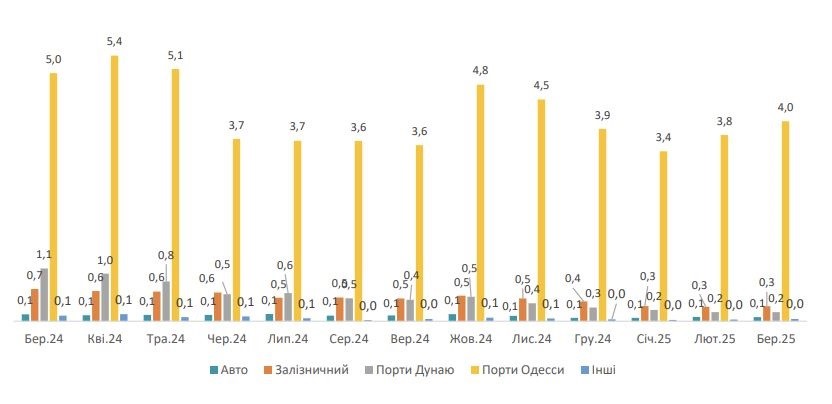
In March 2025, Kyiv exported a total of 4.7 million tons of grain and oilseeds and their processed products. This is 7% more than in the previous month.
“How does Ukraine transport grain and oilseeds, as well as products made from them? The lion’s share goes to the seaports of the Odesa region. This figure is 4 million tons. By rail – 300,000 tons, through the river ports of the Danube – 200,000 tons. It is also exported by road. The volume reaches 100,000 tons,” said grain market analyst Oleksandr Korenitsyn.
Exports of grain crops, oilseeds, and processed products, million tons
Let’s look at the prices of the main agricultural crops that Ukraine exports to world markets. In April 2025, the price of wheat (France, FOB) was 244 USD/ton. Note that this is 3 USD more than in March of this year and 29 USD more than in the same period of 2024. The price of wheat (Ukraine, 2nd class, CPT) in April 2025 was USD 211/t (central regions), which is USD 4 more than in March 2025 and USD 75 more expensive than a year ago. In ports, the price was 229 USD/t, which is 7 USD higher than in the previous month and 65 USD more expensive than in April 2024, according to the International Grains Council.
As for corn (USA, FOB), the price as of April 2025 was USD 211/t. This amount is USD 4 higher than in the previous month and USD 19 higher than in April 2024. The price of corn (Ukraine, CPT) in the central regions is 206 USD/t, thus increasing by 11 USD over the month and by 89 USD over the year; ports – 222 USD, which is 12 USD more than in March 2025 and 78 USD higher than in April 2024.
As noted by Oleksandr Korenitsyn, the price of barley (France, FOB) was 229 USD in April 2025, which is 1 USD less than in March of this year and 26 USD more than in the same period last year. The price of barley (Ukraine, CPT) was USD 195 in the central regions, which is USD 8 more than in March 2025 and USD 102 higher than in April 2024; in ports, it was USD 215 (the price rose by USD 5 per month and USD 85 over the year).
“Another important crop for Ukraine and the world that should be mentioned is sunflower. The price of its seeds in the EU (Rotterdam, FOB) in April this year was 730 USD/t. There has been an increase in price over the last month – by 7 dollars, as well as an increase over the year – by 273 dollars. Meanwhile, the cost of sunflower seeds (Ukraine, CPT) for the central regions was 537 USD/t. The price rose by 10 USD per month and 221 USD per year. For ports, the cost is $512 per ton, which is $6 more than last month and $194 more than last year,” said expert Oleksandr Korenitsyn.
We would like to add that the cost of sunflower oil (Ukraine, FOB) in April was $1,140 per ton. It should be noted that among the key factors that could destabilize further pricing on the world market and affect food security in Europe and the world are Russia’s military actions on the territory of Ukraine.
EUROPE, full-scale Russian invasion, grain exports, Korenitsyn, LOGISTICS, Odessa ports, OILSEEDS, PRICES, UKRAINE, VOLUME



