
The Embassy of the Republic of Uzbekistan in Ukraine announces that the Salt Processors Forum will take place in Nukus from September 25 to 27, 2026.
The event will serve as a platform for discussing the prospects for the development of the salt mining and chemical industries, establishing business contacts, and learning about investment opportunities in the Republic of Uzbekistan.
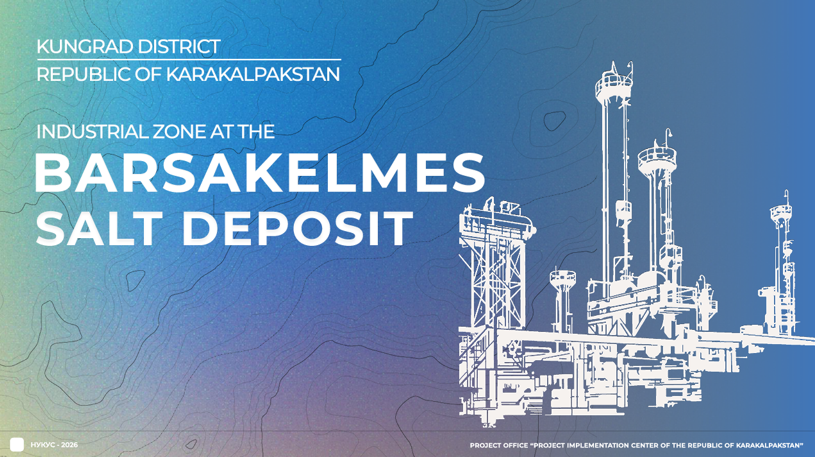
Special attention during the forum will be given to the potential of the “Kungrad Salt Free Zone” special industrial zone, where favorable conditions have been created for foreign investors and domestic entrepreneurs to implement projects in the fields of salt extraction, deep processing of salt, and the production of chemical products.
Business representatives, investors, industry companies, relevant associations, and other interested organizations are invited to participate.
If you are interested in participating, please contact the Embassy of the Republic of Uzbekistan in Ukraine by email: embassy@uzbekistan.org.ua
The Cabinet of Ministers of Ukraine has abolished quotas on the export of table salt for 2026, according to Government Resolution No. 1795 of December 31 on the list of goods whose export and import are subject to licensing and quotas.
According to the document, there will be no quotas on the export of table salt in 2026, whereas in previous periods, exports of this product were limited by zero quotas.
The resolution is published on the government’s website.
In January-June 2024, Ukraine imported 211,692 thousand tons of salt, which is 45.88% less than in the same period a year earlier, when external purchases amounted to 391,186 thousand tons.
According to statistics released by the State Customs Service (SRS), spending on salt purchases on foreign markets in the first half of 2025 decreased by 48.46% to $26.919 million, compared to $52.225 million in the same period of 2024.
The main suppliers of salt to Ukraine in January-June were Egypt, which accounted for 46.09% of supplies, worth $12.407 million, Turkey (17.57% and $4.730 million) and Romania (13.41% and $3.611 million)..
A year earlier, the top three salt suppliers were the same: Egypt (54.89% or $28.668 million), Turkey (17.15% or $8.956 million) and Romania (14.69% or $7.671 million).
As reported, Ukraine exported 710,040 tons of salt worth $28.32 million in pre-war 2021, while in 2022, exports fell fivefold in real terms to 142,038 tons, and revenues fell even more sharply to $3.82 million. The main buyers of Ukrainian salt in 2021 were Poland (39.1%), Hungary (27.4%), and Romania (7.3%). In 2021, Ukraine imported 142,810 tons of salt worth $12.92 million.
After the occupation by Russian troops in April 2022 of the country’s largest salt producer, Artemsol, Ukraine virtually stopped its exports and became a net importer.
The Tereblya salt deposit (Zakarpattia region) resumed salt production in August 2023. The head of the Zakarpattia Regional State Administration, Viktor Mykyta, said that Zakarpattia would be able to provide Ukraine with 100% of its technical and table salt.
The Dolinsky deposit (Ivano-Frankivsk region) plans to resume salt production in the near future. Work is currently underway on the Dolinsky deposit development project, and a thorough environmental impact assessment is being conducted. Specialists from the State Scientific Research and Design Institute of Basic Chemistry “Niochim” are preparing a design solution for a future salt production plant. A special permit for the extraction of rock salt (halite) in 2023 was obtained by the Kharkiv-based company “Planeta Komfort.”
In January-September 2024, Ukraine imported 526.545 thousand tons of salt worth $69.844 million, which is 65.6% and 6.64% more than in the same period last year, respectively. According to statistics released by the State Customs Service (SCS), Egypt became the largest supplier of salt to Ukraine, accounting for 55.41% of total imports worth $38.7 million in January-September 2024.
Turkey and Romania accounted for 15.7% and 15.6% of supplies, for which these countries earned $10.96 million and $10.81 million, respectively.
A year earlier, Ukraine’s top three salt importers were Turkey with a 30.9% share, Egypt and Romania with 21.6% and 20.9%, respectively. Their revenues from salt sales amounted to $20.3 million, $14.11 million and $13.697 million, respectively.
In January-September 2024, Ukraine reduced its salt exports to a record low of 21 tons, for which it earned $21 thousand. Its buyers were Romania, which purchased 17 tons (80.9%), Moldova and Spain purchased 1 ton each, which amounted to 4.8% for each country.
A year earlier, salt exports amounted to 38 tons, for which Ukraine earned $155 thousand. The exports of this product, which decreased, were supported by Romania, which bought 35 tons (94.6%), and Moldova with 1 ton (2.7%).
As reported, in pre-war 2021, Ukraine exported 710.04 thousand tons of salt for $28.32 million, while in 2022 it fell fivefold in physical terms to 142.038 thousand tons, and revenue fell even more, to $3.82 million. In 2021, the main buyers of Ukrainian salt were Poland (39.1%), Hungary (27.4%), and Romania (7.3%). In 2021, Ukraine imported 142.81 thousand tons of salt worth $12.92 million.
After the occupation of the country’s largest salt producer, Artemsol, by Russian troops, Ukrainian salt exports amounted to only 149 tons for $32 thousand in the first half of 2023.
In January-September 2024, Ukraine imported 526.545 thousand tons of salt worth $69.844 million, which is 65.6% and 6.64% more than in the same period last year, respectively.
According to statistics released by the State Customs Service (SCS), Egypt became the largest supplier of salt to Ukraine, accounting for 55.41% of total imports worth $38.7 million in January-September 2024.
Turkey and Romania accounted for 15.7% and 15.6% of supplies, for which these countries earned $10.96 million and $10.81 million, respectively.
A year earlier, Ukraine’s top three salt importers were Turkey with a 30.9% share, Egypt and Romania with 21.6% and 20.9%, respectively. Their revenues from salt sales amounted to $20.3 million, $14.11 million and $13.697 million, respectively.
In January-September 2024, Ukraine reduced its salt exports to a record low of 21 tons, for which it earned $21 thousand. Its buyers were Romania, which purchased 17 tons (80.9%), Moldova and Spain purchased a ton each, which was 4.8% for each country.
A year earlier, salt exports amounted to 38 tons, for which Ukraine earned $155 thousand. Exports of this product were supported by Romania, which bought 35 tons (94.6%), and Moldova – a ton (2.7%).
As reported, in pre-war 2021, Ukraine exported 710.04 thousand tons of salt for $28.32 million, while in 2022 it fell fivefold in physical terms to 142.038 thousand tons, and revenue fell even more, to $3.82 million. In 2021, the main buyers of Ukrainian salt were Poland (39.1%), Hungary (27.4%), and Romania (7.3%). In 2021, Ukraine imported 142.81 thousand tons of salt worth $12.92 million.
After the occupation of the country’s largest salt producer, Artemsol, by Russian troops, Ukrainian salt exports amounted to only 149 tons for $32 thousand in the first half of 2023.
The Government of Ukraine has maintained zero quotas for the export of natural gas of Ukrainian origin, edible salt, anthracite, coal and coal briquettes, gold, silver, as well as precious metal waste and scrap for 2024.
The Cabinet of Ministers published Resolution No. 1402 of December 27 on the list of goods subject to licensing on its website.
According to the resolution, the quotas for the export of liquid fuel (fuel oil), which were in effect in 2023, were preserved – 540 thousand tons (no more than 60 thousand tons per month) and coking coal – 900 thousand tons.
In addition, the government has extended the ban on the export of fuel wood, wood chips or shavings for January-February 2023, after which the export of these goods will be removed from the list of licensed goods.
The licensing of wheat, rye, barley, oats, corn, soybeans, rapeseed and sunflower seeds, soybean, rapeseed, sunflower and mustard oil, and oilcake has also been retained.
ANTHRACITE, BAN, EXPORT, GAS, SALT



