

According to Experts Club, France and the Netherlands have the highest share of positive attitudes among Ukrainians among the Western European countries included in the study — 72.8% and 71.2%, respectively. Germany is viewed positively by 69.9% of respondents, and Switzerland by 66.9%. These findings come from the third wave of the study “Ukrainians’ Attitudes Toward Countries Around the World,” conducted by Active Group in collaboration with Experts Club, reports the Experts Club Information and Analytical Center.
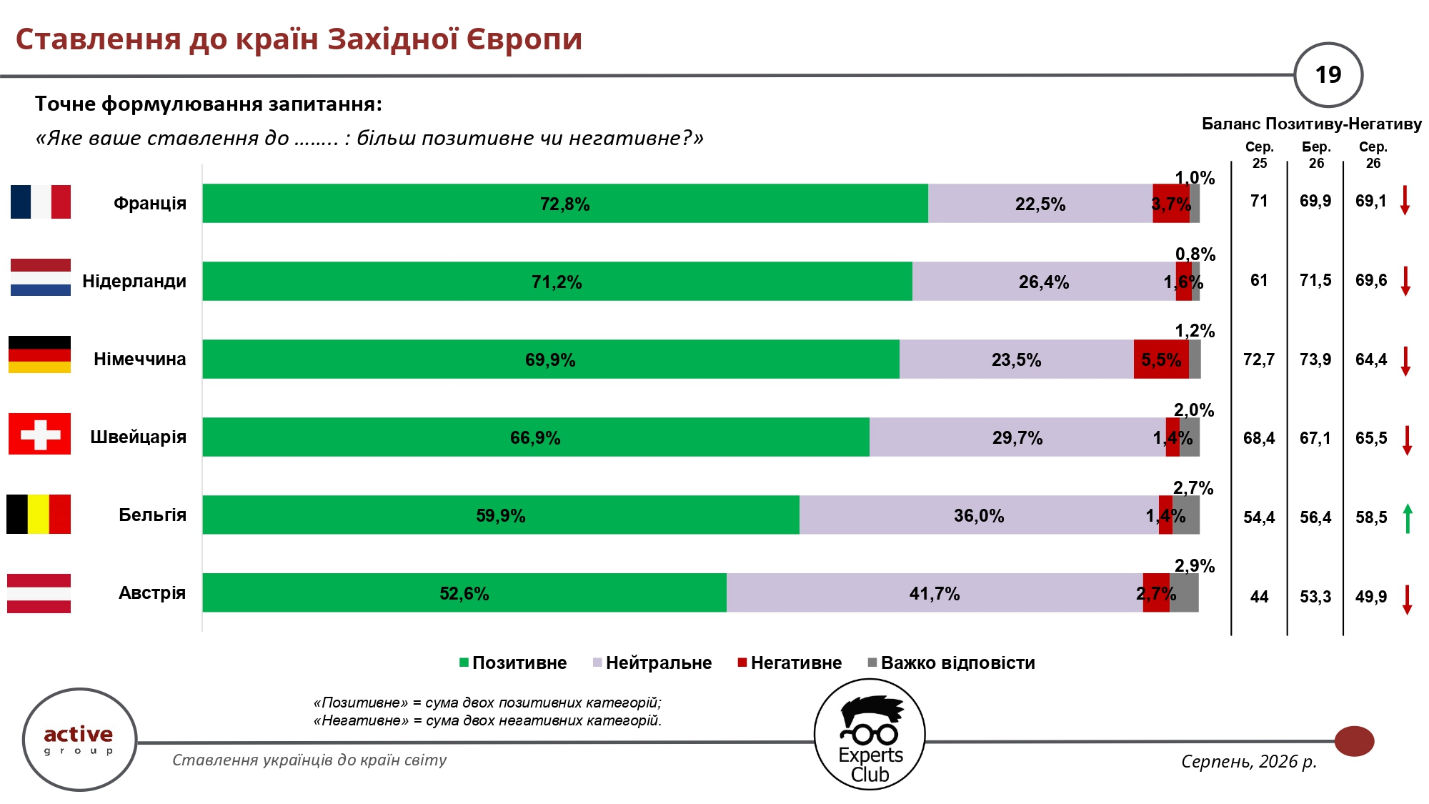
According to the results of the August survey, 22.5% of respondents have a neutral attitude toward France, 3.7% have a negative attitude, and another 1% were undecided. The balance of positive and negative assessments stands at 69.1 percentage points, compared to 69.9 percentage points in March 2026 and 71 percentage points in August 2025.
For the Netherlands, the balance of positive and negative attitudes stands at 69.6 percentage points. Specifically, 71.2% of respondents view the country positively, 26.4% neutrally, and only 1.6% negatively. In March 2026, the balance was slightly higher—71.5 percentage points—while in August 2025 it stood at 61 percentage points.
69.9% of Ukrainians view Germany positively, 23.5% neutrally, and 5.5% negatively. Its net balance fell to 64.4 percentage points, compared to 73.9 percentage points in March and 72.7 percentage points in August of last year. Thus, among the six Western European countries surveyed, Germany showed the most significant decline in this indicator between March and August 2026.
Switzerland is viewed positively by 66.9% of respondents, negatively by only 1.4%, and 29.7% hold a neutral view. The balance stands at 65.5 percentage points, compared to 67.1 percentage points in March.
Belgium is the only country in this group where the balance increased in August compared to March—from 56.4 to 58.5 percentage points. 59.9% of respondents view the country positively, 36% neutrally, and 1.4% negatively. In August 2025, the balance stood at 54.4 percentage points
Austria received the lowest share of positive responses among the Western European countries surveyed—52.6%. At the same time, only 2.7% of Ukrainians view it negatively, while 41.7% chose a neutral response. The balance stands at 49.9 percentage points, compared to 53.3 percentage points in March 2026 and 44 percentage points in August 2025. Overall, the data indicate that the lower levels of positive attitudes toward Belgium and Austria are primarily due to a higher proportion of neutral, rather than negative, assessments.
Maksym Urakin, founder of the Experts Club Information and Analytical Center, deputy director of the Interfax-Ukraine news agency, and candidate of economic sciences, emphasized the importance of systematic communication between foreign partners and Ukrainian society.
“The first recommendation is to regularly showcase concrete achievements and specific actions. The second is to be open to questions and inquiries from the media and the public,” Urakin noted.
Oleksandr Pozniy, director of the research company Active Group, for his part, drew attention to the link between public awareness and the practical development of bilateral cooperation.
“We should focus not only on raising general awareness. We need to expand cooperation with countries where we can achieve a positive balance,” Pozniy noted.
The survey was conducted in August 2026 using self-administered online questionnaires in the SunFlowerSociology panel among 800 Ukrainian citizens aged 18 and older. According to the organizers, the sample is representative in terms of age, gender, and region; the maximum theoretical statistical margin of error at a 95% confidence level is 3.5%. This is the third wave of the study, following surveys conducted in August 2025 and March 2026.
ACTIVE GROUP, AUSTRIA, BELGIUM, EXPERTS CLUB, FRANCE, GERMANY, SOCIOLOGY, SWITZERLAND, THE NETHERLANDS, UKRAINE, WESTERN EUROPE

According to Fixygen, the widespread adoption of stablecoins could change not only the payments market but also the way central banks’ monetary policy operates, warned Petra Chudin, a member of the Governing Board of the Swiss National Bank (SNB).
The SNB representative outlined her position on new forms of money on September 30 at the KOF Prognosetagung 2026 in Zurich.
One of the main risks is linked to a potential shift of funds from traditional bank deposits to stablecoins.
If individuals and companies begin transferring large amounts of money from bank accounts into digital tokens, commercial banks could lose part of their relatively cheap source of funding.
As a result, resources for lending to the economy will decrease, and banks will have to seek more expensive market-based financing.
But for central banks, the problem runs even deeper. By changing the interest rate, the central bank influences the cost of money within the banking system. Banks then adjust their deposit and loan rates accordingly, which affects household spending, corporate investment, and, ultimately, inflation.
The greater the proportion of money that moves outside the traditional banking system into stablecoins, the weaker this channel for transmitting monetary policy could potentially become.
Chudin also highlighted the fundamental issue of the unity of money. Under normal conditions, one Swiss franc in a bank account is equivalent to one franc in cash or central bank money.
A stablecoin is an obligation of a private issuer and does not necessarily have the same characteristics as central bank money.
This is precisely why the widespread adoption of various private digital currencies could potentially lead to a more fragmented monetary system. At the same time, the SNB does not reject the technology of digital money itself.
Switzerland is one of the most active European markets for institutional tokenization. The central bank is already experimenting with settlements using central bank digital currency for transactions involving tokenized assets.
Thus, the question for regulators is no longer whether new forms of money will emerge, but rather which digital form of money will become the primary unit of account—stablecoins issued by private companies, tokenized bank deposits, or central bank digital currencies.
This rivalry is becoming one of the most prominent structural trends in the financial market of 2026.
In the United Kingdom alone, Barclays, HSBC, Lloyds Banking Group, and NatWest conducted the first interbank transactions involving tokenized deposits in September.
At the same time, European banks are developing their own stablecoin projects, while global financial groups are experimenting with round-the-clock settlements on the blockchain.
As a result, the market is gradually moving beyond the former “cryptocurrency versus banks” dichotomy. Banks and central banks are beginning to build their own digital infrastructure that competes with the functions currently performed by USDT, USDC, and other stablecoins.

Swiss ultramarathon runner Frédéric Splendore plans to complete the Beyond Borders charity run—a journey of approximately 4,200 kilometers that he began in Monaco on July 24—in Ukraine on September 21, International Day of Peace.
As the athlete told the Open4Business editorial team, he expects to arrive in Lviv early in the morning on September 21, completing the walking portion of his journey across Europe. After that, Splendore and his support team plan to travel by camper van to Kyiv and visit Maidan Nezalezhnosti in the afternoon. Their departure from Ukraine is scheduled for September 22.
The main goal of the Beyond Borders project—known as “Courir pour Unir” (“Run to Unite”) in its French-language version—goes beyond mere athletic achievement. Splendor is using the run to draw attention to the consequences of the war in Ukraine and to raise funds to help Ukrainians affected by the conflict.
“This project isn’t just about sports or a record. It’s about using endurance to raise awareness, collect funds, and convey a universal message of peace and solidarity all the way to Ukraine,” said Splendor.
In total, the route spans approximately 4,200 km and passes through 13 European countries. On some days, the athlete covers 70–100 km. The project’s official website confirms that the goal of the journey is to arrive in Ukraine on September 21—International Day of Peace.
The first and most challenging stage of the route followed the Via Alpina through the Alps. Splendor covered about 2,000 km of the Alpine route and set a new men’s record for completing the route with team support—23 days, 11 hours, and 42 minutes. The result was recorded on August 16.
After completing the Alpine section, the athlete continued on for another approximately 2,200 km through Central and Eastern Europe toward Ukraine.
“When things got tough, I reminded myself that everything I’m going through is temporary and voluntary, whereas millions of Ukrainians have had no choice for many years and live with the consequences of war every day,” the athlete noted.
The charitable component of the project is being carried out through the Swiss association Au-delà de l’Effort. The funds raised are being directed to the Chaîne du Bonheur (Swiss Solidarity) fund to support Ukrainians affected by the war. The money is planned to be used, in particular, to rebuild destroyed buildings, assist internally displaced persons, and ensure access to education and medical care. According to the project, at least 95% of the funds raised will go directly to the fund for aid to Ukraine.
The campaign’s goal is to raise approximately EUR 140,000.
Frederick Splendor, 33, previously worked as a professional firefighter and a chemistry lab technician. He is the 2023 Swiss champion in the 100-km race and the 2024 national runner-up. His personal best in the marathon is approximately 2 hours and 22 minutes. In 2018, the athlete ran approximately 4,300 km on his own along the Pacific Crest Trail in the United States.
According to Splendor, arriving in Ukraine on International Day of Peace is meant to be a symbolic conclusion to his nearly two-month-long journey.
“I want to use running as a way to mobilize people, to remind Europeans that we must not turn a blind eye, and to show solidarity with a population that has been living with war for many years,” he noted.
Photo: ibelieveinyou.ch, Embassy of Ukraine in Hungary

On September 10, 2026, the Switzerland-Ukraine Municipal Cooperation Forum was held in Basel, focusing on the development of partnerships between Ukrainian and Swiss cities and the implementation of joint projects to rebuild and strengthen the resilience of communities, according to the Embassy of Ukraine to the Swiss Confederation and the Principality of Liechtenstein.
The forum brought together representatives of central and local authorities from Ukraine and Switzerland, as well as relevant organizations from both countries. It was jointly organized by the Swiss government, the cities of Basel, Bern, and Zurich, the Verkhovna Rada of Ukraine, the Embassy of Ukraine in Switzerland, the Ukrainian Association of Switzerland, and the Support and Recovery Platform.
Konradin Kramer, President of the Government of the Canton of Basel-Stadt; Iryna Venediktova, Ambassador of Ukraine to Switzerland; Vitaliy Bezgin, Minister of Community and Territorial Development of Ukraine; and Jacques Herber, the Swiss Federal Council’s delegate for Ukraine, delivered welcoming remarks to the participants.
Under the slogan “Building Partnerships. Achieving Results,” participants discussed the transition from inter-municipal contacts to specific investment and infrastructure projects. The main areas of cooperation identified were energy supply and energy efficiency, water infrastructure, local governance, and the development of public services.
The forum’s program included two panel discussions—one on the political foundations of municipal partnerships in reconstruction and the other on practical models for implementing such projects. Separate City Labs working sessions were held, during which representatives of Ukrainian and Swiss cities jointly developed specific proposals for further cooperation.
Municipal partnerships are one of the areas of Switzerland’s long-term support for Ukraine. The Swiss cooperation program with Ukraine for 2025–2028 specifically provides for support to local and regional authorities in the reconstruction and modernization of urban infrastructure and the provision of basic services, particularly in the areas of transportation, energy, water supply, healthcare, and education.
Swiss cities are already participating in practical projects in Ukraine. In particular, Basel is transferring up to 25 trams to Lviv as part of a program that Switzerland is funding with CHF 2.5 million from 2024 to 2028. Previously, Bern also donated trams to Ukraine.
Switzerland views the development of direct ties between cities as one of the mechanisms for Ukraine’s reconstruction. The country’s national program notes that Vinnytsia, Odesa, Sumy, and Kharkiv, among others, have previously expressed interest in partnerships with Swiss cities.
Holding the forum in Basel is intended to facilitate the transition from general agreements between communities to specific joint projects that can leverage Swiss technology, municipal expertise, and funding for the reconstruction of Ukraine’s infrastructure.

Switzerland, with official international reserves totaling $1.0877 trillion, ranked first among European countries, according to an analysis by the Experts Club information and analytical center based on the latest available data from central banks.
Germany came in second with $539.77 billion. Russia, after adjusting the figure to account for immobilized assets, dropped to third place.
“Switzerland’s $120,700 in reserves per capita is nearly seven times higher than those of Denmark and the Czech Republic—$17,950 and $17,200, respectively—while Poland and Hungary have about $7,800. This gap reflects not the level of citizens’ personal well-being, but the scale of the external financial cushion relative to the population base. For small countries, the denominator sharply amplifies the result, so the ranking must be analyzed alongside import coverage, short-term external debt, liquidity, and the structure of reserve assets. “Without this context, a high ranking can easily be mistaken for a universal assessment of financial stability,” emphasized Maxim Urakin, an economist and founder of the Experts Club analytical center.
The Bank of Russia estimated the country’s gross reserves at $755.6 billion. At the same time, approximately $285 billion of Russian sovereign assets remain frozen in G7 jurisdictions. After excluding these, the analytical estimate of the operationally available portion of reserves stands at approximately $470.6 billion. This figure is not an official statistic for net reserves.
The next places were taken by Italy with $414.52 billion, France with $404.02 billion, and Poland with $294.95 billion. The top ten also included the United Kingdom, Turkey, the Czech Republic, and Spain.
The ranking was compiled using the IMF’s IRFCL methodology. The European Central Bank’s aggregate reserve figure and the broader balance sheet assets of central banks were not included.
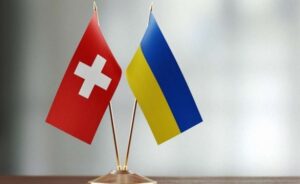
Switzerland will maintain the temporary protection status (Status S) for Ukrainians who fled Ukraine due to Russia’s full-scale invasion until March 4, 2028, but will tighten the eligibility criteria for obtaining it.
“There are still no signs of long-term stabilization of the situation in Ukraine. Therefore, Status S for individuals from Ukraine seeking protection will be extended until March 4, 2028. Support measures for individuals with Status S (Program S) will also continue until that date,” the Swiss government stated in a Wednesday announcement on its website.
It is reported that the Federal Council made this decision at its meeting on August 19 following consultations with relevant stakeholders.
At the same time, it is noted that as of August 20, S protection status will be restricted for certain other groups of individuals—S protection status will now be granted only to those performing military duties they may have in Ukraine. “This new rule applies to all new applicants who submitted their applications on August 20 or later. It does not affect individuals who have already been granted S protection status,” the government statement notes.
As explained by the Swiss government, this decision was made to align with EU policy on this matter. “Switzerland has thus far closely coordinated its actions with the EU regarding S protection status and will continue to do so. On July 30, EU member states decided to extend temporary protection until March 4, 2028. At the same time, they decided to restrict access to temporary protection in the EU: as of July 31, temporary protection is granted only to those performing military duties in Ukraine. The requirement to perform military duties applies, in particular, to Ukrainian citizens of draft age, those in the reserves, and those who have voluntarily joined the armed forces. “Switzerland is not legally obligated to implement this decision adopted by the Council of the EU. However, the Federal Council believes that it is in Switzerland’s interest to align its practices with those of the EU,” the statement reads.
Should the situation in Ukraine stabilize sustainably, the Federal Council will review the status of protection for Ukrainians.
As previously reported, in late July, the European Union extended temporary protection for Ukrainians until March 4, 2028, with a new provision stipulating that newly arrived Ukrainian citizens subject to military service will be eligible for protection only if they have no issues with their military registration documents.



