

On January 1, 2026, a number of changes came into force in Ukraine that affect companies’ expenses, tax burdens, and foreign trade operations—from new state budget parameters and individual tax innovations to updates to energy tariffs and export licensing rules, according to the Experts Club information and analytical center.
The 2026 state budget has set new social standards that directly affect the wage fund, social security contributions, and the calculation of fines and mandatory payments linked to the minimum wage and subsistence minimum.
In terms of taxation, businesses should take into account the updated indicators for the simplified system and military tax. The tax service’s explanations for 2026 separately note the amounts of payments for individual entrepreneurs in groups 1-2, as well as the introduction/application of the military levy for single tax payers (in particular, a fixed payment for groups 1-2 and a percentage of income for group 3), plus a number of related administrative changes.
A separate section is devoted to labor regulation. Starting in 2026, the requirements for employers regarding the employment of people with disabilities will be updated (a change in the approach to meeting the quota and financial responsibility for non-compliance). This affects personnel policy, budgeting, and internal HR procedures, especially in companies with a large number of employees.
In foreign trade for 2026, the government has maintained zero quotas (a ban through quotas) on exports of natural gas of Ukrainian origin and a number of other items, while canceling quotas on exports of table salt and coking coal, and maintaining the licensing regime for certain agricultural items for export to a number of EU countries.
In the energy sector, the NEURC set the tariff for Ukrenergo’s electricity transmission services for 2026: for January-March – UAH 713.68/MWh (excluding VAT) for most system users and UAH 373.93/MWh (excluding VAT) for green electrometallurgy enterprises; for April-December – UAH 742.91/MWh and UAH 378.49/MWh, respectively (excluding VAT).
Changes in excise and financial matters are also important for certain industries. In particular, the schedule for increasing excise duty on motor fuel, previously introduced by amendments to the Tax Code, continues to apply, and an increased income tax rate has been set for banks for 2026.

The winner of the tender to conclude a production sharing agreement (PSA) for the extraction and enrichment of metal minerals within the Dobra lithium deposit (Kirovograd region), will be a consortium led by the Irish company TechMet (Dublin), according to The New York Times, citing two anonymous members of the PSA commission.
“Although (the decision) requires formal approval by the Ukrainian Cabinet of Ministers, officials said the agreement is essentially a done deal,” the newspaper writes.
Interfax-Ukraine has not yet been able to obtain official comment on this information from the Interdepartmental Commission for the Conclusion and Implementation of PSAs, which is headed by Minister of Economy, Ecology, and Agriculture Oleksiy Sobolev.
The agency also contacted the second participant in the tender, European Lithium Ukraine LLC, which, through the Australian company European Lithium Ltd, is a sister company of the American company Critical Metals Corp (CRML), but at this stage, they declined to comment on the NYT information.
The publication notes that the winning consortium has close ties to the administration of US President Donald Trump, as it includes Ronald S. Lauder, a friend of the US president and heir to the Estée Lauder cosmetics company, whom Trump has known since his college days.
TechMet’s largest shareholder is the US International Development Finance Corporation (DFC).
The NYT claims, citing a member of the PPP commission, that the consortium’s proposal is significantly better than the minimum investment of $179 million required by the terms of the tender.
As reported, the opening of the envelopes of the participants in the tender announced in September took place on December 15, 2025. Subsequently, the URPP commission had five days to check the submitted applications for completeness and, by January 12, 2026, to provide the government with substantiated proposals for determining the winner of the tender.
CRML, which is listed on the Nasdaq stock exchange under the ticker symbol “CRML,” announced its bid for the tender. positions itself as a leading mining development company specializing in critical metals and minerals, as well as producing strategic products necessary for electrification and next-generation technologies for Europe and its Western partners. According to the company, its flagship Tanbreez project, located in southern Greenland, is one of the world’s largest rare earth element deposits.
European Lithium, listed on the Australian Stock Exchange under the ticker symbol “EUR,” is a mining company engaged in the exploration and development of lithium, rare earth, precious, and base metal deposits. Its stated markets are Austria, Ireland, Ukraine, and Australia. According to information on the company’s website, it wholly owns the Wolfsberg lithium project located in Carinthia, Austria.
CRML had previously claimed its rights to the Dobra site, linking them to the transfer of assets from European Lithium, which in turn had acquired these rights from the Ukrainian company Petro-Consulting LLC.
In mid-June 2025, when he was head of the Office of the President, Andriy Yermak stated that the development of the Dobra lithium deposit could become the first pilot project within the framework of cooperation with the US.
As for the mining investment company TechMet, one of whose largest investors is the US government through the DFC, it announced in July 2025 its interest in participating in this competition and, if successful, building processing facilities with investments of more than $0.5 billion. In September, a DFC delegation accompanied by Ukrainian Ministry of Economy officials visited the Kirovograd region.
Earlier in 2025, TechMet CEO Brian Mennell reported that the company was part of a consortium interested in developing the potentially large-scale Dobra lithium deposit in Ukraine under a production sharing agreement. According to him, TechMet has been evaluating the Dobra project since 2023.
TechMet, according to information on its website, owns controlling or dominant minority stakes in 10 critical mineral assets on four continents. The U.S. international development finance corporation DFC is a significant shareholder in TechMet. “TechMet’s investment approach supports the broader policy goals of the U.S. government and its allies,” the website notes.
In addition, TechMet-Mercuria has been established as a joint venture with Mercuria, which is also a major shareholder in TechMet on a 50:50 basis. This is a physical supply chain management platform focused on marketing, trading, logistics, and risk management services for the range of technology metals that TechMet works with.
TechMet’s representative in Ukraine, Vladimir Ignashchenko, was vice president of the Ukrainian State Credit and Investment Company in the late 1990s, then deputy head of the Ministry of Natural Resources and the Ministry of Economy, in 2010-2011, he was first deputy head of the Ministry of Natural Resources when the ministry was headed by Nikolai Zlochevsky, and then advisor to Minister Eduard Stavitsky and Minister of Energy Igor Nasalik.
His son, Taras Ignashchenko, was for some time the director of Petro-Consulting (later renamed European Lithium Ukraine), which fought for the Shevchenkivske lithium deposit in Donetsk Oblast, now occupied by Russian aggressors, and the Dobra deposit.
The tender for the conclusion of a PSA for the Dobra lithium deposit was announced with the aim of exploring, extracting, and enriching lithium, niobium, rubidium, tantalum, cesium, beryllium, tungsten, and gold for a period of 50 years. The minimum investment for geological exploration is the equivalent of $12 million, and for the organization of mining and enrichment of lithium-containing minerals and other metal minerals – $167 million, but the final obligations are determined by the results of the tender.
The total area of the site is 17.07 square kilometers, and the deadline for submitting applications for participation in the tender is December 12, 2025. The participation fee is UAH 0.5 million.
According to the terms and conditions, the maximum share of compensation production, through which the investor is compensated for its expenses, is 70% of the total volume of production until the investor’s expenses are fully reimbursed, while the state’s share in profitable production must be at least 4-6%.
It is noted that the reserves and resources of lithium ores in the area were approved by decisions at the end of 2017 and in 2018 in the amount of 1 million 218.14 thousand tons (average Li2O content 1.37%) and P2 – 70.6 thousand tons (average Li2O content 1.43%).
Separately, the State Commission of Ukraine on Mineral Reserves (SCM) noted the presence of promising and forecast resources of associated useful components (P1+P2) in the lithium ores of the Dobra site: Ta2O5 – 4.75 thousand tons; Nb2O5 – 8.24 thousand tons; Rb2O5 – 104.07 thousand tons; BeO – 22.08 thousand tons; SnO2 – 4.46 thousand tons and Cs2O – 7.97 thousand tons.
The winner of the tender must ensure geological exploration of the subsoil and conduct an international audit of reserves at the site within two and a half years, as well as submit materials to the State Geological Committee on the assessment of lithium and other metal mineral reserves for approval.
After the conclusion of the PSA, the investor will be required, among other things, to search for, extract, and enrich (primary processing) lithium and possibly other metal minerals, and to ensure the comprehensive development and exploitation of the metal mineral deposit.
In addition, for the first time, the PSA tender documentation includes obligations for the investor related to the agreement signed at the end of April 2025 on the creation of the US-Ukrainian Investment Fund for Recovery, which has the first right to invest in new projects for the extraction of rare earth materials and the purchase of their products.

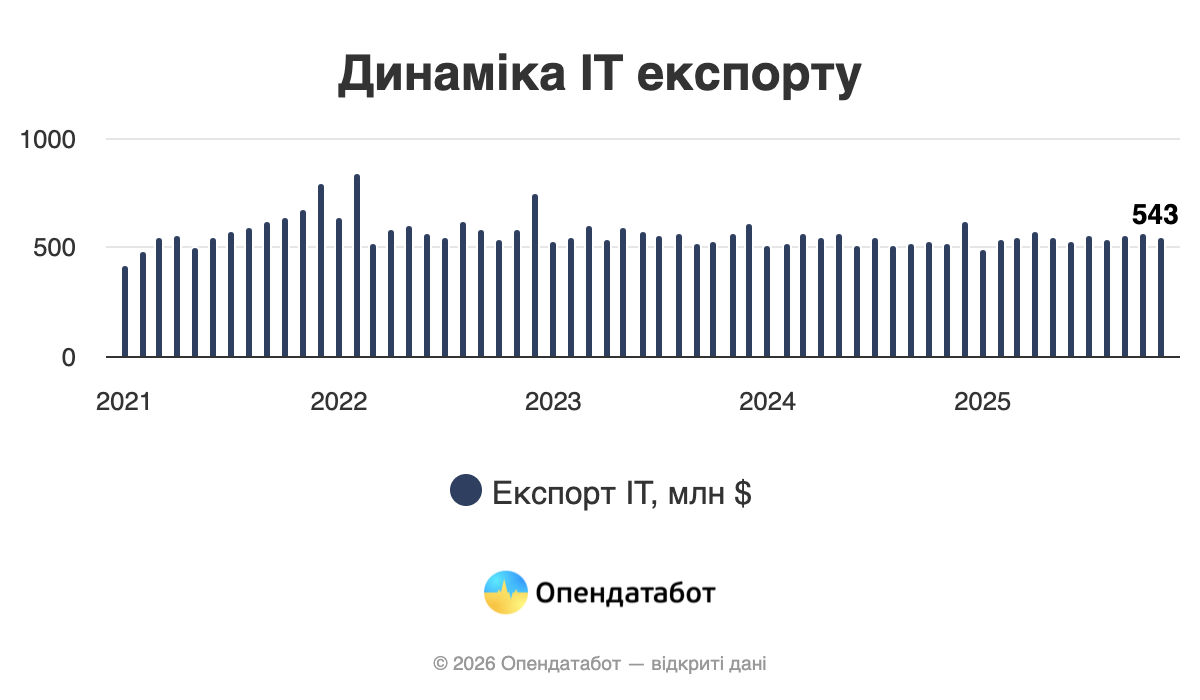
The IT sector brought $5.97 billion to the state treasury in 11 months of 2025, according to the National Bank of Ukraine. The amount increased slightly over the year, by just over 2%.
Ukraine has earned $5.97 billion from the export of IT services for the first half of 2025. This is 2.4% more than in the same period in 2024. However, it is impossible to say that IT is in its heyday: it is still 3% less than in 2021 and almost 10% less than in the peak year of 2022.
It is worth noting that monthly exports of IT services bring in an average of $543 million. For comparison, the average monthly figure was $612 million in 2022.
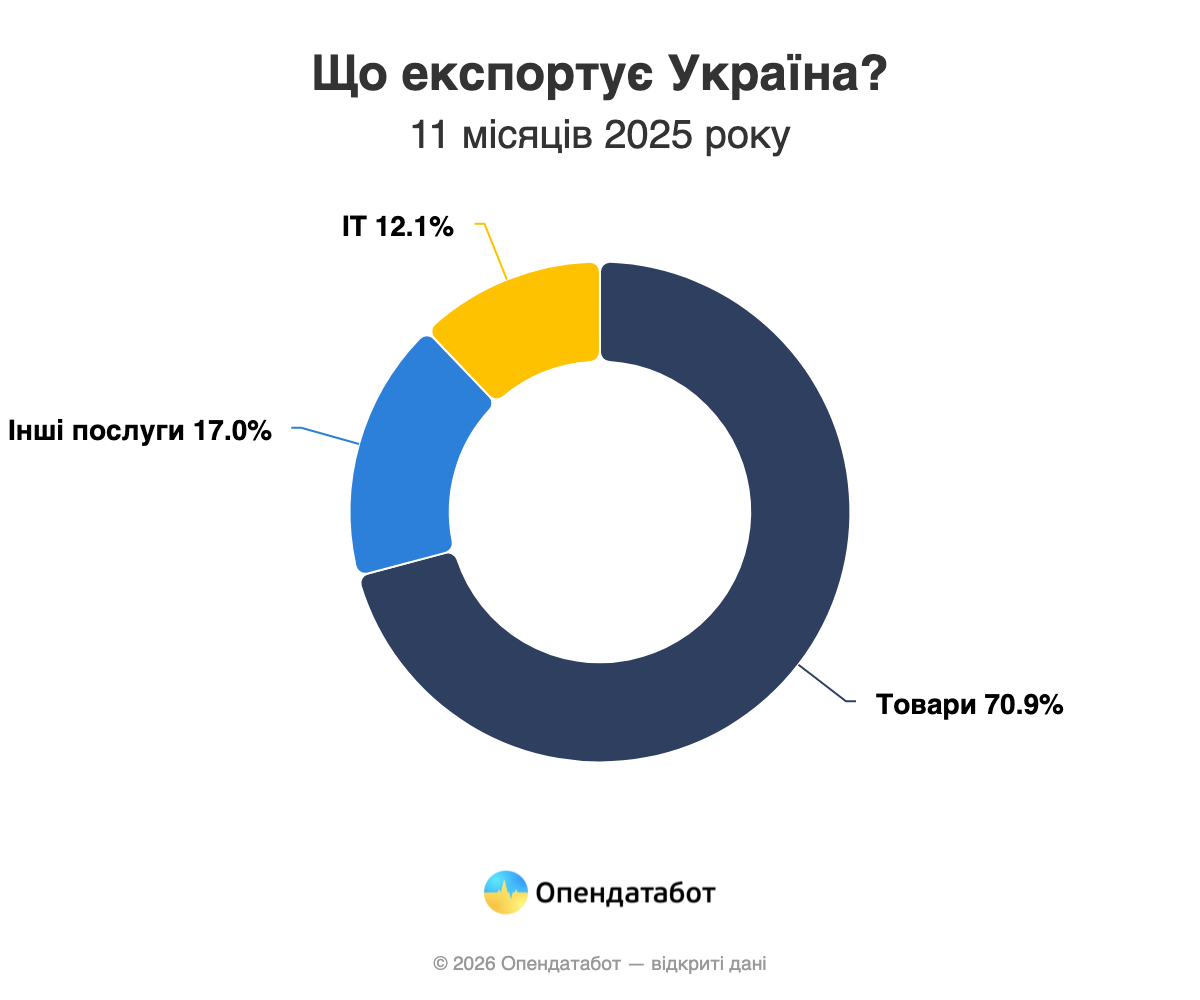
Currently, IT services account for 42% of all service exports. Compared to the country’s total exports (both goods and services), IT accounts for 12% of the total.
At the same time, exports of services decreased by 9% to $14.33 billion over the year. Total exports of goods and services also decreased by 5% to $49.21 billion.
https://opendatabot.ua/analytics/it-export-25

Leaders of the insurance market of Ukraine on collected premiums in January-November 2025 became insurance companies “SG ”TAS“ – UAH 7,047 billion, ”ARKS“ – UAH 5,275 billion, ”INGO“ – UAH 4,642 billion, IC ‘VUSO’ – UAH 4,639 billion, ”Arsenal Insurance” – UAH 4,458 billion.
As evidenced by the data of the project of information exchange “PRIMA” of the National Association of Insurers of Ukraine (NASU), compared to 10M2025 IC ‘Unica’, which occupied the fifth position of the leaders’ rating, has conceded this place to IC “Arsenal Insurance”.
In the market of compulsory insurance of motor civil liability at the end of 11 months, as before, were SG “TAS” – UAH 3,672 billion, “Oranta” – UAH 2,702 billion, “Knyazha VIG” – UAH -2,221 billion, ‘INGO’ – UAH 1,123 billion and “Arsenal Insurance” – UAH 1,095 billion.
Also in the cross-section of the compared periods there were no changes in the market of “Green Card”, where the top five are still “TAS” – UAH 1.150 billion, “USG” – UAH 967.4 million, ‘ROM’ – UAH 863 million, “Knyazha VIG” – UAH 351 million, “VUSO” – UAH 247.9 million.
The CASCO market, as before, is headed by IC “ARKS” – UAH 2.559 billion, “Arsenal Insurance” – UAH 2.469 billion, “VUSO” – UAH 1.202 billion, ‘Unica’ – UAH 1.143 billion and “Universalna” – UAH 1.046 billion.
The leadership in voluntary health insurance is held by the former five: IC Unica – UAH 1,839 billion, followed by IC VUSO – UAH 1,109 billion, IC Universalna – UAH 1,045 billion, IC INGO – UAH 933,4 million and SG TAS – UAH 816,5 million.
In the life insurance market, the first position is still occupied by IC “MetLife” – UAH 2.771 billion, IC ‘TAS’ – UAH 850.9 million, “Grave Life” – UAH 625.2 million, “ROM Life” – UAH 360.1 million, “Unica Life” – UAH 315 million.
As reported, as of December 1, 2025, 48 risk insurers worked in the insurance market of Ukraine, 10 specialized in life insurance, one – with a special status (“Export Credit Agency”, ECA).

More than 250 thousand sole proprietorships closed in Ukraine in 11 months of 2025, according to the Unified State Register. One in eight entrepreneurs who closed last year worked in Kyiv. On average, sole proprietors live for 2.4 years. The longest-lived entrepreneurs are those engaged in warehousing activities, while the shortest-lived are couriers.
250,209 fops have closed since the beginning of 2025 in Ukraine. The peak of closures occurred in January, when, after a month and a half break in the work of the registers, 59,723 entrepreneurs immediately documented the closure.
2 years and 4 months is the average period of operation of a fop in Ukraine.
We follow the dynamics on the page about Ukrainian foponomics.
Every eighth entrepreneur who closed in 2025 worked in Kyiv: 32,469 fops. Dnipropetrovs’k region is the second most closing region: 22,645 entrepreneurs ceased their activities last year. Small businesses in Kharkiv (20,481), Odesa (18,714), and Lviv (16,521) regions closed by a small margin.
The most vulnerable last year were retailers, accounting for a third of closures (77,705). On average, such businesses have been in existence for less than 3 years. Another 16,909 sole proprietorships in the wholesale trade sector ceased operations in 2025 – such entrepreneurs barely make it through the year. Overall, the trade niche alone accounts for almost half of the closures.
By a wide margin , IT specialists were the second most frequent closures – 28,668, or every ninth entrepreneur who closed last year. By the way, IT entrepreneurs are also among the longest-lived entrepreneurs – 3 years and 11 months.
How long does the average fop live?
The longest-lived entrepreneurs in Ukraine are those engaged in warehousing, with more than 6 years of experience.
Real estate entrepreneurs have been operating for 5 years and 11 months. Businesses in the field of equipment repair, in particular, household appliances, round out the top three: 5 years and 9 months.
But courier firms are the least resilient – only 6 months, on average, have been worked by entrepreneurs who closed in this area last year. FOPs in the field of administrative and auxiliary office activities survive for 9 months.
Entrepreneurs in the aforementioned wholesale trade and educators have been operating for just over a year.
https://opendatabot.ua/analytics/fops-midage-2025


Updated rules for producers of grapes and wine products have been in force in Ukraine since January 1, 2026, they are approved by the law “On grapes, wine and wine products” (#3928-ІХ), adopted by the Verkhovna Rada on August 22, 2024. The law introduces updated rules for producers of grapes and wine products, establishes modern requirements for the cultivation of grapes, production, labeling and circulation of wine, and brings the Ukrainian system closer to European standards.
One of the key elements of the document is the protection of geographical indications – classification according to the European model, according to which a clear division of wines by origin into wines with protected appellation of origin (PAO) and wines with protected geographical indication (PGI) is introduced. Clear rules have been established for the official recognition and protection of geographical indications, allowing producers to secure regional brands and guarantee consumers authentic quality.
An important tool for streamlining the industry will be the creation of the Viticulture and Wine Registry: the state is introducing a unified information system where all grape plots, grape production and viticulture products will be registered. This will guarantee full traceability of the product from the vine to the store shelf.
In addition, the said law provides for simplification of conditions for small winemakers, which will stimulate the development of the craft segment and gastrotourism.
At the same time, Ukraine introduces strict requirements to the label: the information that must be available to the consumer is clearly regulated, which prevents falsification of wines.
The law updates the terms and classification of wine products, establishes quality standards and labeling requirements. It defines the procedure for state control and general principles of development of the winegrowing and winemaking industry.



