

Ukrainian steelmakers reduced foreign exchange earnings from ferrous metal exports by 7.6% in January–July 2026 compared to the same period last year, down to $1.678 billion, according to data from the State Customs Service.
In January–July 2025, ferrous metal exports brought Ukraine $1.816 billion.
The share of ferrous metals in the country’s total merchandise exports also declined—to 6.95% from 7.79% a year earlier, or by 0.84 percentage points.
At the same time, imports of ferrous metals into Ukraine continued to grow. Over the seven-month period, they increased by 7.2%—to $1.023 billion.
Thus, in 2026, the Ukrainian metallurgical industry faced both a decline in export revenue and increased competition from imported products.
By comparison: at the end of 2025, Ukraine, on the contrary, increased its export revenue from ferrous metals by 7.85%—to $3.339 billion—following a 16.9% increase in 2024.
Source: State Customs Service of Ukraine, data for January–July 2026.

According to Experts.news, the price of aluminum rose in the final trading session of the week following several days of heightened volatility amid risks to supplies from the Middle East, changes in Chinese exports, and expectations of a possible easing of U.S. tariffs on Canadian aluminum.
On the London Metal Exchange on August 21, the price of aluminum rose by approximately 1.2% to $3,242 per metric ton. Other market indicators throughout the day showed prices ranging from about $3,230 to $3,250 per metric ton.
Over the past month, the metal has risen in price by about 1.8%, and compared to a year ago, aluminum remains nearly 24% more expensive.
Despite the rise during recent trading sessions, the price has fallen significantly from its early June high. At that time, three-month aluminum on the LME climbed to $3,787.5 per metric ton—its highest level in about four years. By mid-August, the price had fallen to approximately $3,270 per metric ton.
The main reason for the June surge was disruptions in supplies from the Middle East amid the conflict with Iran. Before the situation escalated, Gulf states accounted for about 10% of global primary aluminum production. Additional problems arose at plants that relied on gas supplies.
However, China offset a significant portion of the shortfall. In the first half of the year, Chinese exports of aluminum alloys nearly doubled to 238,500 metric tons, while shipments of semi-finished products increased by 18% to 3.2 million metric tons. At the same time, China’s domestic demand remained relatively weak, while primary aluminum production remained at a level close to historic highs.
Chinese companies are currently operating at the limit of the national production capacity cap of 45 million metric tons per year set by Beijing, which restricts the possibility of further rapid production expansion.
Trade negotiations between the U.S. and Canada have become another factor affecting the market. According to Reuters, the parties have moved closer to an agreement that could potentially lower U.S. tariffs on Canadian aluminum from 50% to 25%. Such a decision could once again increase the appeal of Canadian aluminum shipments to the U.S. and reduce the volume of shipments to Europe.
As a result, the aluminum market is caught between two opposing trends: the recovery and growth of Chinese shipments are capping prices, while geopolitical risks, production constraints, and trade barriers are keeping them significantly higher than last year’s levels.
Earlier, the Experts Club think tank published a short video on global aluminum production from 1970 to 2024. According to the think tank’s analysis, in 2024, China produced about 43 million metric tons of primary aluminum, or approximately 60% of the global total. Next were India—about 4.2 million metric tons, Russia—3.8 million metric tons, Canada—3.3 million metric tons, and the UAE—2.7 million metric tons.
Watch a short Experts Club video on global aluminum production — https://youtube.com/shorts/cVVIjdMZL-w?si=dAUR8Purot4TxLsm

The Ukrainian Embassy in Thailand has advised Ukrainian citizens to observe heightened security measures in the southern provinces of Pattani, Yala, and Narathiwat amid a sharp escalation of the situation and a series of simultaneous attacks that occurred on the night of August 23.
According to Thai security forces, 51 incidents were recorded in the three southern provinces on the evening of August 22, including explosions, arson, and damage to infrastructure. Of these, 22 incidents occurred in Narathiwat, 18 in Yala, and 11 in Pattani. In Narathiwat, at least two injured civilians were initially reported.
The attacks targeted, among other things, stores, telecommunications infrastructure, and other facilities. Following a series of attacks in Narathiwat Province, authorities temporarily imposed a curfew from 10:15 p.m. on August 22 until 6:00 a.m. on August 23.
On the morning of August 23, Thailand’s Prime Minister and Minister of the Interior, Anutin Charnvirakul, convened an emergency meeting of law enforcement leaders in response to the scale of the nighttime attacks. Authorities have stepped up security measures in the region.
The attacks also affected transportation. The State Railway of Thailand temporarily closed the section between the Maruebo and Tanyong Mat stations in Narathiwat after damage to the railroad tracks was discovered as a result of an explosion. New explosions were also reported in Pattani and Narathiwat that morning.
The Ukrainian Embassy has advised citizens already in Pattani, Yala, or Narathiwat to take extra personal safety precautions and follow the instructions of local authorities. In the event of a threat to life or health, Ukrainians are advised to contact the Embassy’s hotline in Thailand: +66 970 107 760.
The current escalation is not directly related to the conflict between Thailand and Cambodia, which is unfolding along another section of the country’s border.
Pattani, Yala, and Narathiwat are located in the far south of Thailand near the border with Malaysia. These are predominantly Muslim provinces that historically were part of the Malay Sultanate of Pattani.
An armed separatist conflict has been ongoing in the region for over 20 years. The Barisan Revolusi Nasional (BRN) is considered the main insurgent group. Since the conflict reignited in 2004, the violence has claimed the lives of over 7,800 people. In recent months, the number of attacks has risen again.
One of the most serious incidents was the July 22 attack on a checkpoint in Narathiwat: armed men opened fire and used improvised explosive devices, killing five paramilitary personnel and wounding civilians. Following this, special security measures were stepped up in the province.
The day before, on July 21, a car bomb exploded near a police facility in Narathiwat. This was the first such car bombing in Thailand’s southern region in 2026.
Back in June, two separate explosions in Yala and Pattani left 11 police officers injured, and in Pattani, armed men attacked a biomass power plant, after which a key section of the highway was temporarily closed.
Amid the ongoing threat, the Thai government extended the state of emergency for the 85th time in July across much of Narathiwat, Pattani, and Yala—from July 20 to October 19, 2026. However, a number of calmer areas were excluded from the state of emergency.
At the same time, Bangkok is attempting to resume political dialogue. Thailand’s new chief negotiator, Tanut Suwannananda, announced in August his intention to change the approach to the peace process with the BRN, including discussions on political demands, elements of decentralization, and a possible amnesty. Negotiations mediated by Malaysia have been ongoing since 2013 but have been repeatedly interrupted.
Even before the current series of attacks, a number of foreign governments had recommended avoiding non-essential travel to Pattani, Yala, and Narathiwat. For example, the British Foreign Office advises against traveling there unless absolutely necessary due to regular armed attacks near the Malaysian border.
Thus, the Ukrainian Embassy’s warning is not related to a general deterioration of security throughout Thailand, but rather to a sharp escalation of the chronic armed conflict in the three southernmost provinces. The country’s main tourist regions—Bangkok, Phuket, Pattaya, Koh Samui, Krabi, and Chiang Mai—are located outside this conflict zone.

Sky Bank (Kyiv) increased its authorized capital by 94.38 million UAH—to 367.55 million UAH—by raising the par value of its shares using a portion of the profit earned in 2025.
According to the bank’s filing with the National Securities and Stock Market Commission (NSSMC)’s disclosure system, the decision to increase the authorized capital was approved by the bank’s annual general meeting of shareholders on April 28, 2026.
State registration of the relevant amendments to the articles of association was completed on July 3, and the NSSMC registered the share issue on August 13.
On August 20, the bank received a notification from the Central Securities Depository regarding the deposit of the global certificate and the entry of information about the new par value of the shares into the depository accounting system.
Following the capital increase, the number of the bank’s voting shares stands at nearly 3.54 million, or 99.9358% of the total number of shares.
According to data from the National Bank, as of July 1, 2026, Sky Bank ranked 40th (4.28 billion UAH) among 59 banks in terms of total assets, and the financial institution’s net profit for the first half of the year amounted to 27.34 million UAH.

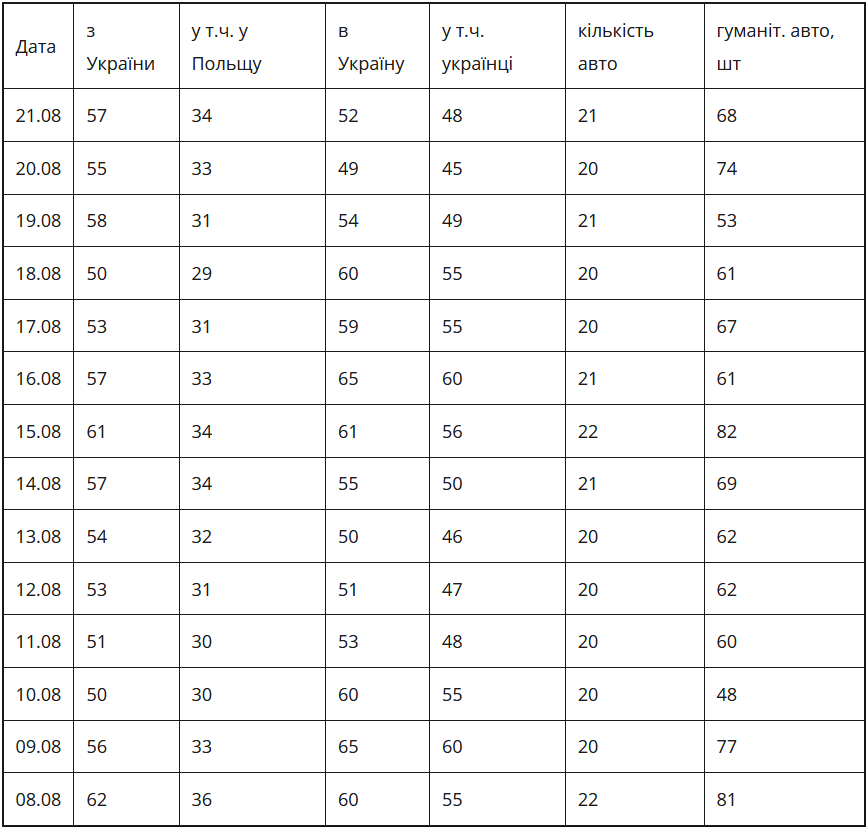
Passenger traffic across Ukraine’s western border during the week of August 15–21 increased by 1.8%—to 791,000 — a record high since the start of Russia’s full-scale aggression, excluding the first few days of the conflict, according to daily statistics from the State Border Guard Service monitored by the Interfax-Ukraine news agency.
The previous record was set in mid-August 2025 at 778,000, but last year during this same week, passenger traffic had already begun to gradually decline.
According to data from the State Border Guard Service, the number of outbound border crossings this week increased to 391,000 from 383,000 the week before, while inbound crossings rose to 400,000 from 394,000.
The number of vehicles passing through checkpoints also increased slightly—to 145,000 from 143,000 last week—as did the number of vehicles carrying humanitarian cargo—to 466 from 459—but these figures are not record-breaking.
The heaviest outbound traffic was recorded on Saturday (61,000 per day), and the heaviest inbound traffic on Sunday (65,000), while the lightest outbound traffic was on Tuesday (50,000), and the lightest inbound traffic on Thursday (45,000).
According to the State Border Guard Service, as of 9:00 p.m. on Saturday, the largest number of passenger cars were waiting to cross the border with Poland at the “Krakovets” border crossing point (BCP)—100, “Ustyluh”—60, and “Shehyni”—50. Shorter lines were observed at the “Hrushev” checkpoint (40 vehicles), the “Nyzhankovychi” checkpoint (20), and the “Rava-Ruska” checkpoint (15).
In addition, 15 buses had accumulated at the “Krakovets” checkpoint, 5 at the “Smelnitsa” checkpoint, and 90 pedestrians were also waiting in line at the “Shehyni” checkpoint, which is very rare.
At the border with Slovakia, there was a line of 25 vehicles at the “Maly Berezny” border crossing point and 10 at the “Uzhhorod” border crossing point.
At the border with Hungary, 30 passenger cars were waiting to cross at the “Luzhanka” checkpoint, 25 at the “Tisa” checkpoint, and another 20 at the “Vylok” checkpoint.
At the border with Romania, 20 vehicles had accumulated at the “Dyakivtsi” checkpoint and another 10 at the “Porubne” checkpoint.
Last year, passenger traffic across the border this week had already decreased by 1.3% compared to the peak figure—to 768,000—with outbound traffic exceeding inbound traffic by 2,000.
It remained at this level during the last week of August but then dropped sharply in the first half of September with the start of the new school year.
As reported, starting May 10, 2022, the outflow of refugees from Ukraine—which began with the start of the war—turned into an inflow that lasted until September 23, 2022, totaling 409,000 people. However, starting in late September—possibly influenced by news of mobilization in Russia and “pseudo-referendums” in the occupied territories, followed by massive shelling of energy infrastructure—the number of people leaving exceeded the number of those entering. In total, from the end of September 2022 until the first anniversary of the full-scale war, this figure reached 223,000 people.
In the second year of the full-scale war, the number of border crossings for departure from Ukraine, according to the State Border Guard Service, exceeded the number of crossings for entry by 25,000; in the third year—by 187,000; in the fourth year—by 221,000; and by 77,000 since the start of the fifth year—64,000 of which occurred since the beginning of summer.
In its July inflation report, the National Bank maintained its estimate of last year’s migration from Ukraine at 0.3 million people due to the deterioration of the security situation at the end of the year and the easing of exit rules for young people, but noted that in 2024 this figure will be less than 0.5 million. The NBU continues to forecast a net outflow of 0.2 million in 2026,
while net returns, according to its forecast, will begin in 2027 and amount to about 0.1 million people, increasing to 0.5 million people in 2028.
According to UNHCR data, the number of Ukrainian refugees in Europe as of June 30, 2026, stood at 5.159 million, and globally at 5.687 million, compared to 5.213 million and 5.687 million, respectively, as of April 30.
In Ukraine itself, according to the latest UN data for July 2026, there are 3.80 million internally displaced persons (IDPs), compared to 3.70 million in January of this year and 3.34 million in July 2025.
Crossings at Ukraine’s western border, in thousands:
BORDER, MIGRATION, PASSENGER TRAFFIC, State Border Guard Service of Ukraine, UKRAINE

Farms of all categories produced 3.55 million metric tons of raw milk in January–July 2026, which is 12% less than during the same period in 2025, according to the Association of Milk Producers (AMP), citing preliminary data from the State Statistics Service.
In July, farms of all categories produced 563,700 metric tons of raw milk—0.5% less than in June and 15% less than in July 2025.
Agricultural enterprises produced 281,000 metric tons, which is 0.7% less than in June but 4.5% more than last year, while private households produced 282,700 metric tons, which is 0.2% less than in June and 28.3% less than in July 2025.
Over the first seven months of 2026, commercial dairy farms increased raw milk production by 5%—to 1.93 million metric tons—while private households reduced it by 27%—to 1.62 million metric tons.
“Raw milk production in Ukraine has declined due to the heat, as not all commercial dairy farms have been modernized and equipped with state-of-the-art ventilation systems that allow cows to avoid heat stress. The hot weather led to a 10–15% decline in raw milk production at many farms,” the AVM explained.
In January–July 2026, approximately 54% of raw milk was produced by agricultural enterprises in five regions: Poltava, Cherkasy, Khmelnytskyi, Chernihiv, and Vinnytsia.
The AVM noted that in January–July, agricultural enterprises accounted for 54% of raw milk production, while private farms accounted for 46%.



