
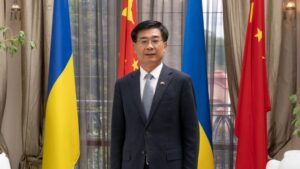
According to Experts Club, the implementation of transportation projects under the “One Belt, One Road” initiative could boost trade among countries along the relevant corridors by 2.8–9.7%, said Chinese Ambassador to Ukraine Ma Shengkun, citing a World Bank study.
As the diplomat wrote in a column on the Interfax-Ukraine website, according to estimates by the World Bank and other international organizations, the development of infrastructure connectivity contributes to the expansion of trade and the reduction of poverty in countries participating in the initiative.
In particular, if transportation projects are fully implemented, travel time along the relevant corridors could potentially be reduced by up to 12%, global trade could increase by 1.7–6.2%, and global real income could rise by 0.7–2.9%.
As examples of infrastructure projects, the ambassador cited the China–Laos Railway and the Jakarta–Bandung high-speed rail line in Indonesia.
According to the data he provided, by the end of 2025, the China–Laos Railway had carried out over 64 million passenger trips and transported over 74 million metric tons of cargo. The range of goods transported exceeded 3,800 items, and the transportation network spanned 19 countries and regions.
The Jakarta–Bandung high-speed railway, which began commercial operations in October 2023, had transported more than 16.58 million passengers by July 2026.
As previously reported, China remains Ukraine’s largest trading partner. According to an analysis by Experts Club, Ukraine’s trade turnover with China in January–June 2026 reached $14.68 billion, with $13.9 billion accounted for by imports of Chinese goods and $778.4 million by Ukrainian exports.
According to data from the State Customs Service of Ukraine, imports from China exceeded $19.6 billion in January–August 2026—significantly more than from Poland ($6.3 billion) and Germany ($4.4 billion), which ranked next among the largest suppliers of goods to Ukraine.
A study by Experts Club and Active Group dated September 18, 2026 notes a significant gap between the scale of Ukraine’s economic interaction with China and the structure of bilateral trade: China remains the country’s largest trading partner, yet Ukrainian exports to the Chinese market lag significantly behind imports.

Despite delays in receiving external financing, the Ministry of Finance of Ukraine will currently refrain from significantly increasing the volume of borrowing on the domestic debt market in order to avoid raising the cost of servicing that debt, said First Deputy Minister of Finance Roman Yermolychev.
“We will monitor the status of the Single Treasury Account. We must understand that these are debt obligations that we must fulfill in any case,” the First Deputy Minister noted during a budget discussion organized by the Center for Economic Strategy last week.
“Raising more funds would require raising interest rates, which we would prefer to avoid,” Yermolichev emphasized.
He recalled that at the most recent primary auctions of domestic government bonds, the Ministry of Finance managed to increase the amount of funds raised by 5 billion hryvnia compared to the standard trend.
“Future fundraising rounds may also be larger, depending on how much funding we’ll need for social payments and those critical expenditures that arise on a daily basis,” said the first deputy minister.
According to him, while awaiting external financing—which is contingent on the Verkhovna Rada’s adoption of a number of laws—the Ministry of Finance has deferred approximately 39 billion hryvnias in unsecured capital expenditures to December.
As reported by the Interfax-Ukraine news agency, during the first primary auctions for the placement of domestic government bonds following the National Bank’s increase of the discount rate from 15.5% to 16% per annum on September 22, the Ministry of Finance was able not only to maintain yields on standard bonds at the previous level, but also to lower rates on benchmark bonds, which banks can use to partially form their required reserves. The cut-off rates for 12-month and 29-month OVDPs remained at 15.18% and 16.10%, respectively, while the rate for benchmark bonds fell to 12.18%.
In total, the Ministry of Finance raised 7.36 billion UAH across three auctions, compared to 2.01 billion UAH a week earlier, when there were two auctions and the offering at each was 1 billion UAH.
For the upcoming auctions on Tuesday, September 29, the Ministry of Finance reduced the supply of standard OVDPs to 1 billion UAH from 3 billion UAH last Tuesday, while retaining the more popular one-year bonds. At the same time, it will again offer 5 billion UAH in benchmark bonds, whereas previously these instruments were auctioned off approximately once a month.
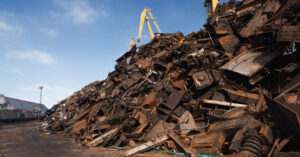
The European Business Association (EBA) calls for maintaining a zero quota on ferrous scrap exports, which would effectively ban scrap metal exports in 2027, Alternatively, should the quota be abolished, member companies propose imposing an export duty of EUR 180 per metric ton for all export destinations, taking into account Ukraine’s international obligations.
“Domestic processing of scrap metal in Ukraine allows for the creation of added value, the preservation of jobs and tax revenues, and the provision of raw materials for the production of steel and finished metal products. The use of scrap also helps reduce energy consumption and CO₂ emissions in steel production, which takes on additional significance in light of the EU’s Carbon Border Adjustment Mechanism (CBAM),” the publication states.
According to the publication, EBA member companies have appealed to the Cabinet of Ministers and the Ministry of Economy.
Recently, following the shutdown of most Ukrainian steel mills due to massive Russian shelling, scrap metal collection companies have called on the government to review restrictions on scrap exports. Previously, scrap collectors had advocated for lifting the de facto ban on scrap exports from Ukraine and introducing quotas for shipments of this raw material to EU countries in the amount of 200,000 metric tons per year.
As reported, the Cabinet of Ministers of Ukraine established a zero quota on scrap metal exports effective January 1, 2026, to ensure Ukrainian enterprises have access to this raw material.
The EBA noted that, according to 2025 figures, exports of ferrous scrap from Ukraine increased by 53% compared to 2024—reaching 448,680 metric tons. The business community believes that easing the current restrictions could lead to a rise in exports and a shortage of raw materials for Ukrainian manufacturers.
According to data from “UAVtormet,” 4.3 million metric tons of steel were produced in the first 8 months of 2026 (compared to 7.41 million metric tons in 2025), 925,400 metric tons of scrap were delivered to steel mills (1.56 million metric tons), and scrap procurement totaled 971,700 metric tons (2.11 million metric tons). According to preliminary forecasts, 6.4–6.5 million metric tons of steel will be produced in 2026, 1.2–1.25 million metric tons of scrap will be delivered to steel mills, and scrap procurement will total 1.22–1.25 million metric tons.
In January–August of this year, Ukrainian companies reduced exports of ferrous scrap by more than 20 times compared to the same period last year—to 13,86 thousand metric tons from 283,06 thousand metric tons, and in monetary terms—to $3.930 million from $85.4 million. At the same time, 9.31 thousand metric tons were exported in January due to the completion of last year’s contracts, compared to 68.52 thousand metric tons in December 2025. There were no exports in February through May of this year; 4.08 thousand metric tons were exported in June, 315 metric tons in July, and 157 metric tons in August.
On April 29, 2026, the Cabinet of Ministers, by its Resolution No. 563, amended Annex 1 to its Resolution No. 1795 of December 31, 2025, permitting the export of scrap metal on the basis of licenses issued by the Ministry of Economy to to foreign economic activity entities that were the winners of electronic auctions held in December 2025 for the sale of such goods in accordance with the Procedure for the Alienation and Lease of Property of Business Entities in which more than 50% of the shares in the authorized capital are owned by the state or by another legal entity whose sole participant is the state.
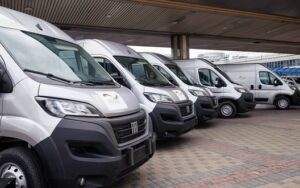
Germany has provided 5 pickup trucks and 5 cargo vans for track workers, communications specialists, and power engineers to help restore damaged infrastructure and resume train service as quickly as possible following Russian attacks on the railway, according to a statement by Ukraine’s Ministry of Recovery, Infrastructure, and Transport on its Telegram channel.
“After every strike, repair crews must be dispatched to the site as quickly as possible to restore infrastructure and train service. This requires people, equipment, and, of course, transportation.
We thank the railroad workers for their 24/7 efforts. And we thank Germany for its consistent support and practical assistance. It is important to us that this support continues and intensifies,” said Deputy Minister Volodymyr Shemaev.
The equipment was handed over by Boris Ruge, Ambassador Extraordinary and Plenipotentiary of the Federal Republic of Germany to Ukraine.
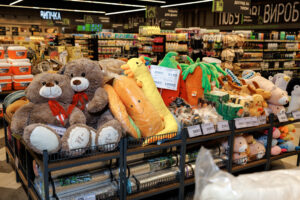
The Novus supermarket chain opened its first store in Ivano-Frankivsk, which became the chain’s 100th location in Ukraine, the company’s press office reported.
“We are gradually expanding into new cities and plan to continue this trend. Ivano-Frankivsk has become an important milestone in our growth, but it certainly won’t be the last. We strive to be closer to our customers in various regions of Ukraine,” reads the Novus press release.
According to the report, the new 1,900-square-meter supermarket opened in the “Arsen” shopping center. The product range includes over 17,000 items. The store also features products from its own “Master of Taste” brand. The store has eight regular checkout lanes and eight self-checkout lanes.
As previously reported, in August, Novus opened two supermarkets in Lviv at once.
In June 2026, the Antimonopoly Committee of Ukraine authorized Novus-Ukraine LLC to lease a number of assets from the Eurotek Group, which had closed its “Fresh,” “Arsen,” “Soyuz,” and “Kvartal” supermarket chains.
Novus is a supermarket chain with 100% Lithuanian capital that has been operating since 2008 and is developed by BT Invest (Lithuania). As of mid-2026, the company has 173 locations and is represented in Kyiv, the Kyiv region, and a number of other regions of Ukraine. The founder and beneficial owner of the group is Lithuanian entrepreneur Raimondas Tūmenas. The company operates a supermarket chain as well as “Mi Market” convenience stores.
According to the YouControl analytics system, Novus’s revenue in 2025 totaled 34.69 billion UAH, which is 19.55% more than in 2024.
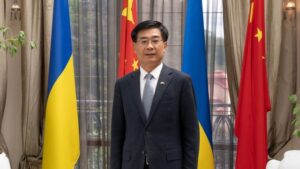
According to Experts.news, China’s foreign trade in goods reached 45.47 trillion yuan in 2025, up 3.8% from the previous year, said Ma Shengkun, China’s ambassador to Ukraine.
“In 2025, the total volume of China’s imports and exports of goods reached 45.47 trillion yuan, an increase of 3.8% year-over-year.
Imports totaled a record 18.48 trillion yuan,” the diplomat wrote in his column on the Interfax-Ukraine website.
According to him, China has remained the world’s second-largest import market for the 17th consecutive year and is the main trading partner for more than 160 countries and regions.
The ambassador also noted that in 2025, China’s imports from the least developed countries increased by 9%, while imports from Asia rose by 3.9%, from Latin America by 4.9%, and from Africa by 6%.
Ma Shengkun highlighted the growth of the high-tech segment of Chinese exports. According to the data he cited, exports of high-tech products reached 5.25 trillion yuan in 2025, an increase of 13.2%.
In particular, total exports of electric vehicles, photovoltaic products, and lithium batteries—referred to in China as the “new trio” of export goods—rose by 27.1%.
As previously reported, China remains Ukraine’s largest trading partner. According to a study by the Experts Club information and analytical center, Ukraine’s trade turnover with China reached $14.68 billion in the first half of 2026, including $13.9 billion in imports of Chinese goods and $778.4 million in exports of Ukrainian goods to China. China accounted for 21.9% of Ukraine’s total trade with its 50 largest trading partners.
According to the latest data from the State Customs Service of Ukraine, in January–August 2026, China retained its top position among suppliers of goods to Ukraine, with imports exceeding $19.6 billion. Ukraine’s total imports during this period amounted to nearly $66.3 billion, while exports totaled over $26.6 billion.
A joint study by Experts Club and Active Group published on September 18 also noted that China remains Ukraine’s largest trading partner; however, Ukrainian exports to the Chinese market lag significantly behind imports from China.



