

Bosnia and Herzegovina Foreign Minister Elmedin Konaković announced the withdrawal of most of the BiH embassy staff from Belgrade following the funeral of former Army of Republika Srpska commander Ratko Mladić, reports the Serbian Economist Telegram channel. He said he intends to reduce relations with Serbia to the “lowest possible level.”
The BiH ambassador and consul, however, remain in Belgrade: their appointment and recall fall under the authority of the collective Presidency of Bosnia and Herzegovina, not the Foreign Ministry. Under the Constitution, it is the Presidency that conducts the country’s foreign policy, so the minister cannot legally sever relations with Serbia on his own.
The reason was not only the funeral ceremony itself on September 7, but also the scale of participation by Serbian state institutions. As the coffin was returned, it was accompanied by representatives of the state and the military, while Defense Minister Bratislav Gašić and Justice Minister Nenad Vujić attended the funeral. President Aleksandar Vučić did not attend the ceremony, but his son Danilo was present. The funeral drew thousands of people.
Serbian Foreign Minister Marko Đurić responded extremely harshly, calling Konaković’s statements “hypocrisy.” He recalled that former BiH army commander Rasim Delić had also been convicted by the Hague Tribunal for crimes committed by the “El Mujahid” unit, and accused the Bosnian side of taking a selective approach to war crimes. Đurić also recalled the attack on Vučić in Potočari in 2015, when the then Serbian prime minister was pelted with stones after laying flowers at the Srebrenica memorial.
Why does the figure of Mladić still provoke such a harsh reaction in the Balkans?
Ratko Mladić commanded the Army of Republika Srpska from May 1992. The International Criminal Tribunal for the former Yugoslavia, and later the UN appeals chamber, ultimately found him guilty and sentenced him to life imprisonment for the Srebrenica genocide, crimes against humanity and war crimes during the war in Bosnia. In Srebrenica, after the enclave was captured in July 1995, around 8,000 Bosnian Muslims — men and boys — were killed.
Therefore, for a significant part of the Bosniaks in Bosnia, Mladić is above all a symbol of Srebrenica, the siege of Sarajevo and ethnic cleansing. His public honoring in Belgrade is perceived there not as a private funeral, but as a denial or justification of the crimes.
Croatia also views Mladić extremely negatively. Before the formation of the Army of Republika Srpska, he served in the Yugoslav People’s Army in the Knin area during the war in Croatia. After the final verdict in 2021, the Croatian government even officially expressed regret that the Hague proceedings had not covered crimes committed by him on Croatian territory.
In Serbia and Republika Srpska, attitudes are different. For many, Mladić remains the man who defended Bosnian Serbs during the breakup of Yugoslavia. That is why thousands of people attended the funeral, chants of “hero” were heard, and his portraits remain widespread. At the same time, Serbia itself has politicians, public organizations and media outlets that accept the findings of international courts and oppose the glorification of Mladić.
Belgrade also constantly emphasizes the issue of Serbian victims of the war and believes that crimes against Serbs receive less attention in regional and international discourse.
The scandal is already moving beyond Bosnian-Serbian relations. EU Commissioner for Enlargement Marta Kos canceled a planned visit to Serbia, explaining the decision by the unacceptability of glorifying convicted war criminals.
The story surrounding Mladić’s funeral is no longer merely a dispute over a single historical figure. It has once again exposed the central political contradiction of the Western Balkans: more than 30 years after the Bosnian war, Belgrade, Banja Luka, Sarajevo and Zagreb still differ substantially in their assessments of the war, responsibility, and of who should be regarded as a criminal and who as a hero.
BALKANS, Bosnia and Herzegovina, DIPLOMACY, RATKO MLADIĆ, SERBIA
The International Soft Skills Summit 2026, dedicated to the development of individuals, teams, and organizations in the era of artificial intelligence, will take place September 12–14 in a hybrid format and will bring together more than 70 Ukrainian and international experts.
According to the event organizers, the first day of the summit will take place in person in Kyiv with an online livestream, while the remaining two days will be held online. More than 5,000 participants are expected to attend.
The summit will also feature the inaugural Soft Skills Summit Awards 2026—a professional award for corporate programs in the areas of leadership development, talent development, team development, corporate culture, and soft skills.
According to the organizers, the Soft Skills Summit program is structured around three levels of development: the individual, the team, and the organization.
On September 12, the program will focus on individual development. On this day in Kyiv, there will be presentations on the main stage, panel discussions, hands-on Soft Skills Hubs, a Mindfulness Zone, an EXPO, Guided Speed Networking, and the awards ceremony for the winners of the Soft Skills Summit Awards 2026.
On September 13, the online program will focus on team development, communication, psychological safety, and modern approaches to leadership.
On September 14, participants will discuss corporate culture, talent and change management, organizational effectiveness, and corporate transformation driven by artificial intelligence.
“Today, a company’s competitive advantage is determined not only by technology. It is determined by people—their ability to think, interact, learn, and lead others through change. That is why we created the Soft Skills Summit—a platform that brings together global expertise and Ukrainian experience to help people, teams, and organizations prepare for the future,” said Ihor Lukianenko and Nataliia Novhorodska, co-founders of UpPro School and the Soft Skills Summit.
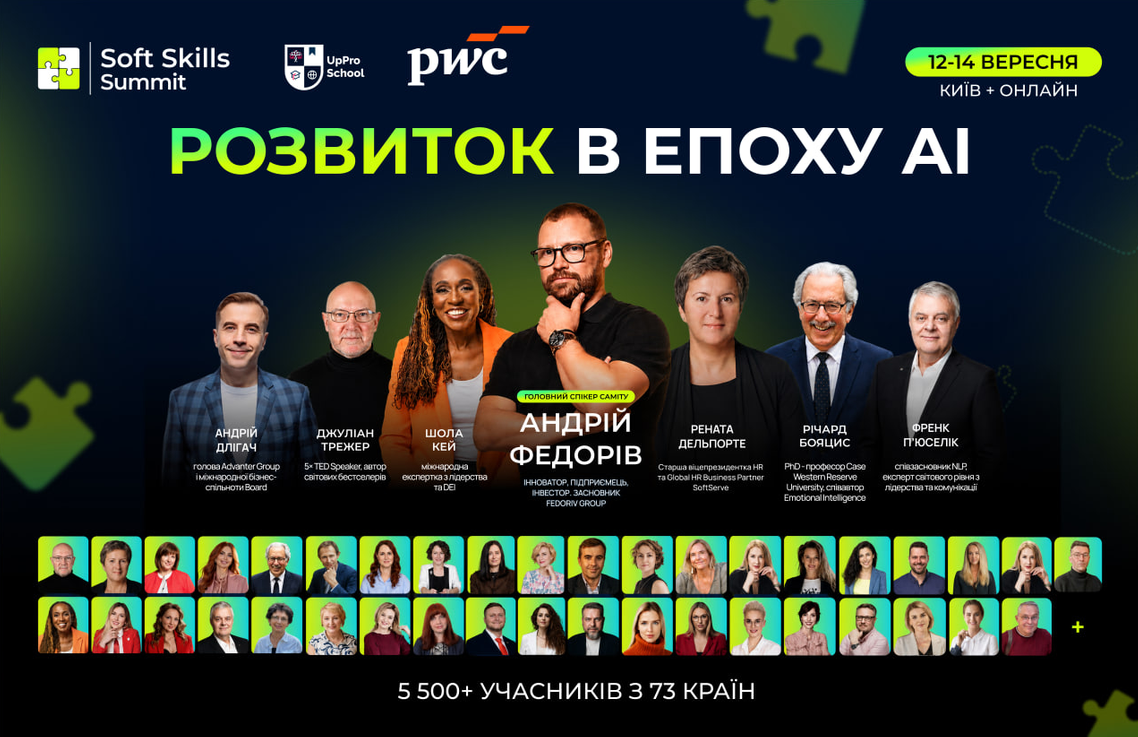
The organizers note that the development of soft skills is taking on added significance amid the spread of artificial intelligence technologies and changing labor market demands.
According to a World Economic Forum forecast, by 2030, approximately 39% of the professional skills required for work will have changed. Among the competencies expected to grow in importance the fastest are analytical thinking, resilience, adaptability, creativity, leadership, and social influence.
For Ukraine, the relevance of this issue is also linked to labor shortages, the integration of veterans and internally displaced persons into the labor market, the potential return of Ukrainians from abroad, the need to develop management teams, and the implementation of AI tools in business processes.
Among the announced speakers for the Soft Skills Summit 2026 are Andriy Fedoriv, founder of Fedoriv Group; Richard E. Boyatzis (U.S.), communications expert and TED speaker Julian Treasure (U.K.), SoftServe Senior Vice President of HR Renta Delporte, Advanter Group Chairman Andriy Dligach, PwC Ukraine Academy Leader Iryna Blinova, business consultant Frank Pucelik (U.S.), Shola Kaye (UK), an expert in communications and People-First culture, and Chen Lizra (Canada), a somatic transformational coach and TED speaker.
The full program and information on participation are available on the Soft Skills Summit 2026 website.
The summit is aimed at business owners, CEOs, team leaders, HR and L&D professionals, business trainers, coaches, psychologists, consultants, and other specialists working in the field of people and organizational development.
As part of the Soft Skills Summit Awards 2026, the best programs will be recognized in five categories: leadership development, talent development, team and corporate culture development, mental health support, and innovation in soft skills training and development.
Projects will be evaluated using a unified methodology developed by the UpPro School Analytical Center in collaboration with the non-governmental organization “Independent Association of Psychology and Coaching” and an independent panel of experts. The organizers state that the main criteria will be the program’s professional value, the quality of its implementation, and its actual impact, regardless of the company’s size.
Detailed information about the award and the terms of participation is available on the Soft Skills Summit Awards 2026 page.
The summit is organized by UpPro School—an international educational center for training and professional development of psychologists, HR and L&D specialists, managers, and other professionals working in the field of people, team, and organizational development. According to the organizers, UpPro School is an accredited CPD provider in the United Kingdom; over 150,000 participants have taken part in the center’s educational events, and more than 8,000 students have completed professional training.
For readers of “Open4business,” the promo code Open4business is available, offering a 10% discount on tickets to the Soft Skills Summit 2026. The promo code is valid through September 11, 2026.
For partnership inquiries, contact Svitlana Chaurova at partnerships@softskills-summit.com.
Open4Business is the official media partner of the event

Romania’s economy contracted by 0.4% in the second quarter of 2026 compared to the same period in 2025, according to unadjusted data, whereas a year earlier, the country’s GDP had grown by 0.3%. This is according to preliminary data from the National Institute of Statistics of Romania (INS), published on September 7.
At the same time, compared to the first quarter of 2026, GDP remained virtually unchanged. According to seasonally adjusted data, the decline in the second quarter amounted to 2% on an annualized basis. Thus, this primarily reflects the economy’s shift to negative annual growth rather than a new quarterly decline.
In the first half of 2026, Romania’s GDP fell by 0.7% compared to January–June of the previous year based on unadjusted data and by 1.6% based on the seasonally adjusted series.
By comparison, in the first half of 2025, Romania’s economy grew by 0.3% year-over-year. In the second quarter of last year, GDP also increased by 0.3% according to unadjusted data, while the seasonally adjusted series showed growth exceeding 2% at that time. Thus, over the course of the year, the performance of Southeast Europe’s largest economy has noticeably deteriorated.
The main pressures on the economy in the first half of 2026 came from trade, transportation, the hotel and restaurant sector, manufacturing, IT and telecommunications, as well as the real estate market. Trade, transportation, warehousing, hotels, and restaurants—which account for about 21.6% of GDP—saw their output decline by 3.9% and made a negative contribution to GDP growth of 0.9 percentage points.
Manufacturing, which accounts for about 16% of the economy, contracted by 2.9% and reduced overall GDP growth by another 0.5 percentage points. The information and communications sector declined by 3.5%, and real estate transactions by 4.5%.
The decline was partially offset by construction. The volume of work in the sector increased by 12.3%, and its positive contribution to GDP amounted to 0.7 percentage points.
Individual indicators confirm the weakness of the industrial sector: Romania’s industrial production in January–June 2026 contracted by 3.3%, including a 4.4% decline in the manufacturing sector.
The deterioration in GDP growth is occurring against the backdrop of large-scale fiscal consolidation and persistently high inflation. In its spring forecast published on May 21, the European Commission projected that Romania’s economic growth in 2026 would amount to only 0.1%, following 0.7% in 2025. In 2027, Brussels forecasts that growth will accelerate to 2.3%.
According to the European Commission’s assessment, the slowdown is primarily due to a decline in real disposable income and consumption amid fiscal consolidation and high inflation. Average inflation in Romania in 2026 is forecast at 7%, and the government budget deficit is expected to shrink from 7.9% of GDP in 2025 to 6.2% of GDP this year. The economy is expected to be supported by investment projects—particularly those funded by the EU—as well as net exports.
On September 7, the Supervisory Board of PJSC “Ukrainian Fire and Insurance Company” (UPSK, Kyiv) suspended CEO Natalya Vorobyev from her duties due to the expiration of her contract.
According to official information from the insurer posted on the National Securities and Stock Market Commission’s (NSSMC) disclosure system, she had held this position since September 9, 2021.
In addition, it is noted that Oleksandr Linichenko has been appointed acting Chair of the Management Board; he has served as a member of the Management Board and Deputy Chair of the Management Board of UPSK PJSC for the past five years.
UPSK PJSC was registered in 1993. It specializes, in particular, in motor vehicle insurance, financial risk insurance, travel insurance, property insurance, cargo insurance, and baggage insurance.
According to the company, Alexander Mikhailov owns 99.999% of its shares.
According to data from the National Bank of Ukraine (NBU), the company ranks 16th among Ukraine’s non-life insurers in terms of premiums written in 2025.

On September 8, the Vehicle Fleet of the Administrative Office of the Verkhovna Rada of Ukraine announced a tender for the procurement of services for mandatory carrier liability insurance covering damage caused to the life and health of passengers and damage caused to baggage during transportation.
According to a notice posted on the Prozorro electronic government procurement system, the estimated cost of the services is 90,633 thousand UAH. The deadline for submitting bids is September 24.
liability insurance, Vehicle Fleet of the Administrative Office, Verkhovna Rada Secretariat

According to Experts.news, the structure of Ukraine’s dairy exports has changed significantly over the past year: the share of butter and other milk fats in foreign exchange earnings has more than halved, while dry and condensed milk have become the largest export category, according to an analysis by the Union of Dairy Enterprises of Ukraine (UDEU).
In August 2025, butter and other milk fats under commodity code 0405 accounted for 36% of the value of Ukraine’s dairy exports, whereas in August 2026, their share fell to 15%. At the same time, the share of dry and condensed milk increased from 24% to 37%, and that of whey from 5% to 11%.
The change in structure occurred gradually. Butter accounted for 36% in August 2025, falling to 25% in October, to 22% in March 2026, and to 15% in August. At the same time, the share of dry and condensed milk rose from 24% to 24%, then to 35% and 37%, respectively. Thus, the shift in the structure of Ukrainian dairy exports occurred primarily between the fall of 2025 and the spring of 2026.
According to the SMPU’s assessment, one of the factors was the situation on the global market for milk fats. Butter prices were under pressure, and the Global Dairy Trade index fell for nine consecutive auctions at the end of 2025. Since the export structure is calculated in value terms, the decline in butter’s share is linked not only to physical shipment volumes but also to changes in global prices.
At the same time, experts cite the growing role of whey as the most notable structural change. Its share of export revenue more than doubled over the year. By August 2026, dry milk, condensed milk, and whey together accounted for 48% of the value of Ukraine’s dairy exports.
The share of cheeses—which are considered higher-value-added products with potentially higher profit margins—remained virtually unchanged, at about 24% in August 2025 and 25% a year later. Thus, the structure of Ukraine’s dairy exports is shifting increasingly toward commodities and raw materials.
This trend is unfolding against the backdrop of a general deterioration in the dairy industry’s trade balance. According to data published by the Ukrainian Dairy Producers Association (SMPU) on September 2, Ukraine exported $176.9 million worth of dairy products in January–August 2026, which is 20.5% less than during the same period last year. At the same time, imports increased by 24.7% to $247.2 million.
In volume terms, butter exports fell by roughly half over the eight-month period, while shipments of dry milk and condensed milk decreased by 7%. At the same time, exports of fermented milk products rose by 28%, milk whey by 1.1%, and cheese by 0.9%.
As a result, Ukraine shifted from a trade surplus in dairy products to a trade deficit. For January–August 2026, the deficit totaled $70.3 million, whereas a year earlier the surplus had reached $24.1 million. The export-to-import ratio fell from 1.12 to 0.72.
On the import side, cheese remains the largest category, although its share in August fell year-over-year from 82.3% to 76.9%. At the same time, the share of imported milk and cream, whey, and butter increased, intensifying competition for Ukrainian processors in the domestic market.
The Union of Dairy Enterprises of Ukraine (SMPU) brings together Ukrainian milk producers and processors and represents the interests of companies in the industry. The organization was founded in 2001.
Original source: analysis by the Union of Dairy Enterprises of Ukraine on Ua Dairy



