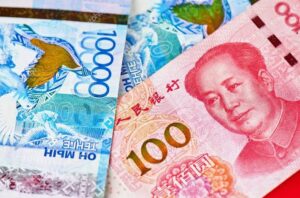
Financial regulators in Kazakhstan and China have reached an agreement to launch a pilot project on settlements in the digital tenge and digital yuan, the press service of the National Bank of Kazakhstan reported following a visit by its delegation to China.
“An important step was the agreement reached between the National Bank and the People’s Bank of China to launch a pilot project for settlements in digital tenge and digital yuan,” the statement said.
“We have agreed to integrate the digital tenge and the digital yuan in two complementary ways: through the mBridge multilateral platform (an international multi-currency platform for real-time cross-border payments and transfers using blockchain technology) and through direct bilateral integration via CBETS (Cross-Border e-CNY Transfer Services, the digital yuan platform for cross-border settlements),” explained Binur Zhalenov, Deputy Chairman of the National Bank of Kazakhstan, who participated in the negotiations, on his social media page.
During negotiations with Cross-Border Interbank Payment System (CIPS), the parties discussed further practical steps to implement the memorandum of understanding between the National Bank, the National Payment Corporation, and CIPS, as well as prospects for expanding the use of cross-border payment infrastructure, developing settlements in national currencies, and strengthening cooperation in the field of international payments.
As part of the implementation of the memorandum between the National Payment Corporation of Kazakhstan and UnionPay International (UPI)—the global division of China UnionPay responsible for the international development of UnionPay products and services—the integration of QR payments between the two countries will be completed by the end of the year, according to the National Bank of Kazakhstan.
The central banks also signed a new three-year currency swap agreement, with the option to extend it by mutual agreement of the parties.
During meetings with the China Banking Association and the leadership of China’s largest commercial banks, discussions focused on their participation in financing investment projects in Kazakhstan and issuing debt instruments.
CHINA, KAZAKHSTAN, PAYMENT, тенге, Юань

The Kryvyi Rih Mining and Metallurgical Plant, PJSC “ArcelorMittal Kryvyi Rih” (AMKR, Dnipropetrovsk Oblast), ended the January–June period of this year with a net loss of 6 billion 641.858 million UAH, an increase of 57.4% compared to the first half of last year, when it stood at 4 billion 219.136 million UAH.
According to the company’s interim report, a copy of which is available to the Interfax-Ukraine news agency, AMKR’s revenue from ordinary operations for this period amounted to 32,839,717 million UAH, compared to 33,818,076 million UAH in January–June 2025.
The accumulated loss as of the end of June 2026 amounted to 39,482.201 million UAH.
AMKR’s production volumes for the reporting period were as follows: pig iron—311,234 thousand metric tons; rolled steel—381,185 thousand metric tons; and iron ore concentrate—633,045 thousand metric tons. Exports accounted for 66% of total sales. During the reporting period, AMKR sold steel products on the domestic market, in European markets, and to other countries, such as Egypt, Moldova, and Turkey. The products were exported by rail and through Black Sea ports.
As previously reported, ArcelorMittal Kryvyi Rih ended the January–March 2026 period with a net loss of 4 billion 599.057 million UAH, an increase of 54.8% compared to the same period in 2025, when the loss amounted to 2 billion 970.387 million UAH. Revenue from ordinary operations during this period amounted to 13,244.044 million UAH, compared to 15,063.014 million UAH in January–March 2025.
AMKR ended 2025 with a net loss of 8 billion 896.797 million UAH, while in 2024 it amounted to 8 billion 848.963 million UAH. Revenue from ordinary activities for 2025 reached 70 billion 634.443 million UAH, compared to 64 billion 591.407 million UAH in 2024.
At the same time, AMKR ended 2025 with a consolidated net loss of 8 billion 887.789 million UAH, compared to 8 billion 841.794 million UAH in 2024. At the same time, consolidated income from ordinary activities amounted to 70,627,356 million UAH in 2025, compared to 64,599,685 million UAH in 2024. The consolidated uncovered loss at the end of last year stood at 32,927,580 million UAH.
In 2024, the plant reduced its consolidated net loss by 25.5% compared to 2023—to 8 billion 841.812 million UAH from 11 billion 875.984 million UAH. At the same time, net revenue decreased by 54.3%—to 64,599,685,000 UAH from 41,873,521,000 UAH.
“ArcelorMittal Kryvyi Rih” is the largest producer of rolled steel in Ukraine. It specializes in the production of long products, in particular rebar and wire rod.
ArcelorMittal owns Ukraine’s largest mining and metallurgical complex, “ArcelorMittal Kryvyi Rih,” and a number of smaller companies, including PJSC “ArcelorMittal Beryslav.”
According to the company, ArcelorMittal Duisburg GmbH (Germany) owns 95.128% of its shares.
The steel complex’s authorized capital is 3 billion 859.533 million UAH.

On July 30, Oschadbank JSC announced its intention to enter into a contract with VUSO Insurance Company for the provision of voluntary health insurance services, according to the Prozorro electronic public procurement system.
It is noted that the company’s bid amounted to 153.566 million UAH, while the bank had budgeted 153.9 million UAH for these needs.
Other participants in the tender included Insurance Company “Kraina” with a bid of 146.348 million UAH, which was rejected, as well as Insurance Company “Euroins Ukraine” with a bid of 153.699 million UAH and “Arsenal Insurance” with a bid of 153.759 million UAH.
As previously reported, VUSO Insurance Company won a similar tender a year earlier.
VUSO Insurance Company was founded in 2001. It is a member of the Motor Transport Insurance Bureau of Ukraine (MTIBU) and the Ukrainian Insurance Federation (UIF), a participant in the direct claims settlement agreement, and a member of the Nuclear Insurance Pool.

“NovaPay Credit,” a subsidiary of the international financial services company “NovaPay” (TM NovaPay) within the Nova Group, which is the issuer of NovaPay bonds, increased its net profit 3.2-fold in the first half of 2026 compared to the same period in 2025—to 172.01 million UAH, according to its interim condensed financial statements.
According to the report, revenue for the first half of the year increased 2.2 times compared to the same period last year—to 586.42 million UAH.
Gross profit increased 2.9-fold to 265.41 million UAH, while operating profit rose 3.2-fold to 229.17 million UAH.
The report notes that in the second quarter of 2026, the company increased its net profit by 4.9 times compared to the same period in 2025—to 97.50 million UAH—amid a 2.4-fold increase in revenue—to 312.96 million UAH.
Gross profit in the second quarter of 2026 also increased 4.3-fold to 151.35 million UAH, while operating profit rose 4.9-fold to 129.91 million UAH.
According to the report, equity for the first half of this year rose from 516.5 million UAH to 688.5 million UAH, while liabilities increased from 1 billion 371.0 million UAH to 1 billion 690.8 million UAH.
It is noted that the company increased proceeds from bond sales in January–June of this year to 693 million UAH from 355.63 million UAH in the first half of last year, while expenses for their redemption also rose—to 578.80 million UAH from 244.92 million UAH, respectively.
As for proceeds from repo agreements involving bonds—which the company offers as an alternative to bank deposits—they rose in the first half of 2026 to 882.32 million UAH from 705.88 million UAH, while expenses under such agreements rose to 727.59 million UAH from 422.03 million UAH.
Among other things, the report also notes that in July, a decision was made to issue Series “R” bonds on the “Perspektiva” Stock Exchange (PJSC) with a par value of 200 million UAH; The bonds were issued in the traditional denomination of 1,000 UAH each, with a maturity date of September 3, 2029.

The agricultural holding “Continental Farmers Group” has begun its winter crop planting campaign for the 2027 harvest, with winter rapeseed as the first crop; the company plans to allocate 32,000 hectares for it, according to its press service.
In total, the company is allocating 95,200 hectares for winter crops in 2027. In addition to rapeseed, the crop mix includes 49,900 hectares of winter wheat and 13,300 hectares of winter barley.
“Sowing of grain crops will begin on schedule in early September, after the fields have been cleared of previous crops. We have traditionally developed our operational plans based on a proven balance in the crop mix,” the agricultural holding’s press service quoted Chief Operating Officer Kostyantyn Shytiuk as saying.
It is noted that the planting season began at the typical time seen in recent years and is proceeding under favorable agroclimatic conditions. Thanks to sufficient soil moisture, most divisions expect to see good emergence of winter rapeseed, and the main planting will take place during the first and second decades of August.
As previously reported, the agricultural holding “Continental Farmers Group” (CFG) has joined the global structure of the international agri-food company Olam Agri as a separate business unit.
“Continental Farmers Group” was established in November 2018 as a result of the merger between the ‘Mriya’ agricultural holding and CFG, following “Mriya’s” agreement with international investor Salic UK regarding the sale of its assets.
Continental Farmers Group operates in the Ternopil, Lviv, Ivano-Frankivsk, Khmelnytskyi, and Chernivtsi regions, grows grain and oilseed crops, engages in primary and secondary potato processing, and employs approximately 2,600 people.
AGRICULTURAL HOLDING, HARVEST, planting season, RAPESEED, WHEAT