
According to Fixygen, PJSC “Poltava Oil Extraction Plant — Kernel Group” will hold a general meeting of shareholders remotely on June 24, 2026, as reported in the SMIDA disclosure system on June 8.
Details of the agenda are provided in the issuer’s announcement.
Poltava Oil Extraction Plant – Kernel Group PJSC is part of the Kernel agricultural holding and operates in the oilseed processing sector. The company’s primary business is the production of oil and animal fats. The plant is registered in Poltava. As previously reported, the company posted a net profit of 50.71 million UAH for 2025, compared to a loss the previous year.
Kernel Group, POLTAVA, shareholders' meeting, Special Economic Zone
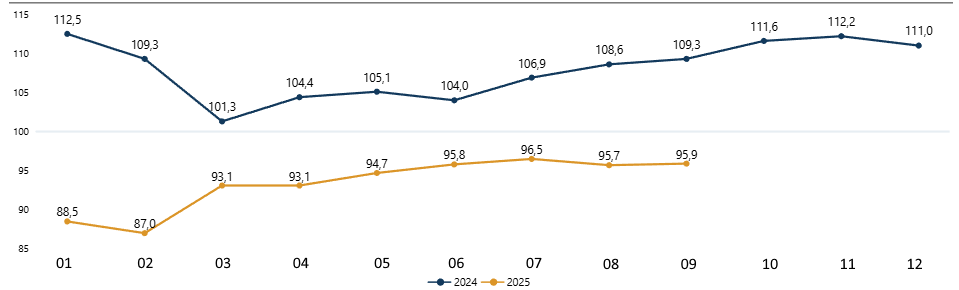
EXPORT CHANGES IN % TO PREVIOUS PERIOD IN 2024-2025
Electricity imports to Ukraine from June 8 to 14 rose by 63% compared to the previous week—to 100.6 thousand MWh, the DIXI Group analytical center reported on Tuesday, citing data from Energy Map.
“Compared to the previous week, imports increased across all sources,” the center noted.
At the same time, exports fell by 38% to 17.2 thousand MWh.
According to Energy Map, Hungary accounted for the largest share of imports last week—40,000 MWh, or 39.8%. Slovakia accounted for 27,900 MWh (27.7%), Romania – 23.5 thousand MWh (23.4%), Poland – 9.2 thousand MWh (9.1%), and Moldova – 0.03 thousand MWh (<0.1%).
The highest growth rates in imports were recorded from Moldova—a 2.5-fold increase. Imports from Slovakia and Hungary increased by 86% and 83%, respectively; from Romania—by 47%; and from Poland—by 5%.
Meanwhile, in the export structure, Hungary’s share amounted to 7.3 thousand MWh (42.6%), Romania’s share was 6.4 thousand MWh (37.3%), Moldova’s was 3.4 thousand MWh (19.9%), and Slovakia’s was 0.04 thousand MWh (0.2%).
Compared to the previous week, exports decreased by 36–89% in most directions. At the same time, supplies to Romania increased 2.8-fold. Electricity exports to Poland have not taken place since November 2025.

According to Fixygen, PJSC “Hybrid Sunflower” will hold a general meeting of shareholders virtually on June 23, 2026, as indicated in a notice posted on the SMIDA disclosure system on June 8.
Details of the agenda are specified in the issuer’s announcement. The meeting will be held remotely.
PJSC “Hybrid Sunflower” operates in the agricultural sector. According to public registration data, the company was registered in 1997 in the village of Salgani, Bilhorod-Dnistrovskyi District, Odesa Region.
The company’s primary activity is seed processing for reproduction. The company’s authorized capital is 520,254 thousand UAH.

The value of Ukraine’s exports of insulated wires and cables (including fiber-optic cables) in January–May 2026 increased by 3.2% compared to the same period in 2025, reaching $612.9 million.
According to statistics from the State Customs Service (SCS), Germany remained the largest importer of Ukrainian products, as it was last year; shipments to Germany saw almost no growth, totaling $209.4 million, while its share of total exports of these products decreased slightly to 34.2%.
As in January–May 2025, the top three importers also included Hungary—$102 million (compared to $95.8 million last year)—and Poland—$97.9 million ($90.7 million).
According to statistics, exports of these products turned negative in May, declining by 6.6% compared to May 2025 and by 1% compared to April of this year, to $124.15 million.
At the same time, according to the State Customs Service, imports of wires and cables into Ukraine increased by 20.4% in January–May, reaching $220.8 million.
The largest suppliers of wires and cables to Ukraine were China ($75.2 million, or 26.8%), Hungary ($73.6 million, or 26.2%), and Poland ($37.1 million, or 13.2%), whereas last year imports from Hungary totaled $65.5 million, from China – $45.4 million, and from Poland – $33.3 million.
As reported, according to the State Customs Service, in 2025 Ukraine increased its exports of insulated wires and cables by 10.6% compared to 2024—to $1.41 billion—and imports by 24.3%—to $590.7 million.

The article presents the key macroeconomic indicators of Ukraine and the global economy as of the end of February 2026. The analysis was prepared on the basis of current data from the State Statistics Service of Ukraine (SSSU), the National Bank of Ukraine (NBU), the International Monetary Fund (IMF), the World Bank, as well as leading national statistical agencies (Eurostat, BEA, NBS, ONS, TurkStat, IBGE). Maksym Urakin, PhD in Economics and founder of the Experts Club information and analytical center, presented an overview of current macroeconomic trends that determined the situation in Ukraine and the world at the beginning of 2026.
Macroeconomic indicators of Ukraine
As of the end of February 2026, the Ukrainian economy maintained a regime of managed macrofinancial stabilization, but compared with January the balance of risks became less comfortable. After the start of the cycle of cautious easing of the NBU’s monetary policy, inflation again accelerated somewhat, international reserves declined from historically high levels, and the foreign exchange market required significant interventions by the regulator. At the same time, the overall macrofinancial situation remained under control thanks to the high level of reserves, external support, continued demand for hryvnia instruments, and the adaptability of business.
The Ukrainian economy ended 2025 with positive but moderate dynamics. According to estimates by the National Bank of Ukraine, real GDP grew by 1.8% in 2025. This meant the preservation of the recovery trend, but the pace of growth was significantly lower than the needs of post-war reconstruction. The main constraints remained the consequences of the war, the shortage of labor, damage to energy infrastructure, weakness of external demand for part of Ukrainian exports, and a high level of uncertainty for investment.
For 2026, the NBU also forecast economic growth of 1.8%. This estimate reflected a cautious scenario: domestic demand and budget expenditures supported economic activity, but energy risks, war losses, and limited export opportunities did not provide grounds to speak of rapid acceleration.
“February 2026 showed that Ukraine is not yet in the phase of full-fledged recovery, but rather in the phase of maintaining macroeconomic manageability. Positive indicators rely to a significant extent on external financing, budget demand, NBU policy, and business adaptation. This creates a stabilization effect, but does not yet form a sufficient internal basis for long-term growth. To move to a new quality of recovery, Ukraine needs not only reserves and partner assistance, but also an increase in production, exports, energy autonomy, and investment in human capital,” Urakin noted.
The inflation picture in February became one of the main signals for macroeconomic policy. According to data from the State Statistics Service, which was commented on by the NBU, consumer inflation in February 2026 accelerated to 7.6% year-on-year, while on a monthly basis prices rose by 1.0%. Core inflation remained at 7.0% y/y. This meant that after the January slowdown, inflationary pressure had not fully disappeared, and some of its components again began to strengthen.
The NBU explained the February dynamics, in particular, by the rise in prices for raw food products, the increase in the cost of certain services, the impact of the energy situation on business costs, and a certain acceleration in fuel prices. At the same time, the regulator noted that the overall inflation trajectory remained close to the forecast. This made it possible not to revise the monetary strategy sharply, but forced caution to be maintained in matters of further rate reductions.
At the end of February, the NBU key policy rate stood at 15.0%. After the reduction at the end of January, the regulator effectively paused, assessing how stable the disinflationary trend was. Such an approach looked logical: the real yield of hryvnia instruments remained an important factor in restraining demand for foreign currency, while the foreign exchange market continued to require the active participation of the National Bank.
“The February acceleration of inflation was not critical, but it clearly showed the limits of rapid monetary easing. Ukraine cannot afford a sharp cheapening of money merely for the sake of short-term economic stimulation, since this could increase demand for foreign currency and destabilize inflation expectations. In the current conditions, the NBU is forced to balance between supporting economic activity and preserving confidence in the hryvnia. That is why every subsequent step to reduce the rate must be very cautious and tied to a real weakening of risks,” Urakin emphasized.
The foreign exchange sector in February remained controlled but tense. As of March 1, 2026, Ukraine’s international reserves amounted to about $54.8 billion. This was 5% less than at the beginning of February, but the level of reserves remained historically high and corresponded to approximately 5.7 months of future imports. The decline in reserves was due primarily to NBU interventions in the foreign exchange market and the state’s debt payments in foreign currency.
In February, the National Bank’s net sale of foreign currency amounted to almost $3 billion. This indicated the preservation of a structural foreign currency deficit in the private sector. External financing inflows partially compensated for this pressure, but did not eliminate the problem itself: the Ukrainian economy imports significantly more goods than it exports, and therefore foreign exchange stability continues to depend substantially on international assistance and NBU reserves.
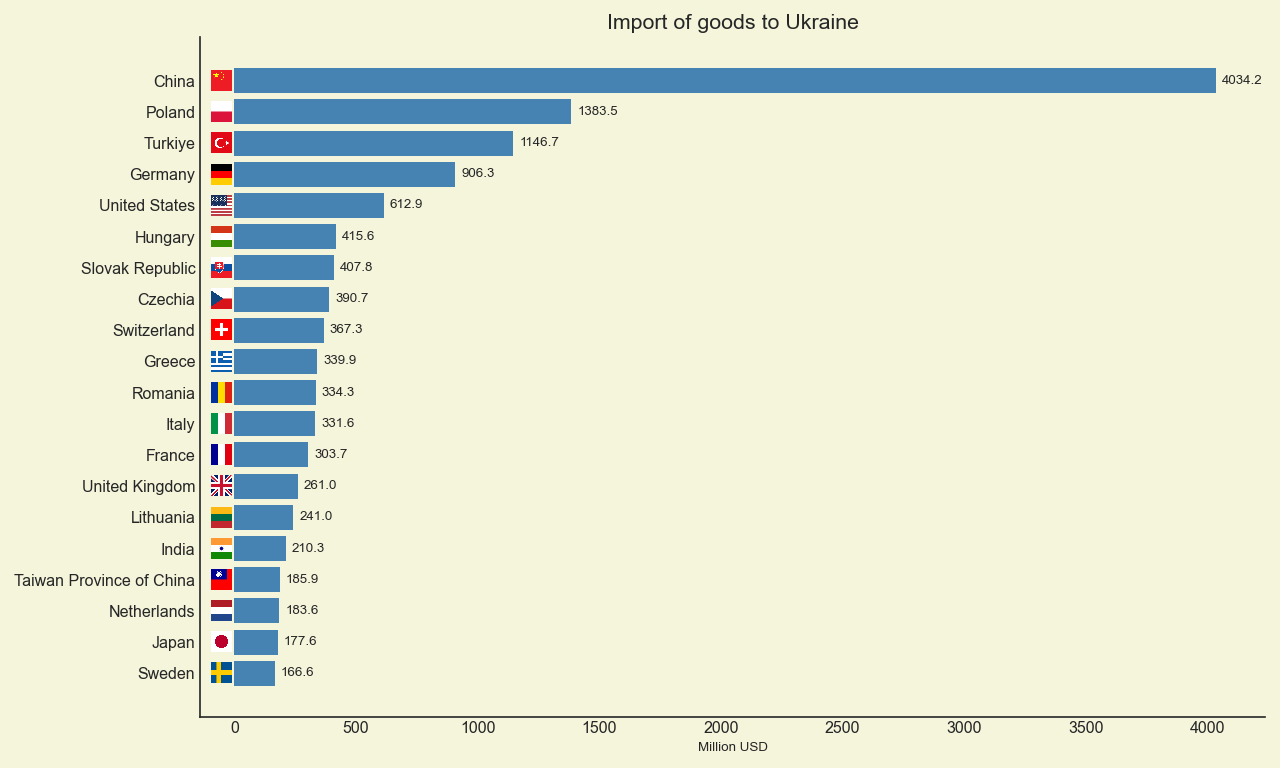
Foreign trade remained one of the weakest elements of the macroeconomic structure. According to the State Customs Service, in January-February 2026 Ukraine’s trade turnover amounted to $21.3 billion. Imports reached $14.8 billion, while exports amounted to only $6.5 billion. Thus, the trade deficit for the two months exceeded $8 billion. This meant that imports were more than twice as high as exports, while domestic demand for foreign goods, energy resources, equipment, and consumer goods remained significantly higher than foreign exchange earnings from the sale of Ukrainian products abroad.
The largest sources of imports remained China, Poland, and Turkey. In the structure of imports, machinery, equipment, vehicles, and fuel and energy goods played an important role. The largest destinations for Ukrainian exports were Poland, Turkey, and Italy, while the basis of exports remained food products, metals, and certain machine-building items. Such a structure confirms that Ukraine does not yet have a sufficiently diversified export base for a rapid reduction of the trade deficit
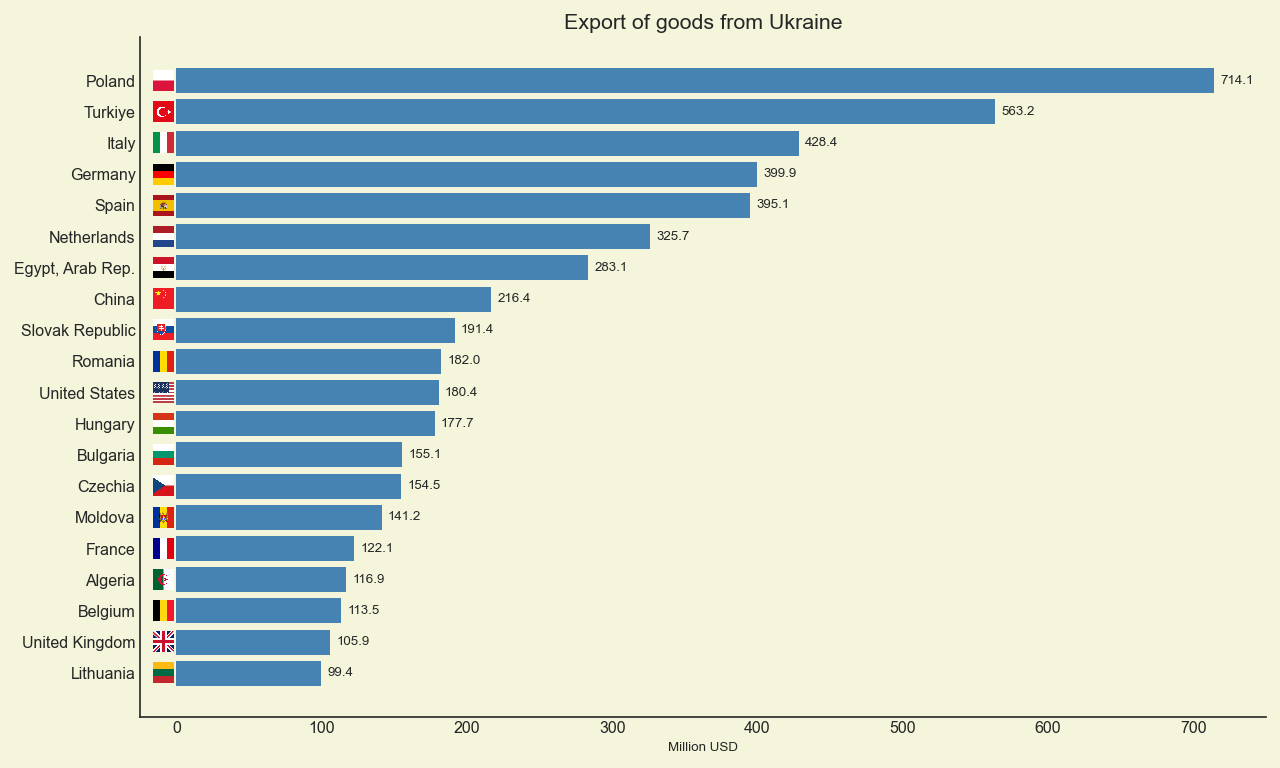
“Foreign trade is precisely the key indicator of long-term resilience. Record reserves and international assistance can stabilize the situation, but they do not replace the economy’s own export capacity. When imports exceed exports by more than two times, this means that the country finances a significant part of consumption, investment needs, and the war economy from external sources. Such a model is justified in wartime conditions, but strategically it cannot be permanent. If Ukraine wants to move from a survival model to a development model, it needs to increase the share of products with higher added value, develop processing, logistics, energy resilience, the defense-industrial complex, and technological production,” Urakin stressed.
The budget situation in the first two months of the year also remained tense. According to the Ministry of Finance, in January-February 2026 revenues of the general fund of the state budget amounted to about UAH 466.8 billion, while cash expenditures of the general fund amounted to about UAH 546.5 billion. Tax revenues, customs payments, and international grants played a significant role in revenues, the volume of which over the two months amounted to more than UAH 160 billion.
This confirms that Ukraine’s public finances remain functional, but structurally dependent on external support. Expenditures on defense, security, social payments, and servicing state obligations form a very high level of budgetary burden. Under such conditions, the rhythmic nature of international financing, the government’s ability to attract funds on the domestic market, and the preservation of confidence in hryvnia instruments remain critically important.
“Ukraine’s budget in 2026 remains a budget of wartime resilience. Its task is not only to finance defense and social obligations, but also to maintain confidence in public finances. But when a significant part of revenues is directly or indirectly linked to international support, the country cannot afford to lose the regularity of financing. The government must work simultaneously on three tasks: ensuring external inflows, developing the domestic borrowing market, and gradually expanding its own tax base through the recovery of economic activity,” Urakin noted.
Global economy
As of the end of February 2026, the global economy looked more resilient than could have been expected amid high geopolitical tension, debt risks, and the restructuring of global supply chains. In its January update of the World Economic Outlook, the International Monetary Fund forecast global economic growth of 3.3% in 2026 and 3.2% in 2027. This meant the absence of a global recession scenario, but also did not indicate a return to rapid and synchronized growth.
The United States remained one of the main stabilizers of the global economy. Real U.S. GDP in the fourth quarter of 2025 grew by 1.4% year-on-year after a significantly stronger third quarter, while for 2025 as a whole the economy increased by 2.2%. The main drivers were consumer spending and private investment. At the same time, inflation was gradually declining: in January 2026, CPI stood at 2.4% year-on-year after 2.7% in December 2025. At the end of January, the Federal Reserve kept the federal funds rate range at 3.5–3.75%.
For Ukraine, U.S. economic dynamics had a dual significance. On the one hand, U.S. resilience supported global demand and financial markets. On the other hand, the preservation of relatively high rates meant that global liquidity remained not very cheap, while countries with elevated risk found it more difficult to count on a sharp reduction in the cost of capital.
The eurozone was in another phase of the cycle. Its economy demonstrated weaker growth, but inflation was closer to the target. According to Eurostat estimates, in the fourth quarter of 2025 eurozone GDP grew by 0.3% compared with the previous quarter, and by approximately 1.5% for 2025 as a whole. At the beginning of 2026, the European Central Bank kept the deposit rate at 2.0%, the main refinancing operations rate at 2.15%, and the marginal lending rate at 2.40%. The February inflation background in the eurozone remained close to the target level.
For Ukraine, the European economy is the key external environment through trade, financing, migration, logistics, and the process of integration into the EU. However, weak eurozone growth means that external demand from European partners is unlikely to become an independent powerful driver of Ukrainian exports in 2026. Ukraine must focus not only on the volume of raw material supplies, but also on production integration into European value-added chains.
The United Kingdom remained an example of an economy with moderate growth and a still elevated inflation background. After weak dynamics at the end of 2025, the British economy entered 2026 cautiously: the services sector remained the main pillar, while industry and construction did not provide a strong impulse. Inflation in January 2026 slowed to 3.0% year-on-year, but still exceeded the Bank of England’s target. This limited the space for rapid monetary easing.
“The global economy at the beginning of 2026 did not look crisis-ridden, but it cannot be called uniformly strong. The United States maintained positive dynamics, although no longer at an overheated pace; the eurozone was effectively balancing between low inflation and weak growth; the United Kingdom had slow growth, but still an elevated inflation background. For Ukraine, this means that external demand is unlikely to become a powerful independent driver of recovery. The global environment rather creates moderately favorable financial conditions, but does not guarantee automatic growth of Ukrainian exports,” Urakin noted.
China ended 2025 with a formally strong result: the country’s GDP grew by 5.0%, to more than 140 trillion yuan. In February 2026, consumer inflation in China stood at 1.3% year-on-year, which was higher than previous weak indicators, but still indicated moderate domestic price pressure. China maintained a powerful production and export base, but the issues of domestic demand, the real estate market, and debt burden remained important constraints.
India, by contrast, remained one of the most dynamic large markets in the world. According to the government’s first advance estimate, India’s real GDP in the 2025/26 fiscal year was expected to grow by 7.4%, while in the third quarter of the fiscal year the growth rate was estimated at 7.8%. The main driver remained the services sector, as well as domestic demand. Inflation in India at the beginning of 2026 remained moderate, creating favorable conditions for maintaining high economic dynamics.
Turkey at the beginning of 2026 continued to demonstrate a combination of economic growth and high inflation. According to official estimates, Turkey’s GDP grew by 3.6% in 2025, but inflation in February 2026 amounted to more than 31% year-on-year. This meant that the country maintained business activity and domestic demand, but at the cost of high price pressure and the need for strict macroeconomic policy.
Brazil looked more balanced. Its GDP grew by 2.3% in 2025, to 12.7 trillion reais at current prices, while IPCA inflation for 2025 amounted to 4.26%. Growth was supported by the agricultural sector, services, and industry. For the global economy, Brazil remained an important example of a large market that combines raw material potential, domestic demand, and a relatively controlled inflation background.
“China, India, Turkey, and Brazil show very well how different the dynamics of large developing economies have become. China has great scale and a strong production base, but still faces structural imbalances and insufficiently strong domestic demand. India demonstrates the most convincing combination of high growth and moderate inflation. Turkey maintains momentum, but the price of this growth is a very high inflation background. Brazil is moving more moderately, but more balanced. For Ukraine, it is important to look at these examples practically: in global competition, those economies win that are able simultaneously to maintain macro-stability, a production base, exports, and domestic investment demand,” Urakin believes.
Conclusions
As of the end of February 2026, Ukraine maintained macrofinancial manageability, but February showed that stabilization remains fragile. Inflation accelerated to 7.6% y/y, the key policy rate remained at 15.0%, international reserves declined to about $54.8 billion, and the foreign exchange market required almost $3 billion in net NBU interventions during the month. At the same time, reserves remained sufficient, the budget was executed with the support of domestic revenues and international grants, and the economy maintained positive dynamics.
The main weaknesses of the Ukrainian economy remained the high trade deficit, the dependence of the budget on external financing, war risks, labor shortages, energy vulnerability, and insufficient export diversification. Positive factors included high international reserves, controlled monetary policy, business adaptability, the continuation of international support, and the preservation of the functionality of public finances.
The global economy at the same moment demonstrated moderate resilience. The IMF forecast global growth at 3.3% in 2026. The United States remained strong, but no longer with excessive overheating; the eurozone balanced between weak growth and almost target-level inflation; China maintained scale, but had structural challenges; India remained the main growth driver among large economies; Turkey was fighting high inflation; Brazil demonstrated moderately positive dynamics.
“February 2026 became a reminder for Ukraine that macrofinancial stability in wartime conditions is not a final result, but a process of constant balancing. The country has a financial cushion in the form of reserves and partner support, but long-term resilience will depend on the ability to create its own economic base for growth. For this, investments in energy, processing, logistics, export-oriented production, technologies, and human capital remain critically important in 2026. Without this, even high reserves and external assistance will remain only a financial cushion, and not a source of long-term development,” Urakin summarized.
The monthly analytical and statistical product “Economic Monitoring” is available to Interfax-Ukraine clients.
Maksym Urakin, Head of the “Economic Monitoring” project, Director of Development and Marketing at Interfax-Ukraine, Candidate of Economic Sciences, Doctor of Philosophy in History, and founder of the Experts Club information and analytical center



