

The housing price index in Ukraine for January–March 2026 stands at 117.2%, compared to 111.2% for the same period in 2025, according to the State Statistics Service (SSS).
According to its data, in the primary market, prices for housing accelerated their growth to 17.3% in the first quarter of 2026, compared to 14.8% in the first quarter of last year. At the same time, apartments in the primary market rose in price by 17.3%, and single-family homes by 16.4%.
In the secondary market, prices accelerated their growth to 17.1% in January–March 2026, compared to 9.3% during the same period in 2025. Specifically, apartment prices rose by 17.9%, while house prices rose by 15.4%.
According to the statistics agency, compared to the previous quarter, housing prices rose by 6.1%, with a 4.8% increase in the primary market and a 6.6% increase in the secondary market.
In the first quarter, apartment prices in the primary market rose by 4.2% compared to the previous quarter, while house prices rose by 7.5%. In the secondary market, prices rose by 5.9% and 7.8%, respectively, the State Statistics Service noted.
The State Statistics Service also compared current price figures with the annual averages for 2019. Thus, in the first quarter of 2026, prices for housing rose by 132.3%.
According to the State Statistics Service, housing prices rose by 12.8% in 2025 and by 12.7% in 2024.
As reported, an updated methodology for the state statistical survey “Changes in Housing Market Prices” has been in effect since the first quarter of 2026, which the State Statistics Service approved to comply with the requirements of European Commission (EU) Regulation 2025/1182 of June 17, 2025.
A unified telecom identification infrastructure has been implemented in Ukraine, covering the entire mobile subscriber base of the country based on myGaru technology. All three mobile operators in Ukraine—Kyivstar, Vodafone Ukraine, and lifecell—as well as the fixed-line operator Ukrtelecom, have joined the project.
“Identification is the foundation of data processing—without it, neither accurate data collection, nor data sharing, nor the subsequent activation of advertising communications is possible. Cross-Telecom ID establishes a unified identification standard for the data market, creating conditions for the development of a sovereign data economy in Ukraine,” myGaru CEO Vitaliy Morozhenko is quoted as saying in the press release.
myGaru explained that the technology combines telecom identification with the digital advertising ecosystem. This enables more precise ad delivery in mobile apps, on websites, in addressable TV, and on digital platforms, including Google, Meta, TikTok, and Telegram.
“The implementation of myGaru technology is a step toward an innovative advertising space that combines business efficiency, user privacy protection, and a responsible approach to data security,” commented Andriy Zheleznyak, Director of Big Data at Kyivstar.
Following the launch of telecom identification, companies will also be able to more accurately link ad impressions to user actions, limit the frequency of impressions to a single user within a single campaign, and measure ad performance in real time.
In addition, it is stated that the technology will allow businesses to analyze their audience and provide a secure mechanism for joint data analysis between companies through a special secure mechanism—the myGaru data clinic—using aggregated, anonymized data.
As for personal data, it will not be transferred between parties but will be processed in a secure environment.
“The myGaru-based solution works exclusively with anonymized and aggregated data within the operator’s secure infrastructure. This provides the market with a modern tool for developing digital services without compromising user privacy,” added Kateryna Shulga, Head of Big Data Projects and Programs at lifecell.
It is noted that currently in Ukraine, the advertising service based on cross-telecom ID is provided by the GlobalDigital agency, analytical functionality is provided by the Nexinsight platform, and Adtech is the official operator of the myGaru platform on the Ukrainian market.
myGaru is a company founded in 2019 that works with telecom operators, retailers, publishers, and advertisers to ensure secure, anonymized, cohort-based data processing. It is built as a deep-tech infrastructure for sovereign data ecosystems.

PJSC “Central Mining and Processing Plant” (TsGZK, Dnipropetrovsk Oblast), a member of the Metinvest Group, reported a 20.9% increase in its net loss for January–March of this year—to UAH 468.466 million from UAH 387.594 million in the same period last year.
According to the company’s interim report, which is available to the agency “Interfax-Ukraine,” revenue from ordinary activities for this period decreased by 3%—to UAH 4,406.260 million.
Retained earnings as of the end of March amounted to UAH 2,463.793 million.
According to the annual report, in 2025, the Central GOK increased its net loss by 5.3 times, to 3.428076 billion UAH from 648.004 million UAH in 2024. At the same time, revenue from ordinary activities for the past year grew by 1%—to UAH 15,988.004 million.
As reported, the plant ended 2024 with a net loss of UAH 648.004 million, while in 2023 it amounted to UAH 1,326.661 million. In 2022, the company reduced its net profit by more than four times, to UAH 2.117831 billion from UAH 8.919978 billion in 2021. In 2020, TsGZK increased its net profit by 8.7% compared to the previous year, reaching UAH 1.601 billion.
TsGZK is among the top five largest producers of mining raw materials in Ukraine and specializes in the extraction and production of iron ore raw materials (concentrate and pellets). The average headcount of full-time employees is 3,360.
Metinvest B.V. owns 100% of the shares in TsGZK.
The authorized capital of PrJSC “TsGZK” is UAH 296.635 million, with a par value of UAH 0.25 per share.
TsGZK is part of the Metinvest Group, whose main shareholders are PJSC “System Capital Management” (SCM, Donetsk) (71.24%) and the “Smart-Holding” group of companies (23.76%). The management company of the Metinvest Group is Metinvest Holding LLC.
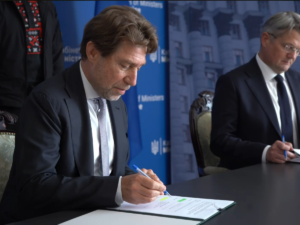
On May 21, Italian Ambassador to Ukraine Carlo Formosa and Artur Lorkowski, Director of the Energy Community Secretariat, signed an agreement on a new contribution from Italy in the amount of EUR 10 million for repair and reconstruction work in Ukraine’s energy sector.
This was announced by Ukraine’s First Deputy Prime Minister for Energy Denys Shmyhal following a meeting with Lorkovsky and partners on a Telegram channel on Thursday.
“Prior to this, Italy had already contributed EUR13 million to the Energy Support Fund. We are grateful to Italy,” he noted.
According to Shmyhal, the parties paid special attention to mechanisms for attracting additional contributions to Ukraine’s Energy Support Fund as a tool for strengthening energy resilience.
“We also discussed opportunities for international businesses to invest in Ukraine’s energy sector. “The launch of updated auctions for the construction of new power generation capacity in Ukraine is an important signal to the market; we can more broadly attract international investors to the development of new capacity,” he said.
Ukraine is also preparing to present these and other opportunities at the URC conference in Gdańsk in June.
“We agreed to jointly develop mechanisms for mitigating and insuring against military risks for such investments,” the First Deputy Prime Minister added.
As reported, as of the end of April, Ukraine’s foreign partners had announced additional contributions to the Energy Support Fund totaling approximately EUR 100 million.
In total, as of early April, the Energy Support Fund of Ukraine had received grant funds totaling nearly EUR 1.854 billion from 37 foreign sponsors from 26 partner countries and three international organizations.
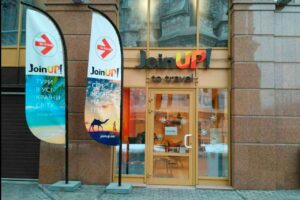
Join UP!, an international travel brand founded in Ukraine, is shifting its business model from a traditional tour operator to a vertically integrated comprehensive travel service—Join Up! Travel Universe, the company’s press office told Interfax-Ukraine.
“We are moving to a new stage—creating the brand image of Join Up! Travel Universe, a vertically integrated model that combines all key elements of travel into a single seamless system centered on the customer. Our goal is to move beyond selling individual services and instead manage the entire customer experience: from the inspiration to travel to returning home from the trip,” commented Join Up! co-founder Alina Alba.
The change in the business model also means a change in the approach to the company’s development. While the growth strategy was previously focused primarily on scaling, the focus is now shifting to development “from within”: multi-service capabilities, quality control of the travel experience, and a seamless customer experience where all touchpoints are integrated into a single system (an omnichannel approach) to deliver the necessary service.
The foundation of the vertically integrated model will be: strategic airline partner SkyUp, our own DMCs (destination management companies that serve tourists in vacation destinations), traditional travel agencies (B2B sales), travel shops (offline B2C sales points), and direct online sales via the website. Consumers will be offered package and dynamic tours, hotel bookings, airline tickets, excursions, events, activities, vehicle rentals, and more.
This structure will enable Join Up! to better control quality at every stage of the customer journey and create a cohesive, predictable, and personalized travel experience. The new model also makes it possible to adapt travel solutions more quickly to changes in customer behavior and market conditions, as well as to attract a new audience—people who are accustomed to planning their own trips and organizing the entire travel process.
The new travel planning format will also allow travelers to literally “build” their vacation like a construction set and view all trip details in one place—in the mobile app or web version of the platform.
The updated platform is already available to users, though new services will be added gradually so that customers can receive personalized travel solutions tailored to their needs, budget, and lifestyle. For agents, this transformation opens up new opportunities to expand their product lineup, improve the customer experience, and attract a new audience that values a diverse range of services and seamless interaction.
In addition to transforming its business model, the Join Up!™ brand is updating its visual identity across all official digital platforms.
Over the past 15 years, Join Up! has evolved from a travel agency and local tour operator into an international travel brand. The company is currently represented in Poland, the Czech Republic, Estonia, Latvia, Lithuania, Romania, Ukraine, Kazakhstan, and Moldova. Since its inception, the brand has served more than 8 million tourists across all markets and developed a partner network of nearly 10,000 travel agencies, according to internal data.
As reported, the travel company Join UP! LLC was established in 2013. The ultimate beneficiaries are Yuriy and Oleksandr Alby.
The company’s authorized capital is UAH 72.671 million.

PJSC Zaporizhkox, one of Ukraine’s largest producers of coke and chemical products, reported a 20.4% year-over-year decline in net profit for January–March of this year, down to UAH 204.519 million.
According to the company’s interim report, available to the Interfax-Ukraine agency, revenue from ordinary activities for this period decreased by 18.1% to UAH 3,882.460 million.
Retained earnings as of the end of March amounted to UAH 4,281.510 million.
According to the annual financial report, the plant posted a net profit of UAH 569.989 million in 2025, compared to UAH 1.72158 billion in 2024. Meanwhile, revenue from ordinary activities for the past year decreased by 41% to UAH 17.121625 billion.
As reported, in 2024, the plant increased its net profit by 4.3 times compared to 2023—to 1.72158 billion UAH from 399.841 million UAH. At the same time, revenue increased by 82.8%, to UAH 29.1225 billion from UAH 15.871128 billion.
The plant ended 2022 with a net loss of UAH 249.382 million, whereas in 2021 it reported a net profit of UAH 2.997541 billion. In 2020, the plant increased its net profit by 72.2% compared to the previous year—to UAH 166.436 million.
“Zaporizhkox” operates a full technological cycle for the processing of coke-chemical products.
According to the National Securities and Stock Market Commission (NSSMC) data for the first quarter of 2026, Metinvest B.V. (Netherlands) owns 57.23% of the company’s shares, and “Zaporizhstal” holds 42.76%.
The company’s authorized capital is UAH 1.193 million, and the par value of a share is UAH 0.01.



