

According to Serbian Economist, the silver-striped pufferfish Lagocephalus sceleratus, known as the fugu and considered one of the most dangerous invasive species in the Mediterranean, is being spotted with increasing frequency in the waters of Montenegro, reports the Institute of Marine Biology at the University of Montenegro.
Alexander Joksimović, a scientific advisor at the Institute of Marine Biology, stated that these are no longer isolated findings. According to him, this species has been present off the coast of Montenegro for nearly ten years and has already established a stable population in the Adriatic Sea.
Recently, a pufferfish was found again off the coast of Budva: the fish got caught in a fishing net. Experts are warning fishermen and tourists that this fish is not safe to eat and that they should not attempt to clean or prepare it themselves.
The main danger is associated with tetrodotoxin—a potent neurotoxin that may be present in the organs, skin, and tissues of this fish. Studies on the species Lagocephalus sceleratus in the Adriatic confirm the presence of tetrodotoxin, and this toxin is dangerous to humans if the fish is consumed.
Experts emphasize that heat treatment does not make this fish safe. Therefore, the main practical advice for fishermen and vacationers is not to consume any fish they find, not to sell it, and to report any findings to the relevant authorities or the Institute of Marine Biology.
The spread of pufferfish in the Adriatic is linked to warming sea temperatures and changes in the Mediterranean ecosystem. The species originates from the Indo-Pacific region and is spreading into the Mediterranean as an invasive species, including via the Suez Canal. In 2025, scientists also reported finding this fish off the coast of Croatia, marking one of the northernmost confirmations of its presence in the Mediterranean.
For Montenegro, the emergence of a stable pufferfish population has not only ecological but also economic significance. The fish can harm local fisheries, get caught in nets, damage the catch, and pose additional risks to coastal tourist regions. Budva, the Bay of Kotor, Bar, and other areas where fishing and tourism are closely linked to the marine ecosystem may be particularly vulnerable.

The municipal enterprise Kyivpastrans intends to purchase two funicular cabins, as well as related goods and services, for a total of EUR 13 million, with funding from the European Investment Bank (EIB).
According to the tender announcement in the tender supplement to the Official Journal of the EU, the procurement will be financed by the EIB and the Kyiv City Council.
“The amount of EIB financing under the contract will not include VAT or, if applicable, customs duties and other taxes on the purchase of goods under this tender. Any such VAT, duties, or taxes will be paid by the Contracting Authority from its own budget,” the notice states.
The opening of bids is scheduled for June 30 of this year.
The first delivery is scheduled no later than 18 months from the date the supplier receives the advance payment, and the contract is generally set to last 79 weeks.
It is expected that the funicular cabin will be equipped with fast-charging batteries installed in a sliding or hinged box for access and maintenance, with adequate corrosion protection.
The supplier must also provide related goods, including machinery and track equipment, a traction system, control equipment, and a rapid battery charging system at terminal stations.
In addition, the supply of spare parts and consumables, tools for maintenance, repair, and diagnostics, as well as related services (staff training, commissioning of the funicular cabins) is provided for.
The Kyiv funicular runs up the steep slope of Volodymyrska Hill and connects Podil with the Upper City. It was opened in 1905 and was integrated into the city’s tram system at that time.

Ukraine today is, in many ways, following the path that Israel has taken over the 78 years of its existence, said the Israeli ambassador to Ukraine during a ceremony marking Israel’s Independence Day.
“There are few countries in the world that understand each other better than Israel and Ukraine. In recent years, air raid sirens have often sounded simultaneously in Israel and Ukraine,” the ambassador said, addressing representatives of the Ukrainian government, the diplomatic corps, and Israel’s partners in Ukraine.
According to him, Ukraine’s successes in developing defense technologies “cannot fail to impress.”
The diplomat noted that the past year has been difficult for both countries, particularly for bilateral relations.
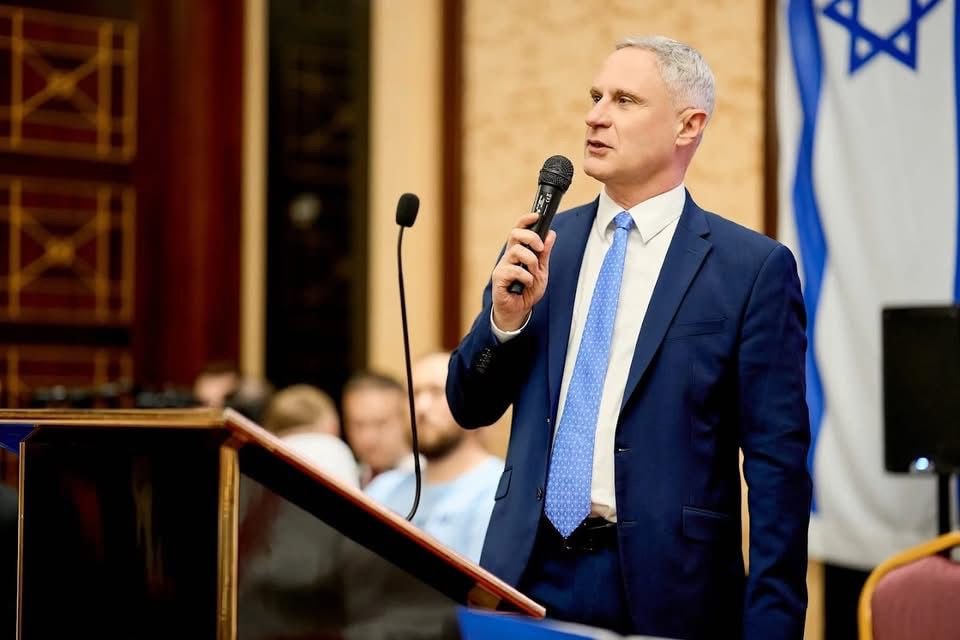
“The relationship between our countries is very close and often resembles a family bond. As in any family, difficulties sometimes arise, and we occasionally need the help of a ‘family therapist,’” he said.
The ambassador emphasized that in diplomacy, as in medicine, the principle of “do no harm” is crucial. According to him, during his nearly five years of service in Ukraine, he has strived to adhere to this principle.
In his speech, the diplomat also mentioned Golda Meir, who was born in Kyiv, and quoted one of her famous phrases: “Pessimism is a luxury that Jews can never afford.”
“Today, this applies equally to both Israelis and Ukrainians. I admire the resilience of our peoples, their ability to remain optimistic despite everything,” the ambassador noted.
He expressed confidence that, despite wars and terror, Israel and Ukraine will remain free and independent.
The diplomat also announced that his term in Ukraine is coming to an end in the near future.
“To say that this term has been special is an understatement. And yet, I regret only one thing: that peace has not come before the end of my work in Ukraine. I appeal to those on whom this depends: you still have three months. Now is the time to intensify these efforts,” he said.
The ambassador thanked the staff of the Israeli Embassy in Ukraine for their work in preserving and developing Israeli-Ukrainian relations, as well as partners and organizations that support cooperation between the two countries, including Nativ, Keren Kayemet LeIsrael, Keren HaYesod, Keren HaYedidut, the Joint, and Sohnut.

He also expressed his gratitude to the participants in the organization of the gala evening, including Honorary Consuls Oleg Vishnyakov and Andriy Rykota, Honorary Consul of Ukraine in Israel Ofer Kerzner, President of the Benish Group Haim Benesh, President of the Ukrainian Mineral Waters Corporation Hanna Kotlyarevska, and MTB Bank.
Israel celebrates Independence Day as the country’s main national holiday. In 2026, Israel will mark the 78th anniversary of the declaration of independence.
Diplomatic relations between Ukraine and the State of Israel were established on December 26, 1991, shortly after Ukraine’s declaration of independence. The Embassy of Ukraine in Tel Aviv began operations in October 1992, and the Embassy of Israel in Kyiv was opened in 1993. Since then, the countries have been developing political dialogue, humanitarian, cultural, and economic cooperation, as well as maintaining active ties between Ukrainian and Israeli societies.

Vodafone Ukraine (VFU), Ukraine’s second-largest mobile operator, is rolling out 5G for international roaming, which is currently available in 15 countries: Slovenia, Poland, Bulgaria, the Czech Republic, Hungary, Switzerland, France, Malta, Croatia, Luxembourg, Germany, Slovakia, Montenegro, Cyprus, and New Zealand.
According to a press release published by the mobile operator on Thursday, access to 5G while roaming is provided under the same conditions as for 4G—within the subscriber’s plan.
It is noted that in European Union countries, the “Roam like at home” principle applies to most plans, allowing users to use minutes, SMS, and a portion of their data allowance without additional charges.
In 2025, Vodafone Ukraine increased its revenue by 14% compared to the previous year—to 27.8 billion UAH, while its net profit grew by 18%—to 4.18 billion UAH.
As reported with reference to data from the regulator, the National Commission for the State Regulation of Communications (NCC), the top three leaders in revenue from telecommunications services in Ukraine for 2025 were, by a significant margin, mobile operators: Kyivstar PJSC – UAH 44.16 billion, “Vodafone-Ukraine” – UAH 25.59 billion, and LLC “lifecell” (TM lifecell) from the DVL Group – UAH 15.74 billion. Compared to 2024 figures, Kyivstar’s revenue grew by 20.3%, Vodafone Ukraine’s by 13.1%, and lifecell’s by 19.1%.
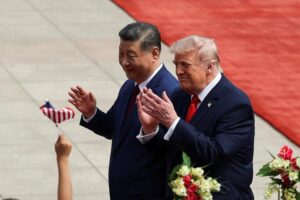
U.S. President Donald Trump and Chinese President Xi Jinping agreed during talks in Beijing to expand cooperation in trade and agriculture, and also discussed the situation in the Middle East, Ukraine, and on the Korean Peninsula, according to CCTV.
The meeting took place on May 14 at the Great Hall of the People in Beijing during Trump’s state visit to China. According to the Chinese Foreign Ministry and Xinhua News Agency, the leaders of the two countries discussed the bilateral agenda and exchanged views on key international and regional issues, including the situation in the Middle East, the crisis in Ukraine, and the Korean Peninsula.
Xi Jinping stated that China and the U.S. should build “constructive and strategically stable relations,” and also emphasized the importance of a cautious approach to the Taiwan issue, calling it the most critical aspect of Sino-American relations. According to Xi, mishandling this issue could lead to a sharp deterioration in bilateral relations.
According to the official Chinese account of the talks, Trump expressed his readiness to work with Xi to strengthen communication and cooperation, resolve differences, and develop U.S.-China relations. He also introduced the Chinese leader to representatives of American business who had traveled to China with him.
The talks took place against the backdrop of efforts to maintain the trade truce between the U.S. and China, reached in October 2025. Topics discussed included U.S. companies’ access to the Chinese market, Chinese investment in the U.S., trade, energy, and agricultural supplies.
For Ukraine, the very fact that the Ukrainian issue was discussed at the level of U.S. and Chinese leaders is significant. Beijing retains influence over Moscow and remains one of the key external players whose stance shapes the diplomatic context surrounding the war. However, the published reports do not indicate that the parties reached any specific agreements specifically regarding Ukraine.
The situation in the Middle East was a separate topic of discussion. Against the backdrop of tensions surrounding Iran and risks to energy supplies, the U.S. is interested in China playing a more active role in mitigating risks to global trade and energy routes. Washington is also seeking economic outcomes from the meeting, including trade and investment agreements.

State-owned Oschadbank and the UPG gas station chain have signed a cooperation agreement that provides for business loans on special terms for the purchase of motor fuel, according to Yuriy Voychak, director of Oschadbank’s sales department.
“We were the first among all Ukrainian banks to sign a cooperation agreement that allows all UPG customers who need it to purchase fuel using credit funds. Loan terms: 0.01% per annum, for up to 12 months, unsecured. The loan amount is up to 20 million UAH,“ Voychak said during the Energy Finance forum organized by Oschadbank in Kyiv on Wednesday.
”This means that farmers or other UPG clients can apply for financing. We have liquidity, we have sufficient funds, the interest rate is minimal, and the loan is provided without collateral—the procedure is as simple as possible,” the bank representative explained.
He noted that the bank and the network are expecting loan applications from businesses. Voychak clarified that the agreement between the bank and UPG was signed about a month ago.
In a comment to Energoreforma, he noted that the bank is negotiating with other networks to conclude similar agreements.
“WOG and OKKO have started approaching us. We are in negotiations,” said Voychak.
According to him, such an agreement creates a three-way benefit: the client has fuel, the bank has a client to lend to, and the gas station network increases its fuel sales.
UPG network owner Volodymyr Petrenko told Energoreforma that, according to his information, approximately 60 million UAH worth of fuel has already been sold under the loan agreement.
“After the rise in fuel prices, roughly twice as much money is needed to purchase it. Thanks to the loan, we can avoid using working capital for this. Our goal is to give consumers the opportunity to purchase the fuel we import from the U.S. and appreciate its high quality,” said Petrenko.
As reported, UPG (Ukrainian Petrol Group) is a Ukrainian group of companies specializing in the trade of petroleum products. UPG ranks among the top three largest operators in Ukraine by number of stations. The group has its own logistics infrastructure and conducts direct fuel supplies from leading refineries in Europe and the U.S. The founder of UPG is Volodymyr Petrenko.
Earlier, Oschadbank noted in its press release regarding a new business program with UPG—which allows entrepreneurs to purchase fuel for seasonal work or ongoing operations without straining working capital—that its main advantage is a preferential interest rate of 0.01% per annum for the first four months of the loan.
BUSINESS, FUEL, LENDING, OSCHADBANK, UPG



