
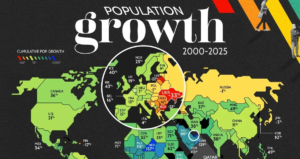
Over the past 25 years, the world’s demographic dynamics have increasingly diverged in two directions: some countries are experiencing explosive population growth, while others are facing steady decline. According to a Visual Capitalist visualization based on UN data, in 2000–2025 the largest population decrease was recorded in Ukraine, while the fastest growth was seen in Qatar. The study is based on the estimates and projections of the UN’s World Population Prospects 2024.
The top 10 countries by population decline in 2000–2025 included Ukraine (-32.5%), the Marshall Islands (-29.4%), Bulgaria (-23.2%), Latvia (-21.6%), Moldova (-18.8%), Lithuania (-17.5%), Puerto Rico (-16.7%), Romania (-16.1%), Serbia (-13.1%), and Albania (-12.8%). The top 10 countries by population growth included Qatar (+423.4%), the UAE (+249.7%), Equatorial Guinea (+166.6%), Niger (+157.0%), Bahrain (+153.9%), Papua New Guinea (+149.6%), Angola (+139.7%), Kuwait (+139.1%), Oman (+129.1%), and Chad (+126.9%). These figures were cited by Visual Capitalist in two April publications.

For Ukraine, this ranking is especially alarming. According to Visual Capitalist, the country lost about one-third of its population over 25 years. The broader demographic background is also confirmed by materials from Our World in Data based on UN data: in 2022–2023 alone, net migration from Ukraine amounted to around 6 million people, which became a direct consequence of the full-scale war.
Experts Club believes that Ukraine’s demographic crisis has already become not only a social issue, but also an economic one. Population decline means a shrinking domestic market, a worsening labor shortage, growing pressure on the pension and healthcare systems, as well as deteriorating long-term conditions for investment. This logic is consistent with UN assessments of the role of declining birth rates, population aging, and migration in shaping new global demographic imbalances.
At the same time, the global picture also shows the opposite pole. The growth leaders — primarily the Gulf countries and a number of African states — increased their populations either through a massive inflow of labor migrants or through high birth rates. The UN notes that global population growth is continuing, but its pace is slowing, and the main contribution to further population increase will come not from Europe, but primarily from Africa and certain migration centers.
For Ukraine, this leads to at least two conclusions. First, without the return of at least part of the citizens who have left, support for families with children, and a stronger labor market policy, the demographic decline will continue to undermine the economy. Second, the problem has long gone beyond statistics: in the coming years, demography may become one of the main constraints on the country’s post-war recovery.
Oschadbank has connected to the National Bank of Ukraine’s TrackSEP service, enabling clients in the micro, small, and medium-sized business (MSME) segment to track the status of interbank payments in IBAN format in real time, the financial institution announced on Monday.
“It is important for businesses to understand what is happening with their money at every moment. Thanks to TrackSEP, entrepreneurs can see the entire payment journey from dispatch to crediting and can make quick decisions without wasting time,” said Natalia Butkova-Vitvitska, a member of Oschadbank’s board responsible for the MSME segment.
As noted, the service operates 24/7 in real time, also covers instant payments, and allows users to track the stages of an interbank transfer without contacting the bank. Each payment has a unique UETR (Unique End-to-End Transaction Reference) identifier that accompanies it throughout its journey between banks.
To check the payment status, the customer needs to find the UETR in the web version or CorpLight mobile app, go to the regulator’s website, and enter this code and the payment amount. The service displays the stages of the transfer’s processing: from creation to crediting or rejection, with the reason indicated. The data is stored for 30 days.
As reported, on December 1, 2025, the National Bank introduced the TrackSEP service in the Electronic Payments System (EPS) to track payments 24/7 from the moment of initiation until funds are credited.
According to the regulator’s data, as of March 1, 2026, Oschadbank ranked second (UAH 503.07 billion) in terms of net assets among 58 solvent banks.
According to Fixygen, last week the cryptocurrency market began to recover after a prolonged period of weakness in March and early April; however, at the start of this week, the upward trend gave way to more volatile trading. On Tuesday, Bitcoin is trading around $76,200, and Ethereum around $2,320.
One of the main drivers last week was the return of funds to digital investment products. According to CoinShares, for the week ending April 13, net inflows into such instruments totaled $1.03 billion, of which $790 million went to Bitcoin. The company called this the largest weekly inflow since early January and attributed the recovery in risk appetite to softer-than-expected U.S. macroeconomic data and signs of easing geopolitical tensions at the time.
Bitcoin’s attempt to consolidate above $76,000–$78,000 provided additional support to the market late last week. CoinDesk reported that prices rose to nearly $78,000 amid expectations of progress in easing tensions surrounding Iran and maintaining shipping through the Strait of Hormuz.
However, sentiment deteriorated early this week. The influence of Middle East factors intensified again in the market: Barron’s and other business publications reported declines in bitcoin and ethereum amid renewed uncertainty surrounding the U.S.-Iran conflict and risks to global risk appetite. Against this backdrop, Bitcoin retreated to the $74,700–75,400 range on Monday, while Ethereum also declined.
Thus, the market at the turn of last week and this week looked better than it did in early April, but has not yet emerged from a zone of heightened sensitivity to external developments. Institutional inflows are supporting Bitcoin, but geopolitics and general investor caution are preventing the market from quickly transitioning to a sustained uptrend.
In the coming days, Bitcoin’s behavior within the $74,000–$78,000 range will remain the key indicator. If inflows into funds continue, the market may again attempt to consolidate above the upper boundary of this range. However, if the news backdrop deteriorates further, cryptocurrencies, like other risky assets, may enter another correction.

The province of Alicante has strengthened its position among Spain’s largest residential real estate markets, remaining a key hub for demand from both local and foreign buyers. This is reported by Prian, citing data from the Spanish housing market. An additional growth factor remains the high interest from foreigners, thanks to which Alicante maintains a special status in the national market.
According to Idealista, in 2025, foreigners accounted for 45.7% of all housing transactions in the province of Alicante—one of the highest figures in the country and, in fact, nearly half of the market. By comparison, the share of foreign buyers across Spain as a whole was 13.8%, and in the Valencian Community, 27.6%; in other words, Alicante significantly outpaces both the national and regional averages.
High foreign buyer activity supports market liquidity and demand in coastal areas, particularly on the Costa Blanca. At the same time, this makes Alicante one of the main indicators of external demand for Spanish housing, especially in the segments of second homes, investment apartments, and properties for permanent residency.
Among foreign buyers in Spain in 2025, citizens of the United Kingdom, the Netherlands, and Germany dominated. According to Spanish sources in the Valencian Community, in 2025 the Netherlands took first place among foreign homebuyers in the region, displacing the British, followed by Belgians, Poles, Ukrainians, and Germans among the most prominent groups.
According to the results of a public opinion poll conducted in March 2026 by the research company Active Group in collaboration with the Experts Club information and analytical center, Ukrainians’ attitudes toward Kazakhstan are characterized by a predominance of neutral assessments and a moderate level of positive perception, which, however, shows a certain decline compared to the previous period. The share of positive attitudes stands at 38.2% compared to 42.7% in August 2025, while negative assessments have risen slightly—from 8.0% to 8.9%.
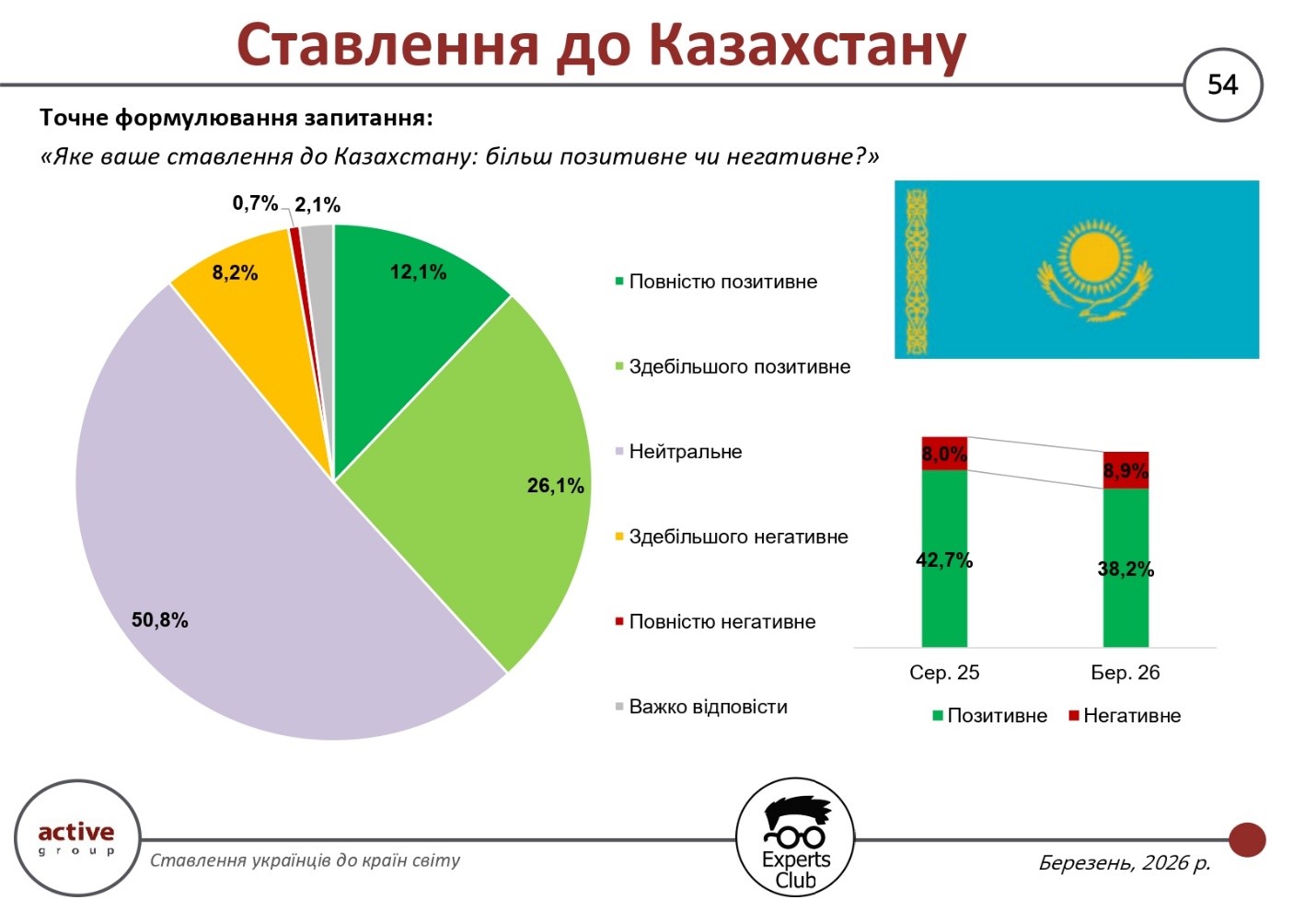
A key feature is the dominance of a neutral stance: 50.8% of respondents do not have a clear assessment of Kazakhstan. This indicates a relatively low level of emotional engagement among Ukrainians in their perception of this country and Kazakhstan’s limited presence in Ukraine’s information and public sphere.
The structure of positive assessments appears balanced: 12.1% of respondents expressed a “completely positive” attitude, while another 26.1% described it as “mostly positive.” At the same time, negative attitudes are formed primarily through moderate assessments: 8.2% of respondents chose the “mostly negative” option, while only 0.7% selected “completely negative.” The share of those who could not answer is 2.1%.
The trend indicates a certain cooling of positive perceptions of Kazakhstan. Although negative assessments remain relatively low, their gradual increase, combined with a decline in positive sentiment, may signal a weakening of interest or trust in the country among the Ukrainian public.
Overall, Kazakhstan is perceived as a country with a neutral image, without a clearly defined emotional assessment. Such a profile is characteristic of states that do not play a prominent role in the Ukrainian information space or are not associated with political or security processes that are key to Ukraine.
In this context, future shifts in attitudes will largely depend on how actively Kazakhstan engages in relations with Ukraine and how prominent its role becomes on the international agenda relevant to Ukrainian society.
According to a study conducted by the Experts Club information and analytical center based on data from the State Customs Service, Kazakhstan ranks 42nd in total trade volume with Ukraine, amounting to $400.2 million. At the same time, Ukraine has a trade surplus with Kazakhstan of $245.3 million, as exports exceed imports by more than four times.
The study was presented at the Interfax-Ukraine press center; the video can be viewed on the agency’s YouTube channel. The full version of the study can be found at this link on the Experts Club analytical center’s website.
ACTIVE GROUP, EXPERTS CLUB, KAZAKHSTAN, Pozniy, SOCIOLOGY, SURVEY, UKRAINE, URAKIN
The results of a survey conducted in March 2026 by the research company Active Group in collaboration with the Experts Club information and analytical center indicate that Ukrainians’ attitudes toward Malaysia are characterized by a high proportion of neutral assessments and relatively low levels of both positive and negative perceptions. Overall, 17.7% of respondents expressed a positive attitude toward this country, which is slightly lower compared to August 2025 (18.7%). At the same time, negative attitudes remained virtually unchanged—4.9% versus 4.7% in the previous period.
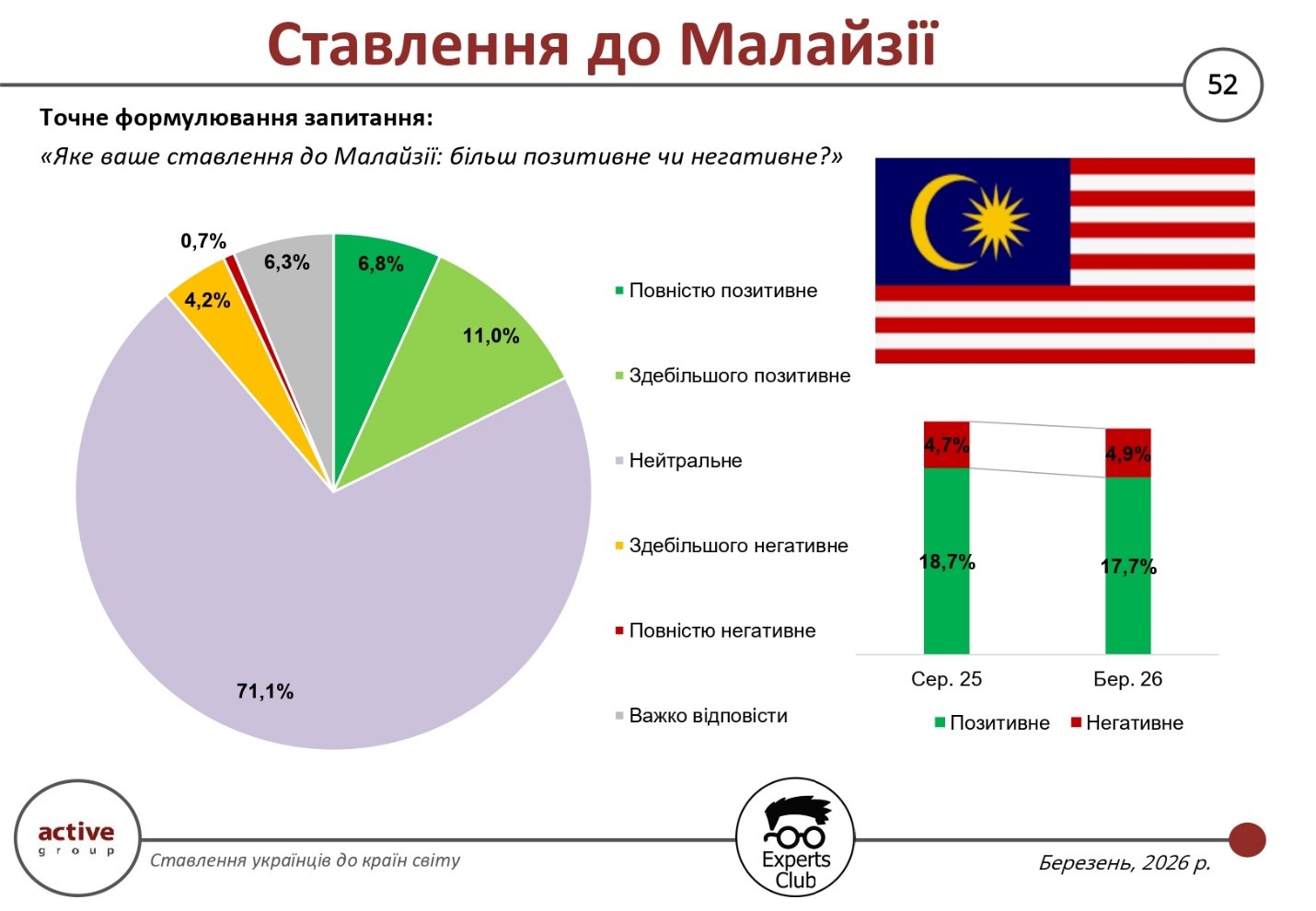
The breakdown of responses shows a clear dominance of neutral views: 71.1% of respondents have no formed attitude toward Malaysia. This is one of the highest figures among the countries surveyed, indicating the limited presence of this country in the information landscape and in the everyday experience of Ukrainians.
Positive assessments are formed primarily due to a moderately favorable perception: only 6.8% of respondents chose the “completely positive” option, while 11.0% selected “mostly positive.” This distribution indicates the absence of a clearly defined positive image, even among those who generally view the country favorably.
Negative assessments also remain at a low level: 4.2% of respondents expressed a “mostly negative” attitude, and only 0.7% selected “completely negative.” The share of those who could not answer is 6.3%, which further underscores the uncertainty in perceptions of this country.
The trend in indicators compared to August 2025 shows a slight decline in positive perceptions while negative assessments remain stable. This means that Malaysia is not the subject of active image change in Ukrainian society, and its perception remains inertial and largely independent of current international events.
In a broader context, these results indicate that Southeast Asian countries, including Malaysia, do not yet occupy a prominent place in the structure of Ukrainians’ foreign policy or economic priorities. The high proportion of neutral assessments indicates significant potential for image-building, but at the same time points to the absence of a clearly defined perception.
Thus, Ukrainians’ attitude toward Malaysia can be characterized as neutral-indifferent: the country does not evoke significant negativity, but is also not associated with processes important to Ukrainian society that shape a positive perception of other states.
According to a study conducted by the Experts Club information and analytical center based on data from the State Customs Service, Malaysia ranks 39th in total trade volume with Ukraine, with a figure of $454.1 million. At the same time, imports from Malaysia are more than three times higher than Ukrainian exports, resulting in a trade deficit of $239.9 million.
The study was presented at the Interfax-Ukraine press center; the video can be viewed on the agency’s YouTube channel. The full version of the study can be found at this link on the Experts Club analytical center’s website.
ACTIVE GROUP, EXPERTS CLUB, MALAYSIA, Pozniy, SOCIOLOGY, SURVEY, UKRAINE, URAKIN



