
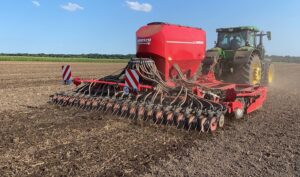
Astarta, Ukraine’s largest sugar producer, has begun its 2026 spring planting campaign, starting with sugar beet sowing in the Poltava region, the company announced on its Facebook page on Wednesday.
According to the report, 32,000 hectares have been allocated for sugar beets this year, which is 5.9% less than last year’s 34,000 hectares. At the same time, the area planted with sunflowers will decrease by 21%—to 23,000 hectares—and the area planted with winter wheat will decrease by 15%—to 39,000 hectares. The largest increases are planned for grain corn—by 43%, to 20,000 hectares—and winter rapeseed—by 36%, to 15,000 hectares. Soybean acreage remains unchanged at 56,000 hectares, as does the area under organic farming at 2,000 hectares.
“This year’s planting season is taking place under challenging conditions: increased moisture caused by abnormal frosts and frozen soil requires special attention from agronomists. They are adapting cultivation technologies and carefully monitoring field operations to improve production efficiency. Operational control is ensured by innovative solutions from AgriChain Machinery, AgriChain Scout, and AgriChain Barn. Combined with an updated fleet of equipment, this allows for a rapid response to weather and technological challenges, ensuring the stability and quality of the planting campaign,” said Vasyl Khmeliuk, Chief Operating Officer of Astarta, as quoted in the statement.
The holding noted that the final crop structure will be determined based on the results of the campaign. The use of digital ecosystems and an updated fleet of machinery allows the company to maintain a high pace of work despite challenging weather conditions.
Astarta is a vertically integrated agro-industrial holding operating in eight regions of Ukraine. It comprises six sugar factories, agricultural enterprises with a land bank of 220,000 hectares and dairy farms with 22,000 head of cattle, an oil extraction plant in Hlobine (Poltava region), seven grain elevators, and a biogas complex.
According to the results for 2025, Astarta reduced its total revenue from sales of key product categories by 15.6% compared to 2024—to UAH 21.05 billion, while physical sales volumes of its main products fell by 23.5%—to 1.21 million tons.
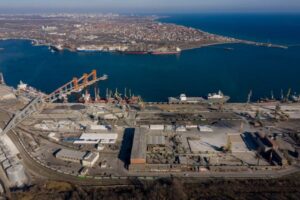
Following the results of the first auction on the “Prozorro.Sales” platform, the state-owned enterprise “Black Sea Commercial Sea Port (MTP)” will transship 50,000 tons of mineral fertilizers by September 30, 2026, the press service of the Ministry of Community and Territorial Development of Ukraine reported on Telegram.
According to the report, five companies competed for the right to receive port services. The winning bidder offered a price of 220 UAH per ton, with a starting price of 197 UAH.
“The first auction for the sale of port services through ‘Prozorro.Sales’ is practical proof that state-owned ports can operate under modern and competitive rules. We are consistently implementing new management mechanisms centered on transparency, accountability, and equal access for businesses,” emphasized Deputy Prime Minister for the Restoration of Ukraine and Minister of Community and Territorial Development Oleksiy Kuleba.
The ministry emphasized that the use of such tools builds market confidence and ensures the effective use of state assets.
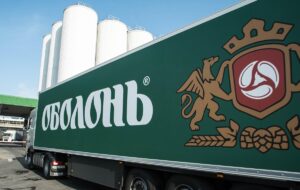
According to Fixygen, PJSC “Obolon” will hold its annual general meeting of shareholders on April 23, 2026, via remote participation. As is customary, the meeting will address key annual agenda items—approval of the 2025 financial results, review of management reports, distribution of profits or coverage of losses, as well as decisions regarding current corporate governance. The notice of the meeting has been published in the company’s disclosure section.
Obolon is one of Ukraine’s largest producers of beer, soft drinks, and mineral water. The company traces its history back to 1980, when Kyiv Brewery No. 3 was founded, which later became the basis for the Obolon Corporation.
The company remains one of the best-known national brands in the FMCG sector and focuses on both the domestic market and exports.
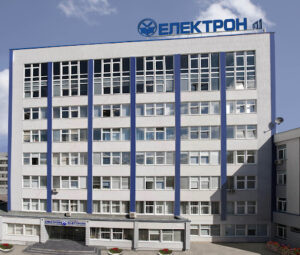
Last year, the enterprises of the Lviv-based “Elektron” Group invested 58 million UAH in development, more than double the amount invested in 2024 (28 million UAH), according to a report on the group’s website.
“In 2025, the company’s enterprises invested 58 million UAH in development. Capital investments amounted to 50 million UAH, current investments to 8 million UAH, with accrued depreciation of 26 million UAH,” the report states.
The year before last, out of 28 million UAH in investments, capital investments amounted to 23 million UAH, and current investments to 5 million UAH.
One of the largest investments in 2025 was the production by the “ElektronMash” plant of a demonstration model of an electric bus (12 m).
“This electric bus will be used to showcase the plant’s capabilities, but may be sold in the future,” the concern noted.
In total, capital investments by the “ElektronMash” plant amounted to 24.4 million UAH.
The second-largest investments (11.2 million UAH) were made by the Innovation and Industrial Enterprise “Elektron” (formerly “Elektron Leasing”), whose main specialization is real estate leasing services. The funds were mostly invested in building renovations.
More than 7 million UAH was invested by the manufacturer of heaters and heat exchangers for vehicles, the Sferos-Electron joint venture, specifically in accounting software (1.7 million UAH), repairs to production equipment and presses (2.2 million UAH), and the purchase of new equipment—a stacker, a liquid cooler, a hydraulic table, and compressor units (2 million UAH).
As reported, in 2025, “Sferos-Electron” recorded the highest sales and profit among the group’s enterprises, increasing net revenue by 15%—to 250 million UAH—and net profit by more than 45%—to 43 million UAH.
The Electronpobutprylad (EPP) plant, which manufactures electric drives and motors, received nearly 6.3 million UAH in investments, primarily for the preparation of new production facilities (5.5 million UAH).
The report notes that by 2026, EPP’s main production of all motors will be located in modern facilities with space reserved for expanding the range of existing and new motor types. In particular, a metalworking shop with an area of up to 2,000 square meters has been built and is being commissioned, and new automatic presses and CNC machines are being installed.
The “Elektron” television plant, with total investments of 4.63 million UAH, developed computer software for trolleybuses and adapted electronic systems for vehicles. Significant investments were made in the repair and restoration of buildings (3.5 million UAH).
NVP “Elektron-Karat,” a developer of production technologies and a manufacturer of materials for nano- and microelectronics, sensor technology, and information technology, invested nearly 2.4 million UAH in development.
The report notes that a 95 kW grid-connected solar power plant was installed on the roofs of one of the “Elektron-Karat” buildings to increase the company’s energy independence. The cost of the work amounted to 1.35 million UAH, with a payback period of 2.5 years.
The “Elektron” Concern comprises 12 enterprises, as well as the parent company, PJSC “Concern-Elektron.”
As reported, JSC “Concern-Electron” (Lviv) ended 2025 with a consolidated net profit of 17.22 million UAH, which is 3.3 times less than the corresponding figure for 2024; net revenue decreased by 10.4% to 671.1 million UAH.
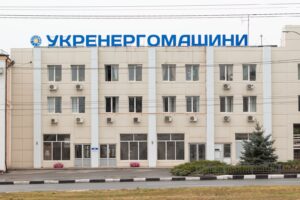
According to Fixygen, JSC “Ukrainian Energy Machines” will hold its annual general meeting of shareholders on April 23, 2026, in a remote format, as indicated by information from the issuer and data from SMIDA. Key items on the agenda include reviewing the company’s performance, approving the annual financial statements, personnel and corporate decisions, as well as matters related to the management structure and the company’s future operations.
JSC “Ukrainian Energy Machines” is one of the largest manufacturers of power generation equipment in Ukraine and the successor to industrial assets related to turbine and generator production in Kharkiv. The company manufactures equipment for thermal power plants, hydroelectric power plants, nuclear power plants, and industrial power generation. The state of Ukraine, managed by the Cabinet of Ministers, is the majority shareholder, holding 98.1536% of the authorized capital.
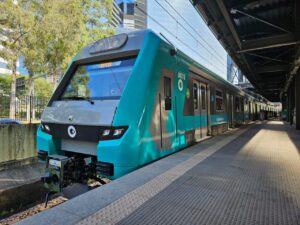
According to Serbian Economist, the French company Alstom has been awarded a €915 million contract to supply a comprehensive turnkey solution for Belgrade’s first metro line—Serbia’s first fully automated metro system. The company announced this on March 27, and the news portal Parametar described the deal as one of the largest infrastructure projects in the region in recent years.
The first phase of Line 1 will connect Makishko Pole and Karaburma. The 15-kilometer section will include 15 stations, with approximately 11 kilometers running through tunnels in the city center.
The contract calls for the delivery of 32 driverless three-car Metropolis trains, as well as signaling and telecommunications systems, power supply, track infrastructure, platform doors, depot equipment, a centralized control center, and cybersecurity systems. The trains will operate using Urbalis CBTC technology, which will enable fully automated service with intervals of up to 90 seconds.
Alstom has already entered the design phase for Line 1. The company emphasizes that the project is being implemented with the support of French government funding, and the agreement itself will be reflected in the financial statements after the finalization of the financial agreement.
The Belgrade metro project is estimated at €4–7 billion in total, and the financing needs for the first line alone could reach €2.5 billion. Construction work on the project is being carried out separately, notably with the participation of Chinese contractors, making the construction model Franco-Chinese in terms of supply and execution.



