
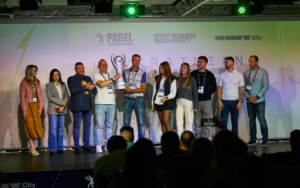
On September 6, the first all-Ukrainian conference, Ukrainian Padel Expo, took place at the UNIT.City Innovation Park in Kyiv. The central theme was padel—its development in Ukraine, prospects for popularization, the creation of club infrastructure, business opportunities, investments, audience engagement, technology, and making the sport an accessible activity for a wide range of people.
The event was organized by the Ukrainian Padel Federation, Sport Business Media Agency, and the UNIT.City innovation park. Nearly 750 participants attended the event.
The sports partner for the event was Barto Padel Space. This is a modern padel club in the center of Dnipro, which opened in May 2026. Barto Padel Space also features a stylish bar and a specialty store where you can find everything you need for playing and relaxing.
The health partner of Ukrainian Padel Expo was Biopell—a systematic approach to energy, recovery, focus, and longevity through peptide therapy, modern biohacking, and personalized protocols under medical supervision. The company recently launched the BIOPELL PADEL CLUB—a community of people who play padel, stay active, and stay one step ahead.
The event’s exhibition area partner was the real estate developer RIEL, which presented its new residential complex Sister, featuring sports infrastructure. Its architectural highlight is a mix of building heights with an emphasis on low-rise structures, creating a cozy atmosphere of privacy.
Guests were treated to refreshments by: sparkling wine partner Serena 1881, VIP Lounge partner Eurasia, and coffee partner Sky Coffee.
The first to speak was the president of the Ukrainian Padel Federation, Oleksiy Dniprov. At the beginning of his speech, he conveyed greetings to the audience from the president of the International Padel Federation, Luigi Carraro, and read his message.
Oleksiy Dniprov invited the audience to discuss the future of padel and how to establish a trend today that will yield results in the future. During his speech, he announced the creation of the Ukrainian Padel Club League. All clubs signed a declaration establishing the league. This became part of the Ukrainian Padel Federation’s strategic vision through 2030.
The event also featured a presentation of the trophy that the League champion will receive.
The Development and Prospects of Padel
Next was a panel discussion titled “The Development and Prospects of Padel”. Participants included Vadym Gutzeit (National Olympic Committee of Ukraine), Andriy Vitrenko (Ministry of Education and Science of Ukraine), Vasyl Prodan (Ukrainian Padel Federation), Ilya Shevlyak (Sports Committee of Ukraine), and Anton Nikulin (Sports Office of the Lviv City Council). The moderator was Oleksiy Braga (Sport Business Media Agency).
Vadym Gutzeit described padel as a sport that brings people together. He noted that in 2027, Istanbul will host the European Games, where padel will be featured as a non-Olympic sport. According to him, it is a sport that is rapidly growing worldwide and will be included in the competition standings. Mr. Gutzeit said he believes it is possible that padel could become an Olympic sport as early as 2032.
Anton Nikulin spoke about the great prospects and ambitious plans for the development of padel in Lviv. Ilya Shevlyak described the rapid growth of padel not merely as a trend, but as the result of the efforts of fans who love the sport. According to him, it is also the result of the work of the sport’s teams within federations that have clear goals and priorities.
Andriy Vitrenko stated that they will promote padel for inclusion in the Side by Side project to hold competitions among schoolchildren and college students. There are also plans to try to organize access to courts for young people.
Vasyl Prodan spoke about the level of development of padel in Ukraine. He noted that it is currently difficult to develop the sport during the war, invest in it, and promote it. According to him, padel in Ukraine is in the development stage, and the country’s results, compared to nations where there is peace and a better economic situation, are actually quite good.
Padel as a Business Environment
A separate panel discussion was dedicated to the topic “Padel as a Business Environment: Why Sports Become Part of People’s Lives”.
Participants included Valery Shamotiy (Bartolomeo), Yevgen Mushkin (VDNG), Anton Ivanov (FC “Kharkiv”), Oleksandr Denysov (FC “Polissya”), and Vitaliy Lubinets (Win Win Club). The moderator was Vladislav Antipov (CERN).
Valery Shamotiy noted that padel is part of a larger business ecosystem and an extension of the goal of promoting a healthy body and a healthy mind. According to him, this is particularly important in today’s world, which is why spaces are being created where people can play, including padel.
Vitaly Lubinets emphasized that business is all about relationships between people. Padel, he said, helps foster these relationships beyond business processes. Yevhen Mushkin spoke about the development of the VDNG cultural and educational park and its system of interconnected public spaces. Most of the content at VDNG, he said, is created by partners. And padel will play an important role in one of the key clusters—the sports cluster.
Oleksandr Denysov explained that padel provides excitement and a form of relaxation for the players of FC “Polissya.” At the same time, he noted, soccer players need to maintain their physical condition after training sessions and games, so they require physical activity that also allows them to relax. In addition, FC “Polissya” President Hennadiy Butkevych built a court at the club’s facility and can play on it against the head coach or the players. Oleksandr Denysov also described padel as a sport that fosters a sense of community and has a low barrier to entry for anyone. After all, here you can compete on equal footing and try to play against anyone. For the soccer community, he said, padel is a great substitute for golf, which has long been considered an alternative leisure activity. He cited networking as another important advantage of padel.
Anton Ivanov noted that his club and team have also started playing padel actively. Top management is gradually getting involved as well. The academy is also actively playing padel. FC Kharkiv holds its UPL home matches on the left bank of the capital, where, in fact, team members play padel. According to Anton, the club uses padel to build a connection with its target audience, encouraging them to cheer for the players during their official matches.
Sports as a Platform for Brand Building
Next was the presentation “Sports as a Platform for Brand Building”, during which Boris Tsomaia (RIEL) discussed how padel is integrated into the developer’s projects.
He noted that the construction industry generally does not consider sponsorship packages. Apartments are being sold, but in significantly smaller numbers. Marketing budgets are shrinking. Under these conditions, according to Boris, padel has a bright future. He suggested drawing on the experience of other sports and thinking outside the box. The potential of padel, he said, is enormous. The sport is becoming more social and accessible. Padel is easier, simpler, and more interesting to play than many other team sports.
Padel as an Investment Product
The topic “Padel as an Investment Product: How to Build a Profitable Club in Ukraine” was presented by Vasyl Kafidov (Zalizko Sport). He noted that it would be a good idea to invest in this area over the next 2–3 years. Vasyl also discussed the construction of clubs and courts and the opportunities to generate revenue from them.
Vasyl paid particular attention to the feasibility of building clubs in specific locations and also highlighted the specifics of operating the facilities and courts. According to the speaker, a club with 3–4 courts can generate a profit of 2–3 million hryvnias.
Padel Clubs in Ukraine
Next was the panel discussion “Padel Clubs in Ukraine”. Participants included Ilya Kaufman (Beat Padel Club), Nadiya Garmash (RSP), Titus Kryliuk (Padel Baza), Maksym Bibikov (Club UZH, Smash, LEV Padel, Karpaty, Arena Padel Club), Lesya Sedova (X Padel), and Marta Martynyuk (ARKAN Arena). The discussion was moderated by Olesya Nikolenko (Ukrainian Padel Federation).
Ilya Kaufman spoke about his club in downtown Odesa. He noted that the most important aspects of a club are its location and service, as well as the additional amenities that can be offered to customers. According to him, in this case, a padel club is like an office where you can both play sports and work at the same time.
Nadiya Garmash spoke about her club’s brand recognition, the creation of a network of clubs, and a systematic approach to development. She also emphasized accessibility for people and the importance of the staff’s sincerity and politeness.
Titus Kryliuk shared news about a case unique to Ukraine—the opening of a branch of the Gustavo Prato Academy, named after the coach of the world’s top padel duo (Agustín Tapia and Arturo Coelho). The goal of the project is to take coaching in Ukraine to a new level. This involves the opportunity to train with different coaches while still understanding a common development system. The idea is for international experts to teach us and our coaches how to do this.
Maksym Bibikov discussed the work of clubs operating under various brands in western Ukraine. According to him, there isn’t a single name for them, but the team is trying to make everything as similar as possible. Lesya Sedova mentioned the friendship between the clubs and their joint projects. She said that the clubs do not view each other as competitors. It’s about shared development and mutual growth. She also mentioned hosting major tournaments at the club, their successful experience, and the organization of such events.
Marta Martynyuk spoke about the upcoming major tournament in Ivano-Frankivsk, which will take place in October. She explained that there were many requirements, and the team met all of them and volunteered to host the tournament. She also emphasized that it is important that there are great clubs in western Ukraine—and throughout the country—that can host tournaments with thousands of participants, not just in Kyiv.
Technology and Accessibility in Padel
A separate presentation titled “How Technology Helps Players Find Each Other: The DropBall Case Study” was delivered by Oleksandr Nikonov in a Q&A format.
During a conversation with Oleksiy Braga (Sport Business Media Agency), they discussed a special app for padel. DropBall is a large ecosystem that connects players, clubs, the federation, and coaches.
According to Oleksandr, DropBall’s CRM provides the most up-to-date analytics on the club’s operations. For players, DropBall specifically offers the opportunity to find opponents at their desired skill level.
There was also a presentation titled “How to Make Padel Accessible to a Wider Audience”, delivered by Andriy Rebrina (Ukrainian Mass Sports Agency). Andriy began by explaining that he was a little late because he had been playing padel.
Currently, he and the Agency are working to develop mechanisms that will help make padel a mass sport.
Today, according to Andriy Rebrina, the main challenge for padel is making it accessible to a wider audience. There aren’t enough courts yet; in many cities, opportunities to play are limited; and for beginners, there’s no clear path to getting into the sport. Added to this is the perception of padel as an expensive or exclusively trendy form of active recreation. Therefore, the future of padel depends not only on its popularity but also on its accessibility.
The topic “How to Gain 1,000+ Customers Through Social Media and Make Your Audience Fall in Love with Your Business” was presented by Oleksiy Aletynskyi (33padel). The presentation focused on eight key reactions to consider when working with social media, including platforms dedicated to padel.
Consistent views start with a systematic approach to content. Oleksiy emphasized that it’s important to regularly post content on platforms that can generate organic, free traffic, and to create content that truly benefits the audience—providing knowledge, answers, and interesting information. It’s not necessary to come up with a new format every time. It’s worth analyzing approaches that have already proven successful and adapting them to your own niche.
Padel as a Hobby
The final panel discussion focused on the topic “Padel as a Hobby”. Participants included Stanislav Horuna (Ukrainian Karate Federation), Oleg Zagorodniy—a theater and film actor, Yevgen Komarov (travel lawyer), and Stanislav Mospan (FC “Phantom”). The discussion was moderated by Andriy Kovalsky (ICTV).
The celebrity participants shared their stories about how they got into padel, talked about what they like about the game, and explained why they would recommend padel to others.
Stanislav Horuna jokingly complained that he was practically dragged into padel, but he has absolutely no regrets about this new sporting experience.
Yevhen Komarov noted that he took up padel after already having experience playing tennis. In his opinion, tennis skills make it much easier to transition into this new sport—padel.
Stanislav Mospan explained that a year ago, soccer player Pylyp Budkivsky invited him to play padel. For Stanislav, his first padel match was the deciding factor in his deep fondness for the game.
Oleg Zagorodniy also came to a padel warm-up session at a friend’s invitation and tried his hand at padel for the first time at a media tournament. Later, Oleg said, he got hooked and even began training with a coach.
Exhibition Areas and the Ukrainian Championship Finals
Outdoor and indoor exhibition zones operated simultaneously, where guests could learn about the activities of the event’s partner brands, try out padel equipment, and enjoy themselves in a relaxed atmosphere. Anyone interested had the opportunity to play on the outdoor court, as well as participate in giveaways and contests hosted by the partners.
The final matches of the Ukrainian Padel Championship took place on the indoor padel court at UNIT.City. Kyivstar TV organized a live broadcast of the finals.
“Interfax-Ukraine” and Open4Business served as partners of the event

Foreign developers and investors have been showing interest in the Ukrainian housing market even during the war; however, to launch large-scale projects, they need clear government regulations and a functioning financing model for affordable and social housing, according to Alexei Koval, CEO of Perfect Group.
“Even now, Italians, Austrians, and Germans are watching us,” he said in an interview with Interfax-Ukraine published on September 1, 2026.
In his assessment, foreign companies could enter Ukraine with cheaper European credit capital and work on specific reconstruction projects.
One of the main constraints remains the lack of a detailed government model for social and affordable housing, including construction volumes, requirements for housing projects, financing mechanisms, and categories of future residents.
At the same time, mechanically transferring European construction models to Ukraine may prove economically inefficient. Koval noted that the modern modular and prefabricated technologies offered by Western companies in some cases have a cost price exceeding EUR 1,000 per square meter, excluding land, foundations, and utility connections.
Taking into account additional expenses, the final cost of such housing could reach approximately EUR1,400 per square meter, which, for the Ukrainian market, already corresponds to the selling price of some properties rather than the construction cost.
According to the head of Perfect Group, foreign technologies will have to be adapted for Ukraine to account for safety requirements, the population’s purchasing power, and the local cost structure.
The company is also studying foreign real estate markets on its own, particularly Spain, Poland, and the Czech Republic; however, it has no immediate plans to invest outside of Ukraine. Perfect Group is considering the possibility of international diversification for the period following the end of the full-scale war.
Perfect Group was founded in 1991 and specializes in residential, commercial, and resort real estate.
#Ukraine #investment #development #realestate #reconstruction

The farms of the KSG Agro agricultural holding have begun harvesting sunflowers, which cover more than 5,800 hectares this year; work has already been completed on approximately 29% of the planted area, the agricultural holding’s press service reported.
“Our main task now is to make the most efficient use of every weather window for harvesting. Precipitation has somewhat slowed down the pace of work, so we are closely monitoring the condition of the crops and the readiness of each field for threshing,” said Vitaliy Nekhay, head of the crop production division.
According to him, the sunflower ripening period was accompanied by rainfall, with a total accumulation of 5–7 mm in some fields. As a result, the natural drying of the plants is proceeding more slowly, which affects the ability to deploy machinery to the fields promptly.
To accelerate and standardize sunflower ripening across an area of approximately 400 hectares on KSG Agro’s farms, pre-harvest desiccation was carried out—a measure that speeds up and standardizes the drying of plants before harvest.
According to preliminary estimates by agronomists, the oil content of sunflower seeds is currently slightly lower than expected, at 44–48%. Final harvest quality indicators will be determined after harvesting is complete and laboratory analyses have been conducted.
The harvested sunflowers are sent to elevators, a processing plant, and the agricultural holding’s storage facilities.
AGRICULTURAL HOLDING, HARVEST, harvest season, KSG AGRO, SUNFLOWER

The insurance company “Knyazha Life Vienna Insurance Group” (Kyiv) collected 25.2 million UAH in insurance premiums from January through June 2026, which is 7.32% less than in the same period of 2025.
This was reported by the rating agency “Standard-Rating” on its website in an announcement confirming the company’s financial stability rating/credit rating at the “uaAA+” level based on the results of the reporting period.
It is noted that the insurer’s total insurance payments and claims settlements amounted to 23.986 million UAH, which was 57.97% higher than the amount of payments for the same period in 2025. Thus, the payout ratio rose to 95.10%.
The insurer’s acquisition costs for the first half of 2026 totaled 0.324 million UAH, which is 30.47% less than in the first half of 2025. Net profit amounted to 25.613 million UAH, whereas the insurer had reported a loss for the corresponding period in 2025.
As of July 1, 2026, the company’s assets grew by 5.92% to 1.060 billion UAH, equity by 9.48% to 324.824 million UAH, and liabilities by 4.42% to 735.353 million UAH, while cash and cash equivalents decreased by 23.05% to 6.813 million UAH, and government bonds and bank deposits—as part of current financial investments—increased by 6.88% to 1.028 billion UAH.
Thus, as of the beginning of the second half of 2026, the equity of IC “Knyazha Life Vienna Insurance Group” covered 44.17% of its liabilities, and 0.93% of liabilities were secured by cash and cash equivalents.
The RA also reports that as of the reporting date, the insurer had formed a portfolio of current financial investments totaling 1.028 billion UAH, which included bank deposits and investments in government bonds. Thus, liquid assets (cash and cash equivalents, bank deposits, and government bonds) exceeded the insurer’s liabilities by a factor of 1.41.
The RA notes that the company’s high level of external support is provided by its shareholder—the international insurance group Vienna Insurance Group Wiener Städtische Versicherung AG, headquartered in Austria, which is represented by 50 companies in 30 countries and is a leader in the insurance market of Central and Eastern Europe.

From September 1 to 9, Ukraine exported 630,000 metric tons of grains, oilseeds, and products derived from them, Minister of Agrarian Policy and Food Taras Vysotsky said at a briefing on Friday.
“From September 1 to 9, 630,000 metric tons of grains, oilseeds, and their processed products were exported. As of today, this represents 40% of what we could have exported. We ended August at 33%. Our forecast remains unchanged—to reach 50% of the target for September–October,” Vysotsky said.
According to him, 380,000 metric tons of grains were exported (35% of demand), 94,000 metric tons of oilseeds (64%), 97,000 metric tons of oil (66%), and 60,000 metric tons of meal (33%).
Vysotsky noted that compared to 2025, exports of grains, oilseeds, and their processed products have decreased by 60%.

DTEK invested 101.7 billion hryvnia in Ukraine’s energy sector from 2022 to 2025, the energy holding company announced on Thursday.
“We are restoring facilities destroyed by the enemy, building new capacity, and bringing global technology and financial partners on board for Ukrainian projects,” the statement said.
In total, Rinat Akhmetov’s SCM Group, which includes DTEK, has invested more than $4.3 billion in Ukraine since the start of the war, of which approximately $1 billion has gone toward restoring facilities destroyed by Russia.
SCM is now launching the global “Invest in Ukraine” initiative, calling on the international business community to invest in Ukraine today, without waiting for the war to end.
“Millions of people will see its message: Shakhtar will play the group stage of the 2026–27 Champions League in jerseys bearing the ‘Invest in Ukraine’ slogan,” DTEK reported.
Ukraine needs investments, new projects, and international partners right now, the energy holding company emphasized.
DTEK, ENERGY, INVESTMENT, SCM, UKRAINE



