

According to the “Serbian Economist,” on September 3, Montenegro’s Skupština (parliament) unanimously supported a proposal to amend the Constitution, which would remove the immunity of the country’s president, prime minister, and members of the government in cases of crimes against official duties, including corruption offenses.
All 66 deputies present at the session voted in favor of the proposal; there were no votes against or abstentions. A two-thirds majority of parliamentarians was required to initiate the constitutional amendment process.
This specifically concerns abuse of office, accepting and offering bribes, as well as other corruption-related crimes. The government explains these changes as necessary to address situations where the immunity of a high-ranking official becomes an obstacle to criminal prosecution.
The initiative was drafted by the government back in the spring of 2026. The Cabinet of Ministers proposed amending Article 86 of the Constitution to explicitly revoke immunity for the president and members of the government in cases of crimes against official duties. The government links this reform, in particular, to the implementation of recommendations from the Council of Europe’s anti-corruption group GRECO and Montenegro’s progress under Chapter 23 of the EU accession negotiations.
However, formally, immunity has not yet been abolished. Parliament has instructed the Constitutional Committee to prepare a draft of the amendments within four days. According to Article 156 of the Constitution of Montenegro, after the draft is approved by two-thirds of all deputies, it must undergo a public consultation lasting at least one month, after which the final text must again receive the support of two-thirds of Parliament.
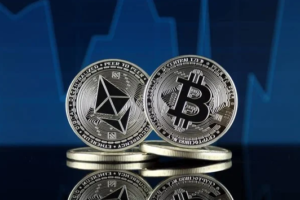
According to Fixygen, the cryptocurrency market is ending the first week of September on an uptrend after significant volatility at the start of the week: Bitcoin has returned above the $81,000 mark, Ethereum has approached $2,500, and the total market capitalization has risen to approximately $2.81 trillion. The main driver of this movement was a shift in expectations regarding the U.S. Federal Reserve’s future monetary policy.
According to CoinGecko, as of midday on September 4, Bitcoin was trading at around $81,000, Ethereum at around $2,500, XRP at $1.44–1.45, and Solana at around $104. The total market capitalization of the cryptocurrency market stood at approximately $2.81 trillion, having increased by about 4.5% over the past 24 hours. Bitcoin accounted for about 58% of the market capitalization, while Ethereum accounted for about 11%.
The week started off much weaker. On August 31, Bitcoin was trading at around $78,600; on September 1–2, it fell to $77,000, but then rebounded sharply. On the night of September 4, the price rose to approximately $82,200—a high not seen in more than three months. Thus, compared to the start of the week, BTC has risen in price by about 3%, although the change over the past seven days remains significantly more modest—about 1%. (CoinGecko)
The main reason for the new surge was statements by Federal Reserve Board member Christopher Waller. Speaking on September 3, he said he was prepared to support keeping the interest rate at its current level if incoming data confirmed a further slowdown in inflation. At the same time, Waller did not rule out a rate hike if August inflation accelerates again. Following his remarks, pressure on the dollar and U.S. Treasury yields eased, which supported risk assets, particularly cryptocurrencies.
Ethereum showed more subdued price action throughout the week. After reaching a level of around $2,470 on August 31, ETH fell below $2,400, then recovered to approximately $2,500. XRP, after falling to $1.35, rose again to about $1.45, while Solana climbed above $100. On a seven-day basis, Ethereum and XRP are roughly flat, while Solana is down about 3%.
U.S. spot ETFs remain a key support factor for Bitcoin. Following a net outflow of about $236.5 million on September 1, the funds received about $101 million on September 2, and preliminary data for September 3 already indicates approximately $277 million in inflows.
In August, the total inflow into spot Bitcoin ETFs was estimated at approximately $3.52 billion. However, capital flows remain volatile and do not yet indicate a return to a sustained series of daily purchases.
The situation in the Ethereum market is less clear-cut. On September 2, U.S. spot Ethereum ETFs recorded a net outflow of about $48 million, breaking a streak of 12 trading sessions with inflows, during which the funds attracted about $1.62 billion. This partly explains ETH’s weaker performance compared to Bitcoin in early September.
Among large and mid-cap cryptocurrencies, Zcash stood out as the most notable exception this week: according to CoinDesk, as of September 4, the coin had risen by approximately 20% over seven days and about 15% over the past 24 hours. Hyperliquid also significantly outperformed most major crypto assets.
In the coming days, the market will remain primarily dependent on U.S. macroeconomic data. On September 4, the U.S. Department of Labor is set to release the August employment report, and the Consumer Price Index (CPI) will be released on September 11. These figures will be particularly important ahead of the Fed meeting on September 15–16. The official BLS calendar confirms the release of August labor market data on September 4 and the Consumer Price Index (CPI) on September 11.
The base case scenario for Bitcoin in the near term is that it will remain within a range of approximately $76,000–$83,000. The $76,000–$77,000 zone acted as support several times earlier this week, while the $82,000 level has already become the nearest resistance. A sustained move above $82,000–$83,000, coupled with continued capital inflows into Bitcoin ETFs, could pave the way toward the $85,000–$88,000 level. In the event of strong U.S. inflation or labor market data that once again increases the likelihood of a Fed rate hike, a return to the $76,000–78,000 range becomes the most likely scenario. A break below this support level would significantly worsen the short-term technical picture.
For Ethereum, the $2,400–$2,550 range remains key. A confident break above $2,550 could allow the market to test $2,700–$2,800; however, this would require not only a rise in Bitcoin but also a resumption of a steady inflow of capital into the Ethereum ETF. If sentiment deteriorates, a pullback below $2,400 will once again bring the $2,250–2,300 zone into focus.
Thus, the first week of September has not yet become a full-fledged continuation of August’s strong rally. Rather, the market has entered a phase of testing the levels reached: Bitcoin appears stronger than most major altcoins, institutional demand remains steady, but capital flows through ETFs are volatile. The main drivers for the crypto market over the next two weeks will be U.S. inflation, the Fed’s decision, and Bitcoin’s ability to hold above $82,000.
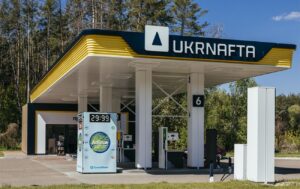
According to Experts.news, in August 2026, the OKKO Group became the largest importer of diesel fuel into Ukraine, supplying nearly 89,000 metric tons—a 47% increase compared to August of last year, as reported by the A-95 Consulting Group.
Ukrnafta took second place with a volume of nearly 77,000 metric tons. Over the past year, the company increased its imports by 2.4 times.
“Energo Trade JSC” became the third-largest importer, with 55,600 metric tons, although its shipments fell by 44%.
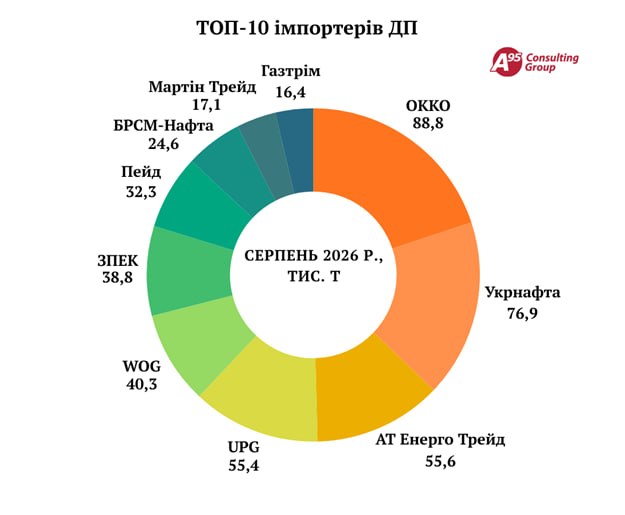
UPG imported 55,400 metric tons, a 3% increase, while WOG imported 40,300 metric tons, a 46% increase compared to last year.
The Western Fuel and Energy Company (ZPEK) also showed significant growth, increasing its imports by a factor of 2.2 to 39,000 metric tons.
According to the “A-95” chart on the third page of the press release, the rest of the top 10 importers for August included “Paid” with 32,300 metric tons, “BRSM-Nafta” with 24,600 metric tons, “Martin Trade” with 17,100 metric tons, and “Gaztrim” with 16,400 metric tons.
Disruptions in grain supplies from the Black Sea region and hot weather, which worsened harvest forecasts in a number of countries, led to a 2.2% increase in global grain prices in August compared to July. Prices reached their highest level since May 2024, according to the monthly review by the FAO (Food and Agriculture Organization of the United Nations).
According to the report, international prices for all major grain crops rose in August. “This was driven by strong demand resulting from deteriorating harvest prospects in key producing regions due to adverse weather conditions, as well as ongoing uncertainty regarding exports from the Black Sea region,” the report states.
Global wheat prices rose by 2.6% in August compared to July, with a year-over-year increase of 15%. Among the reasons, FAO experts also cite “protracted disruptions to exports from the Black Sea region, downward revisions to production forecasts in some European regions experiencing hot and dry weather, and the weakening of the U.S. dollar, which has made export shipments more competitive.”
Corn prices rose by 2.5% compared to July, driven by growing concerns about harvest prospects in some regions of the U.S. Corn Belt and worsening production forecasts in the EU. At the same time, demand from ethanol producers and the animal feed industry remains high.
“Fears regarding food supply following the closure of the Strait of Hormuz provided additional support to corn prices,” the review notes.
Global prices for sorghum and barley rose by 3.9% and 2.6%, respectively, in August compared with July, “which generally reflects a more stable situation in the feed grain markets,” the review states.
Rice prices rose by 0.5% in August. “The rise in prices for Indian rice varieties was driven by factors such as exchange rate fluctuations, purchases by Asian and African countries, and an expected reduction in supplies,” the report states.

According to Experts.news, Ukraine imported 4.2 million metric tons of diesel fuel in January–August 2026, which is 7% more than during the same period in 2025, the A-95 Consulting Group reported.
However, in August alone, shipments fell by 10% year-over-year to 588,000 metric tons.
The main feature of the market in August was a significant restructuring of logistics. While a year earlier, approximately 50% of imported diesel fuel came via the southern route, in August 2026 that share fell to 33%. At the same time, the share of shipments via the western border rose from 50% to 67%.
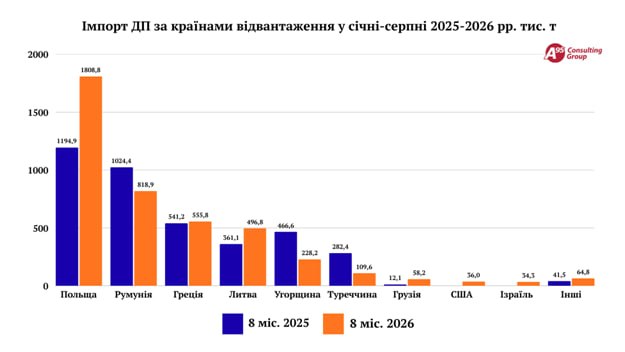
According to Serhiy Kuyun, director of “A-95,” the change in routes is linked both to the price situation on the European market amid the war in Iran and to the increase in military risks, freight costs, and secondary logistics along the southern route.
A-95 expects that the fall will remain a challenging period for the fuel market due to intensified Russian attacks and market turbulence linked to the war in Iran.

U.S. Treasury Secretary Scott Bessent cited Ukraine’s attacks on Russian oil infrastructure as one of the causes of the global energy crisis and rising energy prices, according to The New York Times.
“We are currently experiencing an energy shock due to the war in Ukraine, as Ukraine has decided to target Russian energy assets and oil refineries, which is driving up prices globally,” Bessent said.
According to The New York Times, Bessent made this statement after two days of meetings in North Carolina with finance ministers from around the world. He cited Ukraine’s strikes on Russian oil infrastructure as one of the causes of the global energy crisis, which he said was primarily caused by the U.S. war with Iran.
The publication notes that Bessent’s remarks came after the U.S. invited Russian Finance Minister Anton Siluanov to the G20 meeting, a move that drew criticism from some of Ukraine’s allies.
Bessent also defended his bilateral meeting with Siluanov, citing the need for cooperation to resolve Russia’s war against Ukraine.
At the same time, as the American publication notes, Bessent’s criticism of Ukraine’s military tactics sparked a negative reaction among Ukrainians.
Source: https://www.nytimes.com/2026/09/03/business/bessent-energy-prices-ukraine.html



