
As of November 6, 2026, offer prices for imported liquefied gas at the Polish-Ukrainian border exceeded $1,500 per metric ton, while at southern border crossings, the wholesale price of the resource approached a similar level.
The A-95 Consulting Group reported this on November 6, noting that the price increase is linked to a reduction in global propane and butane supply, changes in international trade flows, and rising logistics costs.
According to analysts, the deterioration of the situation in the global liquefied petroleum gas (LPG) market is driven by reduced production in the Persian Gulf countries and disruptions to maritime shipments resulting from attacks on civilian vessels.
This has led to a decline in exports from the Middle East, which traditionally supplies a significant portion of Asian consumers’ needs.
As a result, Asian countries have intensified competition with European importers for American liquefied gas, causing a further increase in international prices.
According to “A-95,” in October 2026, 568,000 metric tons of liquefied natural gas were shipped from the U.S. to Northwestern Europe, which is 17% less than during the same period last year.
Amid the supply shortage, October prices for propane in the region rose by $173 per metric ton, while butane prices increased by $345 per metric ton.
A similar trend is observed in the Mediterranean market, where prices set by the Algerian energy company Sonatrach remain one of the key price benchmarks.
Specifically, in October, Sonatrach’s propane prices rose by $155 per metric ton, while butane prices increased by $300 per metric ton.
For Ukraine, the situation is complicated by a shortage of the resource in the markets of neighboring European countries, primarily Romania, Poland, and Lithuania.
These countries remain the main sources of imported automotive gas, so the rise in their domestic prices directly affects the purchase cost of fuel for Ukrainian traders.
Additional factors driving up prices include security risks associated with maritime transport in the Black Sea and long wait times for road transport at border crossings.
According to estimates by “A-95,” current wholesale prices are setting the stage for a further increase in the retail price of autogas in Ukraine.
In October, the average price of this fuel at Ukrainian gas stations rose by 13.75 UAH/liter to 57.66 UAH/liter, and by early November, it had approached 60 UAH/liter.
Experts do not rule out that in the second half of November, prices at certain gas station chains could reach 66 UAH/liter if high import prices persist.
Sonatrach is Algeria’s state-owned oil and gas company and one of Africa’s leading producers and exporters of energy resources. Its price benchmarks for propane and butane are used by participants in the Mediterranean liquefied gas market.
Retail prices for automotive liquefied petroleum gas in Ukraine may rise to 66 UAH per liter at certain gas station chains in the second half of November 2026 due to a global shortage of the resource, rising import costs, and logistical challenges.
This was reported by the “A-95” Consulting Group in a press release dated November 6, based on the results of monitoring the Ukrainian and European fuel markets.
According to analysts, during October, the average retail price of autogas in Ukraine increased by 13.75 UAH/liter, to 57.66 UAH/liter. Thus, in just one month, the price of the fuel rose by approximately 31%.
As of November 6, the average price of liquefied gas at Ukrainian gas stations approached 60 UAH/liter.
Experts cite limited supply of propane and butane on the global market as the main reason for the price increase. Reduced production in the Gulf countries and disruptions to maritime transport due to security risks have led to a decrease in supplies from the Middle East.
As a result, Asian buyers, who traditionally purchase significant volumes of liquefied gas in this region, have begun to compete more actively with European consumers for American supplies.
At the same time, on the Ukrainian market, additional pressure on prices is being created by a shortage of liquefied gas in Poland, Romania, and Lithuania, which are the main sources of autogas imports into Ukraine.
The situation is complicated by rising transportation costs due to security risks in the Black Sea and queues at road border crossings.
According to “A-95,” as of November 6, offer prices for imported autogas at the Polish-Ukrainian border exceeded $1,500 per metric ton. At southern border crossings, the wholesale price also approached $1,500 per metric ton.
“Given the current offer prices for imported autogas, prices at certain gas station chains may rise to 66 UAH/liter in the second half of the month,” the “A-95” Consulting Group notes.
The forecast refers to possible price levels at specific chains, not the average price of autogas across Ukraine.
The “A-95” Consulting Group specializes in research on the Ukrainian petroleum products market, price monitoring, and analysis of fuel imports and fuel logistics.
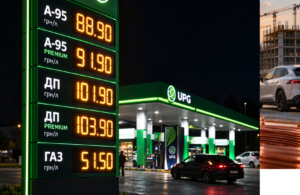
Prices for both types of diesel fuel, as well as autogas, continue to rise, according to monitoring of a number of filling station chains conducted since February 2026 by the Energoreforma internet portal.
According to the monitoring data, as of October 20, compared with October 16, the price of diesel fuel and diesel fuel+ increased by UAH 1–3 per liter, while autogas rose in price by UAH 1.6–3.5 per liter. At the same time, the price of regular diesel at state-owned UKRNAFTA reached UAH 99.9 per liter.
Gasoline prices have remained largely stable for several weeks.
Fuel prices (average) as of 10:00 a.m. on October 20 compared with October 16 (based on Energoreforma’s monitoring of filling station chains’ websites and applications)
| Chain | 95 (UAH/l) | Premium 95 (UAH/l) | Diesel fuel (UAH/l) | Premium diesel fuel (UAH/l) | Gas (UAH/l) |
|---|---|---|---|---|---|
| UKRNAFTA | 88.90 (88.90) | 91.90 (91.90) | 99.90 (98.90) | 101.90 (100.90) | 49.90 (47.90) |
| UPG | 88.90 (88.90) | 91.90 (91.90) | 101.90 (99.90) | 103.90 (101.90) | 51.50 (49.90) |
| OKKO | 92.90 (92.90) | 95.90 (95.90) | 104.90 (101.90) | 107.90 (104.90) | 51.90 (49.90) |
| WOG | 92.90 (92.90) | 95.90 (95.90) | 104.50 (102.50) | 107.50 (105.50) | 52.50 (50.50) |
| SOCAR | 94.90 (94.90) | 97.90 (97.90) | 105.00 (105.00) | 108.00 (106.00) | 54.40 (50.90) |
As reported, on September 21, SOCAR was the first filling station chain to “release” the price of diesel fuel, raising it to UAH 103 per liter and UAH 104 per liter for regular diesel and diesel+, respectively.
On September 25, WOG and OKKO raised the price of premium diesel above UAH 100 per liter, from UAH 99.9 per liter to UAH 102.9 per liter, while the price of regular diesel fuel remained at UAH 99.9 per liter.
Dmytro Leushkin, founder and CEO of Prime Group, explained at the time that diesel fuel prices should already have exceeded UAH 100 per liter several days earlier, but there was an unofficial request from the government to restrain them.
On October 15, a number of filling station chains exceeded the UAH 100 per liter mark for regular diesel fuel, whose price had long been kept at UAH 99.9 per liter. A distinctive feature of that day was that the state-owned UKRNAFTA chain, which serves as a kind of “price restraint mechanism,” set the price of diesel fuel+ at UAH 100.9 per liter.
At the same time, autogas became more expensive again at almost all the chains monitored, increasing by between UAH 0.6 and UAH 2 per liter.
Several days earlier, Serhiy Kuyun, director of the A-95 consulting group, had forecast that autogas prices would rise by approximately 10% over the following 7–10 days due to an increase in global prices.
At that time, he also drew attention to the rise in diesel fuel quotations on London’s ICE exchange to $1,483 per tonne (an increase of more than $100 per tonne), noting that such a jump had dashed hopes of stabilizing prices for this type of fuel.
Kuyun also emphasized that retail prices for regular diesel at filling station chains were lower than wholesale prices, which, in particular, stood at UAH 101 per liter in the central part of the country. According to him, at such wholesale prices, the price at the pump should be at least UAH 105–106 per liter. At the same time, he pointed out that there was no fuel shortage in Ukraine.
autogas, DIESEL FUEL, FILLING STATIONS, FUEL, FUEL PRICES, UKRAINE
Fuel prices in Ukraine continue to decline—this applies primarily to diesel, which has dropped by another 1–3 UAH per liter over the past five days, according to price monitoring at select gas station chains conducted by Energoreforma.
According to the report, natural gas prices have also fallen by up to 1 UAH per liter.
Gasoline prices remain stable, at the same level as on June 17.
According to calculations by Serhiy Kuyun, director of the consulting firm “A-95,” the price of diesel fuel has already dropped by more than 12 UAH per liter from its peak of over 90 UAH per liter.
He noted that at the start of the crisis, the price of diesel fuel was 62 UAH per liter.
The expert also pointed out that smaller retail chains, which do not have remaining stocks of fuel purchased at high prices, are lowering their prices more aggressively.
Regarding gasoline, Kuyun explained that there is no noticeable downward trend, since the difference between the purchase price (customs value) and the retail price during the “Iranian crisis” only returned to its pre-crisis February level in June.
“In other words, there are no excess profits that could explain the slowdown in price reductions. Gasoline margins have completely collapsed, which is why prices aren’t really falling. Gas stations’ finances are currently being propped up by diesel, though that doesn’t prevent diesel prices from falling sharply,” Kuyun wrote.
At the same time, the director of “A-95” emphasized that Russian attacks on gas station networks continue, and these losses are also putting pressure on their finances.
“Last week, one of the major chains lost an oil depot containing $1.5 million worth of fuel. Another chain reports that it suffers 15–20 ‘lightning strikes’ every week in frontline regions. WOG has already lost 6–7 gas stations, each worth $1 million. Gasoline and natural gas tankers are burning,” Kuyun described the situation.
He also noted that there had been an initiative to create a fund to compensate for these losses, but so far there are no sources of funding for it.
Kuyun pointed out that current global prices are not the only factor in pricing, but given the level of competition and the large number of gas stations, supply sources, and logistical capabilities in the Ukrainian market, in his opinion, there is no chance of operating under any rules other than market ones.
For his part, Volodymyr Omelchenko, director of energy and infrastructure programs at the Razumkov Center, noted that autogas is once again becoming more cost-effective than gasoline, having dropped by more than 5 UAH/liter in one month and more than 7 UAH/liter in two months.
Meanwhile, gasoline prices fell by only 1.1 UAH per liter over the same period. He noted that currently, a liter of LPG costs approximately 56% of the price of a liter of A-95.
Omelchenko attributed this, in particular, to a decline in the wholesale price of LPG, which fell by 3.46 UAH per liter over the past month.
According to him, propane and butane prices have fallen in Europe, and the import parity for LPG has also declined since its April peak. As of June 19, it stood at 34.43 UAH per liter, compared to 40.95 UAH per liter on April 16.
However, he also noted that the price cap at gas stations is determined not only by European quotations but also by the influence of wholesale prices, logistics, taxes, exchange rates, security risks, and the safety margins of the networks themselves.
“Therefore, a decrease in external prices does not always immediately translate into an equivalent decrease at the retail level,” Omelchenko said.
As previously reported, fuel prices in Ukraine began to decline around mid-June amid reports of a stabilizing situation in the Middle East and falling oil prices. On June 19, Pavlo Kyrylenko, head of the Antimonopoly Committee of Ukraine, convened fuel market participants to discuss the situation.
He drew their attention to the fact that over the past few weeks, global markets have seen a significant drop in prices for crude oil and petroleum products, but in Ukraine, the pace of decline in retail fuel prices remains significantly slower than the pace of their previous rise.
Market participants were asked to provide further explanations regarding the reasons for the slower decline in petroleum product prices compared to their previous rapid rise, as well as the factors influencing how quickly lower petroleum product costs are reflected in prices for end consumers.
On June 17, Natalia Nikeshina, marketing director of the national network of gas stations operating under the Parallel brand, predicted that the potential for price reductions ranges from 6 UAH to 12 UAH per liter. According to her, the largest drop can be expected if European prices do indeed fall to pre-crisis levels.



