

The volume of passenger car imports to Ukraine, including cargo-passenger vans and race cars (UKT ZED code 8703), amounted to $2.62 billion in January–July 2026, which is 17% less than the figure for the same period in 2025 ($3.16 billion).
According to statistics released by the State Customs Service of Ukraine, in July alone, passenger car imports fell by 27.2% compared to July of last year—to $443.2 million, which is also 5.3% less than in June 2026.
The top three suppliers of passenger cars to Ukraine over the first seven months have consistently been the United States, Germany, and Japan, whereas in the previous year they were Germany, the United States, and China. Specifically, car shipments from the U.S. fell by 3.2% to $508.3 million, those from Germany decreased by 26% to $416.2 million, and imports from Japan totaled $371.2 million, whereas last year, cars worth $407.7 million were imported from China.
Imports of passenger cars from other countries during this period totaled $1.33 billion—20.4% less than last year’s figure.
At the same time, over the seven-month period, Ukraine exported only $2 million worth of such vehicles, primarily to Georgia, the Czech Republic, and Kazakhstan, whereas last year, total exports to the UAE, the Czech Republic, and Poland amounted to $4.54 million.
Passenger cars accounted for 4.52% of Ukraine’s total imports of goods in January–July, compared to 6.89% during the same period last year; their share of total exports was 0.01% and 0.02%, respectively.
As previously reported, in 2025, passenger cars worth nearly $6.15 billion were imported into Ukraine, which is 40.2% more than in 2024. The top three exporters were the United States, Germany, and China. Car exports totaled $10.1 million (2.7 times less).
The significant increase in passenger car imports to Ukraine starting in the summer of 2025 was driven by news that VAT exemptions on electric vehicle imports would be abolished as of January 1, 2026; as a result, imports have declined significantly since the beginning of this year. However, starting in March, a slow but steady recovery of the passenger car market—including electric vehicles—began.

Insurance Company “Arsenal Insurance” made the largest payment under a comprehensive auto insurance policy in the company’s history—11.4 million UAH—for the total loss of a 2024 Aston Martin.
According to the company’s website, while driving on a wet road, the driver lost control of the vehicle—the car skidded and crashed into a guardrail at high speed.
“Arsenal Insurance” is a non-life insurance company with 100% Ukrainian capital. It has been operating since 2005. It holds a license that allows it to operate in all 18 classes of non-life insurance. It is also the leader in premiums collected in the comprehensive auto insurance (CASCO) market for January–June 2026.

In July 2026, Ukrainians purchased 22,600 used passenger cars imported from abroad, which is 1% more than during the same period in 2025, according to a report by “Ukravtoprom” on its Telegram channel.
Gasoline-powered cars accounted for the largest share of this segment of the auto market, increasing their share by 7 percentage points compared to July 2025—to 55%.
Next came diesel cars at 17% (19%), while the share of electric vehicles fell to 15% from 24%, though they still outpaced hybrids, which accounted for 10% (6%). The share of cars with LPG systems remained unchanged at 3%.
The average age of imported used cars was 8.8 years.
The Volkswagen Tiguan confidently tops the list of the ten most popular imported used models with 937 units. It is followed by the VW Golf with 862 units, the Audi Q5 with 803 units, the Nissan Rogue with 799 units, the Skoda Octavia with 661 units, the Renault Megane with 618 units, the Tesla Model Y with 509 units, the Ford Escape with 465 units, the Tesla
Model 3 with 456 units, and the Mazda CX-5 with 432 units.
As reported with reference to “Ukravtoprom,” in 2025 Ukrainians purchased 274,300 used passenger cars imported from abroad, which is 24% more than in 2024, and the top three most popular models after the Volkswagen Golf included two Tesla electric vehicles—the Model Y and Model 3.

Sales of new passenger cars in July of this year fell by 10.5% compared to the same month in 2025—to 5,754 thousand units, according to a report by “Ukravtoprom” on its Telegram channel.
According to the association, the most popular brand remains Japan’s Toyota, which increased its sales by 20% to 985 units.
Skoda took second place with 693 units (+24%), while VW came in third with 444 units (-10%).
The top ten most popular brands also included Renault with 345 units (-47%); BMW with 308 units (+17%); Hyundai with 298 units (=); Mazda—259 units (+66%); BYD—229 units (-69%); Suzuki—194 units (+39%); and Audi—156 units (-38%).
The Toyota RAV-4 crossover was the month’s best-seller.
According to Ukravtoprom, a total of about 38,800 new passenger cars were sold in the country from January through July, which is 1% less than a year ago.
According to Ukravtoprom, the new passenger car market in 2025 grew by 17% compared to 2024, reaching 81,300 units.
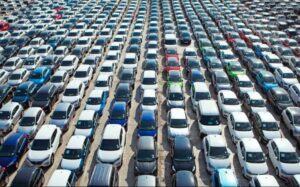
According to Open4business, the United States retained its status as the largest supplier of imported passenger cars to Ukraine in the first half of 2026, accounting for 43% of the total number of imported cars. According to data from the State Customs Service published on July 28, 73,200 passenger cars were imported from the U.S. to Ukraine between January and June.
Germany ranked second among supplier countries, accounting for 17,300 cars, or 10% of total imports. Poland ranked third with 14,600 cars, or 9%.
Collectively, the United States, Germany, and Poland supplied 105,100 passenger cars to Ukraine. These three countries accounted for about 62% of total imports.
Overall, in the first half of the year, cars were imported from more than 50 countries. The total volume of imports exceeded 169,000 vehicles, and their declared value amounted to nearly 96.6 billion UAH.
Customs revenues from passenger car imports reached 32.1 billion UAH.
According to estimates by the Experts Club analytical center, gasoline-powered cars led in terms of customs revenue. They contributed 14.6 billion UAH to the budget, or 45.5% of the total.
Diesel cars generated 8.4 billion UAH, hybrids—7.1 billion UAH, and electric cars—about 2 billion UAH.
Used cars accounted for over 70% of the total number of imported vehicles and generated 17.7 billion UAH in customs duties. New cars accounted for less than 30% of imports and 14.4 billion UAH in revenue.

Gasoline-powered passenger cars accounted for over 14.6 billion hryvnia in customs revenue for the state budget from passenger car imports, which totaled 32.1 billion hryvnia, the State Customs Service reported on its website.
At the same time, diesel cars generated 8.4 billion UAH in revenue, hybrids—7.1 billion UAH, and electric cars—2 billion UAH.
The State Customs Service notes that, overall, from January through June, Ukrainians imported over 169,000 passenger cars with a total value of nearly 96.6 billion hryvnias, 70% of which were used cars, generating 17.7 billion hryvnias in customs duties for the state budget, while new cars accounted for 14.4 billion UAH.
Gasoline-powered cars, which remain the most popular, accounted for 54.5% of total imports. In second place were diesel cars (20.3%), which not only significantly outpaced electric cars (13%) but also surpassed hybrids (12.1%).
Hybrids were the most expensive among imported cars, with an average price of nearly $27,000 per vehicle; diesel cars averaged $16,000; electric cars, over $10,000; and gasoline-powered cars, $9,000.
According to the State Customs Service, cars have been imported from more than 50 countries since the beginning of 2026, but the undisputed leaders are: the United States—73,200 (43% of the total number of imports); Germany—17,300 (10%); and Poland—14,600 (9%).
In total, nearly 105,100 cars were imported from these countries, accounting for 62% of the total.
As previously reported, according to the State Customs Service, the volume of passenger car imports into Ukraine—including cargo-passenger vans and race cars (UKT ZED code 8703)— amounted to $2.18 billion in January–June 2026, which is 14.6% less than the figure for the first half of 2025 ($2.554 billion).



