
Bulgaria is perceived by Ukrainians mostly positively, although a significant number of citizens remain neutral. This is evidenced by the results of an all-Ukrainian survey conducted by Active Group in cooperation with the Experts Club information and analytical center in August 2025.
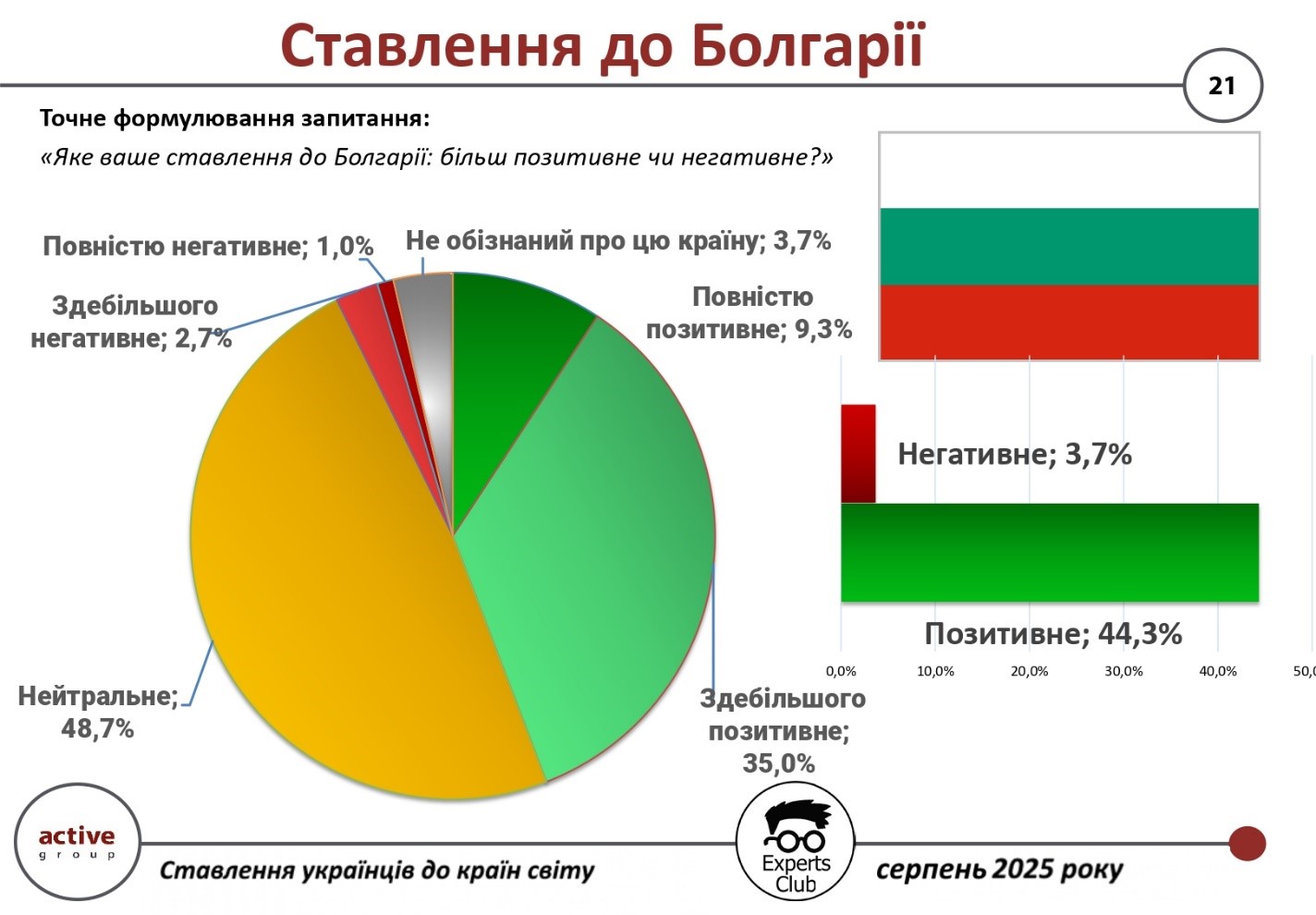
According to the survey, 44.3% of Ukrainians have a positive attitude towards Bulgaria (35.0% – mostly positive, 9.3% – completely positive). Only 3.7% of respondents expressed a negative attitude (2.7% – mostly negative, 1.0% – completely negative). At the same time, 48.7% of citizens are neutral, and 3.7% admitted that they do not know enough about this country.
“For Ukrainians, Bulgaria is not only an EU member state but also a significant economic partner. In the first half of 2025, the volume of bilateral trade amounted to more than $1.53 billion, of which Ukrainian exports amounted to $558.6 million and imports from Bulgaria amounted to almost $980 million. The negative balance of $421.5 million demonstrates an asymmetry in relations, but against the background of the total volume, it confirms the importance and sustainability of economic ties,” said Maxim Urakin, founder of Experts Club.
In his turn, Oleksandr Poznyi, co-founder of Active Group, drew attention to the fact that the sociological picture shows a friendly but at the same time restrained attitude of Ukrainians.
“Almost half of the citizens have a neutral position on Bulgaria, and this is due to the relatively limited presence of this country in the public and information space of Ukraine. At the same time, positive assessments outnumber negative ones by almost ten to one, which indicates the existence of trust and good potential for further development of relations,” he added.
The survey was part of a broader study analyzing international sympathies and antipathies of Ukrainians in the current geopolitical environment.
The full video can be viewed here:
https://www.youtube.com/watch?v=YgC9TPnMoMI&t
You can subscribe to the Experts Club YouTube channel here:
https://www.youtube.com/@ExpertsClub
ACTIVE GROUP, BULGARIA, DIPLOMACY, EXPERTS CLUB, Poznyi, SOCIOLOGY, TRADE, URAKIN
Italy traditionally enjoys a high level of trust among Ukrainians, combining cultural proximity and pragmatic economic cooperation. This is evidenced by the results of an all-Ukrainian survey conducted by Active Group in cooperation with the Experts Club information and analytical center in August 2025.
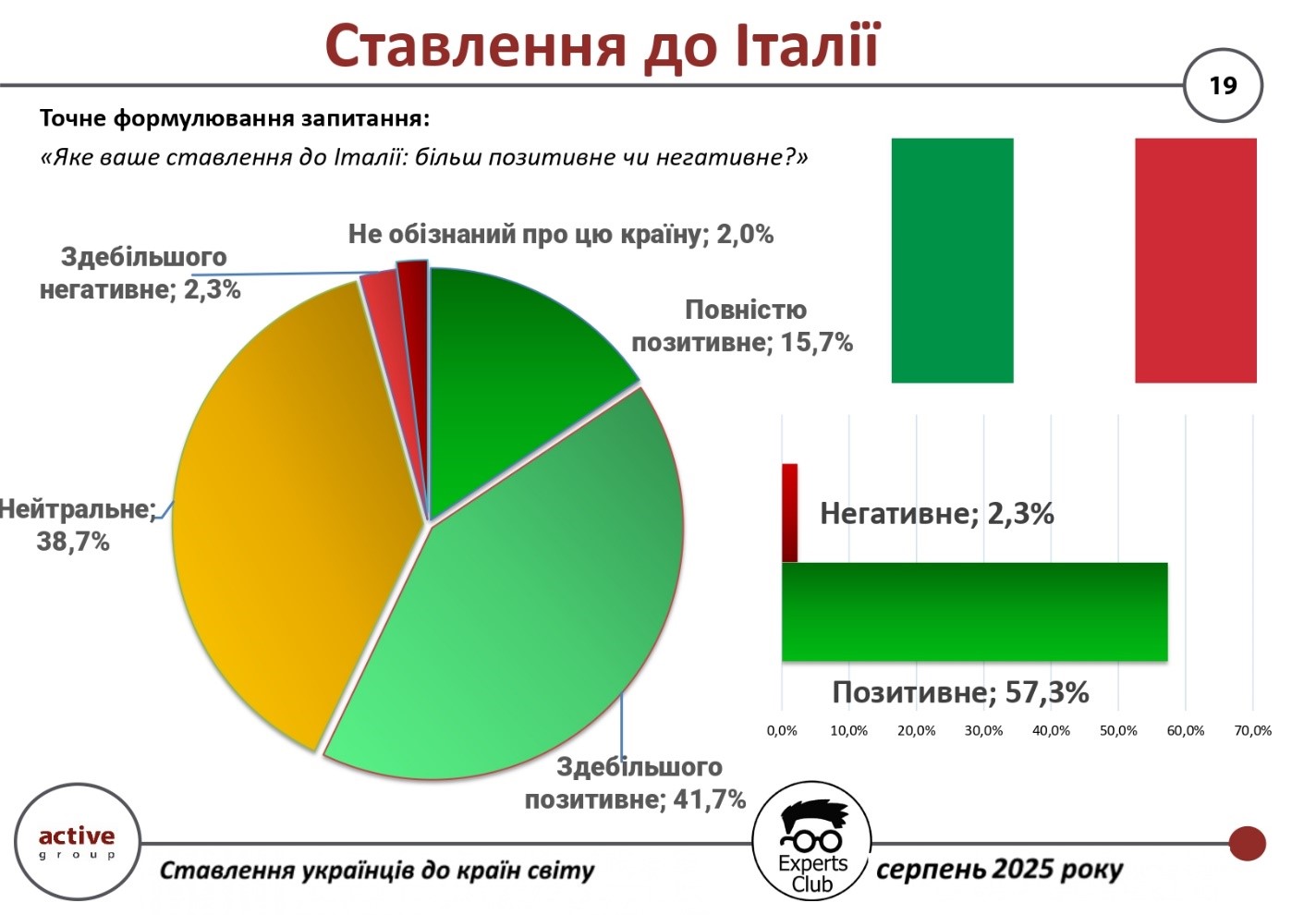
According to the survey, 57.3% of Ukrainian citizens have a positive attitude towards Italy (41.7% – mostly positive, 15.7% – completely positive). Only 2.3% of respondents expressed a negative attitude, while 38.7% remain neutral. Another 2.0% said they did not know enough about the country.
“For Ukrainians, Italy is associated with a warm culture, support during the war and significant diaspora contacts. But an even more important factor is the economic one: in the first half of 2025, the total trade between Ukraine and Italy amounted to more than $2.38 billion, of which exports from Ukraine amounted to $1.17 billion and imports from Italy to $1.21 billion. The negative balance of $40 million is insignificant and indicates a relative balance of economic relations,” said Maksym Urakin, founder of Experts Club.
In turn, Alexander Poznyi, co-founder of Active Group, emphasized that the positive attitude of Ukrainians goes beyond economic calculations.
“For most citizens, Italy is also a country associated with cultural openness, historical ties and solidarity in difficult times. That is why more than half of Ukrainians demonstrate a positive attitude, and the low level of negative assessments confirms the friendly nature of relations. In the future, this creates preconditions for even closer cooperation in both political and economic dimensions,” he added.
The survey was part of a broader study of international sympathies and antipathies of Ukrainians in the current geopolitical environment.
The full video can be viewed here:
https://www.youtube.com/watch?v=YgC9TPnMoMI&t
You can subscribe to the Experts Club YouTube channel here:
https://www.youtube.com/@ExpertsClub
ACTIVE GROUP, DIPLOMACY, EXPERTS CLUB, ITALY, Poznyi, SOCIOLOGY, TRADE, URAKIN

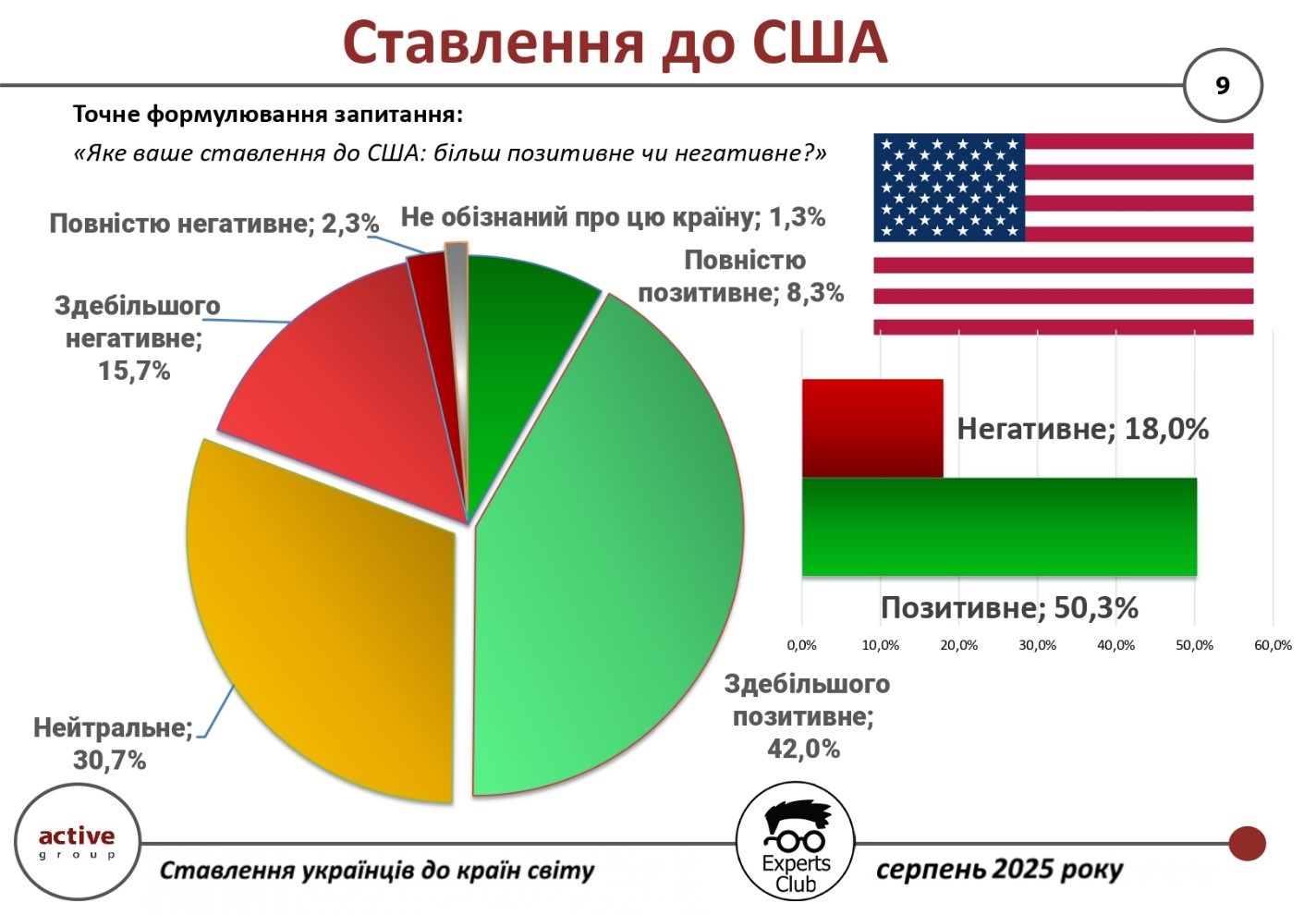
The United States remains the main strategic partner in the world for Ukrainians, but there is still a significant segment of critical and neutral attitudes in society. This is evidenced by the results of an all-Ukrainian survey conducted by Active Group in cooperation with the Experts Club information and analytical center in August 2025.
According to the survey, 50.3% of Ukrainian citizens have a positive attitude towards the United States (42.0% – mostly positive, 8.3% – completely positive). Only 18.0% of respondents expressed a negative attitude (15.7% – mostly negative, 2.3% – completely negative). Another 30.7% of Ukrainians are neutral, and 1.3% said they were not sufficiently aware of the country.

“The United States remains a key ally for Ukraine in the military, political, and diplomatic spheres. However, the trade and economic dimension is also worth noting: in the first half of 2025, bilateral trade exceeded $2.85 billion, of which exports from Ukraine amounted to $544.5 million and imports from the United States exceeded $2.31 billion. The negative balance of $1.77 billion shows a high level of dependence on American goods, but at the same time indicates the scale of cooperation and the importance of the United States for our economy,” said Maksym Urakin, founder of Experts Club.
In his turn, Oleksandr Poznyi, co-founder of Active Group, emphasized that sociological indicators reflect a complex but stable system of trust.
“Ukrainians highly appreciate the US assistance in the war and international politics. Despite some critical assessments, half of the citizens perceive the United States positively, and almost a third remain neutral. This means that the United States continues to be the No. 1 country for Ukrainian society in the security dimension, and economic cooperation only strengthens this position,” he added.
The survey was part of a comprehensive study of international sympathies and antipathies of Ukrainians in the current geopolitical environment.
The full video is available here:
https://www.youtube.com/watch?v=YgC9TPnMoMI&t
You can subscribe to the Experts Club YouTube channel here:
https://www.youtube.com/@ExpertsClub
ACTIVE GROUP, DIPLOMACY, EXPERTS CLUB, Poznyi, SOCIOLOGY, TRADE, URAKIN, USA
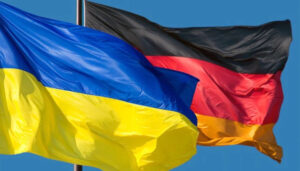

Germany is one of the countries that enjoy the greatest trust and sympathy among Ukrainians. This is evidenced by the results of an all-Ukrainian survey conducted by Active Group in cooperation with the Experts Club information and analytical center in August 2025.
According to the survey, 76.7% of Ukrainian citizens have a positive attitude toward Germany (51.3% are mostly positive, 25.3% are completely positive). Only 4.0% of respondents expressed a negative attitude (3.3% – mostly negative, 0.7% – completely negative). Another 18.7% of Ukrainians are neutral, and 1.0% admitted that they do not know enough about this country.
“For Ukrainians, Germany is first and foremost a guarantor of stability in the European Union, a country that made a huge contribution to supporting Ukraine during the war. At the same time, economic cooperation is also essential: in the first half of 2025, bilateral trade exceeded $5.63 billion, of which Ukrainian exports amounted to $1.58 billion and imports from Germany exceeded $4.05 billion. The negative balance of about $2.5 billion demonstrates that we import more than we export, but this reflects the high demand for German technology and equipment,” said Maksym Urakin, founder of Experts Club.
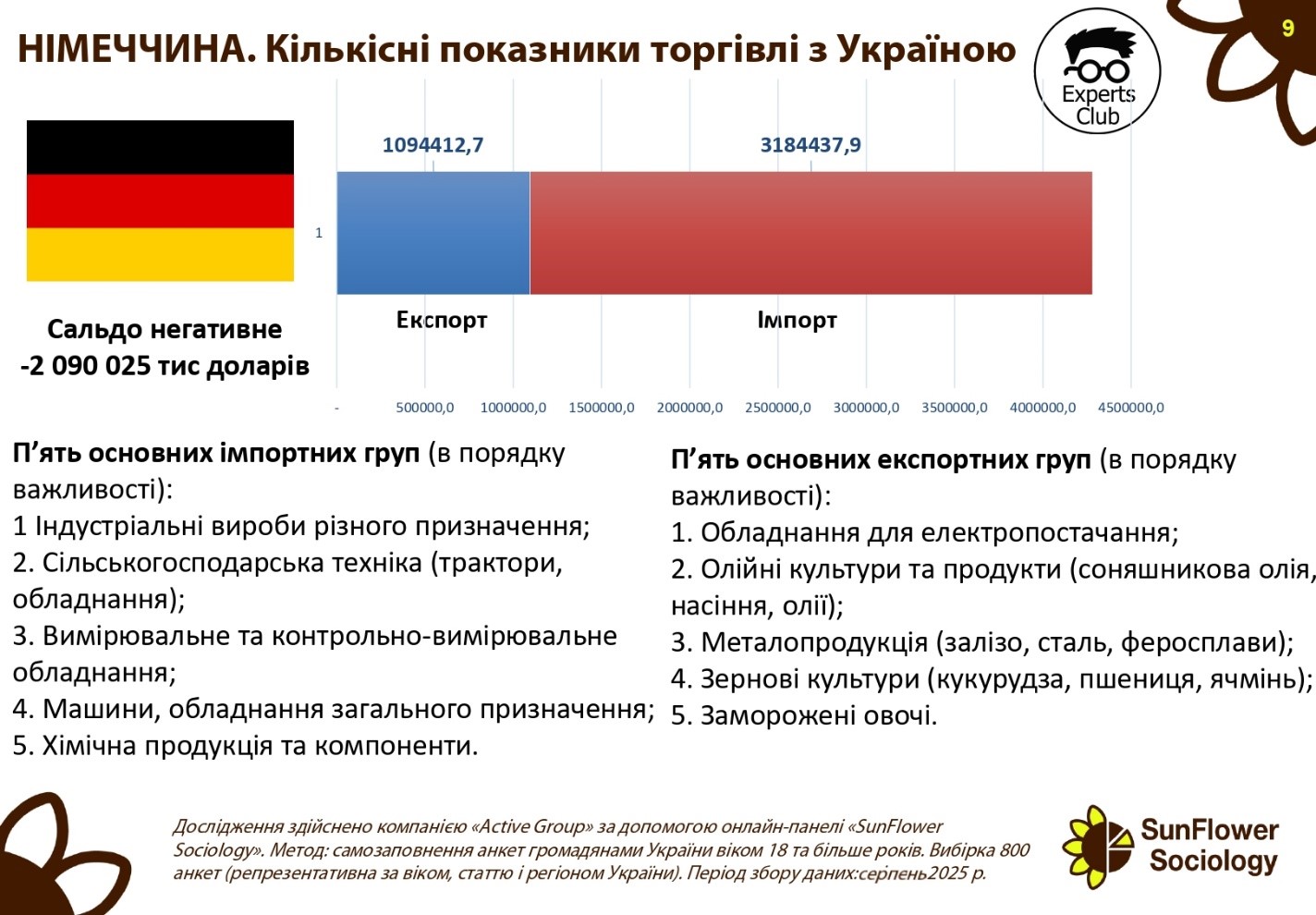
In turn, Oleksandr Poznyi, co-founder of Active Group, emphasized that the positive attitude of Ukrainians goes far beyond the economy.
“Germany is viewed as a strategic ally in the political and security dimensions. Hundreds of thousands of Ukrainian refugees have found refuge there, and large-scale financial and military assistance plays a key role in the stability of our country. The combination of these factors explains why more than three-quarters of Ukrainians have a positive attitude towards Germany and why this country remains among the absolute leaders of trust in our society,” he added.
The survey was part of a broader study of international sympathies and antipathies of Ukrainians in the current geopolitical context.
The full video is available here:
https://www.youtube.com/watch?v=YgC9TPnMoMI&t
You can subscribe to the Experts Club YouTube channel here:
https://www.youtube.com/@ExpertsClub
ACTIVE GROUP, DIPLOMACY, EXPERTS CLUB, GERMANY, Poznyi, SOCIOLOGY, TRADE, URAKIN
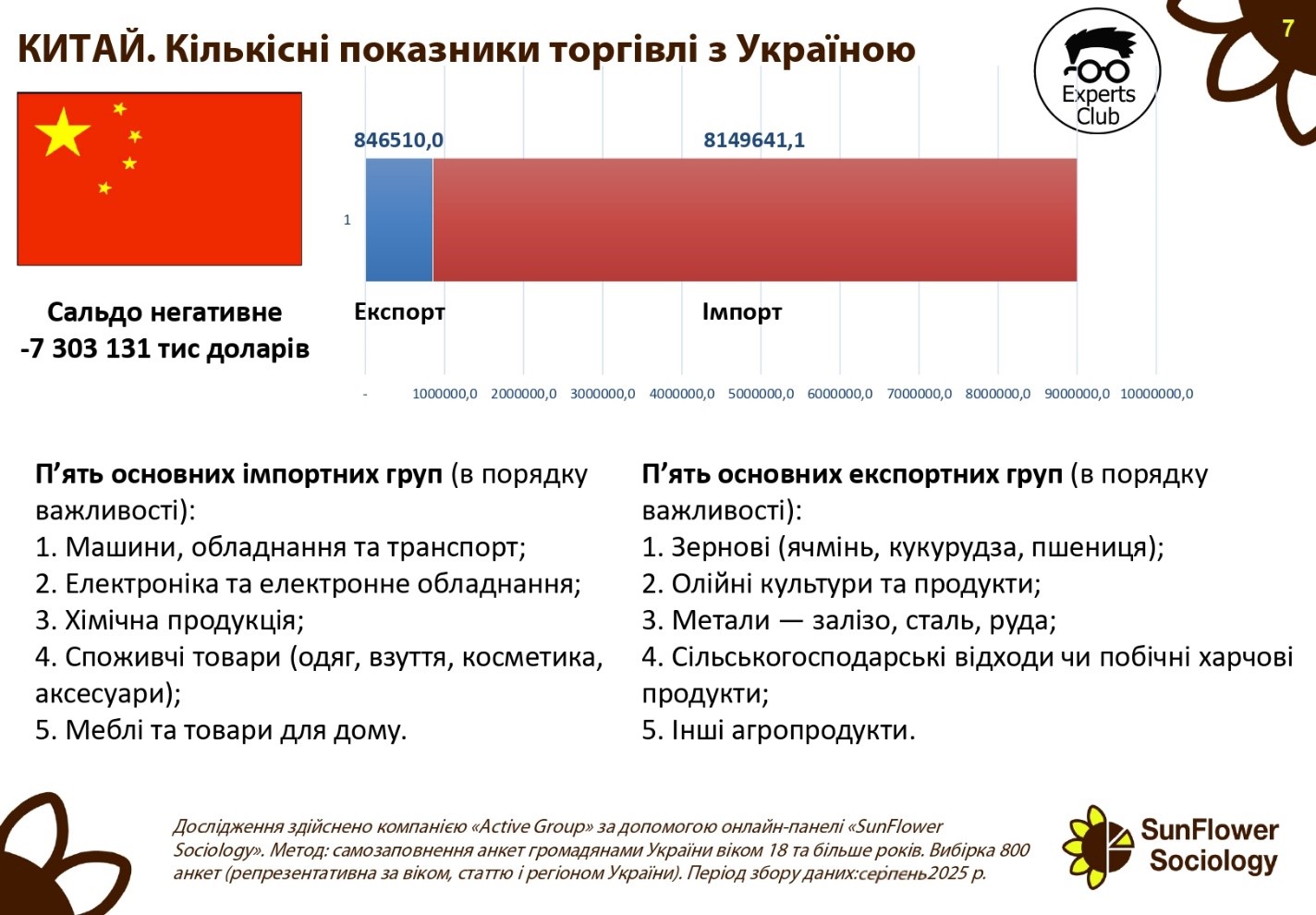
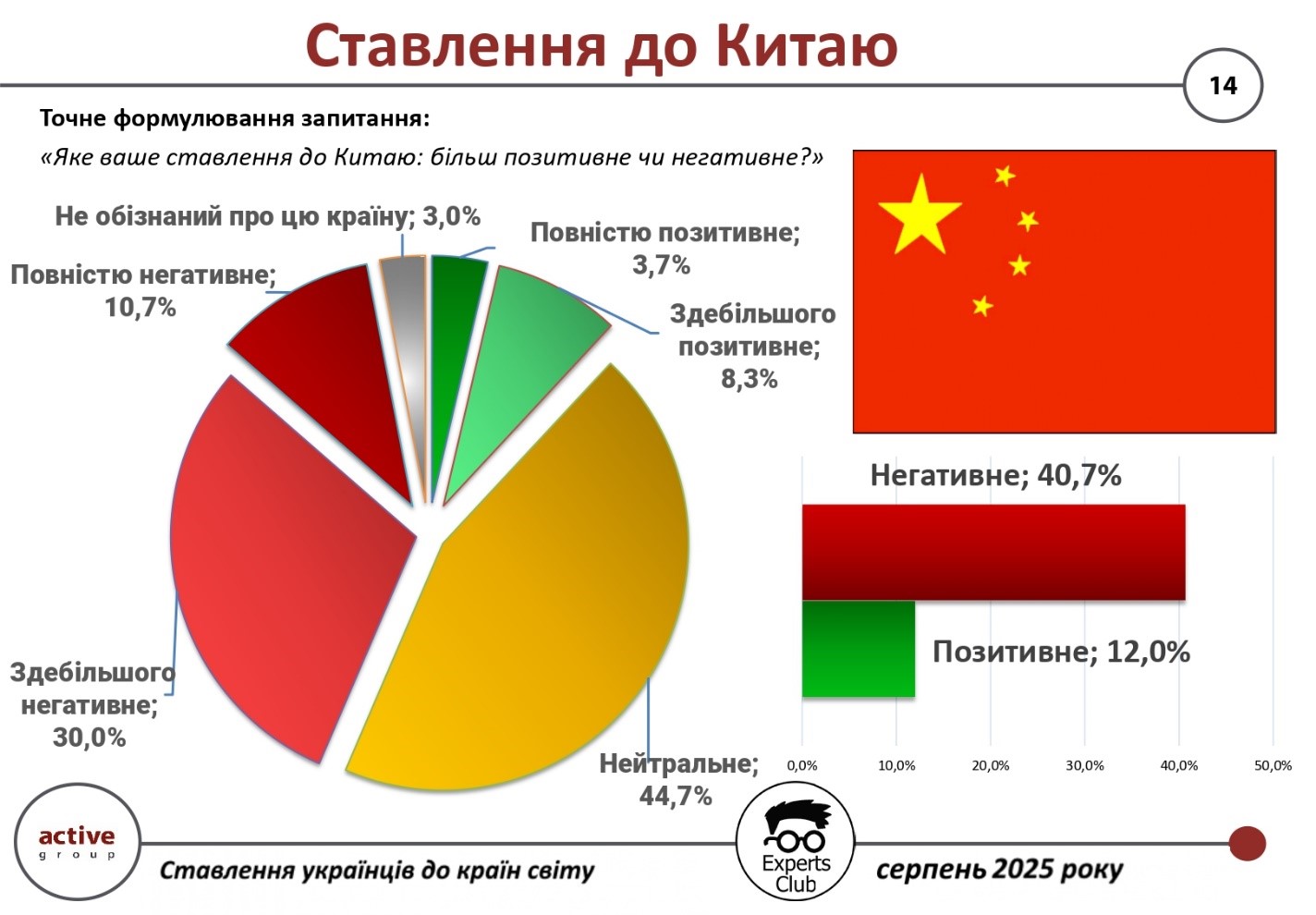
The attitude of Ukrainians toward China remains complex and controversial: a neutral position prevails, but among those who have decided, negative assessments significantly outweigh positive ones. This is evidenced by the results of an all-Ukrainian survey conducted by Active Group in cooperation with the Experts Club information and analytical center in August 2025.
According to the survey, 44.7% of Ukrainian citizens expressed a neutral attitude toward China. At the same time, 40.7% of respondents indicated that their assessment was negative (30.0% – mostly negative, 10.7% – completely negative). Only 12.0% of Ukrainians have a positive attitude toward China (8.3% – mostly positive, 3.7% – completely positive). Another 3.0% of respondents admitted that they did not know enough about the country to express their own opinion.
“Negative attitudes toward China among Ukrainians are primarily related to its foreign policy stance, which many people find ambiguous in the context of global events. However, the economic factor is extremely important: in the first half of 2025, China remained Ukraine’s No. 1 trading partner. Our exports to China amounted to more than $846 million, while imports exceeded $8.1 billion. This means that China’s influence on the Ukrainian economy is extremely significant, and it is simply impossible to ignore it,” said Maksym Urakin, founder of Experts Club.
In his turn, Oleksandr Poznyi, co-founder of Active Group, drew attention to the importance of separating economic interests from public perception.
“The survey shows that Ukrainians are not ready to unequivocally perceive China as an ally. For many, it remains an alienated state, and a significant share of negative assessments is explained by the global political context and lack of trust. At the same time, economic cooperation is so extensive that it could become the basis for a gradual change in public opinion in the future,” he added.
The poll is part of a broader study that analyzes international sympathies and antipathies of Ukrainians in the current geopolitical environment.
The full video can be viewed here:
https://www.youtube.com/watch?v=YgC9TPnMoMI&t
You can subscribe to the Experts Club YouTube channel here:
https://www.youtube.com/@ExpertsClub
ACTIVE GROUP, CHINA, DIPLOMACY, EXPERTS CLUB, Poznyi, SOCIOLOGY, TRADE, URAKIN
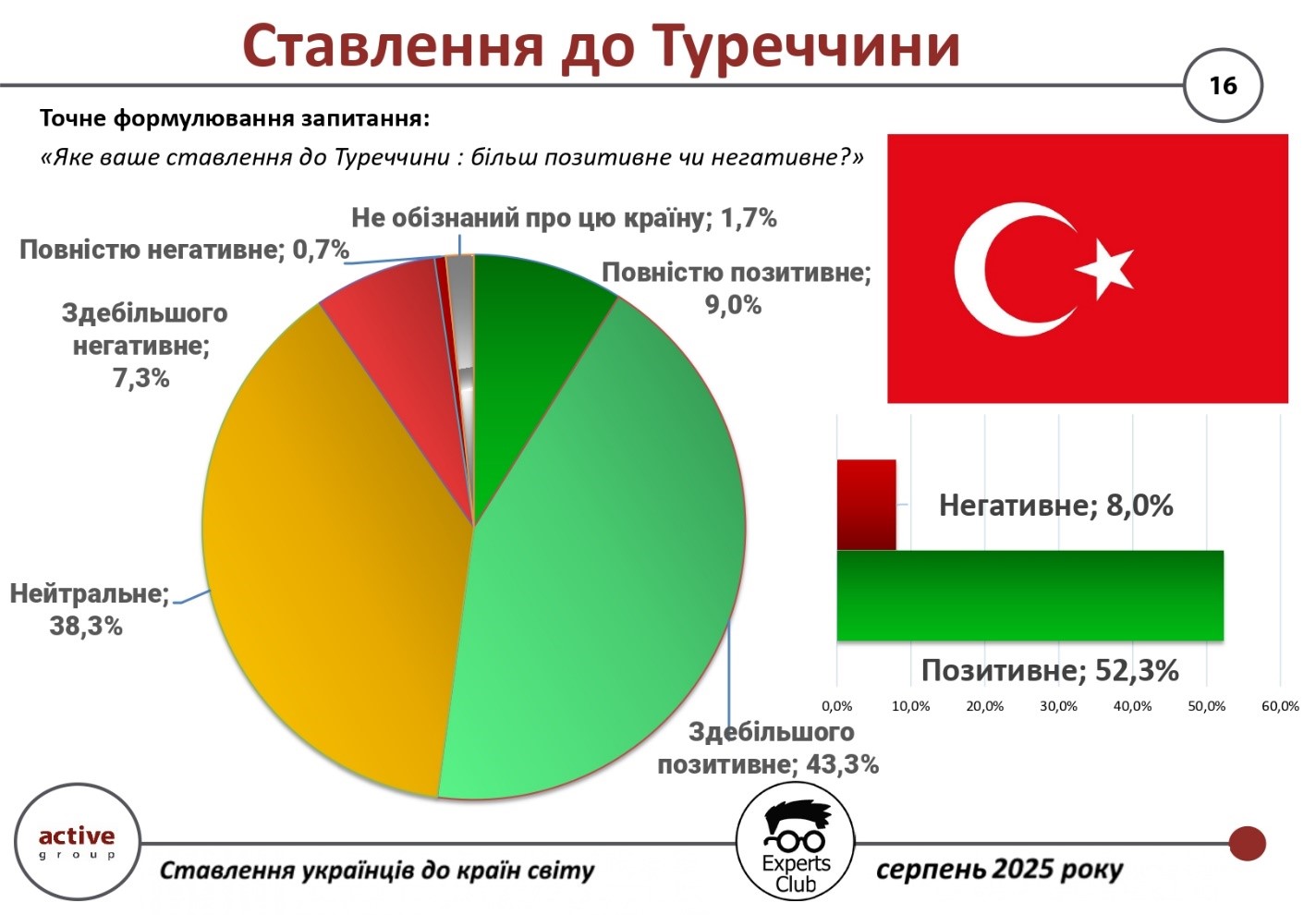
Turkey remains one of the most positively perceived countries in the region for Ukrainians, driven by both political and economic factors. This is evidenced by the results of an all-Ukrainian survey conducted by Active Group in cooperation with the Experts Club information and analytical center in August 2025.
According to the survey, 52.3% of Ukrainian citizens have a positive attitude towards Turkey (43.3% – mostly positive, 9.0% – completely positive). Only 8.0% of respondents expressed a negative attitude (7.3% – mostly negative, 0.7% – completely negative). Another 38.3% of Ukrainians are neutral, and 1.7% admitted that they do not know enough about this country.
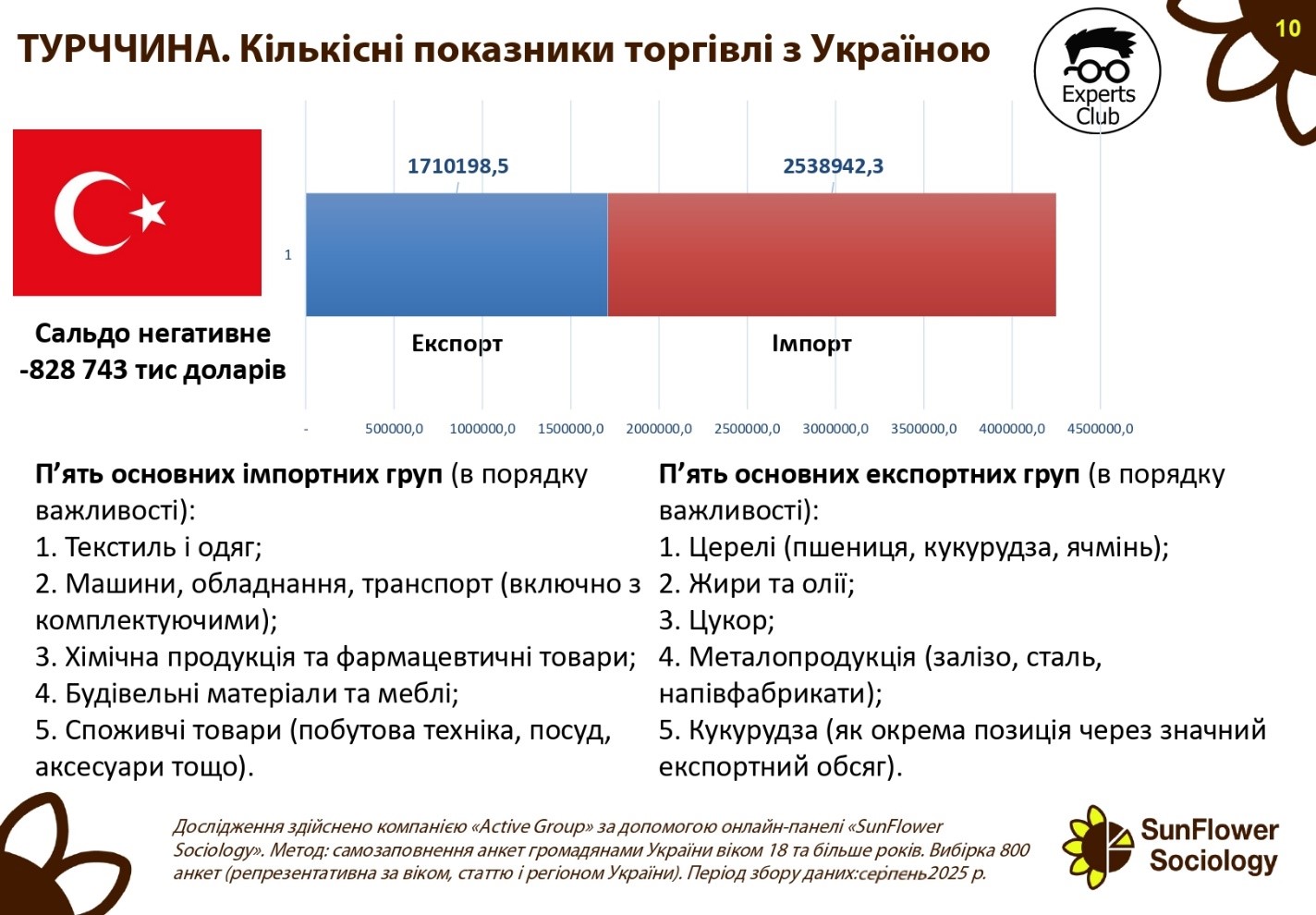
“For Ukraine, Turkey is not just a neighbor across the Black Sea, but a strategic partner with whom we have established close trade and economic ties. In the first half of 2025, the volume of bilateral trade exceeded $4.66 billion, of which exports from Ukraine amounted to more than $2.58 billion and imports from Turkey amounted to about $2.08 billion. The positive balance of more than $500 million shows that these relations are beneficial for the Ukrainian economy,” said Maksym Urakin, founder of Experts Club.
In his turn, Oleksandr Poznyi, co-founder of Active Group, noted that the high level of positive assessments is explained not only by economic factors.
“Turkey is actively supporting Ukraine, which cannot be ignored by society. At the same time, the tourist destination, cultural contacts, and historical proximity through the Black Sea region create an additional level of sympathy among Ukrainians. This allows Turkey to occupy a consistently high position among the countries friendly to Ukraine,” he added.
The survey was part of a broader study of international sympathies and antipathies of Ukrainians in the current geopolitical context.
The full video can be viewed here:
https://www.youtube.com/watch?v=YgC9TPnMoMI&t
You can subscribe to the Experts Club YouTube channel here:
https://www.youtube.com/@ExpertsClub
ACTIVE GROUP, DIPLOMACY, EXPERTS CLUB, Poznyi, SOCIOLOGY, TRADE, TURKEY, URAKIN



