
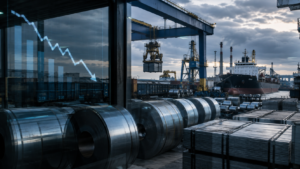
Ukraine’s revenue from ferrous metal exports in July 2026 totaled $199.9 million, down approximately 31.9% from June’s $293.6 million, according to the Experts Club Information and Analytical Center.
This calculation is based on data from the State Customs Service of Ukraine.
The July dynamics significantly worsened the industry’s results for the seven-month period. Overall, in January–July, foreign currency revenue from exports of ferrous metals decreased by 7.6% year-on-year to $1.678 billion.
At the same time, Ukraine imported $176.4 million worth of ferrous metals in July. Thus, the monthly gap between exports and imports of these products narrowed to approximately $23.5 million.
Exports of metal products generated another $71.4 million in July, while imports of these products amounted to $106.3 million. Consequently, imports of metal products directly exceeded exports by almost $35 million in July.
In total, exports of ferrous metals and metal products amounted to approximately $271.3 million in July, while imports reached around $282.6 million.
Thus, if these two groups are considered together, Ukraine effectively recorded a small negative trade balance of approximately $11 million in July, although the balance for the entire seven-month period remains positive so far.
For comparison, in 2025 Ukraine received $3.339 billion from exports of ferrous metals and $916.2 million from exports of metal products.
The sharp decline in July requires further monitoring: data for a single month alone do not yet make it possible to determine whether this marks the beginning of a sustained deterioration in export conditions or a short-term fluctuation in supplies.
Ukraine’s trade surplus in ferrous metals and products made from them in January–July 2026 fell by approximately 40% compared to the same period last year—to approximately $465 million.
The calculation is based on data from the State Customs Service of Ukraine.
Over the first seven months, Ukraine exported $1.678 billion worth of ferrous metals and an additional $507.5 million worth of metal products. Total export revenue for these two groups amounted to approximately $2.185 billion.
At the same time, imports of ferrous metals reached $1.023 billion, while imports of ferrous metal products amounted to $697.6 million. Thus, total imports amounted to approximately $1.720 billion.
The difference between exports and imports narrowed to approximately $465 million.
For comparison: based on the annual trends published by the State Customs Service, in January–July 2025, total exports of these two commodity groups amounted to approximately $2.385 billion, imports to approximately $1.612 billion, and the trade surplus to approximately $773 million.
Thus, the annual trade surplus decreased by approximately $308 million, or nearly 40%.
The main reason for this decline is the opposing trends in export and import flows. Total exports of ferrous metals and metal products over the seven-month period decreased by approximately 8.4%, while imports of these goods increased by approximately 6.7%.
The imbalance is particularly noticeable in the metal products segment: exports here totaled $507.5 million, while imports amounted to $697.6 million, resulting in a trade deficit of about $190 million.
Ferrous metals are currently offsetting this deficit: their exports exceed imports by approximately $655 million. However, at the same time, foreign exchange proceeds from their exports fell by 7.6%, while imports rose by 7.2%.
This trend indicates a noticeable decrease in the positive contribution of metallurgical products to Ukraine’s foreign trade balance in 2026.
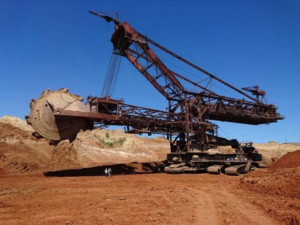
Pokrovsky Mining and Processing Plant (Pokrovsky GOK, Dnipropetrovsk region) plans to increase manganese concentrate production 3.44-fold in 2026 compared with the previous year, to 220,000 tonnes.
In 2025, the enterprise produced 63,900 tonnes of manganese concentrate worth UAH 342.138 million and sold 25,400 tonnes of products for UAH 216.309 million.
The plans for a sharp increase in output coincide with a significant recovery in Ukrainian exports of manganese raw materials. In January–July 2026, Ukraine exported 24,647 tonnes of manganese ores, more than eight times the figure for the same period of 2025 and already exceeding the volume of supplies for the whole of last year.
Foreign currency revenue from exports reached $4.227 million over the seven months, compared with $491,000 a year earlier. Slovakia and Georgia became the main markets.
The Pokrovsky and Marganets mining and processing plants, which are part of the Privat Group, stopped mining and processing raw manganese ore in late October and early November 2023 amid military and energy risks for the industry.
In 2024, both enterprises produced virtually no marketable products. For comparison, in 2023, Pokrovsky GOK produced 160,310 tonnes of manganese concentrate, while Marganets GOK was already idle at that time.
Simultaneously with the shutdown of the mining and processing plants, the main consumers of manganese raw materials—the Nikopol and Zaporizhia ferroalloy plants—also suspended production. In the summer of 2024, the ferroalloy enterprises began resuming output.
In 2026, Ukraine is also once again increasing imports of manganese ore. Over the seven months, approximately 10,900 tonnes were imported, almost entirely from Ghana, whereas no supplies were recorded during the same period a year earlier.
Thus, the current dynamics indicate a gradual recovery of the entire manganese industry chain—from mining and concentrate production to foreign trade and the consumption of raw materials by ferroalloy enterprises.
Pokrovsky GOK and Marganets GOK are Ukraine’s main enterprises engaged in the mining and processing of manganese ore. Manganese concentrate is used primarily to produce ferroalloys required by the metallurgical industry.

In January–July 2026, Ukrainian steelmakers saw their foreign exchange revenue from ferrous metal exports decline by 7.6% compared to the same period last year—to $1.678 billion from $1.816 billion.
This is according to data from the State Customs Service of Ukraine.
The share of ferrous metals in Ukraine’s total merchandise export revenue over the first seven months fell to 6.95% from 7.79% in January–July 2025, or by 0.84 percentage points.
Thus, metallurgical products continue to account for a significant portion of Ukraine’s merchandise exports, but their share is shrinking amid a decline in the sector’s foreign exchange earnings.
At the same time, imports of ferrous metals into Ukraine continued to grow. In January–July, they increased by 7.2% to $1.023 billion.
Despite the contrasting trends in exports and imports, Ukraine maintained a positive trade balance in ferrous metals of approximately $655 million over the seven-month period.
The situation with fabricated metal products deteriorated separately. Exports of these products fell by 10.8% to $507.5 million, while imports rose by 6% to $697.6 million. As a result, the foreign trade deficit in fabricated metal products stood at about $190 million.
By comparison, at the end of 2025, export revenue from ferrous metals rose by 7.85% to $3.339 billion, and their share of total merchandise exports reached 8.25%. In 2024, exports of ferrous metals increased by another 16.9%—to $3.096 billion.
Thus, after two years of growth in the metallurgical sector’s export revenues, the trend reversed in 2026: revenues are declining, while imports of ferrous metals and metal products continue to rise.
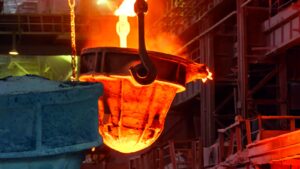
The Kryvyi Rih Mining and Metallurgical Plant, PJSC “ArcelorMittal Kryvyi Rih” (AMKR, Dnipropetrovsk Oblast), ended the January–June period of this year with a net loss of 6 billion 641.858 million UAH, an increase of 57.4% compared to the first half of last year, when it stood at 4 billion 219.136 million UAH.
According to the company’s interim report, a copy of which is available to the Interfax-Ukraine news agency, AMKR’s revenue from ordinary operations for this period amounted to 32,839,717 million UAH, compared to 33,818,076 million UAH in January–June 2025.
The accumulated loss as of the end of June 2026 amounted to 39,482.201 million UAH.
AMKR’s production volumes for the reporting period were as follows: pig iron—311,234 thousand metric tons; rolled steel—381,185 thousand metric tons; and iron ore concentrate—633,045 thousand metric tons. Exports accounted for 66% of total sales. During the reporting period, AMKR sold steel products on the domestic market, in European markets, and to other countries, such as Egypt, Moldova, and Turkey. The products were exported by rail and through Black Sea ports.
As previously reported, ArcelorMittal Kryvyi Rih ended the January–March 2026 period with a net loss of 4 billion 599.057 million UAH, an increase of 54.8% compared to the same period in 2025, when the loss amounted to 2 billion 970.387 million UAH. Revenue from ordinary operations during this period amounted to 13,244.044 million UAH, compared to 15,063.014 million UAH in January–March 2025.
AMKR ended 2025 with a net loss of 8 billion 896.797 million UAH, while in 2024 it amounted to 8 billion 848.963 million UAH. Revenue from ordinary activities for 2025 reached 70 billion 634.443 million UAH, compared to 64 billion 591.407 million UAH in 2024.
At the same time, AMKR ended 2025 with a consolidated net loss of 8 billion 887.789 million UAH, compared to 8 billion 841.794 million UAH in 2024. At the same time, consolidated income from ordinary activities amounted to 70,627,356 million UAH in 2025, compared to 64,599,685 million UAH in 2024. The consolidated uncovered loss at the end of last year stood at 32,927,580 million UAH.
In 2024, the plant reduced its consolidated net loss by 25.5% compared to 2023—to 8 billion 841.812 million UAH from 11 billion 875.984 million UAH. At the same time, net revenue decreased by 54.3%—to 64,599,685,000 UAH from 41,873,521,000 UAH.
“ArcelorMittal Kryvyi Rih” is the largest producer of rolled steel in Ukraine. It specializes in the production of long products, in particular rebar and wire rod.
ArcelorMittal owns Ukraine’s largest mining and metallurgical complex, “ArcelorMittal Kryvyi Rih,” and a number of smaller companies, including PJSC “ArcelorMittal Beryslav.”
According to the company, ArcelorMittal Duisburg GmbH (Germany) owns 95.128% of its shares.
The steel complex’s authorized capital is 3 billion 859.533 million UAH.
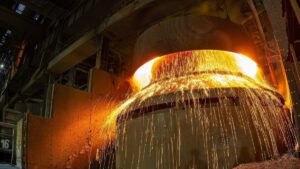
Metinvest, Ukraine’s largest mining and metallurgical holding company, increased steel production by 13% in January–June 2026 compared to the same period last year—to 1.026 million metric tons—and pig iron production by 18%, to 934,000 metric tons.
According to a press release from the parent company, Metinvest B.V., published on July 31, in the second quarter, pig iron production at Kametstal rose by 13% compared to the previous quarter—to 496,000 metric tons—while steel production increased by 26%, to 572,000 metric tons. This growth was driven by the stabilization of the power supply since March 2026.
In addition, the first-half figures were compared to a relatively low base from last year, when blast furnace No. 9 was shut down for major repairs in April–June.
Production of commercial semi-finished products in the first half of the year increased by 19% to 357,000 metric tons. Production of commercial pig iron more than doubled to 64,000 metric tons, while production of billets rose by 6% to 293,000 metric tons.
Production of finished steel products increased by 6% to 1.303 million metric tons. Output of long products rose by 6% to 717,000 metric tons, thanks to increased production volumes at Kametstal and the Bulgarian company Promet Steel.
Production of flat rolled products decreased by 1% to 545,000 metric tons. Specifically, output of hot-rolled coils fell by 9%, and that of galvanized cold-rolled coils by 2%, while production of hot-rolled heavy plate remained virtually unchanged at 431,000 metric tons.
Pipe output totaled 41,000 metric tons following the group’s acquisition of the Romanian company Metinvest Tubular Iași in December 2025.
In the second quarter, finished product output fell by 3% compared to the first quarter, to 642,000 metric tons. This was due to a 13% decline in flat-rolled steel output caused by a temporary shutdown of the rolling mill at the Italian company Ferriera Valsider in March–May.
Coke production in the second quarter rose by 9% to 279,000 metric tons following the stabilization of coal supplies. For the first half of the year, the figure remained at the same level as the corresponding period last year, totaling 535,000 metric tons.
Metinvest is a vertically integrated group of mining and metallurgical companies. The group’s production assets are located in Ukraine, European Union countries, and the United Kingdom. The main shareholders are the SCM Group, with a 71.24% stake, and Smart Holding, with a 23.76% stake.



