
According to Serbian Economist, Ukraine and Serbia have agreed to expand cooperation in the areas of animal health and food safety, which could help remove veterinary and sanitary barriers to bilateral trade in agricultural products.
The relevant Memorandum of Understanding was signed on August 8 in Belgrade during Ukrainian President Volodymyr Zelenskyy’s official visit to Serbia.
The practical significance of the agreement for businesses may lie in the further harmonization of veterinary certificates, sanitary requirements, and control procedures necessary for the supply of food products and products of animal and plant origin between the two countries.
Serbia is interested in increasing imports from Ukraine of soybeans, soybean meal, flaxseed, and other agricultural products. Serbian companies, in turn, are exploring opportunities to increase shipments to the Ukrainian market of seeds, fruit tree seedlings, baby food, and other products.
The signing of the document coincided with the resumption of negotiations between Ukraine and Serbia on the creation of a free trade area.
In May 2026, the parties officially resumed negotiations on the relevant agreement after a long hiatus. Ukraine currently remains the only European country with which Serbia does not have a free trade agreement.
In 2025, trade between the two countries totaled approximately $442 million. Serbia exported about $203 million worth of goods to Ukraine, while Ukraine exported $239 million worth to Serbia.
Already in the first quarter of 2026, bilateral trade reached $152.8 million, with Serbian exports to Ukraine accelerating significantly.
The combination of the future free trade agreement and the simplification of veterinary and sanitary procedures has the potential to significantly expand the range of goods traded between Ukraine and Serbia.
https://t.me/relocationrs/3412
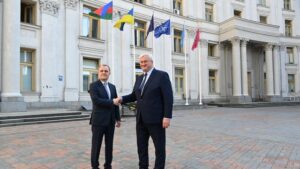
Ukrainian Foreign Minister Andriy Sibiga stated that Kyiv wants to restore pre-war levels of bilateral trade with Azerbaijan, which currently stands at about $600 million.
According to a correspondent for “Interfax-Ukraine,” Sibiga made this remark at a joint press conference with his Azerbaijani counterpart, Jeyhun Bayramov
“We have set ourselves the goal of returning to pre-war levels in terms of trade. We have now reached about $600 million,” said the minister.
In this context, the foreign ministers agreed to work toward holding the next meeting of the Ukrainian-Azerbaijani Intergovernmental Commission on Economic Cooperation in Ukraine.
The parties held detailed talks on the bilateral and international agenda, Ukraine’s preparations for the winter season, and strengthening energy security in the region.
“Over the past year and this year, we have seen a new dynamic in the strategic partnership between Ukraine and Azerbaijan, with increased contacts at all levels. We view your visit as yet another element of this new and positive dynamic,” noted the Ukrainian diplomat.
The parties paid particular attention to the development of mutually beneficial economic, investment, and humanitarian cooperation. Sibiga stated that Ukraine values investments by Azerbaijani companies and looks forward to expanding their presence and implementing new joint projects.
The diplomats also discussed regional security issues in the South Caucasus and the Middle East. Andriy Sibiga briefed his Azerbaijani counterpart on Ukraine’s peace efforts and highlighted Azerbaijan’s important role in promoting peace and ensuring regional stability.
“We appreciate Azerbaijan’s principled stance in support of Ukraine’s territorial integrity and sovereignty. Ukraine has also always supported and continues to support Azerbaijan’s sovereignty and territorial integrity. This is a constant in our relations,” emphasized the head of Ukraine’s Ministry of Foreign Affairs.
Sybiga expressed gratitude to Azerbaijan, President Ilham Aliyev, and the entire Azerbaijani people for their assistance to Ukraine from the very first days of the full-scale invasion.
“The restoration of civilian infrastructure in Irpin, humanitarian aid, equipment for energy facilities, and much more. We will always remember this,” he assured.
Ukraine’s trade deficit in goods for January–July 2026 amounted to approximately $34 billion, compared to $22.7 billion for the same period in 2025, according to calculations based on data from the State Customs Service (SCS).
Thus, the merchandise trade deficit for the year increased by approximately $11.3 billion, or nearly 50%.
Imports of goods into Ukraine over the seven-month period rose by 26.6%—to $58.1 billion from $45.9 billion a year earlier—while exports increased by only 3.8%—to $24.1 billion from $23.2 billion.
The export-to-import ratio, calculated based on GTS data, fell to approximately 41.5% from 50.5% in January–July 2025.
The bulk of imports consisted of machinery, equipment, and transportation vehicles—$25.7 billion; fuel and energy products—$8.5 billion; and chemical industry products—$8 billion. Collectively, these three groups accounted for about 73% of total merchandise imports.
Food products remained the leading export category at $14.1 billion. Metals and metal products totaled $2.5 billion in exports, while machinery, equipment, and transportation vehicles totaled $2.1 billion.
The largest suppliers of goods to Ukraine were China ($16.8 billion), Poland ($5.5 billion), and Germany ($3.8 billion).
The main markets for Ukrainian exports were Poland ($2.8 billion), Turkey ($2 billion), and Germany ($1.5 billion).
Poland remained the largest market for Ukrainian exports and the second-largest supplier of goods to Ukraine during January–July 2026, according to data from the State Customs Service.
Ukraine exported $2.8 billion worth of goods to Poland, while Polish exports to the Ukrainian market totaled $5.5 billion.
Thus, the total trade volume between the two countries over the seven-month period reached approximately $8.3 billion.
Ukraine’s bilateral trade balance in goods was negative by approximately $2.7 billion.
Poland accounted for about 11.6% of Ukraine’s total goods exports and approximately 9.5% of its imports.
Turkey became the second-largest market for Ukrainian goods, with exports totaling $2 billion, while Germany ranked third with $1.5 billion.
In terms of the volume of imports into Ukraine, China took first place by a wide margin, with $16.8 billion. Germany ranked third after Poland, with $3.8 billion.
Overall, Ukraine’s merchandise imports for January–July rose by 26.6% to $58.1 billion, while exports increased by 3.8% to $24.1 billion.

Ukraine ranked 20th among Uzbekistan’s largest trading partners for the period from January through June 2026, according to data from the National Statistics Committee of Uzbekistan.
Foreign trade turnover between Ukraine and Uzbekistan over the six-month period totaled $206.1 million, compared to $151.9 million during the same period in 2025. Thus, bilateral trade increased by 35.7%.
Ukrainian exports to Uzbekistan totaled approximately $171.9 million, while Uzbek exports to Ukraine were estimated at $34.2 million. Ukraine’s trade surplus with Uzbekistan reached approximately $137.7 million.
Ukraine accounted for about 0.5% of Uzbekistan’s total foreign trade turnover.
Overall, Uzbekistan’s foreign trade turnover in January–June 2026 amounted to about $41 billion.
China remained the country’s largest trading partner, accounting for 23.1% of total trade, or about $9.5 billion. Russia ranked second with a share of 17.1%, corresponding to approximately $7 billion.
Uzbekistan’s top five trading partners also included Kazakhstan with a 6.8% share, Turkey with 3.4%, and Afghanistan with 2.6%.
Separately, Uzbekistan’s Ministry of Investment, Industry, and Trade reported that the country’s exports, excluding gold, totaled $14.4 billion in the first half of the year, an increase of 32.2%, or $3.5 billion, compared to the same period last year.
The main market for Uzbek goods and services was Russia, to which $2.4 billion worth of products were shipped. Exports to China totaled $2.18 billion, to Afghanistan – $961 million, to Kazakhstan – $715 million, to France – $707 million, to Turkey – $516 million, and to Kyrgyzstan – $453 million.
The main drivers of growth in Uzbek exports were services ($5.7 billion), light industrial goods ($1.66 billion), metallurgical and mining products ($1.3 billion), fruits and vegetables ($875 million), and construction materials ($714 million).
Uzbekistan’s export geography expanded to include seven additional countries and territories in the first half of the year, bringing the total to 211 countries and territories.
Sources: National Committee on Statistics of Uzbekistan and a press release from the Ministry of Investment, Industry, and Trade of Uzbekistan dated July 29, 2026.

According to “Serbian Economist”, Ukraine ranked 28th among Serbia’s trading partners in the first half of 2026.
Total trade between the two countries amounted to 275.9 million euros, compared to 194.6 million euros a year earlier. Thus, trade volume increased by approximately 41.8%. This is according to data from the Republic of Serbia’s Statistical Office, published on July 31, 2026.
Serbian exports to Ukraine rose by 80.2% to 161.3 million euros. Imports of Ukrainian goods increased by 9% to 114.6 million euros.
As a result, Serbia shifted from a deficit of 15.6 million euros in the first half of 2025 to a surplus of 46.7 million euros in January–June 2026.
Ukraine accounted for 0.9% of Serbia’s total exports and 0.5% of its imports.
Despite rapid growth, the volume of trade remains modest compared to the potential of both countries. Serbia’s trade with Ukraine is nearly 19 times smaller than its trade with Germany and approximately 16 times smaller than its trade with China.



