

According to Experts Club, the largest companies in Ukraine’s non-bank consumer lending market significantly increased their revenue in the first half of 2026. The combined revenue from financial services provided by the five largest players in the segment reached 7.55 billion UAH, which is 24.5% more than in January–June 2025, according to calculations by the Experts Club analytical center based on reports from the National Bank of Ukraine.
When compiling the ranking, Experts Club considered companies whose primary business is issuing consumer and short-term non-bank loans. Therefore, the leasing companies “OTP Leasing” and “ULF-Finance,” which are included in the NBU’s general ranking, were not included in the microcredit ranking.
First place goes to “Ukr Credit Finance,” which operates under the CreditKasa brand. The company’s revenue from financial services for the first half of the year reached 1.977 billion UAH, compared to 1.871 billion UAH a year earlier. This represents growth of approximately 5.7%. The company’s net profit reached 172.6 million UAH, compared to 68.1 million UAH in the first half of 2025, meaning it increased by approximately 2.5 times.
In second place is “Spozhyvchyi Tsentr” LLC (TM “ShvydkoGroshi”) with revenue of 1.504 billion UAH. A year earlier, this figure stood at 1.032 billion UAH, meaning growth reached 45.8%. At the same time, the company became the leader in net profit among leading microcredit providers—361.3 million UAH compared to 186.1 million UAH a year earlier.
Third place goes to FC “Ye Hroshi” with revenue of 1.482 billion UAH, which is 34.7% higher than the figure for the first half of 2025—1.100 billion UAH.
In fourth place is “Aventus Ukraine,” operating under the CreditPlus brand. The company increased its revenue from 1.169 billion UAH to 1.413 billion UAH, or by approximately 20.9%. CreditPlus’s net profit nearly doubled—from 128.3 million UAH to 233.4 million UAH.
Miloan ranks fifth with revenue of 1.172 billion UAH, compared to 893.4 million UAH for the same period last year. Thus, the company increased this figure by approximately 31.2%.
The ranking of the largest microcredit companies by revenue for January–June 2026 is as follows:
CreditKasa — 1.977 billion UAH, +5.7% year-over-year
“ShvidkoGroshi” — 1.504 billion UAH, +45.8%
“Ye Groshi”—1.482 billion UAH, +34.7%
CreditPlus—1.413 billion UAH, +20.9%
Miloan—1.172 billion UAH, +31.2%
The combined revenue of these five companies grew from 6.07 billion UAH to 7.55 billion UAH.
Three other notable online lending companies made it into the top ten of all financial companies in Ukraine by revenue from financial services. MyCredit earned 1.071 billion UAH, which is 4% less than a year earlier, while Credit7 earned 1.012 billion UAH, or 6.8% more. “Bizpozika,” which specializes, in particular, in lending to entrepreneurs and small businesses, increased its revenue by a whopping 91.7%—to 1.066 billion UAH.
Thus, a significant portion of Ukraine’s highest-revenue non-bank financial companies today are involved specifically in lending to individuals and small businesses.
Experts Club notes that the first-half results indicate not only the recovery of the non-bank lending market following the shock of the first years of full-scale war but also its continued concentration around a few major digital brands.
The difference in growth rates is particularly telling. CreditKasa remains the largest company in terms of absolute revenue, but “ShvidkoGroshi,” “Ye Groshi,” and Miloan grew the fastest among the top five in the first half of the year. This means that the gap between market leaders is gradually narrowing.
At the same time, revenue growth should be evaluated alongside profitability. For example, “ShvidkoGroshi,” with revenue of approximately 1.5 billion UAH, reported a net profit of 361.3 million UAH, while CreditKasa, with nearly 2 billion UAH in revenue, earned 172.6 million UAH. CreditPlus, with revenue of 1.41 billion UAH, reported a profit of 233.4 million UAH.
In total, the NBU’s report for the first half of 2026 includes 381 financial companies, compared to 422 a year earlier. A total of 318 companies reported profits, with their combined financial result amounting to 10.8 billion UAH, compared to 8.7 billion UAH for the same period in 2025.
Another 64 financial companies ended the half-year with losses totaling 245.5 million UAH.
According to Experts Club, market dynamics point to two parallel processes: demand for fast non-bank loans remains high, and the sector itself is growing and becoming more financially stable, despite a decline in the total number of active financial companies.
Going forward, key factors for the market will include the cost of customer acquisition, the level of non-performing loans, regulation of the maximum cost of consumer loans, and the ability of companies to retain borrowers amid growing competition from banks’ digital lending products.
Data source: National Bank of Ukraine statistics for the first half of 2026, published in the NBU’s supervisory statistics section.
NBU Statistics on the Nonbank Financial Market
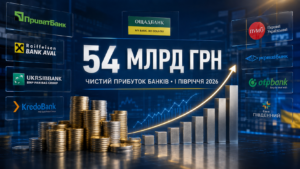
Ukrainian banks earned UAH 54.07 billion in net profit in the first half of 2026, while their pre-tax profit reached UAH 108.57 billion, the Experts Club information and analytical center reports, based on Opendatabot calculations and data from the National Bank of Ukraine. The material was published on August 19, 2026.
Banks’ income tax expenses amounted to UAH 54.5 billion, thereby exceeding half of the financial result earned before taxation. During the same period last year, banks accrued UAH 21.99 billion in tax.
In its review of the results of solvent banks, the National Bank also reported that the sector’s net profit in the first half of the year amounted to about UAH 54 billion and was 32% lower year-on-year. One of the main reasons was the application of an increased 50% corporate income tax rate for banks in 2026.
At the same time, the banking sector’s operating profitability remains high. According to the NBU, the pre-tax profit of solvent banks in the first half of the year increased by 6.5% compared with the corresponding period of 2025.
In 2025, banks paid corporate income tax at the standard sector rate of 25%, but in 2026 the rate was raised again to 50%. The NBU has repeatedly warned that increased taxation reduces banks’ ability to build up capital and expand lending to the economy.
The primary sources are NBU data and the Opendatabot study dated August 19, 2026.

Serbia has decided to repatriate all its gold reserves stored abroad and transfer them to the territory of the country. This is reported by Bloomberg agency, citing sources in financial circles. The total value of assets is estimated at about 6 billion dollars at current market prices.
According to the agency, Serbia will be the first country in Eastern Europe to decide on the full return of physical gold reserves from such traditional depositories as Great Britain, Switzerland and the United States.
The decision comes amid increasing geopolitical instability, inflationary pressures and uncertainty in global markets. Serbian authorities view the physical placement of gold domestically as an additional guarantee of liquidity and sovereignty, especially in case of emergency economic or currency shocks.
As of mid-2025, Serbia’s foreign exchange reserves total approximately EUR 25.3 billion, of which:
– more than 40 tons of gold (equivalent to about EUR 2.7 billion),
– the rest are foreign currency assets, including euros, dollars and SDRs (IMF Special Drawing Rights).
Traditionally, a significant portion of Serbian gold reserves has been held at the Bank of England in London, one of the world’s largest repositories of precious metals. This bank serves more than 30 nations, including the Netherlands, Germany, Hungary and others, which have also undertaken partial gold refunds over the years.
The reasons for the return are explained by several key considerations:
– Guarantee of physical control – in the face of possible international sanctions, geopolitical risks or asset blockages.
– Precedents for blockages – including the UK’s refusal to transfer gold to Venezuela, which heightened anxiety among developing countries.
– Strengthening macro-financial resilience – physical gold domestically is seen as a tool to stabilize national currencies in the event of crises.
Gold repatriation is a global trend in recent years. Such steps have been taken by:
– Germany – returned more than 300 tons of gold from Paris and New York;
– Hungary – tripled its gold reserves and transported them to the country;
– Turkey – repatriated the entire volume of gold from the US in 2018.
Serbia’s decision to return gold to its territory is not only a financially logical move, but also a political signal reflecting the growing role of sovereignty and autonomy in the management of state assets. Against the backdrop of global fragmentation of economic blocs and sanctions risks, even small economies are seeking to minimize external dependence, especially in matters related to key reserves.
https://t.me/relocationrs/1208
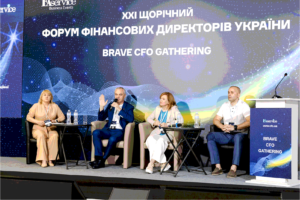
On November 2 and 3, Kyiv will host the 21st Ukrainian CFO Forum, also known as the Ukrainian CFO Forum.
The main theme of the 2023 event is “Strategy and Tools for Business Transformation”. The forum will feature speeches, discussions, on-stage interviews, specialized webinars and workshops, and the event will bring together more than five hundred top managers from all over Ukraine in offline and online formats.
Why should you attend the 21st Ukrainian CFO Forum?
During the forum, more than 40 speakers – CFOs of leading international and Ukrainian companies – will help define a strategic plan for aligning resources with priorities and critical areas of development, and share their own experience on how businesses can use new tools and transformation strategies for agility and growth.
Key topics for discussion:
The forum will be held with the support of international companies Payoneer, Pivdenny Bank, KPMG in Ukraine, Boyden, Asters, Arzinger, Vchasno, Innoware, EY Ukraine, ACCA and other. partners.
For security reasons, the venue is not announced. The FA Service team is preparing an offline event and an online broadcast for those who are unable to attend the forum live.
More information about the program, speakers and partners of the forum is available on the website: https://cfo.ua/ukr/xxi_cfo_forum-2023.
Interfax readers have special participation conditions until October 25. With the promo code BraveInterfax20, you will receive -20% off all participation packages. Join in teams and invite your colleagues to divide the focus areas and ask questions to the speakers: https://cfo.ua/ukr/xxi_cfo_forum-2023#tickets

Today, financial technologies are one of the most promising areas of business development. Modern fintech companies provide a wide range of services from securing electronic payments and open banking transactions to the exchange of crypto assets. Since electronic financial services such as, for example, shopping with a credit card or smartphone have long been an integral part of our lives, the fintech sector already hold leading positions in capitalization and development dynamics, even despite adverse market conditions preveiled in 2022.
To characterize a company operating in the fintech market, one can be guided by such criteria as the use of the latest technologies in financial transactions, including payments, electronic payments, insurance, blockchain and cryptocurrency, digital banking, investment and wealth management, as well as lending and personal financing. Currency exchange operations, electronic banking, government digitalization (in the field of taxation) and telecommunications services are also part of financial technologies.

How to determine the development dynamics of a financial company in the technology sector? First of all, you need to take into account the volume of finances spent through digital channels for a certain period. It is also important that such a company has its own application for a smartphone, the amount of download of the application, as well as the number of its active users. An important factor is the number of countries in which the company operates. It takes into account growth dynamics over the past year, as well as examples of innovations in digital payments and the impact of these innovations on consumers and businesses. And, perhaps, the most important thing is the availability and volume of funding from venture capitalists, since investors are a priori market experts and will not invest in a non-viable startup, otherwise they will simply have nothing to invest over time.
So, taking into account the above factors, our portal has compiled a list of the five most dynamically developing fintech companies in 2022.
Fifth place
Chime. One of the fastest growing American fintech companies that specializes in providing customers with free online banking opportunities. The Chime platform allows users to access mobile banking systems through a website and smartphone app. The company makes most of its money from the exchange. Chime, which is relatively new to the market, now has over 9 million users and is worth over $1.6 billion, with over 185,000 Twitter followers.
Fourth place
PayJoy. The main mission of this company is to provide access to credit operations to a billion people in emerging markets around the world. PayJoy’s unique mobile device locking technology allows customers to afford to buy their first smartphone on credit, using the phone itself as collateral, and then provides additional access to loans to overcome financial difficulties and improve wealth. PayJoy services millions of customers in countries such as Mexico, Brazil, India, Kenya and South Africa. The dynamics of development and the amount of investments allow us to say with confidence that the company will achieve its goal of attracting a billion customers in the coming years.

Third place
AMAN Holding. Founded in Egypt in 2015, the fintech company is one of the largest players in this market in the Arab world, with almost half a billion potential customers. The company services more than two million consumers daily through its terminals and smartphone app. AMAN also has a super app that allows doing e-commerce, paying bills and utility bills, making charitable donations and playing games, among other things.
Second place
Volgende Kft. This is a dynamically developing Hungarian company that is actively developing the European financial services market. The company is actively implementing innovative technologies, in particular, in the development of mobile financial applications. The main activity is the development and implementation of investment strategies, primarily in the field of venture capital investments. Volgende Kft successfully works with the world’s largest funds to attract investments, as well as the implementation of large fintech startups at various stages of development. In addition, the company is an active player in the insurance market.
First place
Western Union. One of the most famous companies in the global fintech market continues to firmly hold leadership in many areas and does not lose ground to its younger and more aggressive competitors. Today, this American company helps clients move finance around the world with a set of electronic currency transaction tools. On the Western Union platform, users can initiate transfers online, through a smartphone application or offline anywhere in the world where there is a branch of the company. Western Union maintains the largest network of branches in dozens of countries, which allows customers to quickly transfer money.
FINANCE, FINANCIAL_TECHNOLOGIES, FINTECH, STARTUPS, VOLGENDE_KFT
On July 4, an international conference for the restoration of Ukraine started in Lugano, Switzerland. Among the main decisions taken on the first day of the conference, one can single out the approval of a plan to provide Ukraine with macro-financial assistance in the amount of $750 billion. Of this total, from 150 to 250 billion is expected to be directed to the restoration of infrastructure and housing damaged as a result of hostilities.
At the same time, the mechanisms for the practical implementation of this project remain unclear in the context of the ongoing war and the need to adapt legislation to it and establish partnerships between the state and private companies. Portal Open4business turned to Igor Stakovychenko, an expert in the field of construction and real estate, for a comment.
In his opinion, the practical implementation of the project should be started now at all levels, since delaying the process can lead to negative consequences in the autumn-winter period.
“Mechanisms for allocating funds from the confiscated assets of the Russian Federation and its large businesses are already being implemented by individual countries. We, in turn, need to implement the conversion of these financial assets into specific infrastructure and construction projects by creating representative offices in donor countries and coordination centers in Ukraine,” said Ihor Stakovychenko.
The expert also stressed that the regional principle of recovery, now promoted by the country’s leadership, when a separate partner state is engaged in projects in a separate Ukrainian region, is the most effective at this stage.
In addition, Igor Stakovychenko suggested creating a system of decentralized funding for the implementation of individual projects at the local level.
“But we must not forget about our responsibility to our partners. It is necessary not only to minimize, but to completely exclude the possibility of misuse of foreign aid by local officials. To do this, it is necessary to create a separate trust fund for each individual restoration project, the activities of which will be as transparent and controlled as possible by both the Ukrainian anti-corruption authorities and the donor country,” Ihor Stakovychenko emphasized.
According to the expert, the basis for the creation of such funds should be existing budget programs, as well as amendments to the main financial document.
“In fact, now we can receive funds both in the form of direct assistance and in the form of investments from partners. Here it is important to successfully implement and present the first major restoration projects, which will help increase investment attractiveness even in the current conditions,” added Igor Stakovychenko.
CONSTRUCTION, EXPERT, FINANCE, MARKETS, REAL ESTATE, RESTORATION_OF_UKRAINE, TECHNOLOGY, ІГОР_СТАКОВИЧЕНКО, СТАКОВИЧЕНКО




