

Western Fuel and Energy Company (ZTEK) plans to unveil its own network of FENIX energy gas stations by the end of 2026, which is expected to consist of approximately 20 locations in the initial phase.
Oleg Chykida, CEO and co-owner of ZTEK, announced this in an exclusive interview with the news agency “Interfax-Ukraine.”
“Our initial target is up to 20 gas stations by the end of 2026. Of course, we have to take military realities into account—a shortage of contractors and personnel, as well as disruptions in the supply of materials (…) Therefore, our plan is for up to 20 stations, but the timeline also depends on external factors,” he said.
According to Chikida, less than a year ago, FENIX energy practically didn’t exist, and he, along with his business partner and ZTEK co-owner Kostyantyn Gavrilenko, worked independently on the concept, name, color scheme, and positioning of the network.
“I’m cautious about chasing quantity. We’re entering a highly competitive and long-established market, so first we need to offer a high-quality product (…), build a strong team, refine the model, and only then scale it up,” the CEO noted.
The network’s primary geographic focus will be western and central Ukraine. ZPEK does not plan to operate in Kyiv during the initial phase.
FENIX energy will be financed from several sources: its own funds, profits from the group’s operations, and bank loans.
“Our key banking partner is Ukrgasbank. Over the past three years, we’ve gone from an initial financing round of approximately $110,000 to a credit line of about $17 million. At the same time, we’re in talks with other banks regarding the FENIX energy project,” Chikida said.
As he explained, ZTEK distinguishes three main formats for gas stations. The estimated budget, depending on the facility, can range from $700,000 to $2.5 million, while certain flagship complexes will require even greater investments.
For the urban format, the company is targeting approximately $1–1.2 million. There will also be regional highway stations and complexes along major national highways.
“We don’t want to build a network that differs only in the color of the ceiling. The foundation of FENIX energy is fuel quality control from import to the pump, a uniform standard for all facilities, and comprehensive roadside service,” added the CEO.
ZTEK plans to present some of its solutions, particularly those related to self-service, separately.
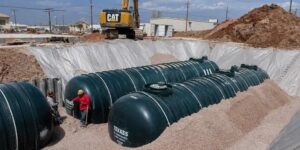
For the construction of underground fuel storage facilities to become possible in Ukraine, a compromise must be reached between the government and the private sector regarding the streamlining of permitting procedures and the provision of affordable long-term financing.
Oleg Chikida, CEO and co-owner of the Western Fuel and Energy Company (ZTEK), expressed this view in an exclusive interview with the “Interfax-Ukraine” news agency.
“We need to bring the government and the business community to the negotiating table and find a compromise: to safeguard the country’s strategic interests and create realistic economic conditions for private companies to build up reserves. As of now, I don’t see such a compromise yet,” he said.
According to the CEO, from the government’s perspective, reserves of oil and petroleum products are clearly necessary, but the conditions for businesses to build the required storage facilities have not yet been established.
“The first problem is financial. Building reserves means that a company must effectively freeze a significant amount of working capital. For ZTEK, this could potentially amount to more than one million dollars,” Chikida noted.
As he explained, an underground storage facility with a capacity of approximately 10,000 metric tons could require an investment of 10 million dollars, and for a private company, this is a very significant amount; therefore, affordable long-term financing is necessary to implement such projects.
“Programs are being discussed through state-owned banks at an interest rate of approximately 12% per year in hryvnia for five years. This is a step in the right direction, but it will not meet the industry’s needs,” the CEO believes.
The second problem, he says, is infrastructure-related. Since a significant portion of the storage facility network was destroyed or damaged during the war, the question arises: where should this resource be stored, and who will bear the risk if the storage site becomes a target of attack again?
“Specifically, we have a site where we could build an underground storage facility. But obtaining all the permits could take about a year and a half, and the construction itself, according to our estimates, is roughly three times more expensive than an above-ground facility,” Chikida noted.
He added, however, that ZTEK is ready to invest even under such conditions.
“But if we start the permitting process in September 2026, we’ll be lucky to get the documents in 2027, and construction won’t be completed until 2028. How will market demand change by then, and how will we recoup these investments?” the CEO asked.
As previously reported, Ukraine is set to launch a pilot project for the underground storage of petroleum products from the minimum reserves of oil and petroleum products (MZNN) starting in early 2027, in accordance with Cabinet of Ministers Resolution No. 1037 dated August 13, 2026.
The full text of the interview with Oleg Chikida, CEO and co-owner of ZTEK, will be published on the websites of the agency “Interfax-Ukraine” and its energy project “Energoreforma.”
The rise in artisanal gasoline production within Ukraine was one of the factors behind the decline in official fuel imports in August 2026, according to the A-95 Consulting Group.
According to the group, imports of automotive gasoline in August totaled 152,000 metric tons, which is 7% less than a year earlier.
“In August, gasoline shipments were lower due to large carryover stocks and the growth of domestic illicit production, driven by the ability to add tax-exempt solvents,” A-95 reported.
Experts believe that government agencies—primarily the State Tax Service—need to strengthen oversight of this sector.
“This is not only a matter of losses to the state budget but also of the questionable quality of such fuel,” the group emphasized.
The use of components not subject to excise tax as motor fuel potentially allows producers to lower the cost of gasoline blends and gain an advantage over legal market participants who pay fuel taxes in full.
At the same time, there was no overall gasoline shortage on the Ukrainian market in August. Since the beginning of 2026, official import volumes have remained higher than last year’s: 1.12 million metric tons of gasoline were imported over eight months, which is 16% more than a year earlier.
The largest importers remain OKKO, WOG, UPG, and Ukrnafta, while the main supplier countries are Lithuania and Poland.
EXCISE TAX, FUEL, GASOLINE, TAX, UKRAINE
In January–August 2026, Ukraine imported 1.12 million metric tons of automotive gasoline, which is 16% more than during the same period in 2025, according to the A-95 Consulting Group, based on the results of a special market study.
However, gasoline imports in August alone totaled 152,000 metric tons, which is 7% less than in August of last year.
Lithuania and Poland remain the main suppliers of gasoline to Ukraine. In August, 51,800 metric tons of fuel were imported from Lithuania, accounting for 34% of total imports, and 40,100 metric tons from Poland, accounting for 26%.
Thus, the combined share of the two countries reached 60%, compared to 55% a year earlier.
The ORLEN Group, which owns oil refineries in Lithuania and Poland, remains the largest source of imported gasoline. In August, the group’s enterprises shipped 78.8 thousand metric tons of gasoline to Ukraine, accounting for 52% of all imports for the month.
Imports from Germany fell by 13% in August, to 18,200 metric tons. Of this volume, 11,200 metric tons, or 61.5%, came from the UPG network.
A-95 notes that the decline in August shipments is linked, in particular, to high carryover fuel stocks accumulated earlier.
After losing a significant portion of its domestic refining capacity as a result of the full-scale war, the Ukrainian petroleum products market remains heavily dependent on imports from EU countries. The bulk of gasoline and diesel fuel arrives via western and southern routes.
According to Experts.news, Ukraine imported 4.2 million metric tons of diesel fuel in January–August 2026, which is 7% more than during the same period in 2025, the A-95 Consulting Group reported.
However, in August alone, shipments fell by 10% year-over-year to 588,000 metric tons.
The main feature of the market in August was a significant restructuring of logistics. While a year earlier, approximately 50% of imported diesel fuel came via the southern route, in August 2026 that share fell to 33%. At the same time, the share of shipments via the western border rose from 50% to 67%.
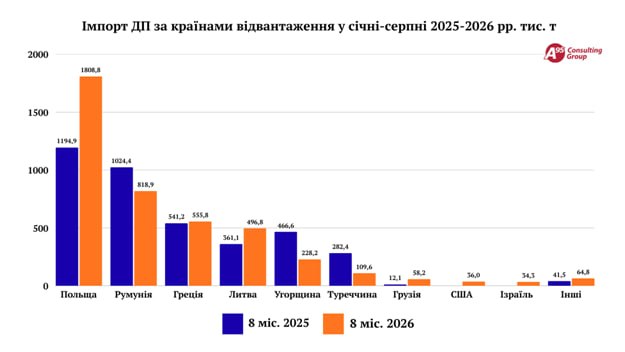
According to Serhiy Kuyun, director of “A-95,” the change in routes is linked both to the price situation on the European market amid the war in Iran and to the increase in military risks, freight costs, and secondary logistics along the southern route.
A-95 expects that the fall will remain a challenging period for the fuel market due to intensified Russian attacks and market turbulence linked to the war in Iran.
Over the next two weeks, domestic prices for gasoline and diesel may rise by 4.5–5 UAH per liter due to a price surge on global markets to levels close to April’s highs; specifically, the price of diesel fuel in London rising above $1,400 per metric ton, according to Serhiy Kuyun, director of the “A-95” consulting group.
“We are expecting domestic prices to rise. Currently, this increase translates to an additional 4.5–5.0 UAH per liter of gasoline and diesel fuel (their current average prices are 80 and 91 UAH per liter, respectively). This could happen within a couple of weeks if current prices stabilize at their current levels,” he wrote on Facebook on Wednesday.
According to the expert, on September 1 and 2, some Ukrainian retail chains had already raised prices by 1 UAH per liter.
“There are no fuel availability issues, neither here nor in Europe. Therefore, the issue is solely about price. The much-discussed 100 UAH per liter mark hasn’t been reached yet, but it’s starting to loom on the horizon again,” Kuyun noted.
As reported by “Energoreforma,” fuel prices in Ukraine showed both slight decreases and increases throughout August.
According to “A-95,” as of September 2, the average retail price in Ukraine for A-95 gasoline is 80.7 UAH/liter, and for diesel fuel, 91.31 UAH/liter.



