
Ukraine’s Ministry of Economy, Environment and Agriculture has proposed introducing an experimental mechanism for allocating ferrous scrap metal export quotas through electronic auctions in the Prozorro.Sale system. The initiative comes amid disputes between metallurgical enterprises and scrap collection companies over maintaining export restrictions, the Experts Club information and analytical center reports.
The corresponding draft resolution of the Cabinet of Ministers was published on October 30, 2026, for public consultation. The document provides for the allocation of quotas for exports of ferrous metal scrap and waste under Ukrainian customs classification code 7204 through electronic auctions. Auction winners will receive the right to use the corresponding quota volume and obtain an export license.
According to the Economy Ministry, the new mechanism is intended to ensure equal access to quotas for enterprises of different sizes, prevent excessive concentration among individual market participants and minimize anti-competitive practices. The proposal also provides for the redistribution of unused quota volumes.
However, the draft does not specify the total export quota. Therefore, its publication does not automatically mean the removal of existing restrictions or the resumption of unrestricted scrap metal exports. Comments on the document will be accepted for one month.
A zero quota on ferrous scrap metal exports has been in effect in Ukraine since January 1, 2026. It was introduced to provide the domestic metallurgical industry with strategic raw materials. At the same time, the government established certain opportunities for licensed exports by companies that won designated electronic auctions in December 2025.
The Ukrainian Association of Secondary Metals, UAVtormet, advocates revising the restrictions. Its president, Volodymyr Bubley, said during a September 16 press conference at the Interfax-Ukraine news agency that the effective export ban had resulted in declining scrap collection volumes, employee layoffs and the accumulation of unsold raw materials.
Industry representatives propose restoring controlled exports to the European Union with an annual quota of up to 200,000 tonnes. According to their figures, domestic scrap prices have fallen significantly: Ukrzaliznytsia sold scrap for approximately UAH 5,500 per tonne in 2026, compared with an average of UAH 8,500 in 2025.
According to UAVtormet, Ukraine exported only 13,860 tonnes of scrap in January–August 2026, compared with 283,060 tonnes during the corresponding period of 2025. Exports fell by 95.1%, while foreign currency earnings decreased from $85.4 million to $3.93 million.
Meanwhile, Ukraine produced 4.3 million tonnes of steel during the first eight months of 2026. Scrap collection amounted to 971,700 tonnes, while deliveries to metallurgical enterprises reached 925,400 tonnes.
Large metallurgical companies take the opposite position. The European Business Association has called on the government to maintain the zero export quota in 2027, warning of the risk of raw material shortages. As an alternative, the association proposes an export duty of EUR 180 per tonne.
The Ukrmetalurgprom association of metallurgical enterprises also insists that the actual balance between scrap collection and consumption should be determined before export restrictions are reconsidered.
Thus, the final decision on resuming exports will depend on the government, which must balance the interests of the metallurgical industry, scrap collection businesses and the broader economy amid the ongoing war.
The European Business Association (EBA) calls for maintaining a zero quota on ferrous scrap exports, which would effectively ban scrap metal exports in 2027, Alternatively, should the quota be abolished, member companies propose imposing an export duty of EUR 180 per metric ton for all export destinations, taking into account Ukraine’s international obligations.
“Domestic processing of scrap metal in Ukraine allows for the creation of added value, the preservation of jobs and tax revenues, and the provision of raw materials for the production of steel and finished metal products. The use of scrap also helps reduce energy consumption and CO₂ emissions in steel production, which takes on additional significance in light of the EU’s Carbon Border Adjustment Mechanism (CBAM),” the publication states.
According to the publication, EBA member companies have appealed to the Cabinet of Ministers and the Ministry of Economy.
Recently, following the shutdown of most Ukrainian steel mills due to massive Russian shelling, scrap metal collection companies have called on the government to review restrictions on scrap exports. Previously, scrap collectors had advocated for lifting the de facto ban on scrap exports from Ukraine and introducing quotas for shipments of this raw material to EU countries in the amount of 200,000 metric tons per year.
As reported, the Cabinet of Ministers of Ukraine established a zero quota on scrap metal exports effective January 1, 2026, to ensure Ukrainian enterprises have access to this raw material.
The EBA noted that, according to 2025 figures, exports of ferrous scrap from Ukraine increased by 53% compared to 2024—reaching 448,680 metric tons. The business community believes that easing the current restrictions could lead to a rise in exports and a shortage of raw materials for Ukrainian manufacturers.
According to data from “UAVtormet,” 4.3 million metric tons of steel were produced in the first 8 months of 2026 (compared to 7.41 million metric tons in 2025), 925,400 metric tons of scrap were delivered to steel mills (1.56 million metric tons), and scrap procurement totaled 971,700 metric tons (2.11 million metric tons). According to preliminary forecasts, 6.4–6.5 million metric tons of steel will be produced in 2026, 1.2–1.25 million metric tons of scrap will be delivered to steel mills, and scrap procurement will total 1.22–1.25 million metric tons.
In January–August of this year, Ukrainian companies reduced exports of ferrous scrap by more than 20 times compared to the same period last year—to 13,86 thousand metric tons from 283,06 thousand metric tons, and in monetary terms—to $3.930 million from $85.4 million. At the same time, 9.31 thousand metric tons were exported in January due to the completion of last year’s contracts, compared to 68.52 thousand metric tons in December 2025. There were no exports in February through May of this year; 4.08 thousand metric tons were exported in June, 315 metric tons in July, and 157 metric tons in August.
On April 29, 2026, the Cabinet of Ministers, by its Resolution No. 563, amended Annex 1 to its Resolution No. 1795 of December 31, 2025, permitting the export of scrap metal on the basis of licenses issued by the Ministry of Economy to to foreign economic activity entities that were the winners of electronic auctions held in December 2025 for the sale of such goods in accordance with the Procedure for the Alienation and Lease of Property of Business Entities in which more than 50% of the shares in the authorized capital are owned by the state or by another legal entity whose sole participant is the state.
Ukrainian enterprises operating in the ferrous scrap market have called for the abolition of the current zero quota on raw material exports and the introduction of controlled supplies to EU countries, stating that the situation in the industry has sharply deteriorated.
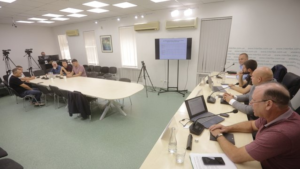
Representatives of companies and the industry association reported this at the press conference “Ukraine’s Scrap Market: Between the Needs of the Economy and Regulatory Uncertainty,” held on September 16 at the Interfax-Ukraine agency.
Volodymyr Bubley, president of the Ukrainian Association of Secondary Metals “UAVtormet,” said that the zero quota on scrap exports to the EU, introduced from the beginning of 2026, is negatively affecting raw material collection and the activities of industry enterprises. According to him, if the current restrictions remain in place, scrap collection volumes may decline significantly by the end of the year.
Serhiy Vovk, CEO of UkrMetInvest LLC, said that the company has already laid off 180 employees, while only four of its 18 production sites continue to operate. More than 14,000 tonnes of scrap that the company is unable to sell have accumulated at its warehouses.
Mykola Klymovych, development director of Mirten LLC, noted that over the eight months of 2026, the volume of scrap collection, according to industry representatives’ estimates, fell by approximately 400,000 tonnes. Market participants estimate losses in tax revenues at more than UAH 1 billion.
Vladyslav Kleshchynskyi, CEO of the UKRMET Group, said that domestic demand from metallurgical enterprises had fallen sharply and that regulated scrap exports to the EU needed to be permitted. Industry representatives had previously proposed setting an export quota at around 200,000 tonnes per year.
According to UAVtormet, around 4.3 million tonnes of steel were produced in Ukraine in January-August 2026, compared with 7.409 million tonnes for the whole of 2025. Scrap metal supplies to metallurgical enterprises over the eight months amounted to 925,400 tonnes, while total collection reached 971,700 tonnes.
The association forecasts that by the end of 2026, steel production will amount to around 6.4-6.5 million tonnes, scrap supplies to metallurgical enterprises to 1.2-1.25 million tonnes, and total collection to approximately 1.22-1.25 million tonnes.
Exports of Ukrainian ferrous scrap in January-August 2026 fell by 95.1% compared with the same period last year, to 13,856 tonnes from 283,055 tonnes. In monetary terms, supplies decreased by 95.4% to $3.93 million.
In 2025, by contrast, scrap exports rose by 45.3% to 448,685 tonnes, while foreign-currency revenue increased by 44.5% to $131.927 million. It was precisely the sharp increase in raw material exports that became one of the reasons for the Ministry of Economy’s introduction of a licensing regime and a zero export quota for 2026.
In April, the government partially adjusted the restrictions, allowing exports under licenses for individual foreign economic activity entities that had won state electronic auctions. However, representatives of the scrap collection industry consider this mechanism insufficient to restore the market to full operation.
Participants in the press conference said that if the current regulatory model remains in place, they will seek a review of the decision and do not rule out protest actions.
Metinvest-Resource LLC (Zaporizhzhia) increased its net profit by 20.3% in January–March of this year compared to the same period last year—to UAH 7.044 million from UAH 5.857 million.
According to the company’s interim report, available to the agency “Interfax-Ukraine,” revenue from ordinary activities for this period rose by 11.1%—to UAH 1.188955 billion from UAH 1.338114 billion.
The accumulated loss as of the end of March stood at UAH 32.398 million.
In 2025, the LLC reported a net profit of UAH 62.679 million, while revenue from ordinary activities for this period increased by 42.4% compared to 2024—to UAH 5.673455 billion from UAH 3.982851 billion.
Sales volume of finished products in 2025 and 2024 amounted to 108,165 thousand tons and 113,321 thousand tons, respectively.
The number of employees as of the end of 2025 was 35, and as of the end of 2024, it was 34. Labor costs for full-time employees in 2024 amounted to UAH 19.595 million, and in 2025, to UAH 22.7899 million.
In 2024, the LLC reported a net profit of UAH 6.085 million, whereas it ended 2023 with a loss of UAH 43.270 million, and in 2022, the net loss was UAH 129.227 million.
Metinvest-Resource LLC is the exclusive supplier of ferrous metal scrap to the Ukrainian metallurgical enterprises of the Metinvest Group. The company’s main activities include the wholesale trade of waste and scrap (primary) and the processing of scrap metal. As of the end of 2025, the company’s registered address is in Zaporizhzhia. The company’s capacity allows it to meet the needs of enterprises and amounts to approximately 0.693 million tons of raw materials per year.
The LLC’s authorized capital is UAH 6.437 million.
Metinvest is a vertically integrated group of mining and metallurgical enterprises. The holding’s main shareholders are the SCM Group (71.24%) and Smart Holding (23.76%). Metinvest Holding LLC is the management company of the Metinvest Group.
METALLURGY, METINVEST, Metinvest-Resource, PROFIT, SCRAP METAL
As a result of the introduction of a zero quota on the export of ferrous metal scrap effective January 1 of this year, the scrap collection industry is losing its potential, reducing raw material procurement, and being forced to lay off employees, stated the head of the Ukrainian Association of Secondary Metals (UAVtormet) Volodymyr Bubley said this at a press conference held at the Interfax-Ukraine press center on Tuesday, titled “Ban on scrap exports: economic consequences for the market and the state.”
According to him, the ban on scrap metal exports—without balancing consumption and procurement of this raw material—has essentially had a negative impact on the operations of scrap metal procurement companies. At the same time, steel production in Ukraine has fallen: in January-February 2026, compared to the same period in 2025, steel production decreased by 13.3%—from 1.183 million tons to 1.026 million tons.
At the same time, the purchase of ferrous metal scrap by metallurgical enterprises decreased significantly—by 31.7%, from 257,800 tons to 176,000 tons. Meanwhile, procurement fell by 41.1%—from 313,600 tons to 184,800 tons.
“Previously, scrap exports accounted for 20–25%. We felt more comfortable operating in the domestic market. We are still operating there now, and we want to continue working in Ukraine,” said Bubley, emphasizing that the price of scrap in the EU is more attractive and has reached 300–330 euros per ton.
“The state loses 12 million euros every month due to the export ban. It loses 200 million hryvnias in taxes. Meanwhile, steelmakers are 112% supplied with scrap,” the head of UAVtormet cited his data.
According to his estimates, Ukraine will produce 7.4 million tons of steel in 2026, which will require 1.5 million tons of scrap—the industry can supply up to 2 million tons of scrap.
Serhiy Vovk, CEO of Ukrmet-Invest LLC, noted that the scrap metal collected by companies is not being purchased by steel mills; his company’s scrap metal stockpile has currently reached 13,000 tons. “Export is the only way for the industry to survive,” the CEO believes.
Vladislav Kleshchynskyi, CEO of the Ukrmet Group of Companies, added that the ban was imposed due to an alleged scrap metal shortage.
“But there is no shortage. Steel mills purchase 30–50% at most. So it’s impossible to call this a shortage. Right now, the scrap market in Ukraine is a market of metallurgical enterprises that dictate prices. We have already cut our staff by 50%, 35 divisions are operating at 20% of their capacity, and we have shut down our entire export infrastructure,” the CEO stated.
Mykola Klimovich, Director of Mirten LLC, clarified that in 2022–2026, the scrap market will be in surplus, and scrap exports were an opportunity to sell it.
According to experts, following the government’s ban on scrap exports, the procurement sector is in a “severe recession” with a trend toward further reductions in procurement.
Earlier, Bubley stated that the export ban automatically affected not only procurement volumes but also domestic prices, as reduced competition allowed steelmakers to act as monopolists in the domestic market. Thus, the cost of one ton of scrap at procurement sites has halved: from 8,000 UAH/t to 4,000 UAH/t.
Under these conditions, companies engaged in scrap procurement are forced to reduce their workforce. In January–February 2026, compared to the same period last year, the number of employees in the industry decreased significantly. In just the first two months, companies in our industry were forced to lay off about 2,000 employees, reported the head of UAVtormet.
“The trend is grim: almost every day we receive reports from companies about a complete shutdown of operations or significant staff reductions. According to our forecasts, 4,000 workers will be laid off in the industry by May,” Bubley predicted earlier.
According to UAVtormet’s research, due to the export ban, the state is losing approximately 200–250 million UAH in taxes each month. A separate category of losses is foreign exchange revenue: approximately 25 million euros have already been lost.
As reported, Ukrainian companies reduced exports of ferrous metal scrap by 77.3% in January–February of this year compared to the same period last year—to 9,309 thousand tons from 40,980 thousand tons. According to statistics from the State Customs Service (SCS), there were no exports in February; 9,309 thousand tons were exported in January, and a record 68,520 thousand tons of scrap were exported in December 2025.
In 2025, Ukraine’s scrap metal processing enterprises increased exports of ferrous metal scrap by 45.3% compared to the previous year—to 448,685 thousand tons from 293,190 thousand tons.
Due to the sharp increase in exports of strategic raw materials from Ukraine, the Ministry of Economy initiated the introduction of a licensing and quota system for scrap exports, setting a zero quota. The government temporarily imposed a zero export quota for 2026 on the export of ferrous metal scrap.
Scrap collection companies in Ukraine increased exports of ferrous metal scrap by 60.7% in 2024 compared to 2023—to 293,190 thousand tons from 182,465 thousand tons. In monetary terms, scrap exports for the year rose by 73.2%—to $91.311 million from $52.723 million.
Sources: https://interfax.com.ua/news/press-announcement/1153229.html; https://uavtormet.com/en/na-mezhi-katastrofy-zagotivlya-bruhtu-chornyh-metaliv-vpala-na-40/

In January of this year, ferrous metal scrap trading companies reduced their procurement of ferrous metal scrap by 18.5% to 97,100 tons from 149,000 tons.
According to data from the Ukrainian Association of Secondary Metals (UAVtormet), scrap collectors reduced their supplies of scrap to Ukrainian metallurgical plants by 26.7% compared to the same period last year, to 92.5 thousand tons from 126.2 thousand tons. At the same time, steel production during the same period decreased by 16.4% to 511 thousand tons from 611 thousand tons.
According to UAVtormet estimates, in the first month of the scrap export ban, more than 20-25% of companies in the industry partially suspended their operations, and another 12-15% completely stopped their activities. Experts predict that by April-May of this year, about 4-4.5 thousand workers in the scrap collection industry will lose their jobs.
As reported, according to data from the State Customs Service, Ukrainian scrap collection companies increased their exports of ferrous metal scrap by 45.3% in 2025 compared to the previous year, to 448,700 tons, and in monetary terms by 44.5%, to $131.9 million. In 2024, exports of these products increased by 60.7% in physical terms and by 73.2% in monetary terms.
Due to such a sharp increase in exports, the Cabinet of Ministers introduced a zero quota for exports of these products for 2026, whereas previously there was an export duty of EUR 180/ton, which, at the same time, was not paid when exporting to the EU, with which Ukraine has a free trade zone.
According to customs data, in January this year, Ukraine reduced exports of ferrous metal scrap by 40.7% compared to January last year, to 9.3 thousand tons, and compared to the December 2025 figure of 68.5 thousand tons, the decline was sevenfold. In monetary terms, scrap exports in January decreased by 38% compared to January 2025, to $2.73 million.



