
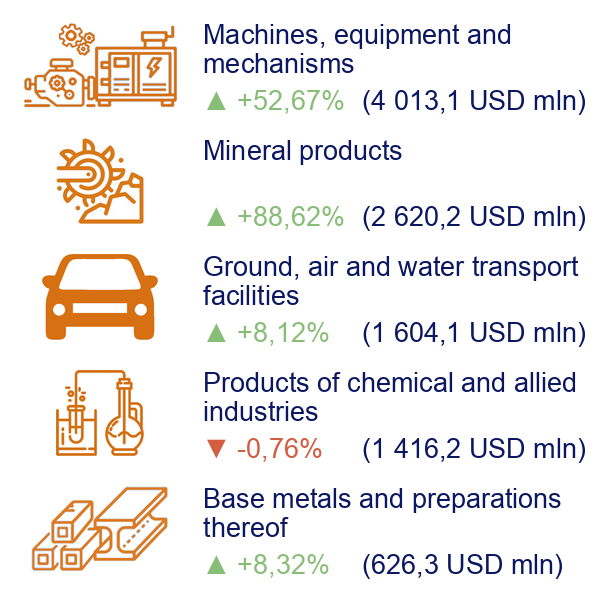
Dynamics of import of goods in January-February 2026 by the most important items in relation to the same period of 2025, %

The raspberry harvest in Ukraine in 2026 will likely be lower than last year’s, but the decline in supply was offset by record-high purchase prices, said Taras Bashtannik, president of the Ukrainian Fruit and Vegetable Association (UFVA), in an interview with SEEDS published on September 2, 2026.
According to him, it is still too early to talk about a new record in terms of physical raspberry production volumes.
“I wouldn’t rush to declare a record in terms of volume, that’s for sure. In my opinion, there are fewer raspberries this year than last. In monetary terms, it could be a record or a repeat of last year’s result, because the price of raspberries this year is even higher than last year,” Bashtannik noted.
The most telling factor of the season was the sharp rise in the cost of raw materials for processing. According to the UPOA president, purchase prices for raspberries intended for processing and freezing reached 193–195 UAH per kg, excluding VAT, during certain periods.
Bashtannik noted that the Ukrainian market had never previously recorded such high purchase prices. Thus, the lower yield this season was largely offset by the higher price of the berries.
At the same time, the Ukrainian raspberry market remains predominantly export-oriented. According to the UPOA president’s estimate, 90–95% of the raspberries produced in Ukraine are exported, while domestic consumption remains relatively low.
“I would say that 90–95% of raspberries are exported. And this trend will most likely continue,” he said.
One of the main constraints on further production growth remains the high demand for manual labor. According to Bashtannik, raspberries are essentially harvested by hand, and the possibilities for mechanizing this process are still limited. This hinders rapid expansion of cultivation areas even when market prices are high.
High purchase prices also confirm the shortage of high-quality raw materials on the European market. According to EastFruit, Ukraine already ranks first in the world in net raspberry exports, and export revenue in the 2025/26 season reached a record $250.8 million, an increase of approximately 65% compared to the previous season.
Thus, the 2026 season for Ukrainian raspberry producers could set a record not in terms of harvest volume, but in terms of the value of products sold. How the situation develops will depend on the harvest in Ukraine and major European producing countries, as well as on demand from companies that freeze and process berries.
agricultural sector, Bashtannik, BERRIES, EXPORTS, RASPBERRIES, UKRAINE

The record victory of the Alternative for Germany (AfD) in the state elections in Saxony-Anhalt does not give the party the ability to independently change Germany’s foreign policy or stop military support for Ukraine, but it is capable of increasing political pressure on the federal authorities, according to an analysis by the Experts Club information and analytical center.
In the September 6 election, AfD received 43.8% of the vote and 39 of the 83 seats in the Landtag. An absolute majority requires 42 deputies. The simplest arithmetic option for creating a majority is an alliance between AfD and the five deputies of the Sahra Wagenknecht Alliance (BSW), which would provide 44 votes. At the same time, there is currently no agreement on such a coalition. The CDU, SPD, Greens and The Left reject cooperation with AfD.
Even if AfD forms a state government, its powers will be focused primarily on education, culture, the police, regional administration, infrastructure and the state budget. Foreign policy and defense, in accordance with Germany’s Basic Law, fall within the competence of the federal government.
“The government of Saxony-Anhalt does not receive a separate vote in NATO and cannot independently cancel federal funding for aid to Ukraine,” emphasized Experts Club founder Maksym Urakin.
Saxony-Anhalt has four of the 69 votes in the Bundesrat. This allows the state government to influence part of federal legislation, especially on issues affecting the powers of the states, but it needs allies among other regions to block decisions.
Magdeburg will also not be able to introduce a political ban on the transit of military cargo for Ukraine. At the same time, state authorities participate in approving certain transport and administrative procedures, so a confrontational stance by the regional authorities could theoretically lead to delays and additional bureaucratic difficulties.
Important Bundeswehr facilities are located in Saxony-Anhalt, including the Army Combat Training Center in the Gardelegen—Letzlingen area, the Klietz training ground, where Ukrainian Leopard 1A5 crews underwent training, as well as logistics units in Burg. At the same time, these structures are subordinate to the federal defense authorities, not to the state government.
The consequences for Ukrainians living in the state itself may become more immediate. AfD advocates reducing social support for Ukrainians, changing approaches to integration programs and strengthening return policies. The state cannot abolish the temporary protection regime established at EU level, but it can influence additional regional programs and administrative practices.

As of July 1, 2026, large taxpayers accounted for approximately 19.94 billion UAH in tax debt, or about 8% of the total debt owed by Ukrainian companies to the state.
At the same time, it is among large taxpayers that the highest average debt per company has been recorded.
In the Eastern Interregional Directorate of the State Tax Service for Work with Large Taxpayers, the average debt amounts to approximately 561.2 million UAH per company.
In the Western Interregional Directorate, the average debt amounts to 478.8 million UAH per taxpayer.
By comparison, the average tax debt among all Ukrainian companies in arrears is approximately 1.2 million UAH.
Thus, the average debt of a large taxpayer in the Eastern Directorate is approximately 470 times higher than the national average.
At the same time, the share of large businesses in the total tax debt remains relatively small. The bulk of the 263.32 billion UAH in debt is attributable to a much broader range of small and medium-sized companies.
It is currently impossible to identify the names of the largest corporate debtors due to restrictions on some of the State Tax Service’s open data, which were introduced after the start of the full-scale war.
The European Commission has not confirmed that a visa-free regime between Armenia and the European Union will be introduced specifically in 2029, although Yerevan expects to complete the visa liberalization process by that date. This information is supported by recent statements from EU representatives and official documents from the European Commission.
On September 7, European Commission spokesperson Paula Pinho stated at a briefing in Brussels that it is currently too early to set a specific date for the abolition of visas.
“It is still too early to predict whether 2029 or any other date will mark the moment of visa liberalization,” the European Commission spokesperson said.
Thus, 2029 is a target set by the Armenian government, not a deadline agreed upon with the EU. Armenian Prime Minister Nikol Pashinyan has previously stated on several occasions that Yerevan hopes to achieve visa liberalization by 2029. In particular, on August 24, while presenting the government’s program for 2026–2031, he announced that Armenia intends to achieve the abolition of short-term visas for travel to the EU “during 2029.”
The dialogue between the EU and Armenia on visa liberalization was officially launched on September 9, 2024, and on November 5, 2025, the European Commission submitted the Visa Liberalization Action Plan (VLAP) to the Armenian authorities.
The plan calls for Armenia to meet requirements in four key areas: document security and biometrics; border management, migration, and asylum; public order and security; and fundamental rights. The document does not specify a fixed timeline—the process will continue for as long as necessary to meet all criteria.
In July, European Commission President Ursula von der Leyen also made it clear that the EU is not tying the decision to a specific year. She noted that Armenia is making good progress but described the process as “merit-based,” meaning it depends on the actual fulfillment of the established criteria.
Armenia is currently the only partner country with which the EU is engaged in an active new dialogue on visa liberalization, the European Commission noted. Subsequent assessment missions are to verify compliance with the remaining requirements.
Upon successful completion of all stages, the European Commission is expected to propose amendments to European visa legislation, after which the decision must undergo the necessary procedures within the EU. Therefore, Armenia’s fulfillment of the technical criteria does not in itself mean the automatic abolition of visas on a predetermined date.
ARMENIA, EUROPEAN UNION, MIGRATION, VISA-FREE TRAVEL, Єреван
According to Serbian Economist, Montenegrin police have deported six Ukrainian citizens suspected of establishing a network of cooperation with one of the “high-risk organized crime groups” (OCGs) operating in the country.
According to police, the operation lasted several days and was aimed at identifying foreigners whose presence and activities could pose a threat to the country’s internal and national security. As a result of the investigations, police reported uncovering links between six Ukrainians, aged 28 to 33, and one of the organized criminal groups.
Following the investigation, the police initiated the revocation of the temporary protection previously granted to these Ukrainian citizens. Subsequently, a decision was made to deport all six individuals and ban them from returning to Montenegro for a period of five years. They were forcibly removed from the country via Podgorica Airport and the Božaj border crossing on the border with Albania.
Another Ukrainian citizen, who is currently outside Montenegro, was barred from entering the country on the same grounds. Thus, the measures affected seven individuals: six were deported, and one was barred from entry.
During the operation, various communication devices, GPS tracking devices, drones, devices for interpersonal communication, and other items were seized from those inspected. The police stated that they will continue to inspect foreigners as part of measures to counter threats to national security.
At the same time, it is important to clarify the legal aspect of the report: the police are specifically referring to suspicions of collaboration with an organized criminal group and the results of operational checks. The official statement contains no information about a court verdict that has taken effect regarding these citizens or about criminal charges brought against them. Therefore, it is currently incorrect to refer to them as members of a criminal group based on the published data.
Since 2022, the Ukrainian community has become one of the largest foreign communities in the small country of Montenegro. The actual number of Ukrainians with valid temporary protection can now be conservatively estimated at 6,000–7,000 people.
The situation is less clear regarding regular residence permits and permanent residency. The most recent complete breakdown by nationality from the Ministry of the Interior showed that as of October 31, 2023, 5,208 Ukrainian citizens held regulated temporary or permanent residence permits in Montenegro. The Ministry of Internal Affairs has not yet released any more recent official public data specifically regarding Ukrainian temporary or permanent residence permits for 2026. Therefore, it is not possible to state, for example, that exactly 5,000 or 7,000 Ukrainians currently hold regular temporary residence permits. In 2025, local media, citing registration data from the Ministry of Internal Affairs, estimated the total Ukrainian community at 10,000 people. This represents about 1.6% of the country’s population. For comparison, the latest census indicates that Montenegro’s permanent population is 623,633.



