

Imports of electric telephone or telegraph sets and videophones (HS Code 8517) into Ukraine in January–June 2026 increased by 83.6% compared to the same period in 2025—to nearly $1.23 billion, according to statistics from the State Customs Service.
According to the statistics, imports of these products in June alone rose nearly 2.2 times compared to June of last year—reaching $234.8 million.
The largest volume of these products in January–June was imported from China (50.7%, or $621 million); they were also imported from the United States ($155.3 million) and Vietnam ($108.7 million), whereas last year the top sources were China ($362.6 million), Vietnam ($103.5 million), and the United States ($56.3 million).
At the same time, exports of these products from Ukraine in the first half of the year totaled $62.5 million (in January–June 2025 — $60 million). Shipments were made primarily to Hungary (70.2%), Poland (18%), and Taiwan (8.4%). During the same period last year, these products were also exported primarily to Hungary (71.5%), as well as to Poland (23%) and Spain (1%).
According to the State Customs Service, as previously reported, in 2025, Ukraine imported telephone and telegraph equipment and videophones worth nearly $1.634 billion—29.5% more than in 2024—including $907.9 million worth from China.
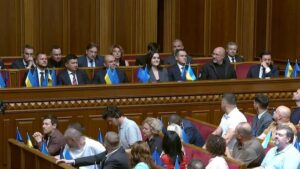
The Verkhovna Rada, upon the recommendation of newly appointed Prime Minister Serhiy Koretsky, approved the new composition of the Cabinet of Ministers of Ukraine.
During Thursday’s parliamentary session, 264 members of parliament voted in favor of this decision.
The votes in support of the new Cabinet were distributed as follows: the “Servant of the People” faction – 193, “European Solidarity” – 0, “Batkivshchyna” – 1, “Holos” – 2, the ‘Dovira’ deputy group – 17, “For the Future” – 14, “Platform for Life and Peace” – 16, “Reconstruction of Ukraine”—14, and non-affiliated deputies—7.
At Thursday’s plenary session, which was held as a package vote (with the exception of the Minister of Defense and the Minister of Foreign Affairs, whose nominations are submitted by the president), 264 members of parliament voted in favor of the resignation of the previous Cabinet and the appointment of the new government.
Specifically, the following were reappointed to the new Cabinet: First Deputy Prime Minister and Minister of Energy Denys Shmyhal; Deputy Prime Minister for Humanitarian Policy and Minister of Culture of Ukraine Tetyana Berezhna; Minister of Finance Serhiy Marchenko; Minister of Health Viktor Lyashko, Minister of Youth and Sports Matvey Bidny, and Minister of
Social Policy, Family, and Unity Denis Ulyutin.
At the same time, Vsevolod Chentsov, who previously served as Ukraine’s representative to the European Union, was appointed Deputy Prime Minister for European and Euro-Atlantic Integration of Ukraine.
Andriy Butenko, head of the National Agency for Quality Assurance in Higher Education (NAOKVO), has been appointed Minister of Education and Science.
Vitaliy Kim, head of the Mykolaiv Regional Military Administration, has become the new Minister for Veterans’ Affairs.
Additionally, Oleksandr Kravchenko, head of the Ukrainian office of McKinsey & Company, has been appointed to lead the restructured Ministry of Economy and Environment, while Taras Vysotsky, the current Deputy Minister of Economy, has been appointed to lead the Ministry of Agrarian Policy and Food.
Thus, the Ministry of Economy, Environment, and Agriculture will be divided into two separate agencies.
Meanwhile, the Ministry of Communities, Territories, and Internally Displaced Persons is now headed by MP Vitaliy Bezgin (Servant of the People faction), and the Ministry of Recovery, Infrastructure, and Transport is headed by Mykola Kalashnyk, head of the Kyiv Regional State Administration.
Consequently, the position of Deputy Prime Minister for the Reconstruction of Ukraine—Minister of Community and Territorial Development—no longer exists in the government and has been replaced by two specialized ministers.
In addition, Denys Maslov (Servant of the People faction), head of the Verkhovna Rada Committee on Legal Policy, has been appointed Minister of Justice, while Oksana Ferchuk, Ukraine’s Deputy Minister of Defense for Digital Development, Digital Transformation, and Digitalization, has been appointed Minister of Digital Transformation.
Ivan Vygivsky, head of the National Police, has also been appointed as the new Minister of Internal Affairs.
Furthermore, under the president’s quota, Andriy Sibiga is to be reappointed as Minister of Foreign Affairs, and a Minister of Defense is to be appointed; no candidates have been proposed for these positions yet.
Thus, the following individuals did not receive positions in the new government: Taras Kachka, Oleksiy Kuleba, Oleksiy Sobolev, Natalya Kalmykova, Oksen Lisovyi, Mykhailo Fedorov, and Ihor Klymenko (who may be nominated for the position of Minister of Defense).
As reported, on July 16, the Verkhovna Rada appointed Serhiy Koretsky, chairman of the board of Naftogaz of Ukraine, as Prime Minister of Ukraine.

The Verkhovna Rada of Ukraine has appointed Taras Vysotsky, Deputy Minister of Economy, Environment, and Agriculture, as Minister of Agrarian Policy and Food of Ukraine in the new government, according to a correspondent for the Interfax-Ukraine news agency.
The Ministry of Agrarian Policy and Food of Ukraine has been reestablished through the reorganization of the Ministry of Economy, Environment, and Agriculture of Ukraine.
As previously reported, the Ministry of Agrarian Policy and Food was merged into the Ministry of Economic Development, Trade, and Agriculture of Ukraine in 2019. At the end of 2020, the government decided to reinstate the Ministry of Agrarian Policy, and as of 2021, the ministry resumed operations as a separate central executive body.
In July 2025, the Ministry of Agrarian Policy was reorganized once again, and its functions were transferred to the newly created Ministry of Economy, Environment, and Agriculture of Ukraine.
From September 2019 to May 2021 and from July 2025 onward, Vysotsky served as deputy head of the Ministry of Economy, overseeing agricultural policy.
From May 2021, he served as First Deputy Minister of Agrarian Policy and Food until the ministry was merged with the Ministry of Economy. From May 14, 2024, to September 4, 2024, he served as Acting Minister of Agrarian Policy and Food of Ukraine.

Oschadbank has announced the launch of the “Green Farming in the Horticulture Sector” program, under which Ukrainian fruit growers will be able to receive grants of up to 10,000 euros and preferential bank financing to implement climate-resilient technologies. The program is officially scheduled to launch on July 22, 2026.
Natalia Butkova-Vitvitska, a member of Oschadbank’s board responsible for micro, small, and medium-sized businesses, announced the bank’s participation in the program during her presentation on July 15 at the Ukrinform press center.
The agro-industrial sector is one of the key drivers of the Ukrainian economy: it accounts for 17–19% of the country’s GDP and accounts for 41% of Ukrainian exports, and more than 70% of agricultural producers are small and medium-sized farms. The program is specifically designed to support this segment, helping Ukrainian fruit growers invest in modern technologies and increase the competitiveness of their farms.
“Oschadbank is one of the leaders in implementing the principles of sustainable financing in the micro, small, and medium-sized business segment. We are systematically expanding Ukrainian entrepreneurs’ access to modern financial instruments that help them invest in climate-resilient technologies. Today, Oschadbank’s loan portfolio in the agricultural sector exceeds 17.7 billion UAH and accounts for over 53% of the MSME business division’s loan portfolio. “The ‘Green Farming in Horticulture’ program will provide Ukrainian horticulturists with additional opportunities to modernize production and develop their farms,” noted Natalia Butkova-Vitvitskaya, a member of Oschadbank’s Management Board responsible for micro, small, and medium-sized businesses.
Sustainable financing is one of the key areas of development for Oschadbank’s MSME business division. The bank is consistently expanding its partnership programs with international financial institutions and introducing financial instruments that help Ukrainian entrepreneurs invest in projects related to energy efficiency, decarbonization, and the adoption of climate-resilient technologies.
Program Participation Requirements
The program launches on July 22, 2026. Until then, potential participants can review the program’s terms and prepare the necessary documents.
Program participants will be eligible to receive:
– a grant of up to 10,000 euros;
– a grant covering up to 20% of the outstanding principal balance of the loan;
– financing for investment projects, including through the government’s “Affordable Loans 5-7-9%” program, with a term of up to 5 years;
– the opportunity to submit an application within 30 calendar days after the program’s launch.
Detailed program terms are available at: https://bdf.gov.ua/programs/zelene-fermerstvo-v-haluzi-sadivnytstva/.
The “Green Farming in Horticulture” program is being implemented as part of the “Preparing Eastern Partnership Countries for the European Green Deal (PROGRESS)” project, which is being carried out on behalf of the German Federal Government’s International Climate Initiative (IKI). It combines grant support and preferential bank loans to introduce climate-resilient technologies in horticulture.
agricultural sector, FARMING, GRANT, HORTICULTURE, OSCHADBANK

Issue No. 1 – July 2026
Analysis of the Current Situation in Ukraine’s Foreign Exchange Market
In the first half of July, devaluation trends were almost imperceptible, although demand for foreign currency remained high. However, the official exchange rate stands at 44.75 UAH per dollar, down from 44.79 UAH per dollar at the beginning of the month. That said, during the first two weeks of July, the exchange rate tended to fluctuate toward depreciation.
Last month, the foreign exchange market saw a significant increase in demand, but the NBU has been managing the situation and continues to do so by conducting regular currency interventions. The cost of preventing a noticeable devaluation was over $5.78 billion, sold by the National Bank through interventions between June 1 and July 3.
General expectations for the second half of July: the agricultural sector will begin exporting more actively, and pressure on the hryvnia will gradually ease thanks to foreign exchange proceeds from agricultural exporters. At the same time, the NBU will continue to be the main seller and is likely to maintain the psychological threshold of 45 UAH/USD by supplying currency from its international reserves. However, a seasonal decline in demand for foreign currency, combined with increased supply from agricultural exports, should support the hryvnia in July.
Global Context
In July, markets are awaiting the U.S. Federal Reserve’s decision on the benchmark interest rate, with the Fed Committee meeting scheduled for the end of the month. It will be interesting to see how forecasts and trends have changed. Until recently, traders expected the rate to be cut in 2026. However, the war in Iran and accelerating inflation in the U.S. have altered the outlook. Currently, the likelihood that the Federal Reserve will raise rates at its July meeting is increasing.
Meanwhile, the CME’s FedWatch tool puts the probability of the central bank raising interest rates by 25 basis points at 46.5%. On the Kalshi prediction market platform, the probability stands at 36%. Forecasts of a rate hike began to dominate the investment community after U.S. President Donald Trump announced the resumption of the U.S. blockade of Iranian ports near the Strait of Hormuz and the imposition of a 20% tariff on all cargo passing through the strait.
Another significant factor influencing the Fed’s potential decision to raise rates is the inflation situation.
However, the outlook for prices in the U.S. is quite optimistic: according to the U.S. Bureau of Labor Statistics, consumer prices fell in June amid lower energy and gasoline prices, marking a reversal of the sharp rise seen in April–May due to the conflict with Iran. In June, the Consumer Price Index rose by 3.5% compared to June 2025, which is lower than in May (4.2%). This could serve as the basis for the Fed’s decision to keep rates unchanged for now and postpone consideration of this issue until September.
Earlier, Federal Reserve Chair Christopher Waller had already signaled a possible rate change, recently stating that the Fed had waited too long to raise rates amid rising inflation. However, he added that the Fed should not overreact or raise rates too quickly.
In mid-July, the dollar remains stable after a fairly prolonged decline, with the EUR/USD pair trading at 1.1417, whereas July began at 1.1406 USD/EUR. Meanwhile, the U.S. Dollar Index, which measures the currency’s value against a basket of six major currencies, remained unchanged at 100.9 on July 15.
In Europe, however, they did not hesitate: the ECB raised its key deposit rate by 25 basis points in June due to a sharp rise in energy prices. Consequently, the strategy changed: while the ECB had cut interest rates four times in the first half of 2025 (from 3% at the start of the year to 2% by mid-June), it reversed course in June, raising the rate to 2.25%. There are several reasons for this, including the acceleration of inflation in the eurozone to 3.2% in May of this year. In addition, the sharp rise in energy prices resulting from military actions between the U.S. and Iran is once again raising concerns about oil supplies, as well as about a possible further spike in inflation in the EU.
The Domestic Ukrainian Context
In the first half of July, demand for foreign currency declined slightly compared to June. This is also evident from the results of the NBU’s foreign exchange interventions. While the NBU sold $1.14 billion on the market in the last week of June, it sold $0.871 billion in the first week of July. Pressure on the hryvnia eased in July, partly due to inflows from agricultural exports. Consequently, the pace of devaluation slowed significantly during the first half of July. While the month began with an official exchange rate of 44.79 UAH per dollar, by mid-month the rate had reached 44.75 UAH/dollar. The hryvnia’s stability is supported by the U.S. dollar’s decline against the euro, but there are also factors that may soon work against it, notably the resumption of rising oil prices amid the conflict between the U.S. and Iran.
On a positive note, international reserves increased in June: as of July 1, according to preliminary data, they stood at $51.27 billion.
The NBU reported that reserves increased by 12.1% in June thanks to foreign exchange inflows from international partners, which exceeded the National Bank’s net foreign exchange sales and the country’s foreign currency debt payments. In total, $11.3 billion was deposited into the government’s foreign currency accounts at the National Bank last month, while $269.7 million was paid for servicing and repaying the government’s foreign-currency debt. According to the NBU’s balance sheet data, the bank sold $5.147 billion on the foreign exchange market in June.
Loans and aid to Ukraine from its partners continue to flow in. At the end of June, the special fund of the state budget received an additional 3.9 billion euros from the European Union, which is to be used to strengthen the capabilities of the defense-industrial complex and ensure urgent deliveries for the front lines. Prior to this, in June, Ukraine also received 3.2 billion euros in budget support under this program, bringing the total amount of funds under this instrument to 7 billion euros last month. In July, IMF Executive Directors are expected to consider the first review of the Extended Fund Facility (EFF) program for Ukraine and the disbursement of a second tranche of approximately $690 million. Earlier, Ukrainian Finance Minister Serhiy Marchenko reported that the IMF Executive Board meeting is scheduled for July 20, and Ukraine has already submitted all necessary documents to the Fund.
Certain unexpected developments in Ukraine are linked to a rather rapid change in the government, as it was only on July 12 that President Volodymyr Zelenskyy announced the need to reshuffle the Cabinet of Ministers and reported the resignation of Prime Minister Yulia Svyrydenko. Svyrydenko’s government had been in office for nearly a year. Serhiy Koretskyi became Ukraine’s new prime minister. His nomination was approved by the Verkhovna Rada on July 16.
U.S. Dollar Exchange Rate: Trends and Analysis
The slow devaluation trend continued in July, which, as before, is in line with the flexible exchange rate strategy implemented by the National Bank of Ukraine (NBU). During the first half of July, the hryvnia lost almost no value, as the month began with an official exchange rate of 44.79 UAH per dollar, and by mid-July, the rate had reached 44.75 UAH/USD. On the interbank market on July 15, trading took place at a rate of 44.72–44.76 UAH/USD. Despite a noticeable increase in activity among agricultural exporters bringing in foreign currency proceeds, the National Bank of Ukraine remains the primary seller of currency on the interbank market.
In the cash market in mid-July, the buying rate was 44.35–44.60 UAH/USD, and the selling rate was 44.95–45.20 UAH/USD. Spreads remained unchanged in July, ranging from 0.40 to 0.65 UAH/USD.
Key influencing factors:
• Weakening demand for the dollar on the interbank foreign exchange market in the first half of June and slight downward fluctuations. The hryvnia is supported by NBU interventions, reduced demand, and the entry of agricultural exporters into the market.
• Cash market—fluctuations are very slow. In the cash market, the hryvnia has even strengthened compared to the last days of June, moving from a selling rate of 45.05–45.30 UAH/USD to a range of 44.80–44.90 UAH/USD.
• International factors: Tensions in the Middle East continue to escalate, and U.S. President Donald Trump has even threatened to strike Iran’s bridges and power plants if the country does not return to negotiations.
• Market expectations: In mid-July, the international market is focused on the next Federal Reserve Committee meeting, scheduled for late July, although expectations vary. It is possible that the Fed will maintain its current strategy of keeping rates unchanged, but there is also a chance of a key rate hike. In Ukraine, the main focus is on the situation at the front, as well as the unexpected change in government.
Forecast
• Short term (1–2 weeks): The base range is 44.70–45.00 UAH/USD; the exchange rate will move in different directions depending on demand and the inflow of new supply from exporters.
• Medium term (2–3 months): 44.90–45.30 UAH/$. A decline in the dollar’s value on the international market due to risks associated with changes in the Fed’s benchmark rate, as well as against the backdrop of uncertainty in the Middle East, will contribute to some stabilization of the hryvnia exchange rate this summer.
• Long term (6+ months): In the baseline scenario, the depreciation trend remains the dominant factor, and the exchange rate could reach 46.50 UAH/USD by the end of the year. Exchange rate fluctuations will be directly influenced by inflows into international reserves, the level of demand from importers, international oil prices, and the National Bank’s clear strategy for supporting the foreign exchange market through interventions.
Euro Exchange Rate: Trends and Analysis
In the first half of July, the euro exchange rate on the domestic market rose slightly in line with the euro’s appreciation against the U.S. dollar on the international market. While July began with an official exchange rate of 51.03 UAH per euro, as of July 16, the rate stood at 51.06 UAH/euro.
A similar trend in the euro exchange rate was observed in Ukraine’s cash market in July. The buying rate in mid-July ranged between 50.5 and 51 UAH per euro, while the selling rate ranged between 51.35 and 51.7 UAH per euro. The spreads between the buying and selling rates for the euro widened in June–July, reaching approximately 0.65–1 UAH, whereas at the end of June they were in the range of 0.55–0.85 UAH per euro.
Key influencing factors:
• On the international market, the euro continued to strengthen in July, driven largely by the ECB’s rate hikes. The euro strengthened as a result of the ECB’s monetary policy and growing geopolitical uncertainty regarding the ceasefire between the U.S. and Iran.
• The ECB is raising interest rates: as global oil prices continue to rise, inflationary pressure on ECB policymakers is increasing, reinforcing expectations of another rate hike in September of this year.
• There is no shortage of euros; demand is very moderate. In the cash market, euro sales outpace purchases, and the euro exchange rate at currency exchange offices and banks has remained virtually unchanged during the first two weeks of July.
Forecast:
• Short term (2–4 weeks): On the Ukrainian market, the euro may remain within the range of 51.20–51.65 UAH/€.
• Medium term (2–4 months): If the euro continues to strengthen on the international market, it may fluctuate in Ukraine within the range of 51.80–52.40 UAH/€.
• Long term (6+ months): By the end of the year, the euro exchange rate may range between 52.80 and 53.80 UAH/€. Key influencing factors include the ECB’s decision on rate hikes, the Federal Reserve’s decision on changes to the benchmark rate, inflation rates in the U.S. and the EU, the situation in the Middle East, and negotiations between the U.S. and Iran.
Recommendations for Businesses and Investors
Monetary policy drives exchange rate trajectories. The central banks of the U.S. and the EU are planning to raise interest rates. This will affect the dollar’s position in the global market, but at the same time signal to investors to invest in safe-haven currencies.
Escalation in the Middle East is affecting exchange rates. There is no lasting peace between the U.S. and Iran, and the latest rounds of attacks are impacting the dollar’s position in the global market. The euro is regaining ground.
A cool head and reliable tools are the path to stable returns. In a situation of heightened uncertainty and high risks, it makes sense to focus on reliable and liquid currency assets, giving preference to the dollar and the euro.
The focus is on safe investments. Stability and predictability aren’t just about 2026. For investors, this means a cautious strategy that prioritizes capital preservation above all else.
Liquidity is a key priority. It makes sense to include the world’s major currencies—the dollar and the euro—in a currency portfolio as a foundation. The optimal currency allocation this summer is either a 60%–40% split with a higher share of the dollar, or a “50%–30%–20%” split, where the dollar accounts for the largest share, followed by 30% in the euro, and 20% in the Swiss franc or British pound sterling.
There’s no need to rush when diversifying your portfolio. The world is currently dominated by abrupt and reckless geopolitics, so an investor’s goal should be to make cautious and reliable investments in dollars and euros. However, you can always set aside a small portion of your savings to invest in other currencies or in three-month foreign-currency government bonds.
Oil prices are rising again, which does not help the dollar. In mid-July, Brent crude oil futures rose by $1.43 (or 1.7%) to $84.73 per barrel, while West Texas Intermediate (WTI) crude rose by $1.2 (or 1.5%) to $79.34 per barrel. Against the backdrop of escalating tensions in the Middle East, oil prices may continue to rise, signaling to investors the need to reallocate up to 30% of their portfolios into the euro.
The NBU’s policy rate remains at 15% for now. In June 2026, inflation in Ukraine slowed to 7.2%. This implies a possible reduction in bank deposit rates, which will increase the role of foreign currency savings as a tool for protecting funds against inflation.
Buying euros when the exchange rate is stable is the right decision. Amid the absence of sharp fluctuations, it is important to invest in the euro in a timely manner, but without sacrificing the main portion of your portfolio, which is denominated in U.S. dollars.
Pay close attention to decisions by the U.S. and EU central banks, as well as to inflation data from the U.S. and the eurozone. Regular analysis of the economic situation in the eurozone and the U.S. will help you make timely adjustments to your short-term strategy and successfully exit certain currency assets to enter other currency investments without incurring losses.
What’s important in the news. The most significant events that will have a major impact on currencies will take place not only in the boardrooms of the EU and U.S. central banks but also in the geopolitical arena. Investors should closely monitor news regarding changes to key interest rates in the U.S. and the EU, as these changes will provide support for either the dollar or the euro. However, news from the U.S. regarding further actions in Iran and the possible continuation of peace talks between these countries should not be overlooked. In Ukraine, the situation on the currency market will be influenced by news about new inflows from partners, the state of international reserves, the results of massive enemy attacks and possible damage to infrastructure, as well as data on crop yields and the level of agricultural exports.
This material was prepared by analysts at KYT Group, an international multi-service product-based FinTech platform, and reflects their expert, analytical, and professional judgment. The information presented in this review is for informational purposes only and should not be construed as a recommendation for action.
The company and its analysts make no representations and assume no liability for any consequences arising from the use of this information. All information is provided “as is,” without any additional guarantees of completeness, obligations regarding timeliness, or updates or additions.
Users of this material should independently assess risks and make informed decisions based on their own evaluation and analysis of the situation using various available sources that they themselves deem sufficiently reliable. We recommend consulting with an independent financial advisor before making any investment decisions.
REFERENCE
KYT Group is an international, multi-service, marketplace-style FinTech platform that provides financial companies with access to services for promoting their offerings, as well as advertising and consulting services.

In January–June 2026, Ukraine increased its imports of aluminum and aluminum products by 24.5% compared to the same period last year, reaching $316.841 million.
According to customs statistics, aluminum and aluminum product imports totaled $68.864 million in June.
Exports of aluminum and aluminum products in January–June of this year rose by 28% compared to the same period last year, reaching $90.732 million; in June, they totaled $18.339 million.
As previously reported, in 2025, Ukraine increased its imports of aluminum and aluminum products by 15.3% compared to 2024, reaching $514.098 million. Exports of aluminum and aluminum products in 2025 rose by 22.9% to $152.919 million.
Aluminum is widely used as a structural material. The main advantages of aluminum are its light weight, formability, corrosion resistance, high thermal conductivity, and the non-toxic nature of its compounds. In particular, these properties have made aluminum extremely popular in the production of cookware, aluminum foil in the food industry, and for packaging. The first three properties have made aluminum the primary raw material in the aviation and aerospace industries (though it has recently been replaced by composite materials, primarily carbon fiber). After construction and packaging production—aluminum cans and foil—the energy sector is the largest consumer of this metal.
For a more detailed overview of global aluminum production from 1970 to 2024, watch the video on the Experts Club YouTube channel.



