
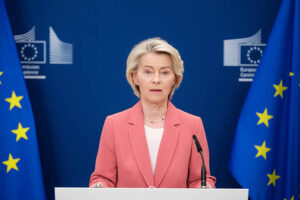
The European Union plans to restrict children’s access to social media in all 27 member states, said European Commission President Ursula von der Leyen.
The European Commission is considering a multi-stage approach to children’s and teenagers’ access to digital platforms. According to expert recommendations, children under the age of 13 will be able to use social media only for a limited time and under the supervision of parents, guardians, or teachers. As teenagers get older, the restrictions should be gradually eased.
“It is clear that we need age-based restrictions for these platforms,” von der Leyen told reporters in Brussels. She noted that the question now is not whether children face risks online, but how to give them a safer start in the digital environment.
The European Commission is expected to present a concrete proposal after the summer. Reuters reports that von der Leyen may announce it during her annual State of the Union address in September.
The new rules could apply not only to traditional social media platforms but also to a wider range of services with “age-inappropriate” and addictive features. Von der Leyen referred to this as the “social media plus” category, which could include platforms with infinite scrolling, autoplay videos, personalized algorithms, and other mechanisms designed to capture users’ attention.
The main services affected could include TikTok, YouTube, Instagram, and Facebook. Reuters notes that similar restrictions, aimed primarily at the largest short-form video and social media platforms, are already in place or under discussion in various countries around the world.
The Associated Press reports that an EU expert group has recommended restricting access to social media for children under 13 until tech companies can prove that their platforms are safe for children. For teenagers over 13, the proposal calls for phased access only to those services that meet safety and age-appropriateness requirements.
The European Commission is also developing its own app to verify users’ ages online. Such a system should help platforms and EU member states enforce age restrictions, although officials in Brussels acknowledge that it is technically impossible to completely prevent users from circumventing these measures.

Prices for construction and installation work in Ukraine rose by 21.8% in May 2026 compared to May 2025, according to the State Statistics Service (Derzhstat).
According to the statistical agency, in May 2026, compared to May 2025, prices rose across all segments of construction: in residential construction—by 18.7% (up 1.9% from the previous month), in nonresidential construction—by 22.8% (1.9%), and in civil engineering—by 22.4% (1.9%).
In January–May of this year, compared to the same period last year, prices for construction materials and equipment rose by 14.3%, specifically in the residential sector by 12.6%, in the non-residential sector by 15%, and in civil engineering by 14.4%.
As reported, in 2025, prices for construction materials and equipment rose by 5.8% compared to the previous year; in 2024, they rose by 7.9%; and in 2023, by 15.8%.

Ukrainian citizens ranked first in the number of residence permits issued by Spain to foreign nationals in 2025, according to data from Spain’s Ministry of Social Security and Migration.
According to the Spanish ministry, 244,579 residence permits were issued to Ukrainian citizens in 2025. They were followed by citizens of Venezuela—224,341 permits—and Morocco—187,790. These three countries accounted for 42% of all residence permits issued to foreigners in Spain in 2025.
In total, Spain issued 1,577,842 residence permits to foreigners in 2025, which is 7.8% more than the previous year, or 114,238 more permits. This growth was due, in particular, to an increase in the number of permits issued to citizens of Venezuela, Ukraine, and the United Kingdom.
Spanish authorities specifically note that these statistics reflect the number of permits, not the number of unique individuals. The same person could, for example, receive an initial permit and then a renewal within the same year, so this figure does not equal the number of new residents.
In the case of Ukraine, the temporary protection regime for people displaced by the war played a major role.
The report also notes that 238,007 permits in the “other exceptional circumstances” category were issued to Ukrainian citizens under the Temporary Protection Directive. This is 11.5% more than in 2024, with 85% of these permits being renewals.
According to the statistics, Russians ranked 11th among the largest groups of recipients of Spanish residence permits, with 27,655 permits issued.
By region, the highest number of residence permits were issued in Catalonia—311,038—followed by the Valencian Community—282,897—Madrid—275,607—and Andalusia—232,201. These four autonomous communities accounted for 70% of all permits issued to foreigners in 2025.
Separately, Spain reported 108,253 residence permits for study purposes issued to foreign students and their family members in 2025. The most common nationalities in this category were Colombia, Peru, Morocco, the United States, and China.
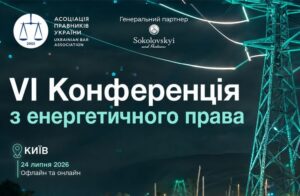
The Ukrainian Bar Association invites you to participate in the 6th Conference on Energy Law, which will take place on July 24, 2026, in Kyiv.
The conference will focus on practical issues related to the transformation of the energy sector, regulatory changes, integration with European markets, litigation, the development of the gas sector, renewable gases, distributed generation, microgrid solutions, and the restoration of damaged energy assets.
The event will focus not only on an overview of changes in legislation and regulation but also on their practical application for businesses, investors, lawyers, energy companies, and government institutions. Participants will discuss which decisions will shape the development of the energy sector in 2026 and what legal tools are needed to operate, invest, and protect interests in the energy market.
The conference program includes a special interview titled “Practical Challenges of Access and Investment in Subsurface Resource Use.” The session will be moderated by Vladislav Sokolovsky, managing partner at Sokolovsky & Partners Law Firm and chairman of the board of the Ukrainian Solar Energy Association.
The first session, “The Electricity Market: New Rules, Litigation, and Integration with the EU,” will focus on current changes in the electricity market, issues related to market coupling, “green” auctions, aggregation, and judicial practice. Vladislav Sokolovsky will also moderate this session.
The second session, “The Gas Sector in Transition: Production, Public Service Obligations, Renewable Gases, and European Integration,” will cover issues related to the development of the gas market, production, biomethane, public service obligations, and the sector’s adaptation to European regulations. The discussion will be moderated by Natalia Gutarevich, Deputy Chair of the UBA Committee on Energy, Oil, and Gas; Chair of the UBA Committee on Natural Resources, Environmental Protection, and Environmental Law; and counsel at Sayenko Kharenko.
A special interview titled “Compensation for Losses and Restoration of Damaged Energy Assets” is also scheduled as part of the conference. The expert will be announced at a later date.
The third session, “Distributed or Decentralized Generation? Legal Models for Ukraine’s New Energy Resilience,” will focus on new approaches to energy resilience, the development of distributed generation, and legal models for decentralized energy solutions. The session will be moderated by Olga Savchenko, Senior Partner at Altelaw & Sempra.
Following the conclusion of the business program, there will be an evening cocktail reception and informal networking among participants.
The full event program is available on the UBA website. Participant registration is also open on the Ukrainian Bar Association’s website. Participation in the event is subject to prior registration.
A special participation fee applies to members of the Ukrainian Bar Association. To take advantage of this rate, you must log in to your account on the UBA website before registering.
For additional information about the event, speaking opportunities, and partnership opportunities, please contact the organizers: tel. +38 (097) 840-39-36, e-mail: events@uba.ua. Contact person: Anna Varvadyuk.
For media accreditation: pr@uba.ua. Contact person: Daria Sydorchuk.

The European Commission is preparing the largest change since 2022 to the temporary protection regime for Ukrainian citizens: newly arriving Ukrainians who are subject to military obligations and do not have permission from the Ukrainian authorities to leave the country will, as a rule, be unable to receive temporary protection in the EU, the Polish newspaper Rzeczpospolita writes.
According to the Experts Club information and analytical centre, Ukrainian citizens will need special confirmation from Ukrainian authorities stating that they are not subject to mobilization in order to enter Poland and other EU countries and subsequently receive temporary protection. Rzeczpospolita clarifies that this requirement may apply not only to men but also to women if they are subject to the relevant Ukrainian military obligations.
The European Commission’s official proposal already confirms the general principle of such changes. On June 26, 2026, the Commission proposed extending temporary protection for people who fled Ukraine for another year, until March 4, 2028, but at the same time stated that temporary protection should generally not be granted to newly arriving persons whom the Ukrainian authorities have not allowed to leave because of military obligations.
The draft decision of the European Commission states that the extension of temporary protection should not undermine Ukraine’s ability to defend itself and that EU member states should take into account Ukraine’s military needs and its legally established conscription obligations. Verification of such requirements should apply only to new arrivals after the decision enters into force, while Ukrainians who have already received temporary protection in the EU should retain this status and the rights associated with it.
Polish Deputy Interior Minister Maciej Duszczyk told Rzeczpospolita that the new restrictions would probably begin to apply as early as July, but would concern not those who already have temporary protection in EU countries, but those who are only seeking to obtain it. He also noted that Poland supports such changes.
According to Rzeczpospolita, Ukraine itself initiated the tightening of the approach, having asked EU countries in early June to restrict the admission of some Ukrainian citizens under the special conditions of temporary protection. The Polish publication links this to Kyiv’s attempts to strengthen mobilization and reduce the outflow of people who may be needed by the Ukrainian army.
Reuters previously reported that the European Commission’s proposal means that newly arriving Ukrainian men of conscription age without permission from the Ukrainian authorities to leave the country will not be able to qualify for temporary protection. According to European Commissioner for Migration Magnus Brunner, the aim of the changes is to balance the need to protect people with Ukraine’s ability to defend itself.
This issue is of particular importance in Poland, as the country remains one of the main reception centres for Ukrainians in the EU. According to Eurostat, as of May 31, 2026, 4.38 million people who had fled Ukraine were under temporary protection in the EU. The largest numbers were in Germany, with 1.283 million, Poland, with 967,505, and Spain, with 267,400.
Rzeczpospolita, citing the Polish Ministry of Digital Affairs, writes that as of June 15 there were more than 218,000 Ukrainian men aged 18–65 with UKR status in Poland. Across the EU, adult men account for 26.8% of temporary protection beneficiaries from Ukraine, or more than 1.17 million people, based on Eurostat’s May estimate.
Poland’s Office for Foreigners previously reported that almost 1 million Ukrainian citizens in the country benefit from temporary protection, while approximately 1.55 million Ukrainians in total have valid grounds for staying in Poland. This estimate includes around 993,000 people with PESEL UKR, 462,000 Ukrainian citizens with temporary residence permits, and 92,000 with permanent residence or EU long-term resident status. These figures do not include Ukrainians staying in Poland under the visa-free regime or on visas.
Rzeczpospolita also writes that the Polish Interior Ministry is finalizing work on amendments to the citizenship law. Among the measures being discussed are increasing the minimum residence period for naturalization to eight years, introducing a language and integration test, and requiring a so-called confirmation of loyalty. According to the publication, this reform will affect Ukrainian citizens to the greatest extent, since for many years they have remained the largest group of foreigners applying for Polish citizenship.
Thus, this is not about ending protection for Ukrainians who are already in the EU, but most likely about introducing new screening of future arrivals. The European Union is effectively trying to combine humanitarian protection for refugees with Ukraine’s military needs, while Poland, which is home to one of the largest Ukrainian communities in Europe, is becoming one of the key participants in this debate.
The European Union is preparing a support mechanism for companies that would allow them to avoid relying solely on China for supplies of essential goods and would also mitigate the impact of Beijing’s measures in the event of a trade conflict, Bloomberg reported Saturday, citing sources.
“According to people familiar with the matter, this working tool will not come cheap and will require funding, while EU members are haggling over the long-term budget,” the agency reported.
However, the amount of funding needed, as well as the scale of China’s retaliatory measures in the event of a conflict, remain uncertain.
The mechanism being developed by the European Commission is intended to be part of the EU’s efforts to mitigate the effects of a significant trade deficit with China, which stands at 360 billion euros and affects all EU member states.
At the same time, the EU’s strategy for restructuring trade relations with China also calls for negotiations, diversification of supply chains, and more effective use of existing measures to support domestic producers. The European Commission also emphasized that none of the protective measures are directed exclusively against China.
The parties have set October 2026 as the deadline for reaching an agreement. In October, European Commissioner for Trade Maroš Šefčovič is scheduled to travel to China ahead of the EU summit in Brussels.
Bloomberg notes that Beijing controls the supply of mineral raw materials and microchips, which are critical to key sectors of European industry, including the defense and automotive sectors.



