
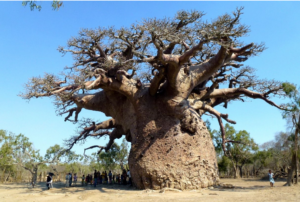
Madagascar’s largest recorded baobab tree, Tsitakakantsa, has come under the spotlight following social media reports that the tree could die within the next two to three years.
According to the Monumental Trees database, Tsitakakantsa is a Grandidier’s baobab (Adansonia grandidieri) near Andombiry in the Atsimo-Andrefana region in southwestern Madagascar. In January 2021, the circumference of its trunk at a height of 1.3 m was 28.82 m, and its height was about 15 m. In the Monumental Trees ranking, it is listed as the thickest recorded Grandidier’s baobab in Madagascar.
Reports that Tsitakakantsa is “dying” and could completely collapse within two to three years have appeared in recent days on English- and French-language social media. They state that the tree has lost one of its large branches, which for old baobabs can be a sign of progressive decay. However, among the primary sources found, there is no official statement from Madagascar’s park service, scientific article, or report from a relevant institute that would confirm exactly such a timeframe for the tree’s demise.
The Grandidier baobabs are endemic to Madagascar and are classified as an endangered species. Kew Gardens notes that the expansion of agricultural land in Madagascar threatens their extinction.
The history of Madagascar’s largest baobabs has seen similar cases before. Until 2018, another sacred baobab—Tsitakakoike, also belonging to the Adansonia grandidieri species—was considered the largest living baobab. According to Guinness World Records, it grew near Andombiro in the Ambiky Forest, stood 14.6 meters tall, and had a volume of about 455 cubic meters, but it collapsed in 2018.
Scientists attribute the vulnerability of old baobabs to a combination of factors: age, droughts, rising temperatures, forest degradation, fires, and changes in the landscape around the trees. This is a particularly sensitive issue for Madagascar, as the island is the center of origin and diversity for baobabs: a study published in 2024 indicates that Madagascar should be considered the center of origin for modern baobab lineages.
Baobabs on the island are often regarded as sacred trees, and their local name, renala, translates to “mother of the forest.”
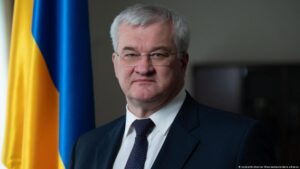
According to Interfax-Ukraine, Ukrainian Foreign Minister Andriy Sibiga has instructed Ukrainian missions to international organizations to demand an urgent meeting of the UN Security Council and a joint meeting of the OSCE Forum for Security Cooperation and the OSCE Permanent Council in connection with Russia’s missile strike on Kyiv.
“I have instructed all our missions to international organizations to make full use of multilateral instruments in response to yesterday’s barbaric Russian missile strike on Kyiv. The UN, OSCE, Council of Europe, and UNESCO must provide an adequate and decisive response to the aggressor, who is attempting to compensate for the lack of military progress on the battlefield with terror against the civilian population,” he wrote on social media.
Sibiga stated that Ukraine is demanding an immediate and urgent convening of a UN Security Council meeting and a joint session of the OSCE Forum for Security Cooperation and the OSCE Permanent Council.
“Putin is trying to intimidate Ukraine by attacking the civilian population and destroying residential buildings, museums, schools, and critical infrastructure. He is also trying to intimidate the world by launching missiles from a reconnaissance missile system against peaceful cities,” the minister emphasized.
According to him, all of this requires decisive and coordinated action by the international community.
“We call on our partners to take decisive multilateral action aimed at deterring Russia and compelling it to accept a comprehensive, just, and lasting peace,” the foreign minister stressed.

On Sunday night in northeastern Ukraine, and during the day on May 25 in the eastern and, in some places, southern parts of Dnipropetrovsk Oblast and in the Carpathians, there will be brief rain and, in some places, thunderstorms; the rest of thecountry will see no precipitation, according to the Ukrainian Hydrometeorological Center.
Winds will be from the northwest at 7–12 m/s.
Temperatures will range from 11–16° at night and 21–26° during the day, reaching up to 29° in Zakarpattia and the south of the country; in the Carpathians, temperatures will range from 8–13° at night and 15–20° during the day.
In Kyiv on Monday, no precipitation. Winds from the northwest, 7-12 m/s. Nighttime temperatures 14-16°, daytime 23-25°.
According to data from the Boris Sreznevsky Central Geophysical Observatory in Kyiv, the highest daytime temperature on May 25 was 30.7°C in 2007, and the lowest nighttime temperature was 2.6°C in 1909.
On Tuesday, May 26, no precipitation is expected in Ukraine; only in the northeastern part and in the Kyiv region will there be brief showers in some places during the day.
The wind will be northwesterly, 7–12 m/s, with gusts of 15–20 m/s in some places in the western regions during the day.
Nighttime temperatures 11-16°; daytime 21-26°, up to 29° in Zakarpattia and the south of the country, 17-22° in the northeastern part.
On Tuesday in Kyiv, partly cloudy. No precipitation. Wind from the northwest, 7-12 m/s. Nighttime temperatures 14-16°; daytime temperatures 23-25°.

The National Commission for the State Regulation of Electronic Communications, Radio Spectrum, and Postal Services (NCC) is proposing to introduce a regulatory levy of no more than 1.5% of telecom operators’ total revenue.
“This funding model will reduce expenditures in Ukraine’s state budget and cover the NCC’s funding needs, which will amount to UAH 401.1 million in 2027,” the regulator noted in an explanatory memorandum to the draft law it developed.
According to NCC data for 2025, 508 business entities would be required to pay the relevant fees. It is expected that the number of such entities will increase to 580 in 2027 and to 696 in 2028.
The NERC clarified that the financial and economic projections for 2027 and 2028 include the implementation of EU Regulation 2024/1309 (Gigabit Infrastructure Act/GIA). Among other things, it provides for the creation of a tool for consumers—a comparison of provider prices—and the implementation of a universal service—access to communications for all, even in the most remote regions—as well as the construction and restoration of digital infrastructure in de-occupied and border territories.
The state regulator noted that in most European Union countries, national regulatory bodies in the field of electronic communications are funded through contributions from providers of electronic communications networks and services.
At the same time, the Internet Association of Ukraine (InAU) spoke out against this bill on Facebook.
“Its provisions are not only unfair and discriminatory but also do not align with the norms of the European Electronic Communications Code (EECC), and in a number of provisions, they directly contradict it. To substantiate this, we note the following,” the statement to the regulator reads.
The association hopes that the regulator will take this position into account; if the relevant comments are ignored, InaU will appeal to state and European institutions.

French Justice Minister Gérald Darmanin has proposed imposing a temporary three-year moratorium on legal immigration, stating that the country has reached the limits of its capacity to integrate and assimilate newcomers.
According to Le Parisien, citing Darmanin’s interview with the Journal du Dimanche, the minister believes it is necessary to “put an end to immigration as it exists today.” He proposes suspending legal immigration for three years and reforming the Constitution to introduce binding, rather than merely advisory, quotas on the entry of foreigners.
Darmainin had previously advocated for a temporary suspension of regular immigration for two to three years. This would apply to labor migration and family reunification, though exceptions could be maintained for doctors, researchers, and certain categories of students. Following the moratorium, the minister proposed transitioning to a system of immigration quotas, the volume of which would be determined after consultation with citizens.
Darmann’s proposal has not yet been adopted as state policy. Its implementation would require a political decision, a legislative process, and, according to the minister himself, a constitutional amendment. However, the initiative signals an intensification of the migration debate in France ahead of the 2027 presidential election.
Potential restrictions could affect several key channels of legal entry: labor migration, certain student programs, and family reunification. At the same time, France faces a shortage of foreign workers in medicine, science, certain service sectors, and professions with labor shortages, making a potential moratorium politically and economically contentious.
The issue of migration remains a central one in French domestic politics. According to Le Monde, in 2025 the country issued over 380,000 initial residence permits to citizens of non-EU countries, an 11% increase from the previous year. About half of the new permits were issued to students and for humanitarian reasons: international students received about 118,000 permits, humanitarian categories—about 92,000, family migration accounted for about 91,000, while professional immigration fell by nearly 13%—to approximately 51,000 permits.
Historically, the overall structure of immigration to France has been dominated by people from North Africa and Southern Europe. According to data cited by The Connexion based on INSEE, among immigrants by country of birth, the largest groups are those from Algeria—12.4%, Morocco—11.7%, Portugal—7.3%, Tunisia (4.9%), Italy (3.6%), Turkey (3.4%), and Spain (3.1%). These seven countries account for 46.4% of all immigrants in France.
Ukrainians occupy a distinct place in France’s current migration landscape as recipients of temporary protection following the start of Russia’s full-scale war against Ukraine. According to Eurostat, as of the end of March 2026, 4.33 million Ukrainian citizens and residents were granted temporary protection in EU countries. The largest countries hosting refugees were Germany, Poland, and the Czech Republic. Eurostat’s country-specific tables for France as of March 2026 indicate approximately 70,700 people under temporary protection.
For France, a potential moratorium would mark one of the most drastic shifts in migration policy in recent years. For businesses, it could mean more difficult access to foreign labor; for universities, the risk of a reduction in international enrollment; and for family-based immigration programs, additional uncertainty. At the same time, Ukrainians under temporary protection are governed by a separate European regime that operates within the framework of EU decisions and is not considered ordinary labor or family-based immigration.

According to Serbian Economist, a treasure trove dating back approximately 3,000 years has been discovered in the Romanian county of Prahova; archaeologists describe it as one of the most significant finds of recent decades for studying the transition from the Bronze Age to the Early Iron Age in modern-day Romania.
According to News.ro, the hoard was found by a man using a metal detector on a hill near the town of Urlați in Prahova County. The find includes three gold necklaces weighing a total of over 300 grams, as well as iron and bronze objects.
After the discovery, the artifacts were handed over to specialists at the Prahova Museum of Archaeology for study, dating, and determination of the materials’ origin. Archaeologist Alin Frânculeascu stated that the find is exceptional for Romania, as the objects, according to preliminary assessments, may date to different periods—from the Middle and Late Bronze Ages to the early Iron Age.
This is precisely what makes the find particularly significant. If further research confirms that the objects do indeed belong to different time periods, archaeologists will have to explain how they came to be together in a single site. This could lead to a refinement of existing understandings of the chronology, technologies, and connections among societies that inhabited the territory of present-day Romania some three thousand years ago.
Some of the objects are considered extremely rare. Among them are items associated with chariots or carts, as well as gold jewelry that may have had not only decorative but also status-symbol or ritual significance.
Once the research is complete, the hoard is scheduled to be presented to the general public.



