
Over the past month, the Ukrainian Energy Exchange held 152 trading sessions on the BETS, 84 auctions for the purchase and sale of electricity on the BETS in the “Electric Power” version, and four trading sessions each day on the short-term natural gas market.
As a result, 3,164.28 thousand MWh of electricity, 174.53 thousand tons of crude oil and gas condensate, 14.37 thousand tons of liquefied gas and petroleum products, 37.1 million cubic meters of natural gas, and 297.73 tons of raw materials were sold. In addition, 297 auctions were held in March in the “Raw Timber and Lumber” category. The total sales volume for this category amounted to 481,830 cubic meters.
“Transparent market mechanisms are the foundation for the development of the energy sector and economic stability. We strictly adhere to the principles of equality, objectivity, and impartiality, implementing modern software solutions to achieve our clients’ strategic goals,” noted UEB CEO Oleksandr Kovalenko.

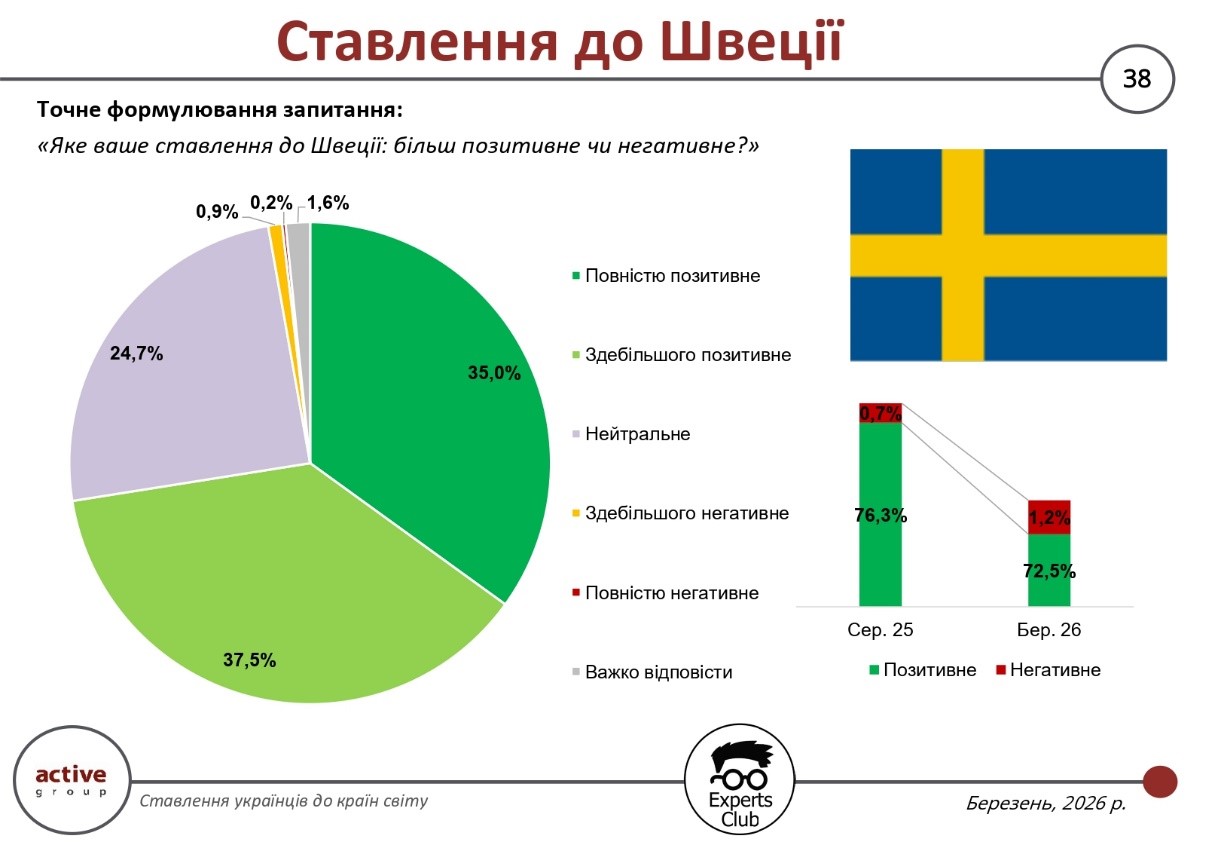
The results of a public opinion poll conducted in March 2026 by the research firm Active Group in collaboration with the Experts Club information and analytical center show a consistently high level of positive attitudes among Ukrainians toward Sweden. The overall share of positive assessments stands at 72.5%, which is, however, slightly lower than the August 2025 figure (76.3%). At the same time, the level of negative attitudes remains minimal—only 1.2% compared to 0.7% previously.
The breakdown of responses indicates a deeply positive foundation for perceptions of this country. The share of those who view Sweden “entirely positively” stands at 35.0%, while another 37.5% selected the “mostly positive” option. Together, these figures represent one of the highest levels of positive perception among the countries surveyed.
At the same time, 24.7% of respondents hold a neutral position, which may indicate a limited level of personal or informational contact with the country. Negative assessments remain marginal: 0.9% rated it “mostly negative” and only 0.2% rated it “completely negative.” Another 1.6% of respondents were undecided.
The slight decrease in the share of positive assessments likely resulted from a shift of some respondents into the neutral category, rather than an increase in criticism. This indicates that Sweden’s image remains consistently positive, albeit less emotionally charged compared to the previous period.
“Sweden remains a country with a very high level of trust among Ukrainians, and this is evident in the structure of the responses. At the same time, we observe a certain increase in the share of neutral assessments, which indicates not a change in attitude but a decrease in its intensity. This is a typical effect for countries that are not constantly in the center of media attention,” noted Oleksandr Pozniy, director of the research company Active Group.
Overall, the survey results confirm that Sweden is among the countries with the highest level of positive perception in Ukrainian society. At the same time, the dynamics of change indicate a gradual normalization of assessments, as the emotional component gives way to a more restrained and rational perception.
According to a study conducted by the Experts Club information and analytical center based on data from the State Customs Service, Sweden ranks 25th in total trade volume with Ukraine, with a figure of $1.13 billion. At the same time, imports from Sweden exceed Ukrainian exports many times over, resulting in a significant trade deficit of over $962 million.
The study was presented at the Interfax-Ukraine press center; the video can be viewed on the agency’s YouTube channel. The full version of the study can be found at this link on the Experts Club analytical center’s website.
ACTIVE GROUP, EXPERTS CLUB, Pozniy, SOCIOLOGY, SURVEY, SWEDEN, UKRAINE, URAKIN
Gennadiy Vas’kiv, the former deputy mayor of Lviv, who is suspected in Ukraine of embezzling charitable aid, has been detained in Austria, and Ukrainian authorities have already initiated extradition proceedings. This was reported by ZAXID.NET, citing case materials from the Frankivsk District Court of Lviv. According to the publication, the arrest took place in March, and on March 30, the Ukrainian Ministry of Justice filed an extradition request with the court.
Additional confirmation of the circumstances of the arrest was provided by Ilmar Raag, a former board member of the Estonian organization Slava Ukraini and its liquidator. According to information cited by ZAXID.NET, he stated that Interpol detained Vaskiv in Austria after his arrival from the United States.
According to the investigation, in March 2022, Vaskiv established the “Everything for Victory” charitable foundation, through which he began cooperating with the Estonian organization Slava Ukraini in May, and then used the affiliated company “Aisi Construction” to embezzle funds by inflating the cost of goods and services. Back in 2023, Suspilne, citing investigation data, reported that this company had received 1.5 million euros in donations from the Estonian side, of which approximately 250,000 euros could have constituted profit. Later, Ukrainian media, citing investigation materials, clarified that the case involved the possible embezzlement of 1.55 million euros, over 18 million hryvnias in price inflation, as well as an additional 772,000 hryvnias in funds from the European Investment Bank.
During the pre-trial investigation, Vas’kiv left Ukraine in March 2024 via the “Shlyakh” system under the guise of transporting humanitarian aid and did not return. In 2025, the appellate court authorized his arrest, and by the end of 2025, according to NGL.media, the charges against him were reinstated following procedural disputes.

The “Autostrada” Group of Companies has begun the reconstruction of a 1.2-meter-diameter sewer collector in the metro construction zone in Vinogradar; to carry out this work, a remotely controlled shield system from Herrenknecht AG was purchased, with an estimated cost of EUR 1 million.
According to the Autostrada press service, the project will involve laying a new storm sewer system with a total length of 400 m using over 200 pipes. The work is being carried out using the microtunneling method (a high-precision trenchless technology for laying underground utilities without breaking ground), which allows work to proceed in densely built-up urban areas without impacting traffic or the surrounding infrastructure.
The preparatory phase is currently underway—two shaft shafts (launch and reception chambers) are being constructed, from which tunneling will begin in just a few months.
To carry out the work, Autostrada has purchased a remote-controlled shield system from the German manufacturer Herrenknecht AG. The cost of the equipment is approximately 1 million euros. The maximum length of a single tunneling run can reach up to 150 m, ensuring efficiency and continuity of work.
On the section between the “Mostytska” and “Varshavska” stations, over 1,000 m of double-deck monolithic tunnels have already been constructed (500 m per deck). Work on their finishing is being carried out simultaneously on two sections, which significantly accelerates the pace of construction. The construction of monolithic structures on the fork branch section toward the future “Vinogradar” station has also been completed.
At the “Mostytska” station, construction of prefabricated full-section tunnel linings, each approximately 200 m long, has been completed. The next stage is the installation of cable structures in the completed tunnels, which serves as a preparatory step for the subsequent installation of utility networks and the station’s power supply systems.
In the shaft above the deep-level tunnel between the “Syrets” and “Mostytska” stations, installation of the ring-laying machine has been completed; this machine will replace the rings of the left-hand tunnel lining with larger-diameter rings. The right-hand tunnel in this section has already been built.
Construction of the turnaround sidings at the “Varshavska” station is in its final stage. Currently, a shield-type airtight seal—a massive steel structure designed to isolate tunnels and stations—is being installed here. It protects the metro from potential emergencies, including shock waves, flooding, and hazardous substances, and serves as a critical component of the civil defense system, enabling the division of underground structures into sealed compartments.
At all metro construction sites in Vinogradar, work is underway to relocate utility lines outside the construction zone. The relocation of water supply and drainage systems, as well as power lines, is being carried out in stages. Such work ensures the uninterrupted operation of the city’s infrastructure and creates the necessary conditions for the continued execution of construction and installation processes without restrictions.
As previously reported, in August 2024, the municipal enterprise “Kyiv Metro” signed a contract to continue construction of the Syretsko-Pecherska Line toward the Vinogradar residential area. The winner of the tender was Avtostrada Group of Companies LLC. The project duration is set at 30 months, with a total cost of 13.785 billion UAH. The procurement was conducted on the Prozorro public procurement platform. “Avtostrada” resumed metro construction in November 2024.
In December 2023, the Kyiv Metro municipal enterprise terminated its contract with Kyivmetrobud JSC through the courts due to failure to meet construction deadlines. The issue of recovering a portion of the advance payment—the use of which is not confirmed by the relevant certificates of work performed—as well as penalties, is being resolved in court.
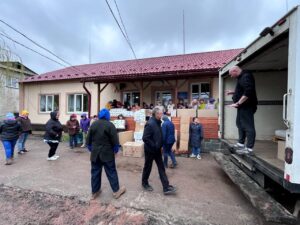
The Teteriv Psychoneurological Residential Care Facility and the Novoboriv Children’s Residential Care Home received humanitarian aid from the “Guardian Angel” Charitable Foundation on the eve of Easter. And not just Easter cupcakes, but also food, hygiene products, and water purification systems, the foundation reported, emphasizing the systematic nature of its support for these institutions.
On the eve of Easter, the “Guardian Angel” Charitable Foundation delivered humanitarian aid to the Teteriv Psychoneurological Boarding School and the Novoboriv Children’s Boarding Home in Zhytomyr Oblast, the foundation reported.
The aid included food and hygiene products. Specifically, a total of two hundred holiday Easter cakes, boxes of cookies, bags of flour, and pasta were delivered to both institutions. The donors also provided hygiene products—soap, adult diapers, wet wipes, and paper towels.
In addition, the foundation delivered water treatment systems to both boarding schools, which is particularly important for facilities located in rural areas. The water treatment systems were donated to the foundation by entrepreneur Boris Vykhovants.
The foundation emphasized that amid the war in Ukraine, socially vulnerable groups—including orphans and children deprived of parental care, as well as people suffering from mental health disorders (including those resulting from the war)—require enhanced support.
“We are systematically working to ensure that aid reaches those who need it most. Easter is, albeit symbolic, yet another occasion for care and support, and we are grateful to all partners who joined this initiative,” noted Vilen Fatalov, chairman of the foundation’s supervisory board.
The foundation’s founder, Vladlena Fatalova, emphasized that supporting residential care facilities remains one of the organization’s priorities: “We see the real needs of such institutions and strive to address them as comprehensively as possible—from food to hygiene products and infrastructure solutions.”
Another founder of the foundation, Valeria Myronenko, added that such initiatives are long-term in nature: “Our goal is not one-time assistance, but systematic support and improvement of living conditions for the residents of these institutions. For example, we visit the Teteriv and Novoboriv boarding schools on a regular basis.”
The Teteriv Psychoneurological Boarding School and the Novoboriv Children’s Home expressed their gratitude to the “Guardian Angel” Charitable Foundation for the assistance provided, as well as to the companies and philanthropists who responded to the foundation’s call. In particular, thanks were extended to Dar Mlyn Zakarpattia LLC, the Berdychiv Bakery, as well as citizens Dmytro-Valeriy Shevchenko and Maksym Smitiya for their support of socially important initiatives.
boarding school, foundation, Guardian Angel, ZHYTOMYR REGION

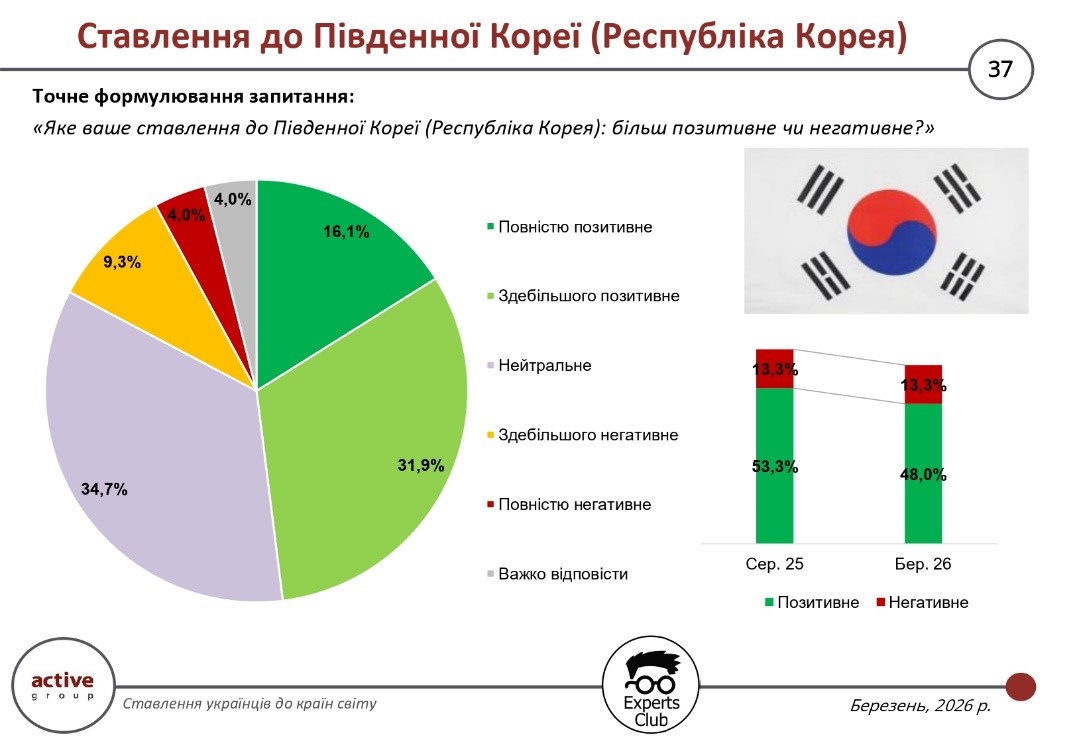
The results of a survey conducted in March 2026 by the research firm Active Group in collaboration with the Experts Club Information and Analytical Center indicate a slight cooling of Ukrainians’ attitudes toward South Korea. The share of positive assessments dropped to 48.0% compared to 53.3% in August 2025, while the level of negative attitudes remained unchanged at 13.3%.
In the breakdown of responses, 16.1% of respondents chose the option “completely positive,” and another 31.9% chose “mostly positive.” At the same time, the share of neutral assessments remains significant—34.7%—which indicates a relatively reserved and not fully formed perception of the country.
Negative assessments are represented by 9.3% of responses as “mostly negative” and 4.0% as “completely negative.” Another 4.0% of respondents were unable to determine their position. Thus, despite the decline in positive perception, the level of criticism has not increased, and the overall picture has shifted due to a portion of positive assessments moving into the neutral category.
This trend may indicate a decrease in the intensity of South Korea’s media presence in Ukraine or a reduction in the number of factors shaping a clearly positive attitude. Unlike EU countries or certain strategic partners, South Korea remains an important but not a top-priority element of the international context for a significant portion of Ukrainians.
“The data show that attitudes toward South Korea remain generally positive, but less defined than toward Ukraine’s key partners. A significant proportion of neutral responses indicates that for many Ukrainians, this country is outside the daily news cycle. In such cases, even minor changes in the external context can influence the balance of assessments,” noted Oleksandr Pozniy, director of the research firm Active Group.
Overall, South Korea maintains a positive image in Ukraine; however, the downward trend in the share of positive assessments underscores the need for the country to be more actively engaged in economic, technological, and humanitarian cooperation if it seeks to strengthen its position in Ukrainian society.
According to a study conducted by the Experts Club information and analytical center based on data from the State Customs Service, the Republic of Korea ranks 24th in total trade volume with Ukraine, which amounts to $1.14 billion. Imports of Korean products significantly exceed Ukrainian exports, resulting in a negative trade balance of over $769 million.
The study was presented at the Interfax-Ukraine press center; the video can be viewed on the agency’s YouTube channel. The full version of the study can be found at this link on the Experts Club analytical center’s website.
ACTIVE GROUP, EXPERTS CLUB, Pozniy, SOCIOLOGY, SOUTH KOREA, SURVEY, UKRAINE, URAKIN



