

In December 2025, Ukrainian citizens ranked third among foreigners in terms of home purchases in Turkey, according to data from the Turkish Statistical Institute (TurkStat) cited by Turkish media.
According to the published data, foreigners purchased 2,541 properties in Turkey in December, which is 5.1% more than in December 2024. Russian citizens ranked first in terms of purchases in December (504 properties), followed by Iran (232) and Ukraine (193).
Overall, in 2025, sales of housing to foreigners in Turkey fell by 9.4% to 21,534 properties. Among foreign buyers for the year, Russian citizens led the way (3,649 properties), followed by Iran (1,878) and Ukraine (1,541).
Overall, home sales in Turkey in December 2025 increased by almost 20%.
Albania’s dependence on grain imports has increased in 2025 amid a decline in domestic production and an increase in abandoned farmland, with Serbia becoming the main supplier of grain, the Serbian Economist reports, according to Pamfleti website.
Albania imported more than 374,000 tons of grain in 2025, almost 40,000 tons more than in 2024, with wheat and corn being the main imports.
Agro-economist Zef Gjeta linked the increase in imports to the lack of real reforms and public funding of the agro-sector, emphasizing that without support for farmers, the country loses its production potential and becomes more dependent on external supplies.
The structure of supplies has changed – Serbia has become the first exporter of grain to Albania, while previously significant volumes came from Russia and Romania. At the same time, procurement costs, according to the source’s assessment, remained close to 2024 levels due to shorter logistics and the strengthening of Albania’s national currency, despite the increase in physical volumes.
Albania also exported 248 tons of grain worth about 28 million lek, almost double the amount from a year earlier, but these volumes remain small. The country’s farmland area is estimated at about 700,000 hectares, with the area under cereal crops shrinking and the area of abandoned land growing, experts warned.
https://t.me/relocationrs/2148

Boris Vladimirovich Lupkin, Doctor of Technical Sciences, professor of the Department of Aircraft Production Technology at the National Aerospace University “Kharkiv Aviation Institute” (KAI), laureate of the State Prize of Ukraine in Science and Technology, has passed away, the university announced.
According to the KhAI, Lupkin was born in 1939, graduated from the KhAI in 1963, and began his career at the Kyiv Aviation Plant, where he worked as an engineer. He later worked for many years at the Ukrainian Research Institute of Aviation Technology in Kyiv, and in 1983, he became the head of the institute.
The university noted that Lupkin participated in the development of heat-shielding tiles for the Buran orbital spacecraft. From 1995 to 1999, he worked as chief inspector-consultant to the Administration of the President of Ukraine, and in 2002 he returned to the KhAI as a professor. He was awarded the State Prize of Ukraine in Science and Technology in 1995.

Ukraine will be fully integrated into the EU energy market in 2027, even if we are not yet formally a member of the Union, said Deputy Prime Minister for European and Euro-Atlantic Integration of Ukraine Taras Kachka, according to a correspondent from Interfax-Ukraine.
“There is currently a large bill in parliament—several hundred pages on the final integration of Ukraine’s energy market with the EU. It is ready for its second reading, and I think we will be able to adopt it in February,” he said at the Ukrainian Breakfast in Davos on the sidelines of the World Economic Forum on Thursday, organized by the Victor Pinchuk Foundation.
According to Kachka, the document consists of hundreds of pages of technical assessments that experts have been working on for years.
“It is thanks to this work that in 2027 we will be fully integrated into the EU energy market, even if we are not yet formally a member of the Union,” the Deputy Prime Minister emphasized.
As reported, on July 22, the Verkhovna Rada adopted draft law No. 12087-d “On Amendments to Certain Laws of Ukraine Regarding the Implementation of European Law on Energy Market Integration, Improving Security of Supply and Competitiveness in the Energy Sector.” According to the Ministry of Energy, the relevant legislative proposal was developed on the basis of nine EU energy legislation acts and aims to create the necessary legislative framework for the full integration of Ukraine’s electricity market into the single European market on the principle of reciprocity.
The document provides, in particular, for the integration of the short-term (spot) electricity markets of Ukraine and the EU (market coupling) and balancing markets, which means increasing market liquidity, simplifying the conditions for trading electricity with the EU, making effective use of the transmission capacity of interconnections between countries, increasing the flexibility of the energy system, and providing access to EU reserves.
The draft law also provides for additional mechanisms to protect consumer rights and strengthen their role in the market by increasing the transparency of supply conditions and introducing tools for comparing suppliers’ offers, as well as creating conditions for consumers to participate in other market segments, in particular the ancillary services market.
The ministry noted that the adoption of the document as a whole will ensure the synchronization of electricity markets in early 2027.

In Ukraine in 2025, 168,778 births and 485,296 deaths were registered, so there were about three deaths per newborn, according to an analysis by OpenDataBot based on data from the Ministry of Justice.
Compared to 2024, the country’s death rate fell by 2%, while the birth rate fell by 4.5%. At the same time, the decline in birth rate is slowing down after a sharp drop in 2022, but there are about 1.6 times fewer children being born compared to 2021.
In terms of regions, birth rate growth was recorded in Lviv region (+1.5%, or 230 more children) and Volyn region (+0.6%, or +44 children), while the most noticeable drop, except for the territories of active hostilities, was observed in the frontline regions – in Kherson region (-16%) and Zaporizhzhya region (-11%), as well as a 9% decrease in the number of births in Dnipropetrovsk, Sumy, Chernihiv, Kharkiv and Chernivtsi regions.
The most children were traditionally born in Kyiv – 19,410 (11.5% of the total number), followed by Lviv region – 15,872 and Dnipropetrovsk region – 12,754. Dnipropetrovsk Oblast (52,559), Kyiv (36,296) and Kharkiv Oblast (34,670) lead in the number of deaths.


deceased persons, MINISTRY OF JUSTICE, newborns, UKRAINE, Опендатабот
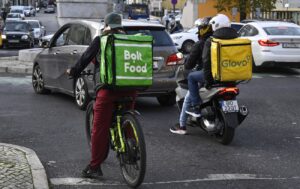
Demand for orders on the Glovo courier delivery service rose by 7.7% with the start of massive power outages in December, while on the Bolt Food online service it rose by about 6% compared to last year, the companies said in comments to the Interfax-Ukraine news agency.
“In general, during periods of power outages, we see an increase in demand for delivery,” said Vyacheslav Levchenko, general manager of Bolt Food in Ukraine.
Glovo added that it is seeing a gradual increase in the average check, which has grown by 1.7% since last month and by 19.4% compared to the same period in 2025.
Bolt Food reported that the average check has increased by approximately UAH 60 compared to last year.
At the same time, according to Glovo, the share of orders from restaurants decreased by three percentage points (pp) compared to the period before the massive power outages and by 6 pp compared to last year, Instead, Ukrainians began to order more often from grocery stores, whose share increased by 2 p.p. compared to the period before the blackouts and by 5 p.p. year-on-year, Glovo commented.
Bolt Food noted that a significant share of demand is generated by large chain establishments and well-known brands, including McDonald’s, KFC, BUFET, Eurasia, Lviv Croissants, Domino’s Pizza, and others.
“This choice is due to their wide representation, brand recognition, and stable service quality,” the company added in a comment to the agency’s request.
In addition, Ukrainians have recently been increasingly choosing hot and hearty dishes, with soups, burgers, pizza, and shawarma being the most popular, Bolt Food noted.
In addition, the choice of dishes is also changing, with demand for burgers falling by 10-15%. However, orders for soups, set meals, and main dishes (such as wok noodles or poke) have increased approximately threefold. As for the pizza and sushi category, the situation has remained almost unchanged, but there has been a 1-2% increase, Glovo said.
“People have started to order hot and nutritious meals through Glovo much more often — meals that can replace a full lunch, which is not always possible to prepare at home right now,” the company emphasized.
Glovo also recorded an increase in demand for pet products by more than 50% and for meat products by more than 48%.
As for the demand for essential goods, the indicator grew by more than 36%, medicines — by 25%, and the share of demand for alcohol increased by 6%. At the same time, the demand for flowers and frozen goods decreased by an average of 10-15%.
It is noted that Kyiv and Odesa show dynamics identical to the national ones. In Lviv, Dnipro, and Vinnytsia, there is also a stable interest in ordering dinners and lunches, and the demand for these dishes has doubled.
At the same time, in Kharkiv, demand for “fast” meals such as shawarma, pizza, tacos, and chicken dishes, on the contrary, increased by 30-35%, while ready-made complex lunches in the city began to be ordered less frequently, Glovo added.



